Smart factory - module 4
 Call Kai
 Learn
Learn Practice Test
 Spaced Repetition
 Match
Match Flashcards
 Knowt Play
1/28

There's no tags or description
Looks like no tags are added yet.
Name | Mastery | Learn | Test | Matching | Spaced | Call with Kai | Chat |
|---|
No analytics yet
Send a link to your students to track their progress
29 Terms
Advantages of smart PPC
more profitability
better production and quality
more production flexibility
expansion into new markets
Developping new services for existing productions
Challenges of Smart PPC
skilled labor shortage
uncertainty about return of inverstement (ROI)
lack of data availability
legal system and IT infrastructure
How does the workforce change with industry 4.0
more highly skilled intellectual workers(in tech and other cognitive areas), less manual skills
Change in the role of AI with industry 4.0
instead of being a differentiator between who does well and who doesnt, it’ll be a basic requirement to even enter the magnet
used in predictive maintenance, knowledge based systems (instad of experts of subjects), adaptive robotics (learns tasks in real time instead of being programmed)
Vertical depth vs horizontal scale, which will drive the future of production
horizontal scale: broad genaral produts that can be used in a lot of different industries
vertical scale: Specialised products with one specific use
vertical scale will grow more
Types of production environment
discrete - built unit by unit on assembly line, can be undone
hybrid - has both a process stage and a discrete manufacturing stages
process - continuous flow of production, production cannot be undone ( like recipes )
AI
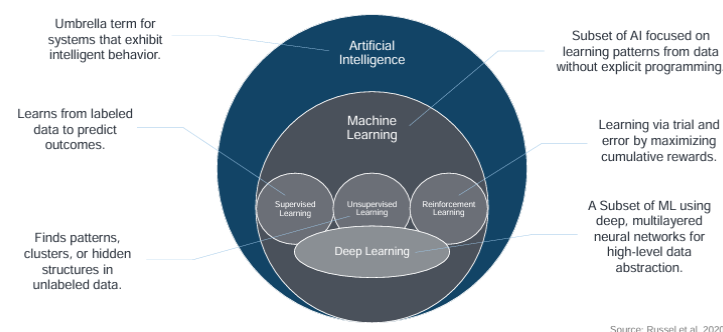
Umbrella term for systems that exhibit intelligent behavior.
Why is AI (machine learning specifically) necessary in production planning and control
it enables data-drive smart and adaptable planning and control of systems
helps with:
increasing complexity of production
adaptability
faster changing circumstances
Enables
▪ Optimized planning & scheduling ▪ Autonomous decision making ▪ Resource efficiency & cost reduction ▪ Real-time adaptability
3 different machine learning methods
unsupervised learning - finds patterns, clusters, or hidden structures in unlabeled data ( clustering, dimension reduction)
supervised learning - learns from labeled data to predict outcomes (regression, classification into discrete classes)
reinforcement learning - learning via trial and error by maximising cumulative rewards (independant learning with problem solving strategy)
machine learning
Subset of AI focused on learning patterns from data without explicit programming.
deep learning
A Subset of ML using deep, multilayered neural networks to process data and mimic human thought , represent the world as nested hierarchy of concepts
LASSO regression and at what stage of PPC can it be used
falls in supervised learning
Least absolute shrinkage and selection operator, models linear relationship btwn target variable y and 1+ predictor variables x, and adds a penalty to model to eliminate irrelevant variables. Parametric model
used typically in sales and operations planning to know which variables are actually relevant to better efficiency ((S&OP))
Advantages and disadvantages of Lasso model
Pros: Reduces overfitting, eliminates irrelevant features, improves interpretability.
Cons: Unstable with correlated variables (selects randomly), introduces bias (shrinks valid coefficients), parameter selection is critical.
Correlation Analysis and at what stage of PPC can it be used
falls in unsupervised learning
examines the relationship between two or more variables without presupposing causality, determines strength and direction of relationship. Statistical data analysis model
eg Pearson, Spearman
would be used in quality control (production optimisation or market reasearch as well) (S&OP)
pros and cons of correlation analysis
Pros:
▪ Simplicity
▪ Versatility
▪ Visualization
cons:
▪ Spurius correlation (not actual correlation, there is hidden '3rd factor for example or its pure chance)
▪ Linear constraint
▪ Susceptibility to erros
Multilayer Perceptron (Neural Networks) MLP
Falls in supervised learning, deep learning
neural networks to solve complex tasks like preidctions, classification or regression. all neurons are connected via weighted connection. One way flow (from input data to output)
pattern recognition (S&OP)
pros and cons of Multilayer Perceptron
Pros:
Universality
Flexibility
Scalability
Cons:
Computional Effort
Dependency on data
Overfitting
Clustering
unsupervised learning
Data points are grouped so that points in same cluster are similar and points in different clusters are dissimilar
can be used in quality anaysis, customer segmentation, process grouping
Dimension reduction
unsupervised learning
Data transforms complex data with multiple variables into simpler form with less variables but still keeping all significant features
can be used to evaluated component health/wear with more simple graph
Type of clustering and how it works
K - means clustering
1. choose number of clusers you want : k
2. chose k random center points
3. assign points to closest center point
4. update centroids
Repeat 3 and 4 until cluster centers no longer change(convergence)
Scheduling in terms of traditional vs smart approaches
traditional: based on empirical data, limited flexibility for complex processes , high dependance of individual experts
smart approaches: use reinforcement learning to predict best schedule, MCTS (Monte Carlo Tree Search)
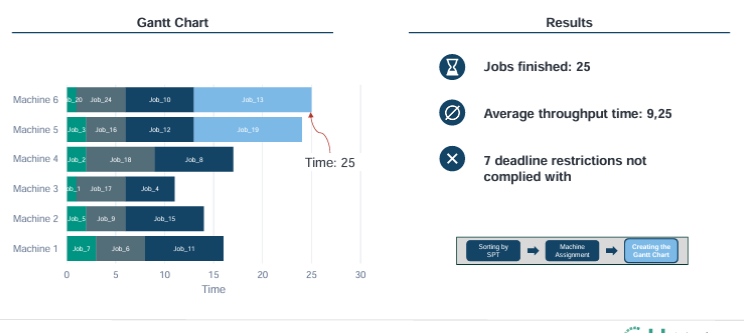
Scheduling algorithm
Sort jobs by Shortest Processing time (SPT)
Machine assignment - jobs assigned in order of SPT to available machines
Creation of Gantt chart
Gantt chart
visual project management tool that plots tasks across horizontal timeline, showing start and end dates and task dependencies
Monte Carlo Tree Search (MTCS)
tree search algorithm for decision making processes with lots of possible options, finds optimal decisions in incomplete or uncertain environments
pros and cons of MCTS
Pros
different parts of tree can be worked on at the same time (speeds up simulation)
dynamic condition assessment (updates strategy continuously as it gets feedback from current simulation)
Cons
high computationa effort for deep trees
Depends on number of simulations ran, so it can account for randomness
Reinforment learning
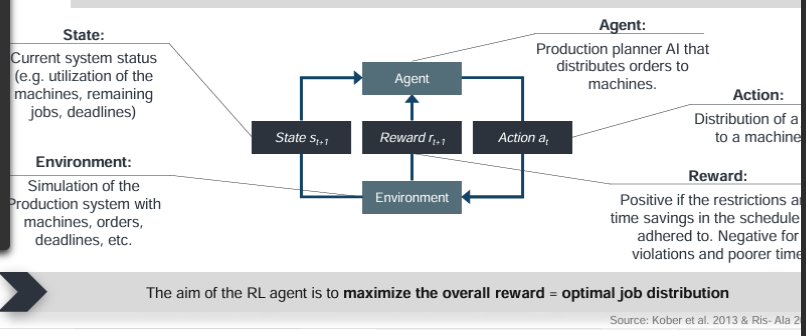
agent learns by interacting with its environment.The agent performs actions, receives rewards or Description punishments, and adjusts its strategy (policy) to maximize cumulative rewards in the long run
Pros and Cons of reinforcement learning
Pros
flexibitlity
learning
long term planning (cummulative reward over time)
Cons
computational effort
dependance of rewad signals (depends entirely on how well humans designed reward function)
exploration vs exploitation (agent must balance exploiting what it already knows and exploring new unknown actions - excessive exploitation makes agent settle on suboptimal good enough option, excessive exploration wastes time)
Matrix production system
stations arranged in grid pattern and product can flow multiple different sequences. flexible machine utilisation( if press 1 is busy, easily go to press 2)
VDI Guidelines
The VDI-Guidelines are technical guidelines produced by the Association of German Engineers (VDI) to create standards an best practices for a variety of technical and engineering topics.