2.1. Aerodynamic forces on aerodynamic and bluff bodies
 Studied by 0 people
 Call Kai
 Learn
Learn Practice Test
 Spaced Repetition
 Match
Match Flashcards
 Knowt Play
1/17

There's no tags or description
Looks like no tags are added yet.
Name | Mastery | Learn | Test | Matching | Spaced |
|---|
No study sessions yet.
18 Terms
Which are the similarities between bluff and aerodynamic bodies?
they both:
need a BL
move at high Re
have characteristic geometry
need to be correctly oriented
what does the drag coefficent describe? (car context)
the efficiency of a car
Cd value for efficient cars? (plateau)
0.26
Which are the differences between bluff and aerodynamic bodies?
aerodynamic bodies
BL is thin and attached
b«L
pressure drag is only 10% of total drag → mostly due to friction
bluff bodies
BL is separated
b~L
pressure drag is 90% of total drag
if in 2D a bluff body is infinitely long, …
no turbulences, as turbulence is a 3D phenomenon
fixed vs. free separation point
fixed separation point
geometry: triangle
imposed with a corner
free separation point
geometry: circle
empirically determined by analyzing the pressure gradient

explain the iterative model for bluff body
consider irrotational flow everywhere except on the surface
problem: wake not negligible in bluff body, and it’s a rotational area
so need to find a way to model the wake. Have two issues:
uknown separation point
potential flow not valid in wake
assume known separation point → can introduce the Helmholtz model (help us understand what happens in the wake)
purely empirical model
say that the pressure in the wake (pressure of the base, which is the surface on which the wake insists) is the same as the pressure calculated at the separation point → P_wake=P_s
now can apply the iterative method in our body made by two contributions: real body + wake
so, procedure:
can apply the panel method to the entire body (body+wake) and estimate the sources for each panel → estimate the velocity and c_P
can take the c_P value at P_s and estimate drag using the Helmoltz method
uses
usually the industries use CFD methods, summing the c_P for all elements
also used a scale for practical measurements which evaluates the forces acting on different directions

explain the Helmholtz model
purely empirical model
say that the pressure in the wake (pressure of the base, which is the surface on which the wake insists) is the same as the pressure calculated at the separation point → P_wake=P_s
procedure for iterative model for bluff body
can apply the panel method to the entire body (body+wake) and estimate the sources for each panel → estimate the velocity and c_P
can take the c_P value at P_s and estimate drag using the Helmoltz method
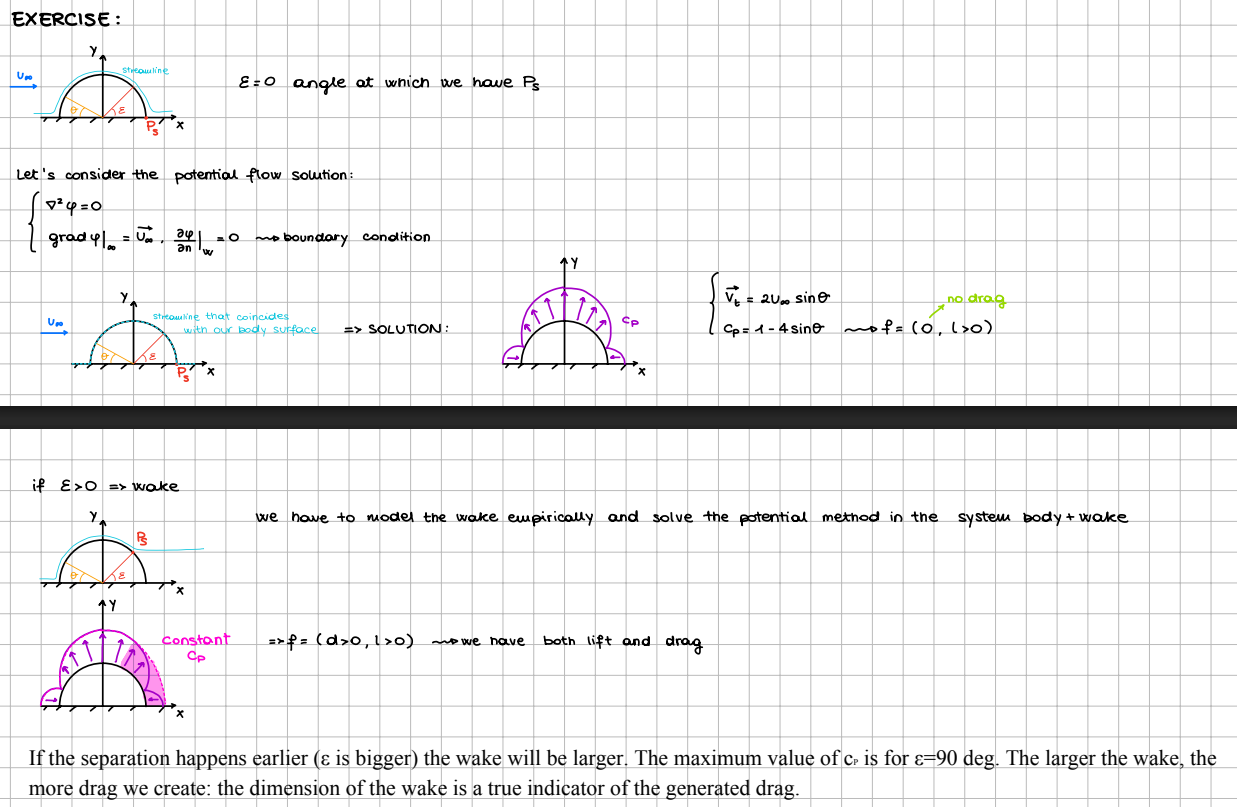
exercise in aerodynamic forces in bluff body
exercises
If the separation happens earlier (ε is bigger) the wake will be larger. The maximum value of c_P is for ε=90 deg. The larger the wake, the more drag we create: the dimension of the wake is a true indicator of the generated drag
the two drag types
pressure
friction
two methods for friction drag
Polhausen method
simplification of body → transform disk into flat plate → flat plate analogy
explain Polhausen method
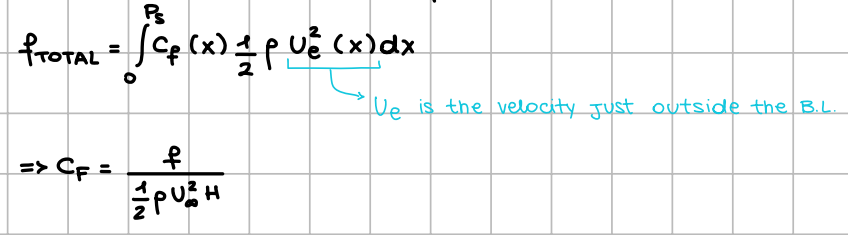
if have pressure distribution on x, by applying Polhausen we can find c_f(x)
then, we can find total friction → f_total formula → c_f formula
if we want to simplify this we use flat plate analogy
explain flat plate analogy
can transform our body into a flat plane and evaluate the friction coefficient of it by using Blasius (assuming a laminar B.L.)
having a low tau is not always useful because the BL is more fragile: tends to separate more easily → bigger wake → bigger pressure drag
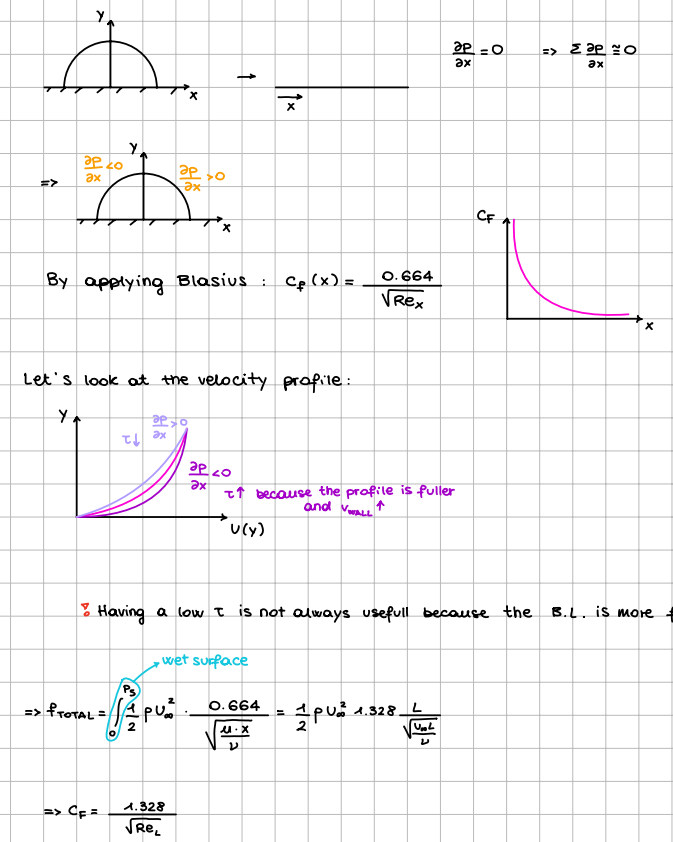
half cylinder exercise (section 2.1)
exercise
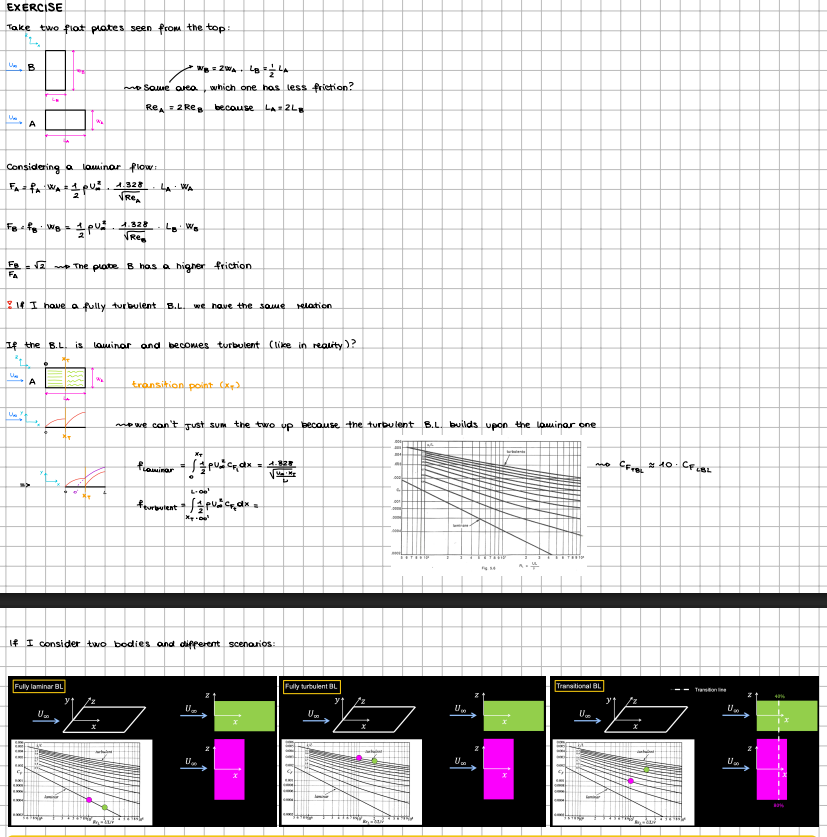
with a turbulent BL we have a higher friction (both because tau is higher and because BL is more
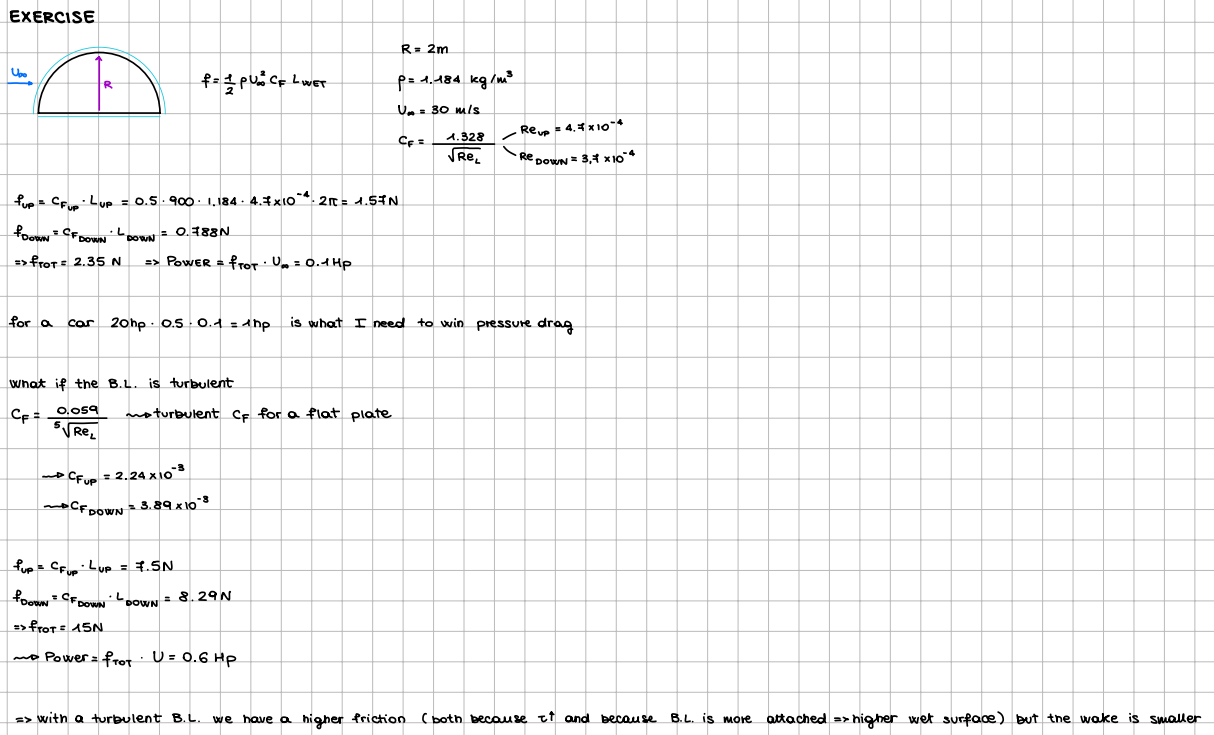
what is tau?
shear stress, which is related to skin friction
two flat plates exercise (section 2.1)
exercise