Endoparasites General
 Call Kai
 Learn
Learn Practice Test
 Spaced Repetition
 Match
Match Flashcards
 Knowt Play
1/64

There's no tags or description
Looks like no tags are added yet.
Name | Mastery | Learn | Test | Matching | Spaced | Call with Kai |
|---|
No analytics yet
Send a link to your students to track their progress
65 Terms
Types of endoparasites
Nematodes
Cestodes
Trematodes
Acanthocephalans
Protozoa
Types of nematodes
Roundworms
Whipworms
Hookworms
General morphology of nematodes
Unsegmented
Circular in cross section
Different types of shapes - spherical, whip-like (whipworms), terminal enlargements (strongylus vulgaris)
Characteristics of nematodes
Dioecious - two sexes
Has GI tract - with mouth variations
Has reproductive tract - big and extensive
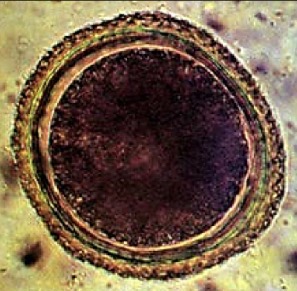
Ascarid egg (nematode)
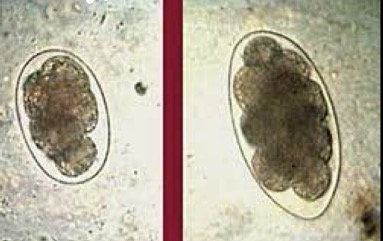
Strongyle (trichnstronglye) egg (nematode)
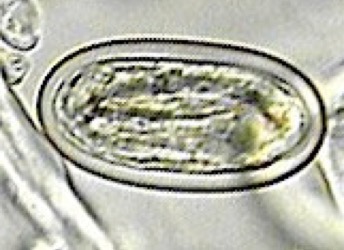
Spiruroid egg (nematode)
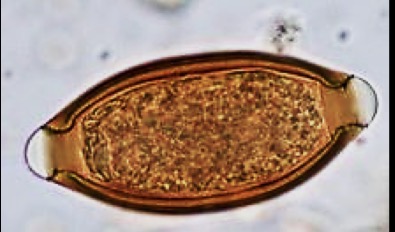
Trichuroid egg
Direct life cycle of nematodes
No intermediate host - they stay on one host for its whole life
Indirect life cycle of nematode
Has intermediate hosts - changes host
Simple cycle of a nematode
Egg → single cell to morula → tadpole → L1 (stage 1 larvae) → egg hatches → L2 → molts → L3 (INFECTIVE) → L4 → L5 (immature adult) → migrate to site predilection → mature adult (REPRODUCING EGGS)
Types of nematode eggs
Ascarid
Strongyle
Trichuroid
Spiruroid
Two types of cestodes
Cotyloda (pseudotapeworms)
Eucestodia (true tapeworm)
Cestodes aka
Tapeworms
Morphology of cestodes
Segmented*
Neck
Strobilia/body - proglottids → hermaphroditic, they self/cross fertilize
Dorsoventrally flattened like a ribbon
Internal structures of cestodes
Internal structures - NO GI tract (they absorb nutrients from intestine)
Reproductive tract - each proglottid has its own reproductive tract, mature are reproducing
Cestodes egg types
Pyriform apparatus
Dipylidium
Taenia
Pseudophyllidean
Pyriform apparatus egg (cestodes)
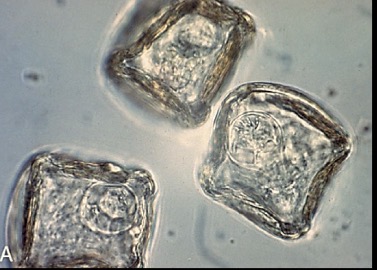
Dipylidium egg (cestodes)
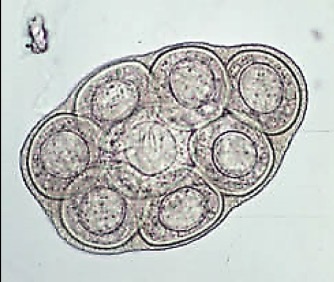
Taenia egg (cestodes)
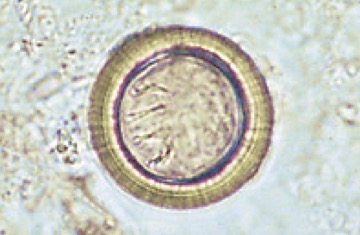
Pseudophyllidean egg (cestodes)
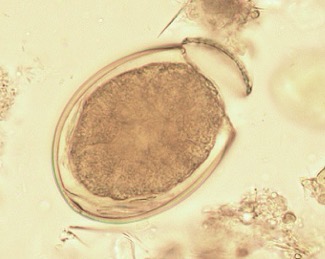
Cotyloda (pseudotapeworm) life cycle
Eggs passed individually*
Egg is in external environment and hatches in water → coracidium
Coracidum ingested by 1st intermediate host (copepod crustacean) → Procercoid
Procecercoid ingested by 2nd intermediate host (fish) → Plerocercoid (INFECTIVE)
2nd intermediate host ingested by definitive host → tapeworm emerges, attaches to intestine
1st intermediate host of cotyloda
Copepod crustacean
2nd intermediate host of cotyloda
Fish
Eucestode (true tapeworm) life cycle
Proglottids passed intact (thousand of eggs)
Eggs ingested by intermediate host
Develops - metacestode → different forms of
Intermediate host ingested by definitive - attaches to intestine
Intermediate host of eucestode
Invertebrate or vertebrate animals - basically anything that ingests it
Trematodes aka
Flukes
Morphology of trematodes
Unsegmented*
Flattened
Shape variations - leaf-like (fasciola hepatica), worm-like (schistomes)
Types of trematodes
Monogenetic - single host
Digenetic* - 2-4 obligate hosts
Characteristics of trematodes
Hermaphroditic - both sexes, except blood flukes
Internal structures - GI tract → has mouth structures, esophagus, blind ceca (NO anus) - so they regurgitate food
No body cavity
Has ventral sucker on acetabulum for attachment
Digenetic trematode life cycle
Eggs passed → external environment or water → hatches into miracidium (motile and can move)
Miracidium penetrates intermediate host → Cercariae
Cercariae has 3 options
Penetrate skin of def host → migrate to predilection site → matures to adult
Attach to vegetation → encyst → eaten by defin host → Migrate to predilection site, mature to adult
Penetrate 2nd intermediate host ingested → encysts into metacercaria → 2nd intermediate host is eaten by def host → migrates to predilection site and matures to adults
Predilection sites of trematodes (aka where they stay after they become adults)
GI - rumen, reticulum, intestines, liver, bile duct
Respiratory - lungs
Blood vessels - schistosomes
Trematodes egg
Operculated
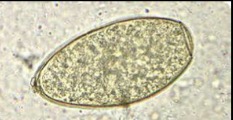
Type of digenetic trematode life cycle
Indirect
1st intermediate host of digenetic trematode
Mollusk (snail)
1st intermediate host of digenetic trematode
Mollusk (snail)
Morphology of acanthocephalans
Elongated
Cylindrical
Retractable proboscis (nose) - spine covered, caudally directed attachment
Internal structures of acanthocephalans
No GI tract - they need to absorb nutrients
Dioecious
Life cycle of acanthocephalans
Eggs passed in feces (has acanthor)
Intermediate host ingests arthropods → egg hatches into a larvae → develops into acanthella, then cystacanth
Definitive host ingests intermediate host → attaches to intestine, matures to an adult
Intermediate host of acanthocephalans
Arthropods - dung beetle
Types of protozoa
Mastigophora - flagellates
Sarcodina - amoeba
Cliophora - ciliates
Apicomplexa
Types of parasitic flagellates protozoans (mastigophora)
Leishmania spp.
Trypanosoma spp.
Trichomonas spp.
Histomonas spp.
Giardia spp.
What is a trophozoite
Active feeding form of protozoa that can be motile
Can develop into a cyst
What kind of environment do flagellates need
Liquid environment like blood, lymphatic fluid, CSF
What kind of environment do amoeba need
Require solid surfaces
What are the parasitic amoeba we can see
Entamoeba histiolytica
Acanthomoeba spp.
Entamoeba coli
Naegleria fowleri
What kind of envoinrment do ciliates need
Liquid environment
Out of all the protozoans, which is the highly pathogenic one as a parasite
ciliates - ciliophora
What are the pathogenic ciliates
Balantidium coli
Ichthyophthirus multifiliis
What are the types of pathogenic apicomplexans
Haemosporidia - in the blood
Piroplasms - in the cells in the blood
Coccidia
What are types of haemosporidia
Plasmodium vivax
Haemoproteus columbae
Leucocytozoon spp.
What are types of piroplasms
Babesia spp.*
Theileria spp.*
Cytauxzoon felis.
Mastigophora or flagellates are
Protozoans
What are the types of coccidia
Eimeria spp.
Cystoisospora spp.
Cryptosporidium spp.
Toxoplasma gondii
Sarcocystitits spp.
Encephalitozoon spp.
Hepatozoon spp.
Sarcodina or amoeba are
Protozoans
Ciliophora or ciliates are
Protozoans
Roundworms are
Nematodes
Hookworms are
Nematodes
Whipworms are
Nematodes
Tapeworms are
Cestodes
Flukes are
Trematodes
Development of cotyloda (pseudotapeworm) eggs
Eggs hatch → coracidium → ingested by 1st int. host → procercoid → ingested by 2nd int. host → plerocercoid (INFECTIVE) → 2nd int. host ingested by def. host → tapeworm emerges and attaches to intestine
Development of eucestode egg
Egg → metacestode → cysticercoid → cysticercus → coenurus → hydatid cyst → tetrathyrdium (i think) → intermediate host ingested by def host → tapeworm emerges
Digenetic trematode egg development
Egg passed in water → hatches into miracidium → penetrates int. host and sporocysts into cercariae → can take 3 options to reach def host → if it penetrates 2nd int. host → becomes metacercaria → migrates to predilection site and matures to adult
3 routes for trematode cercaria to go
Penetrate skin → migrates to predilection site → mature to adult
Attach to vegetation → encysts → eaten by def. host → migrates to predilection site and matures
Penetrates 2nd int. host → encysts → hatches into metacercaria → 2nd int. host eaten by def host and migrates to predilection site and matures to adult