Microbiology 3050 Lab Culture of Microorganisms
 Call Kai
 Learn
Learn Practice Test
 Spaced Repetition
 Match
Match Flashcards
 Knowt Play
1/64

There's no tags or description
Looks like no tags are added yet.
Name | Mastery | Learn | Test | Matching | Spaced | Call with Kai | Chat |
|---|
No analytics yet
Send a link to your students to track their progress
65 Terms
What elements are essential when it comes to microbial nutrition?
H, C, N, O, P, and S
What are the essential cat/anions for microbial nutrition?
Na, Mg, K, Ca, and Cl
What are some trace metals that are used for microbial nutrition?
V, Mn, Fe, Co, Ni, Cu, Zn, Mo, and W
What element is most important to microbes?
Carbon, 50% of the dry weight of E. coli is C
What macromolecule makes up the most dry weight?
Proteins, then RNA, a few others and DNA is last
What element is most needed for proteins?
N
What element is most needed for RNA?
P
Nutrient preparations are devised to support the …
growth (reproduction) of microorganisms (includes macronutrients and micronutrients - trace metals and growth factors)
Culture medias can be …
solid or liquid, the solid medias are usually solidified with agar
What are 4 medias we often use?
agar plate, agar deep tube, broth, and agar slant
What are the basic classifications for types of media?
Chemical composition (defined or complex), Physical nature (liquid, semisolid, solid), and function (supportive, enriched, selective or differential)
What is defined media?
we know it exact composition down to the mole, qualitative and quantitative known, would use this in very specific higher level settings, can be used to determine what a bacteria eats
What is complex media?
contains some ingredients of unknown composition or concentration, like yeast extract or broth (we know how much yeast we added but not its exact chemical formula
How can we make defined media complex?
by adding an extract or broth
What are some common components for complex media?
Peptones, extracts, and agar
Peptones are …
protein hydrolysates prepared by the partial digestion of various protein sources such as casein and soybeans
Extracts are usually things like …
aqueous extracts of beef or broth
Agar is …
sulfated polysaccharide used to solidify liquid media, most microorganisms cannot degrade it, does NOT change a defined media into a complex media
Functional types of media include …
supportive, enriched, minimal, and, selective
General purpose media/supportive media supports …
the growth of MANY microorganisms, the cheese pizza of medias, not everyone’s favorite but it works
Example of general purpose media
tryptic soy agar - has peptones
Enriched media is …
general purpose media supplements with highly nutritious substances such as blood (blood also would make it a complex media)
Example of enriched media
chocolate agar, uses heated blood, often used to grow STI’s
Minimal media contains …
the minimal necessities for growth of the wild-type (regular/most common genes coming from the “wild” so not altered in a lab)
What do minimal medias contain?
inorganic salts, a simple carbon source, and water
Selective media favors …
the growth of some microorganisms and inhibits the growth of others, so it selects against those it isn’t trying to grow
Example of selective media
EMB agar, selects for gram - negative bacteria
Differential media disntinguishes between …
different groups of microorganisms based on their biological characteristics
Example of differential media
Blood agar: hemolytic (blood breakdown) versus nonhemolytic bacteria

What is MacConkey agar?
another differential media that allows us to pinpoint lactose fermenters versus nonfermenters using an indicator that turns pink
Using different media is really helpful for making …
pure cultures (population of cells arising from a single cell)

What do pure cultures allow us?
to study a single type of microorganism
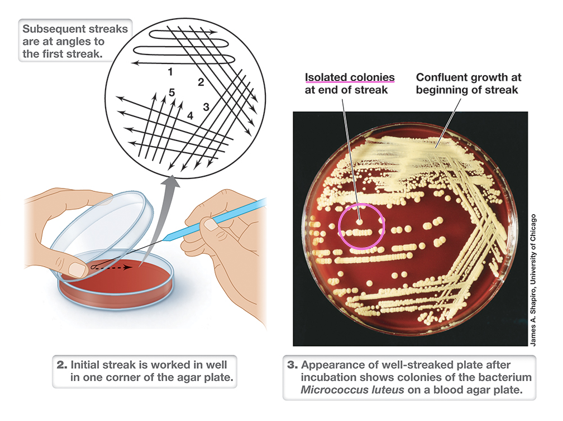
When making pure cultures, a mixture of cells is applied to an agar surface …
so that individual cells are well separated from each other
What are some methods to creating pure cultures?
streak plate, spread plate, and pour plate
Which two of the three pure culture methods give us the most information?
spread and pour plates because they give us numbers while the streak plate doesn’t
When studying bacteria it is best to use …
aseptic technique
Streak plating:
Spread plate uses …
a small volume of diluted culture and is transferred to agar surface, culture is spread evenly over surface with a sterile bent rod called a hockey stick (made of glass)

Pour plates use …
diluted samples that are mixed with liquid agar, mixture of cells and agar are poured into sterile culture dishes

Both pour and spread plates provide …
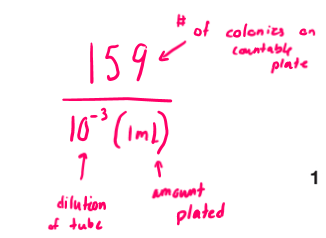
isolated colonies and countable plates which are plates with 30-300 colonies on them
Why isn’t a plate with 12 colonies on it not countable?
Because for statistical use we need a sample of at least 30, we need a representative sample, can’t be more than 300 because it becomes difficult to distinguish colonies from each other
Dilution
Remember the exponent rule only works with dilution using factors of 10!
Mycobacterium are gram …
positive according to their DNA, but their cell wall structures are weird and this is why they can are stained using the acid-fast technique
Species form characteristic …
colonies, they can be different shapes, pigmentations, size, etc.
There are differences in growth rate from the edge to the center of a …
colony due to available oxygen, nutrients, and toxic products that could be produced by the other cells in the colony, and cells may be dead in some areas because of these limitations
Not all 100,000 bacteria that make up one colony are …
the same, the center bacteria (the first one to start replicating) will have the most differences compared to ones on the most outer ring of the colony
Bacteria on the outer most ring of a colony are …
the youngest
Their are differing forms of bacteria in colonies that include
Punctiform, circular, filamentous, irregular, rhizoid, and spindle
What does Punctiform form look like?
small or pin-point

What does Circular form look like?

What does Filamentous form and margin look like?
margin is the bottom one

What does Irregular form look like?

What does Rhizoid form look like?

What does Spindle form look like?
lens

What does flat elevation look like?

What does raised elevation look like?

What does convex elevation look like?

What does pulvinate elevation look like?

What does Umbonate elevation look like?

What does entire(even) margin look like?

What does undulate(wavy) margin look like?

What does lobate(lobes) margin look like?

What does erose(serrated) margin look like?
What does curled margin look like?
