Week 3 Online Homework
 Studied by 0 people
 Call Kai
 Learn
Learn Practice Test
 Spaced Repetition
 Match
Match Flashcards
 Knowt Play
1/17

There's no tags or description
Looks like no tags are added yet.
Name | Mastery | Learn | Test | Matching | Spaced | Call with Kai |
|---|
No study sessions yet.
18 Terms
Compared to a human, the total distance that oxygen has to diffuse to reach cells in blue whales is _____, while the distance of bulk flow for oxygen in blue whales is _____.
roughly the same, larger
What is a prerequisite (requirement) for counter-current exchange to function?
unidirectional flow of the outside medium (air or water)
bulk flow (mass flow) of blood and external medium (air or water)
First, identify the concentration gradient for both inhalation and for exhalation in the hypothetical alveoli above that are plumbed for counter-current exchange during inhalation.
blood during exhalation → Phigh
blood during inhalation → Plow
air during exhalation → Plow
air during inhalation → Phigh
Based on your answer to the previous question, what problem prevents mammalian lungs from engaging in counter-current design?
If mammalian alveoli had respiratory capillaries directed to engage in counter-current exchange during inhalation ...
... the concentration gradient would reverse during exhalation and cause diffusion of oxygen from blood to the air.
Lugworms create a unidirectional water current that runs through their U-shaped burrows. Why does this allow lugworms to establish a countercurrent oxygen exchange in their gills?
Capillaries in gills can be consistently directed to run blood in the opposite direction as external water flow
How is/are the relevant variable(s) of Fick's Law optimized by the countercurrent oxygen exchange in lugworm gills?
(Phigh-Plow) is re-established
What is the role of each of the following structures in the mammalian respiratory system?
hemoglobin in pulmonary capillaries → supports low Plow in blood serum (liquid)
hemoglobin in systemic capillaries → supports high Phigh in blood serum (liquid)
bulk flow of blood from pulmonary to systemic capillary beds → supports low L
capillaries forming a dense net over the alveoli → supports high A
water film lining inner surface of alveoli (as opposed to dry cell surface) → supports high D
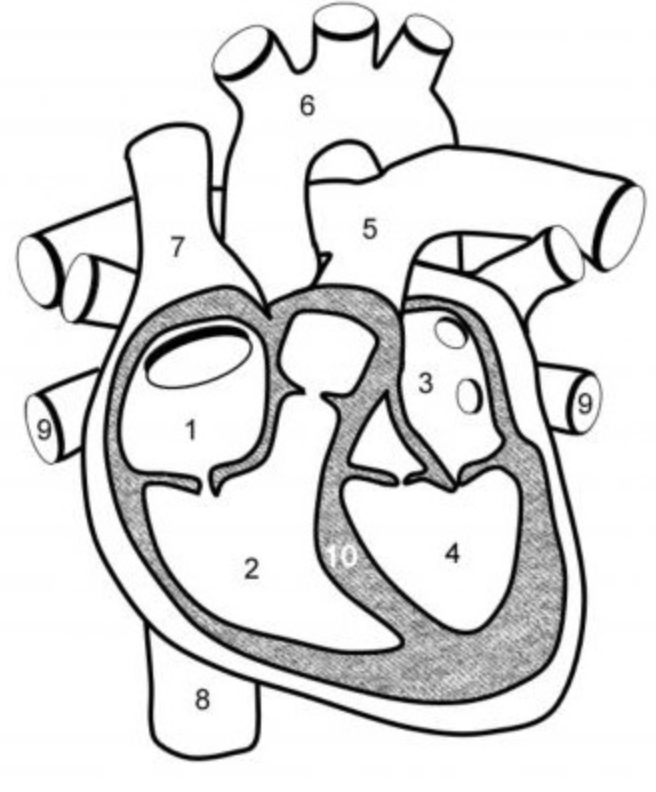
structure 1 → right atrium
structure 2 → right ventricle
structure 3 → left atrium
structure 4 → left ventricle
structure 5 → pulmonary artery
structure 6 → aorta
structure 7 → superior vena cava
structure 8 → inferior vena cava
structure 9 → pulmonary veins
structure 10 → septum
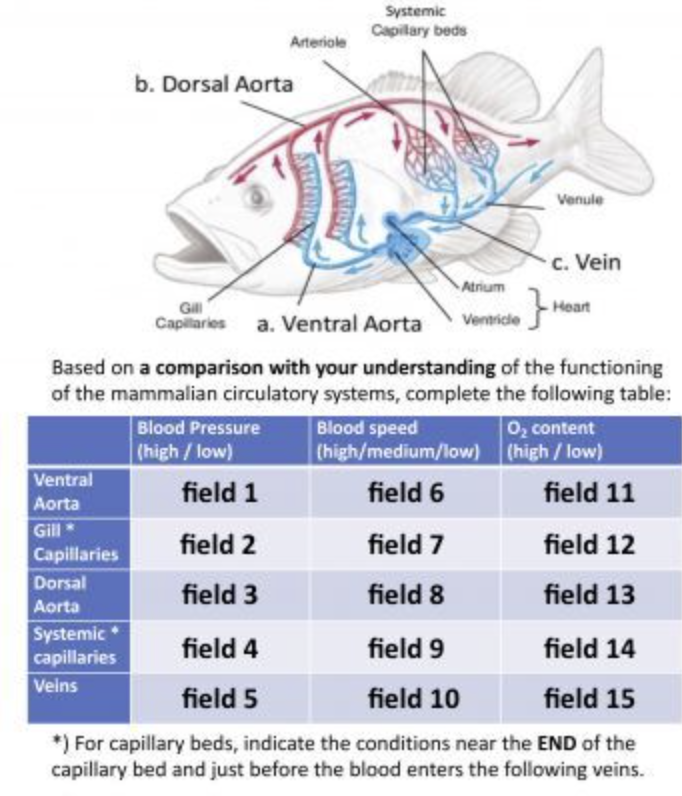
field 1 → high
field 2 → low
field 3 → low
field 4 → low
field 5 → low
field 6 → high
field 7 → low
field 8 → low
field 9 → low
field 10 → low
field 11 → low
field 12 → high
field 13 → high
field 14 → low
field 15 → low
Why is the oxygenated blood that reaches the body cells of a fish generally at lower pressure than in a mammal?
The fish’s blood does not return to the heart after acquiring O2 in the capillaries of the gills.
Which variable differs systematically for the two distances that requires us to consider the rate of diffusion for these two layers separately?
A
What is a likely explanation for this observation?
Increased drought conditions forced plants to reduce the variable ‘Area” in Fick’s Law to avoid water loss to a degree that the reduced diffusion rates of CO2 were similar to present values despite the higher atmospheric CO2 concentrations.
What relationship do the data in the graph reveal as the trout grow larger?
The ratio of gill respiratory surface area to body volume is constant (stays the same)
Based on her data, what did Abigail conclude enabled the fish to maintain this relationship of respiratory surface area to body volume during the fish's growth?
As the body of the fish grows, its gill surface area has to increase much faster than predicted for the SA/V ratio of a body of the same shape so that its gill surface area doubles when its body volume doubles during growth.
Knowing the difference in oxygen concentration in their environment, and assuming everything else in carp is equal to the brook trout example, which of the dotted lines shows the predicted relationship of body volume to gill surface area in carp in comparison to the brook trout relationship (thin solid line)?
Line A
Which of the following hypotheses may be possible explanations that are consistent with the data and that Alessandro can set out to test next in his carp study system?
Carp have a higher concentration of hemoglobin in their blood than trout do
Carp have a lower metabolic energy requirement than trout do
Carp experience higher oxygen concentrations in their environment than previously assumed
Below are some additional observations about icefish. Match each of these observations to a relevant variable of Fick's Law that could help explain how these curious fish can maintain sufficient oxygen supply to satisfy their metabolic demand despite the lack of respiratory pigments.
Cold water can dissolve more oxygen than warm water. → high Phigh (high concentration)
Ice fish contain a protein in their blood that acts as an antifreeze. → does not explain meeting metabolic demand for oxygen
Icefish only live in water near the freezing point. → low metabolic demand for oxygen
Icefish have no scales in their skin, and can hence use their skin as a respiratory surface. → high A (area)
Some species of icefish are nearly transparent because they also lost the muscle pigment myoglobin. → does not explain meeting metabolic demand for oxygen
Ice fish have an unusually high volume of blood compared to their body weight. → high rate of O2 transport via bulk flow
Birds engage in counter-current exchange, mammals do not. Simply based on what you know about counter-current exchange, in which group of animal would you predict to find that respiratory capillaries flow alongside respiratory surfaces over a longer length for?
Birds