2 THEORY OF SOUND
 Call Kai
 Learn
Learn Practice Test
 Spaced Repetition
 Match
Match Flashcards
 Knowt Play
1/97

There's no tags or description
Looks like no tags are added yet.
Name | Mastery | Learn | Test | Matching | Spaced | Call with Kai | Chat |
|---|
No analytics yet
Send a link to your students to track their progress
98 Terms
Sound
is an energy form that travels in waves, created by vibrating objects and carried through different media, and is perceived by our ears and brains as various pitches and volumes.
Sound
Auditory sensation in the ear.
Sound
Disturbance in a medium that can cause this sensation.
Sound
Can be studied using the principles of generation, transmission, and control of energy.
Source/Transmitter, Transmission Path/Medium, Receiver/Detector
All acoustical situations involve three elements, these are:
Source or Transmitter
Generates the sound.
Source or Transmitter
Almost anything that moves, vibrates, oscillates, or pulsates can be a sound source, such as human voice and speech, music and instruments, machinery and industrial equipment, and motorized traffic.
Transmission Path or Medium
The material through which sound waves travel.
Transmission Path or Medium
The density of the medium determines the ease, distance, and speed of sound transmission. The higher the density of the medium, the slower sound travels through it.
Receiver or Detector
Acts as the receiver of the sound wave and accepts the sound whether wanted or unwanted.
Vibrating Bodies, Changing Airflow, Time-Dependent Heat Sources, Supersonic Flow
Four methods of Sound Production
Vibrating Bodies
Sound is produced when a solid object vibrates and causes surrounding air particles to move.
Changing Airflow
Sound is generated by varying or interrupting a steady stream of air.
Time-Dependent Heat Sources
Rapid heating and cooling cause air expansion and contraction, producing pressure waves.
Supersonic Flow
When an object moves faster than the speed of sound, it creates shock waves that are heard as a "sonic boom.
By location, continuity, geometry
Three classification of sound sources by?
By Location
External/Environmental: traffic, airplanes, construction noise
Indoor: voices, appliances, HVAC systems
By Continuity
Continuous: humming machinery, steady fan noise
Non-continuous: footsteps, doors closing
By Geometry
Point sources: loudspeaker, siren
Line sources: busy highway, conveyor belt
Areal sources: factory floor, large crowd
Sound Waves
Pressure fluctuations that travel through a medium.
Sound Waves
are mechanical waves that are formed when an object vibrates. This causes the air molecules closest to the vibration source to be pushed back and forth, creating a chain reaction of waves traveling outward from the source.
Sound Waves
propagate through a medium, such as air, water, or solids, by creating alternating zones of compression and rarefaction.
Compression
A region in a longitudinal wave where the where the medium is compressed.
Rarefaction
A region in a longitudinal wave where the medium is spread out.
Longitudinal Waves, Transverse Waves, Surface Waves
Sound waves can be categorized into three main types
Longitudinal Waves
Occur when the particle displacement is parallel to the direction of wave propagation. Ex. sound travelling through air or fluids.
Transverse Waves
Particle displacement is perpendicular to the direction of wave travel. Ex. sound travelling through solid materials
Surface waves
Travel along the boundary of two different media and can have a combination of longitudinal and transverse motions.
Wavelength (A)
Pressure fluctuations
Wavelength (A)
The distance between two consecutive points that are in phase (e.g., from crest to crest or trough to trough).
Wavelength (A)
Measured in meters (m)
Wavelength (A)
Inversely proportional to frequency.
Frequency (Hz)
The number of times the wavelength occurs in one second.
Frequency (Hz)
Measured in Hertz (Hz), where 1 Hertz = 1 vibration/second.
Frequency (Hz)
Determines the pitch of the sound.
Period (T)
The time it takes for one complete cycle of the wave.
Period (T)
Inverse of frequency (T = 1/f)
Period (T)
Usually measured in a fraction of a second.
Amplitude (dB)
The height of the wave.
Amplitude (dB)
Measured in Decibels
Amplitude (dB)
Determines the loudness or intensity of the sound.
Velocity (v)
The speed at which the sound wave travels through a medium.
Velocity (v)
Depends on the properties of the medium - temperature, density, and elasticity.
Airborne Sound
Sound waves that travel through the air. These sounds originate from sources such as voices, musical instruments, loudspeakers, and environmental noise like traffic.
Structure-borne Sound
Sound that travels through solid materials, such as building structures, floors, walls, and ceilings. These sounds are typically generated by impacts or vibrations that directly interact with the structure.
Sound Field
Sound waves propagate away from the source until they encounter obstacles or boundaries in their path. After which, some of the energy will be absorbed, some transmitted and the rest reflected into the room.
Direct Sound Field, Indirect/Reflected Sound Field
When the wavelength of a sound is just the same as one of the room's dimensions, a standing wave is created. When a sound comes from a source, the hearer of the sound hears two types of sounds:
Direct Sound Field
Sound that travels directly from the sound source to the receiving point itself.
Direct Sound Field
Independent of room shape and materials, but dependent upon the distance between source and receiver.
Indirect/Reflected Sound Field
Sound that reaches the listener after reflecting off surfaces like walls, ceilings, or objects in the environment.
Indirect/Reflected Sound Field
Independent of the source and receiver distance but greatly dependent on room properties.
Inverse Square Law
A fundamental principle in physics that describes how the intensity of a physical quantity of sound decreases as the distance from the source increases.
Inverse Square Law
As sound waves spread out from the source, their energy is distributed over a larger area, leading to a decrease in sound intensity by approximately 6 dB every time the distance from the source doubles.
Inverse Square Law
As you move away from a sound source, the sound intensity decreases. If you double the distance from the source, the sound intensity decreases to one-fourth of its original level of about 6 Db.
6 Db
As you move away from a sound source, the sound intensity decreases. If you double the distance from the source, the sound intensity decreases to one-fourth of its original level of about how many Db?
Psychoacoustics
The study of how humans perceive sound. It explores the psychological and physiological responses to sound waves, focusing on how the brain interprets different auditory signals.
Perception of Sound
This involves how we interpret the three main characteristics of sound which are pitch, loudness, and quality (timbre).
Pitch
Refers to how high or low a sound is, determined by the frequency of the sound waves.
Pitch
Higher frequencies correspond to higher pitches, while lower frequencies correspond to lower pitches.
Loudness
The perceived intensity or volume of a sound, which is related to the amplitude of the sound waves.
Loudness
Greater amplitudes produce louder sounds.
Quality (Timbre)
The distinctive sound that allows us to differentiate between different sources of sound, even when they produce the same pitch and loudness.
Quality (Timbre)
Timbre is influenced by the sound's harmonic content and dynamic characteristics.
Timbre
______ allows us to perceive and identify the unique sound of a flute compared to a guitar, even if they play the same note
20 Hz to 20,000 Hz
Audible Frequency Range
300 Hz to 3,000 Hz
Human Speech Frequency Range
2,000 Hz to 5,000 Hz
Unpleasant Sound Range
20 Hz to 250 Hz
Low-frequency sounds
Low-frequency sounds (20 Hz to 250 Hz)
Deep or bass tones
Low-frequency sounds (20 Hz to 250 Hz)
Physical Effects
Can cause vibrations in buildings and objects
Prolonged exposure can lead to discomfort or even health issues like nausea and headaches
Low-frequency sounds (20 Hz to 250 Hz)
Auditory Impact: Less directional, making them difficult to locate spatially.
above 2000 Hz
High-frequency sounds
High-frequency sounds (above 2000 Hz)
Sharp or treble tones
High-frequency sounds (above 2000 Hz)
Physical Effects
Can be piercing or irritating at high volumes
Prolonged exposure may lead to hearing loss, particularly at frequencies above 10,000 Hz
High-frequency sounds (above 2000 Hz)
Auditory Impact: More directional, aiding in sound localization and speech clarity.
0
Threshold of hearing
40
Comfortable hearing, moderate snoring
130
Gunshot
140
Threshold of pain
Sound Pressure Level (dB)
Quantifies the pressure variation caused by a sound wave to the ambient atmospheric pressure.
Sound Pressure Level (dB)
Measured in decibels, and represents the loudness of the sound.
0 dB to 15 dB
Hearing threshold, lowest sound heard by humans
120 dB to 140 dB
Pain Threshold, highest sound heard by humans
Spatial Hearing and Localization
refers to our ability to perceive the direction and distance of sounds, which is critical for localization.
Spatial Hearing and Localization
This ability relies on the timing, intensity, and phase differences of sounds reaching each ear, allowing us to pinpoint where a sound is coming from in our environment.
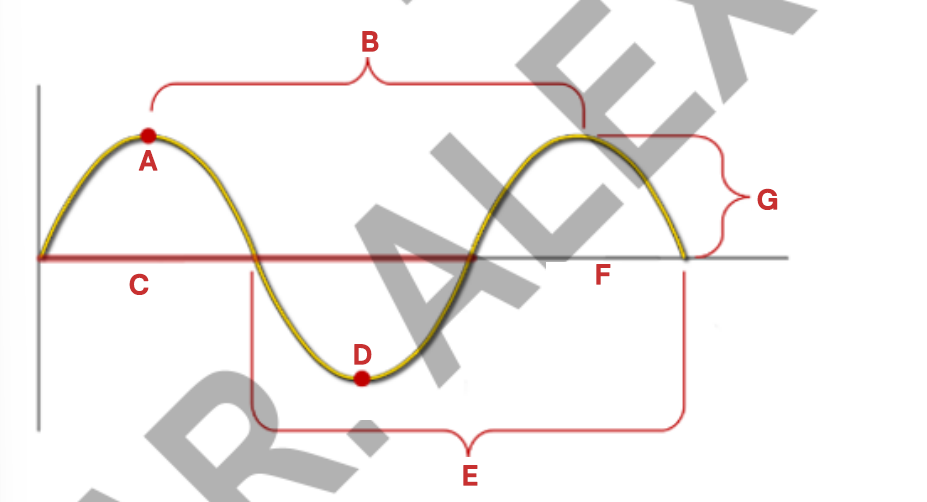
Rarefaction
Point A is called?

Compression
Point B is called?

Crest
Point A is called?

Wavelength
Point B is called?

Period
Point C is called?
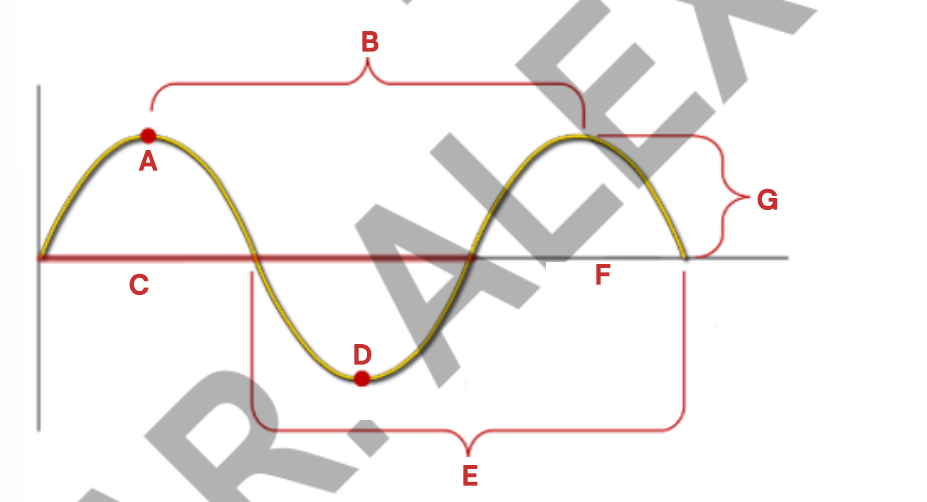
Trough
Point D is called?

Frequency
Point E is called?

Time
Point F is called?

Amplitude
Point G is called?
Higher Frequency, Higher Pitch Sound

Lower Frequency, Lower Pitch Sound

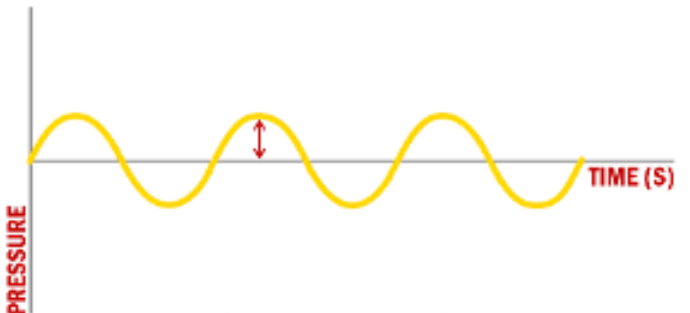
Higher Amplitude, Louder Sound
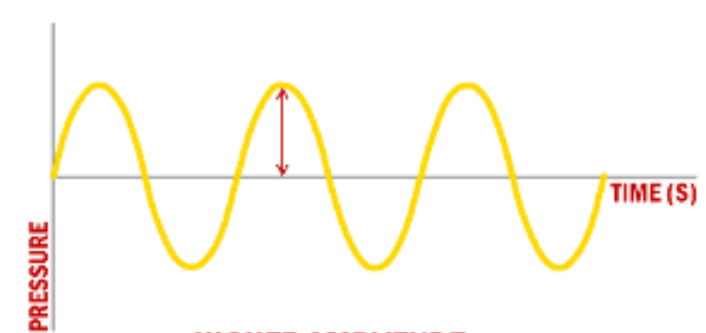
Lower Amplitude, Quieter Sound