Ecosystem, Biome, and Biogeochemical Cycle Review for Students
 Call Kai
 Learn
Learn Practice Test
 Spaced Repetition
 Match
Match Flashcards
 Knowt Play
1/121

There's no tags or description
Looks like no tags are added yet.
Name | Mastery | Learn | Test | Matching | Spaced | Call with Kai | Chat |
|---|
No analytics yet
Send a link to your students to track their progress
122 Terms
Community
All living organisms in an area
Individual
One organism (elk)
Population
Group of individuals of the same species (elk herd)
Ecosystem
All living & nonliving things in an area (plants, animals, rocks, soil, water, air)
Biome
The plants and animals found in a given region (determined by climate)
Mutualism
Relationship that benefits both organisms (coral reef)

Commensalism
Relationship that benefits one organism & doesn't impact the other (birds nest in trees)

Competition
Organisms fighting over a resource like food or shelter; limits population size
Predation
One organism using another for energy source (hunters, parasites)

Parasitism
Relationship that benefits one organism & harms the other

Herbivores
(Plant eaters) eat plants for energy (giraffe & tree)
True predators
(Carnivores) kill and eat prey for energy (leopard & giraffe)
Parasites
Use a host organism for energy, often without killing the host & often living inside host
Parasitoids
Lay eggs inside a host organism; eggs hatch & larvae eat host for energy

Symbiosis
Any close and long-term interaction between two organisms of different species
Interspecific competition
Two different species competing for the same resource
Intraspecific competition
Two of the same species competing for the same resource
Resource partitioning
Different species using the same resource in different ways to reduce competition
Temporal partitioning
Using resource at different times, such as wolves & coyotes hunting at different times (night vs. day)

Spatial partitioning
Using different areas of a shared habitat (different length roots)
Morphological partitioning
Using different resources based on different evolved body features
Biome characteristics
Defined by average annual temperature & precipitation
Nutrient availability in Tropical Rainforest
Nutrient-poor soil
Nutrient availability in Boreal forest
Nutrient-poor
Nutrient availability in Temperate forest
Nutrient-rich soil
Wetland
Area with soil submerged/saturated in water for at least part of the year, but shallow enough for emergent plants
Estuaries
Areas where rivers empty into the ocean; mix of fresh & salt water
Salt Marsh
Estuary habitat along coast in temperate climates; breeding ground for many fish & shellfish species
Mangrove Trees
Trees with long, stilt roots that stabilize shorelines and provide habitat for many species of fish and shellfish.

Coral Reef
Warm shallow waters beyond the shoreline; most diverse marine biome on earth.
Mutualistic Relationship
Relationship between coral (animals) and algae (producers) where both species rely on each other.
Coral's Role in Carbon Cycle
Coral takes CO2 out of the ocean to create calcium carbonate exoskeleton and provides CO2 to algae.
Algae's Role in Carbon Cycle
Algae live in the reef and provide sugar (energy) to coral through photosynthesis.
Intertidal Zones
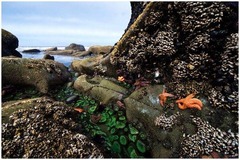
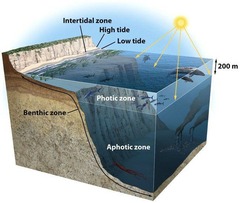
Narrow band of coastline between high and low tide where organisms must adapt to survive.

Adaptations in Intertidal Zones
Organisms like barnacles, sea stars, and crabs attach to rocks and have shells to prevent desiccation.
Open Ocean
So large that algae and phytoplankton produce a lot of earth's O2 and absorb a lot of atmospheric CO2.
Photic Zone
Area where sunlight can reach, allowing for photosynthesis.
Aphotic Zone
Area too deep for sunlight, where species rely on detritus or chemosynthetic microbes for energy.
Carbon Cycle
Movement of molecules that contain Carbon (CO2, glucose, CH4) between sources and sinks.
Carbon Sink
Reservoir that takes in more carbon than it releases, such as oceans, plants, and soil.
Carbon Source
Reservoir that releases more carbon than it takes in, such as fossil fuel combustion and deforestation.
Photosynthesis
Process that removes CO2 from the atmosphere and converts it to glucose.
Cellular Respiration
Process done by plants, animals, and microbes to release stored energy and releases CO2 into the atmosphere.
Direct Exchange
CO2 moves directly between atmosphere and the ocean by dissolving into and out of ocean water.
Ocean Acidification
Result of increased atmospheric CO2 leading to net movement of CO2 into the ocean.
Sedimentation
Process where calcium carbonate precipitates out as sediment and settles on the ocean floor.
Burial
Slow geological process that stores carbon in underground sinks like sedimentary rock or fossil fuels.
Fossil Fuels
Formed from fossilized remains of organic matter; their decomposition produces natural gas (CH4).
Extraction and Combustion
Digging up or mining fossil fuels and burning them as energy sources, releasing CO2 into the atmosphere.
Rate of Carbon Transfer
The rate at which fossil fuels are transferred into the atmosphere has altered the carbon cycle over the past 250 years.
Nitrogen Cycle
Movement of N-containing molecules between sources & sinks/reservoirs
Fixation
Conversion of atmospheric nitrogen (N2) into usable forms like NH3 or NH4
Assimilation
Process where plants take in NH4 or NO3 and incorporate it into new biomass
Ammonification
Conversion of organic nitrogen into ammonium (NH4) by soil microbes/decomposers
Nitrification
Aerobic bacteria convert ammonium (NH4) into nitrite (NO2-) and then nitrate (NO3)
Denitrification
Bacteria convert nitrate (NO3) into N2 gas, returning it to the atmosphere
Nitrogen Fixation
Conversion of atmospheric nitrogen (N2) into ammonium (NH4) or nitrate (NO3) for plant use
Biotic Fixation
Bacteria in soil and root nodules convert N2 into ammonia (NH3)
Abiotic Fixation
Processes like lightning or fossil fuel combustion convert N2 into usable forms
Limiting Nutrient
A nutrient that limits primary productivity, such as nitrogen in soil
Phosphorus Cycle
Movement of phosphorus compounds between sources, sinks, and reservoirs
Phosphorus Reservoirs
Rocks and ocean sediments are the largest reservoirs of phosphorus
Weathering
Slow breakdown of phosphorus-containing rocks releasing phosphate (PO4-3)
Eutrophication
Excess nutrients in aquatic ecosystems leading to algae blooms and oxygen depletion
Synthetic Sources of Phosphorus
Mining phosphate minerals and adding phosphates to fertilizers and detergents
Assimilation in Phosphorus Cycle
Plants absorb phosphorus and incorporate it into their tissues
Geological Uplift
Tectonic plate collision forcing up rock layers, restarting the phosphorus cycle
Human Impacts on Nitrogen Cycle
N2O (nitrous oxide) produced by denitrification contributes to climate change
Algae Blooms
Rapid increase in algae due to excess nutrients, blocking sunlight and killing aquatic plants
Positive Feedback Loop in Eutrophication
Lower oxygen levels lead to more dead organisms, which further deplete oxygen
Nitrogen Cycle Steps
Fixation, assimilation, ammonification, nitrification, and denitrification
Main Nitrogen Reservoir
Atmosphere, primarily as N2 gas, which is not usable by plants or animals
Importance of Nitrogen
Essential for building DNA, proteins, and chlorophyll in plants
Phosphorus as a Limiting Nutrient
Phosphorus is often limiting in aquatic and terrestrial ecosystems due to slow cycling
Animal Assimilation of Phosphorus
Animals assimilate phosphorus by consuming plants or other animals
Hydrologic Cycle
Movement of H2O (in different states) between sources & sinks.
Water Cycle
State of matter (solid/liquid/gas) as well as where water is moving are key in H2O cycle.
Precipitation
Atmospheric gas that becomes liquid on land or surface water.
Evaporation
Process where liquid water becomes water vapor (gas) in the atmosphere.
Evapotranspiration
Amount of H2O that enters atmosphere from transpiration + evaporation combined.
Transpiration
Loss of water vapor from leaves into atmosphere.
Stomata
Leaf openings that allow water to evaporate into the atmosphere from the leaf.
Runoff
Precipitation that flows over earth's surface into a body of water.
Infiltration
Precipitation that trickles through soil down into groundwater aquifers.
Groundwater
Aquifers that are important freshwater reservoirs for humans & animals.
Primary Productivity
Rate that solar energy is converted into organic compounds via photosynthesis over a unit of time.
Net Primary Productivity (NPP)
The amount of energy (biomass) leftover for consumers after plants have used some for respiration.
Gross Primary Productivity (GPP)
The total amount of sun energy (light) that plants capture and convert to energy (glucose) through photosynthesis.
Respiration Loss (RL)
Plants use up some of the energy they generate via photosynthesis by doing cellular respiration.
Ecological Efficiency
The portion of consumed (or captured) energy that can be passed from one trophic level to the next.
10% Rule
Energy transfer is roughly ~10% efficient from trophic level to trophic level.
Biodiversity
Ecosystems with high primary productivity are usually more biodiverse than ecosystems with low primary productivity.
Factors affecting NPP
Water availability, higher temperature, and nutrient availability lead to high NPP.
Conservation of Matter & Energy
Matter & energy are never created or destroyed; they only change forms.
1st Law of Thermodynamics
Energy is never created or destroyed.
Biogeochemical Cycles
Cycles that involve the movement of elements and compounds through living organisms and the environment.
Pollutants in Runoff
Runoff can carry pollutants into water sources.
Reservoirs of Water
Groundwater (aquifers) & surface waters (lakes/rivers) are important freshwater reservoirs.
Energy from the Sun
Drives the hydrologic cycle.
Conservation of Matter
Cycles demonstrate conservation of matter (C/N/H2O/P)