2.1.3 Employment and Unemployment
 Studied by 0 people
 Call Kai
 Learn
Learn Practice Test
 Spaced Repetition
 Match
Match Flashcards
 Knowt Play
1/17

There's no tags or description
Looks like no tags are added yet.
Name | Mastery | Learn | Test | Matching | Spaced |
|---|
No study sessions yet.
18 Terms
Spec points
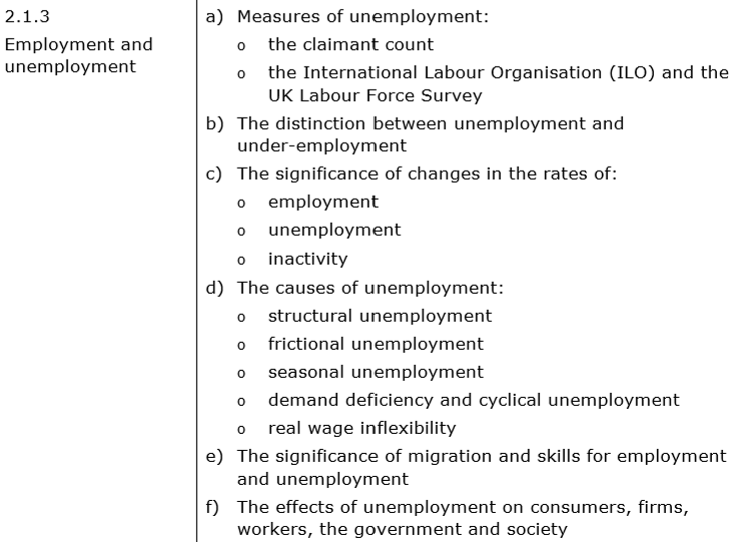
Give the 2 measures of unemployment
Claimant Count
How is the Claimant Count used to measure unemployment?
The Claimant Counts is a measure of unemployment based on the number of people who are claiming unemployment-related benefits, such as Job seeker’s Allowance.
It provides a narrow definition of unemployment, as it only includes those actively seeking and receiving government benefits
How is International Labour Organisation (ILO) and the UK Labour force survey used to measure inflation?
the ILO define unemployment as individuals of working age who are without work, actively seeking work, and available for work
the UK Labour Force Survey is the primary source of unemployment data in the UK and follows the ILO definition.
It provides a broader and more comprehensive picture of unemployment, including those not eligible for benefits
What is the difference between unemployment and under-employment?
Unemployment refers to individuals who are not currently employed but are actively seeking and available for work
Under-employment occurs when individuals are employed but their job does not fully utilise their skills and qualifications. This can result in part-time work, low wages, or jobs below their skill level.
What does Employment Rate measure?
Measures the proportion of working-age population in employment. A rising employment rate indicates economic growth.
Define unemployment rate?
Measures the proportion of the labour force actively seeking work.
A rising unemployment rate indicates economic problems
Define Inactivity rate
measure the proportion of the working-age population that is not in the labour force.
It can indicate a lack of job opportunities or demographic factors.
Give 5 causes of unemployment
Structural unemployment
Frictional unemployment
Seasonal unemployment
Demand deficiency (cyclical) unemployment:
Real wage inflexibility:
Define Real wage inflexibility
when wages are too high, leading to job curs or an unwillingness to hire.
Define demand deficiency (cyclical) unemployment
arises from a lack of aggregate demand during economics downturns
Define seasonal unemployment
linked to seasonal variations in demand, e.g tourism or agriculture
Define frictional unemployment
temporary unemployment when individuals are between jobs or entering the workforce.
Define structural unemployment
Occurs when there is a mismatch between skills of the workforce and the requirement of available jobs?
What is the significance of migration for employment and unemployment
Migration can impact employment by changing the supply of labour in specific region. Immigrants may fill labour gap, but this can also lead to wage pressures.
What is the significance of skills for employment and unemployment
Skills are crucial for employment. A highly skilled workforce is more adaptable and less prone to unemployment in a changing economy.
Who does unemployment effect and how?
Consumers: Reduced income can lead to lower consumer spending, impacting businesses
Firms: High unemployment can lead to a larger labour pool, potentially reducing wage pressures.
Workers: Lost income, reducing job prospects, and psychological stress
Government: Increased spending on unemployment benefits and lost tax revenue, social issues.
Society: Social unrest, reduced well-being, inequality
Give a real world example of unemployment
During the 2008 financial crisis, structural unemployment increased workers in declining industries (e.g manufacturing) struggling to find jobs in growing sectors (e.g technology). This highlighted the importance of retaining programs and skills development to address unemployment issues.