BIOL 2001C - Fluids, Electrolytes & Organic Chemistry Study Flashcards
 Call Kai
 Learn
Learn Practice Test
 Spaced Repetition
 Match
Match Flashcards
 Knowt Play
1/34

Earn XP
Description and Tags
Vocabulary flashcards created from the BIOL 2001C Fluids, Electrolytes & Organic Chemistry Condensed MEGA Study Notes.
Name | Mastery | Learn | Test | Matching | Spaced | Call with Kai | Chat |
|---|
No analytics yet
Send a link to your students to track their progress
35 Terms
Hydrolysis
A chemical reaction in which water is added to break larger molecules apart into smaller units.
Dehydration synthesis
A chemical reaction in which water is removed to build larger molecules from smaller units.
Intracellular fluid (ICF)
Fluid located inside cells, also known as cytosol, which contains most of the body's water.
Extracellular fluid (ECF)
Fluid located outside cells, composed of interstitial fluid (between cells) and plasma (the fluid portion of blood).

Electrolyte Distribution in Body Compartments
In ECF, the major cation is Na+ and major anions are Cl− and HCO3−; in ICF, the major cation is K+ and major anions are proteins.
Sodium Compartment Concentrations
Clinical electrolyte values where ECF Na+→high≈140 mEq and ICF Na+→low≈10 mEq.
Potassium Compartment Concentrations
Clinical electrolyte values where ICF K+→high≈160 mEq and ECF K+→low≈3.5–5.5 mEq.
Diffusion
Spontaneous net movement of solute and solvent from an area of HIGH concentration to an area of LOW concentration.
Osmosis
Movement of solvent (usually water) through a selectively permeable membrane from lower solute concentration to higher solute concentration.
Hypertonic solution
A solution with a higher solute concentration than the cell, causing water to leave the cell so that the cell shrivels.
Hypotonic solution
A solution with a lower solute concentration than the cell, causing water to enter the cell so that it swells and may lyse.
Isotonic solution
A solution with equal solute concentration relative to the cell, resulting in no major net water shift so the cell remains normal.
Dehydration
Loss of water without proportional electrolyte loss, causing extracellular fluid to become more concentrated and drawing water OUT of cells.
Overhydration
Addition of water without electrolytes, causing extracellular fluid to become more dilute and drawing water INTO cells.
pH scale formula
The formula pH=−log[H+], where each whole pH unit change represents a 10× change in H+ concentration.
Buffer
A substance that minimizes changes in pH by accepting H+ when there are too many or donating H+ when there are too few.

Disaccharides
Two monosaccharides joined by a glycosidic linkage: Maltose (glucose + glucose), Lactose (galactose + glucose), and Sucrose (glucose + fructose).
Cellulose
A plant cell wall polysaccharide containing β-1,4 glycosidic bonds that humans cannot hydrolyze, acting as dietary fiber to help form stool.
Glycogen
A highly branched carbohydrate storage polysaccharide in animals and humans, stored mainly in the liver and muscle.
Structural Isomers
Molecules with the same chemical formula but different structural arrangements, such as glucose, galactose, and fructose.
Glucagon
A hormone produced by alpha cells of pancreatic islets that functions to raise blood glucose levels.
Insulin
A hormone produced by beta cells of pancreatic islets that functions to lower blood glucose levels.
Hyperglycemia
A condition characterized by a blood glucose concentration greater than 120 mg/dL.
Hypoglycemia
A condition characterized by a blood glucose concentration less than 70 mg/dL.
Saturated fatty acid
A fatty acid with all single carbon-carbon bonds and maximum hydrogens, forming straight chains that pack tightly and tend to be solid at room temperature.
Unsaturated fatty acid
A fatty acid with at least one C=C double bond creating a kink, preventing tight packing and tending to be liquid at room temperature.
Triglyceride
A lipid molecule composed of 1 glycerol and 3 fatty acid chains formed by dehydration synthesis.
Phospholipid
A lipid composed of glycerol, 2 fatty acids, and a phosphate group, featuring a polar hydrophilic head and nonpolar hydrophobic tails that form cell membrane bilayers.
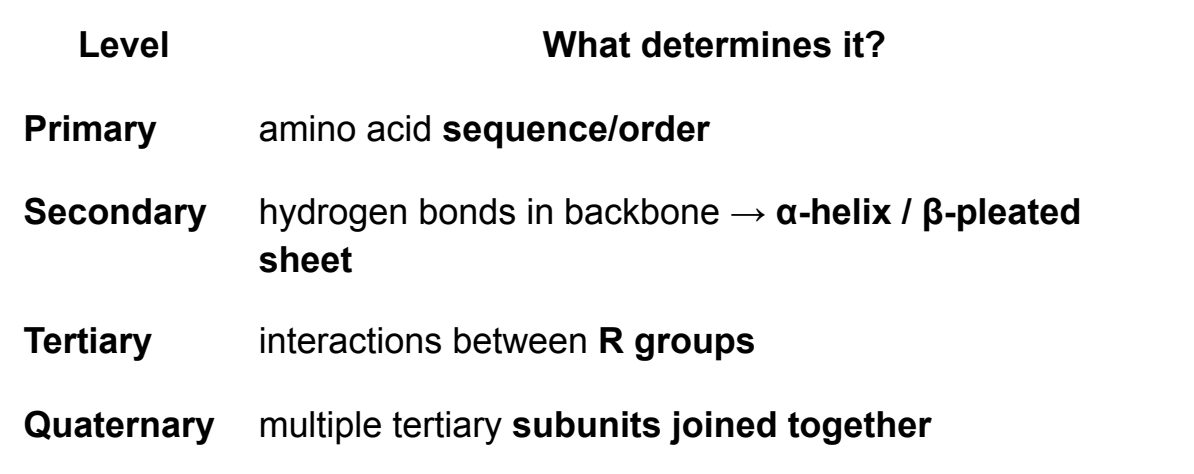
Four Levels of Protein Structure
Primary (amino acid sequence), Secondary (hydrogen bonds in backbone forming alpha-helix or beta-pleated sheet), Tertiary (R group interactions), and Quaternary (multiple tertiary subunits joined together).
Denaturation
The alteration or loss of a protein's normal secondary, tertiary, and/or quaternary structure due to factors like temperature, pH, organic solvents, or salt solutions.
Enzyme
A protein catalyst that speeds up chemical reactions to the speed of life by lowering activation energy without being consumed in the reaction.
Purines
Double-ring nitrogenous bases consisting of Adenine (A) and Guanine (G).
Pyrimidines
Single-ring nitrogenous bases consisting of Cytosine (C), Thymine (T), and Uracil (U).
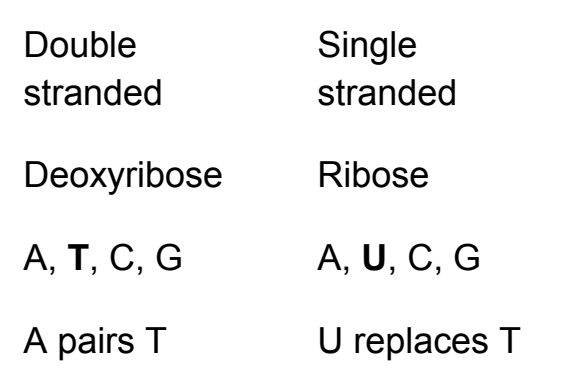
DNA vs. RNA Differences
DNA is double stranded with deoxyribose sugar and bases A, T, C, G (A pairs T); RNA is single stranded with ribose sugar and bases A, U, C, G (U replaces T).
Adenosine Triphosphate (ATP)
An energy molecule consisting of adenine, ribose, and three negatively charged phosphate groups that releases usable energy via ATP→ADP+P+energy.