A&P Lecture - Week 1 - Body Position and Transport Mechanisms

0.0(0)
Studied by 2 people
call kaiCall Kai
Locked
learnLearn
examPractice Test
spaced repetitionSpaced Repetition
heart puzzleMatch
flashcardsFlashcards
GameKnowt Play
Card Sorting

1/310

encourage image

There's no tags or description

Looks like no tags are added yet.

Last updated 10:27 PM on 9/21/26
Name
Mastery
Learn
Test
Matching
Spaced
Call with Kai
Chat

No analytics yet

Send a link to your students to track their progress

311 Terms

1
New cards

๐Ÿ”ฅ๐ŸŽฏ [S12] What is the difference between anatomy and physiology?

Anatomy = structure; physiology = function.

2
New cards

๐Ÿ”ฅ๐ŸŽฏ [S7/S12] According to Dr. Sigmon, which changes come first: anatomical or physiological changes?

Changes in anatomy occur first and lead to changes in physiology, not the other way around.

3
New cards

๐Ÿ”ฅ๐ŸŽฏ [S3โ€“5] Put the levels of organization in order from simplest to most complex.

Atom โ†’ molecule โ†’ macromolecule โ†’ organelle โ†’ cell โ†’ tissue โ†’ organ โ†’ organ system โ†’ organism.

4
New cards

[S4โ€“5] What are the key definitions from cell through organism?

Cell = basic living unit; tissue = group of cells functioning together; organ = group of tissues; organ system = group of organs functioning together; organism = organ systems functioning together.

5
New cards

๐Ÿ”ฅ [S7] What three major organizational features of the human body are emphasized in Lecture 1?

Cavities, membranes, and organ systems.

6
New cards

[S8] What is the appendicular portion of the body?

The upper and lower limbs.

7
New cards

[S8] What is the axial portion of the body?

The head, neck, and trunk.

8
New cards

๐Ÿ”ฅ [S8] What are viscera?

The organs contained within body cavities.

9
New cards

๐Ÿ”ฅ๐ŸŽฏ [S8โ€“9] What subdivisions make up the dorsal body cavity?

Cranial cavity and vertebral canal.

10
New cards

๐Ÿ”ฅ [S8โ€“9] What major structures are found in the dorsal cavity?

Brain in the cranial cavity and spinal cord in the vertebral canal.

11
New cards

๐Ÿ”ฅ๐ŸŽฏ [S8โ€“9] What subdivisions make up the ventral body cavity?

Thoracic cavity and abdominopelvic cavity.

12
New cards

๐Ÿ”ฅ [S9] What separates the thoracic cavity from the abdominopelvic cavity?

The diaphragm.

13
New cards

๐Ÿ”ฅ [S9] What is the mediastinum?

The central region of the thorax that divides it into right and left portions.

14
New cards

๐Ÿ”ฅ [S9] What are the two subdivisions of the abdominopelvic cavity?

Abdominal cavity and pelvic cavity.

15
New cards

โญ๐Ÿ”ฅ [S8โ€“9] In which body cavity is the urinary bladder located?

Pelvic cavity.

16
New cards

[S9] What smaller cavities are found within the head?

Oral cavity, nasal cavity, orbital cavities, and middle ear cavities.

17
New cards

๐Ÿ”ฅ๐ŸŽฏ [S10โ€“11] What is the general difference between a visceral and a parietal serous membrane?

Visceral membrane contacts/covers the organ; parietal membrane lines the cavity wall.

18
New cards

๐Ÿ”ฅ [S10] What is the relationship between parietal and visceral pleura?

Parietal pleura lines the thoracic cavity; visceral pleura covers the lungs.

19
New cards

๐Ÿ”ฅ [S10โ€“11] What is the relationship between parietal and visceral pericardium?

Visceral pericardium covers the heart; parietal pericardium forms the outer sac surrounding it.

20
New cards

โญ๐Ÿ”ฅ๐ŸŽฏ [S10] Which membrane covers an organ such as the intestine in the abdominopelvic cavity?

Visceral peritoneum.

21
New cards

๐Ÿ”ฅ [S10] What is the relationship between parietal and visceral peritoneum?

Parietal peritoneum lines the abdominopelvic cavity wall; visceral peritoneum covers the organs.

22
New cards

๐Ÿ”ฅ [S10โ€“11] What do serous membranes produce, and what is its purpose?

They produce a small amount of serous fluid that lubricates surfaces and reduces friction.

23
New cards

๐Ÿ–ผ๏ธ๐Ÿ”ฅ [S11] In the fist-in-a-balloon analogy, what represents the layer touching the heart and what represents the outer layer?

Layer touching the heart = visceral pericardium; outer layer = parietal pericardium; space between them = pericardial cavity.

24
New cards

๐ŸŽฏ [S13โ€“14] What is the overall function of the integumentary system?

Covers/encloses the body, contains many sensory receptors, and helps regulate body temperature.

25
New cards

๐ŸŽฏ [S14] What are the main functions of the skeletal and muscular systems?

Skeletal: supports the body and enables movement with muscles. Muscular: produces movement with the skeleton and helps maintain body temperature.

26
New cards

๐ŸŽฏ [S14] What are the main functions of the nervous and endocrine systems?

Nervous: detects/processes sensory information and activates responses. Endocrine: secretes hormones that regulate body processes.

27
New cards

๐ŸŽฏ [S14] What are the main functions of the cardiovascular and lymphatic systems?

Cardiovascular: delivers oxygen and nutrients to tissues and helps equalize body temperature. Lymphatic: returns fluid to the blood and defends against pathogens.

28
New cards

๐ŸŽฏ [S14] What are the main functions of the respiratory and digestive systems?

Respiratory: delivers oxygen to blood and removes carbon dioxide. Digestive: processes food and removes waste from undigested food.

29
New cards

๐ŸŽฏ [S14] What are the main functions of the urinary system?

Controls water balance and removes wastes from the blood for excretion.

30
New cards

๐ŸŽฏ [S14] What are the main functions of the male and female reproductive systems?

Both produce sex hormones and gametes; male delivers gametes to the female, while female supports the embryo/fetus and produces milk for the infant.

31
New cards

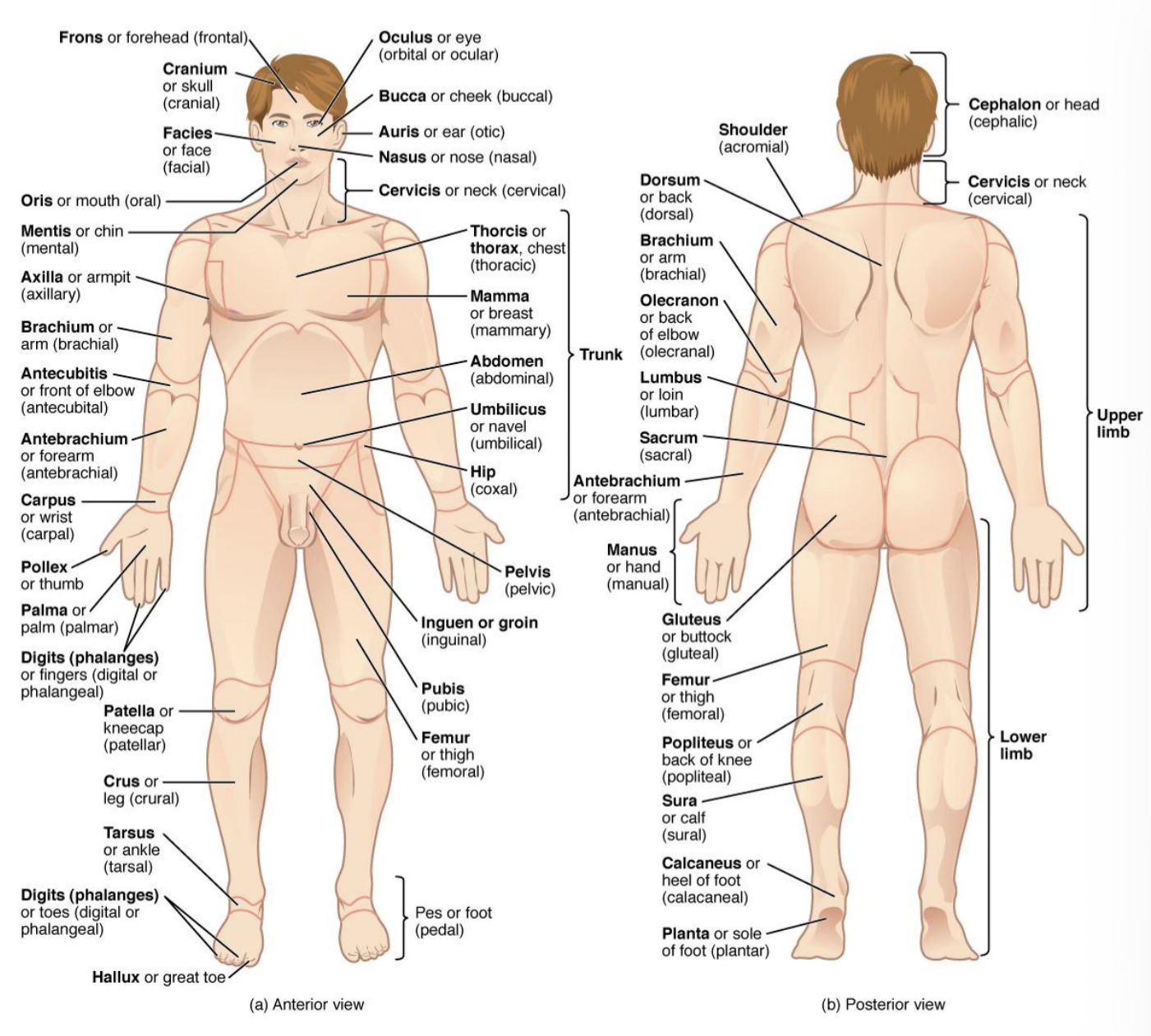
๐Ÿ–ผ๏ธ๐Ÿ”ฅ [S15] What is the anatomical position?

Standing upright with the body facing forward, feet forward, and palms facing outward/anteriorly.

32
New cards
<p><span><strong>Identify the indicated cavity and name a major organ found there</strong></span></p><p></p>

Identify the indicated cavity and name a major organ found there


knowt flashcard image
33
New cards
<p><span><strong>Identify A, B, and C. Which layer directly contacts the heart? </strong>Why serous fluid is present?</span></p><p></p>

Identify A, B, and C. Which layer directly contacts the heart? Why serous fluid is present?


To reduce friction


<p>To <span><strong>reduce friction</strong></span></p><p></p>
34
New cards
<p>Label the image</p>

Label the image

knowt flashcard image
35
New cards
<p>Label the image</p>

Label the image

knowt flashcard image
36
New cards
๐Ÿ”ฅ๐ŸŽฏ [S16] Why is anatomical position important?
It gives a universal reference point so everyone describes body parts in the same way.
37
New cards
๐Ÿ”ฅ๐ŸŽฏ [S16] What are the main pairs of terms of relative position?
Superior/inferior, anterior/posterior, medial/lateral, proximal/distal, superficial (peripheral)/deep, and ipsilateral/contralateral.
38
New cards
๐Ÿ”ฅ [S16โ€“17] What does superior mean?
Toward the head; above.
39
New cards
๐Ÿ”ฅ [S16โ€“17] What does inferior mean?
Away from the head; below.
40
New cards
๐Ÿ”ฅ [S16โ€“17] What does anterior (ventral) mean?
Toward the front of the body.
41
New cards
๐Ÿ”ฅ [S16โ€“17] What does posterior (dorsal) mean?
Toward the back of the body.
42
New cards
๐Ÿ”ฅ [S16โ€“17] What does medial mean?
Toward the midline of the body.
43
New cards
๐Ÿ”ฅ [S16โ€“17] What does lateral mean?
Away from the midline of the body.
44
New cards
โญ๐Ÿ”ฅ [S16โ€“17] What does proximal mean?
Closer to the trunk or point of origin.
45
New cards
โญ๐Ÿ”ฅ [S16โ€“17] What does distal mean?
Farther from the trunk or point of origin.
46
New cards
๐Ÿ”ฅ [S16] What does superficial (peripheral) mean?
Toward or at the body surface.
47
New cards
๐Ÿ”ฅ [S16] What does deep mean?
Away from the body surface; more internal.
48
New cards
๐Ÿ”ฅ [S16] What does ipsilateral mean?
On the same side of the body.
49
New cards
๐Ÿ”ฅ [S16] What does contralateral mean?
On opposite sides of the body.
50
New cards
๐ŸŽฏ [S17] What do cranial and caudal mean?
Cranial = toward the head; caudal = toward the tail/butt/inferior end.
51
New cards
๐Ÿ”ฅ๐Ÿ–ผ๏ธ [S18] What does palmar mean?
The palm side of the hand.
52
New cards
๐Ÿ”ฅ๐Ÿ–ผ๏ธ [S18] What does dorsal mean when referring to the hand?
The back side of the hand.
53
New cards
โญ๐Ÿ”ฅ๐Ÿ–ผ๏ธ [S18] What does supine mean?
Lying on the back, face upward.
54
New cards
๐Ÿ”ฅ๐Ÿ–ผ๏ธ [S18] What does prone mean?
Lying on the stomach, face downward.
55
New cards
๐Ÿ”ฅ๐Ÿ–ผ๏ธ [S18] What does right lateral recumbent mean?
Lying on the right side.
56
New cards
๐Ÿ”ฅ๐Ÿ–ผ๏ธ [S18] What does left lateral recumbent mean?
Lying on the left side.
57
New cards
โญ๐Ÿ”ฅ [S19] The thoracic cavity is ______ to the abdominal cavity.
Superior.
58
New cards
๐Ÿ”ฅ [S19] The neck is ______ to the head.
Inferior.
59
New cards
๐Ÿ”ฅ [S19] The eyes are ______ to the brain.
Anterior.
60
New cards
๐Ÿ”ฅ [S19] The nose is ______ to the eyes.
Medial.
61
New cards
โญ๐Ÿ”ฅ [S19] The elbow is ______ to the wrist.
Proximal.
62
New cards
๐Ÿ”ฅ [S19] The ears are ______ to the eyes.
Lateral.
63
New cards
๐Ÿ”ฅ [S19] The fingers are ______ to the wrist.
Distal.
64
New cards
โญ๐Ÿ”ฅ๐ŸŽฏ [S20โ€“21] What is a sagittal section?
A section that divides the body into right and left portions.
65
New cards
๐ŸŽฏ [S20 + lecture] What is a parasagittal section?
A sagittal cut that is off-center, not exactly down the midline.
66
New cards
โญ๐Ÿ”ฅ๐ŸŽฏ [S20โ€“21] What is a transverse section?
A section that divides the body into superior and inferior portions; a cross section.
67
New cards
๐Ÿ”ฅ๐ŸŽฏ [S20โ€“21] What is a coronal (frontal) section?
A section that divides the body into anterior and posterior portions.
68
New cards
๐Ÿ”ฅ๐ŸŽฏ [S22] How can the abdominal area be divided?
Into 9 abdominopelvic regions and 4 quadrants.
69
New cards
๐Ÿ”ฅ๐Ÿ–ผ๏ธ [S22] What are the 9 abdominopelvic regions?
Right hypochondriac, epigastric, left hypochondriac, right lumbar, umbilical, left lumbar, right iliac (inguinal), hypogastric, left iliac (inguinal).
70
New cards
๐Ÿ”ฅ๐Ÿ–ผ๏ธ [S22] What are the 4 abdominopelvic quadrants?
Right upper quadrant (RUQ), left upper quadrant (LUQ), right lower quadrant (RLQ), left lower quadrant (LLQ).
71
New cards
โญ๐Ÿ”ฅ๐ŸŽฏ [S23] What organs are commonly found in the right hypochondriac region?
Liver, gallbladder, right kidney, and part of the small intestine.
72
New cards
๐Ÿ”ฅ [S23] What organs are commonly found in the left hypochondriac region?
Spleen, left kidney, pancreas, and part of the colon.
73
New cards
๐Ÿ”ฅ [S23] What organs are commonly found in the epigastric region?
Stomach, liver, pancreas, duodenum, spleen, and adrenal glands.
74
New cards
๐Ÿ”ฅ [S23] What organs are commonly found in the right lumbar region?
Right colon, liver, and gallbladder.
75
New cards
๐Ÿ”ฅ [S23] What organs are commonly found in the left lumbar region?
Left kidney and descending colon.
76
New cards
๐Ÿ”ฅ [S24] What organs are commonly found in the umbilical region?
Duodenum, jejunum, ileum, and the umbilicus.
77
New cards
๐Ÿ”ฅ [S24] What organs are commonly found in the right iliac fossa (right inguinal region)?
Cecum and appendix.
78
New cards
๐Ÿ”ฅ [S24] What organs are commonly found in the left iliac fossa (left inguinal region)?
Sigmoid colon and descending colon.
79
New cards
๐Ÿ”ฅ๐ŸŽฏ [S24] What organs are commonly found in the hypogastrium?
Urinary bladder, sigmoid colon, and female reproductive organs.
80
New cards
๐Ÿ”ฅ๐ŸŽฏ [S25] What are the main functions of cell membranes in this lecture?
They separate intracellular fluid (ICF) from extracellular fluid (ECF), allow exchange between them, and are selectively permeable.
81
New cards
๐Ÿ”ฅ [S25] What does selectively permeable mean?
The membrane allows some substances to cross more easily than others.
82
New cards
๐Ÿ”ฅ๐ŸŽฏ [S26] Which types of molecules cross the membrane easily?
Nonpolar molecules.
83
New cards
๐Ÿ”ฅ [S26] Give examples of nonpolar molecules that cross the membrane easily.
O2, CO2, and fatty acids.
84
New cards
โญ๐Ÿ”ฅ๐ŸŽฏ [S26] Which substances do NOT normally cross the lipid bilayer easily on their own?
Ions and polar molecules.
85
New cards
๐Ÿ”ฅ [S26] Give examples of ions/polar molecules that usually need help crossing the membrane.
Glucose, proteins, and Na+.
86
New cards
๐ŸŽฏ [S27] Under normal conditions, which ion is higher inside the cell: Na+ or K+?
K+ is much higher inside the cell.
87
New cards
๐ŸŽฏ [S27] Under normal conditions, which ion is higher outside the cell: Na+ or K+?
Na+ is much higher outside the cell.
88
New cards
๐ŸŽฏ [S27] Under normal conditions, are protein and phosphate generally higher inside or outside the cell?
Inside the cell.
89
New cards
๐ŸŽฏ [S27] Under normal conditions, are Ca2+ and Clโˆ’ generally higher inside or outside the cell?
Outside the cell.
90
New cards
๐ŸŽฏ [S27 + lecture] What important comparison did Dr. Sigmon emphasize about ICF vs ECF?
Individual ion concentrations differ between ICF and ECF, but total solute concentration is normally equal overall.
91
New cards
โญ๐Ÿ”ฅ๐ŸŽฏ [S28] What is passive transport?
Spontaneous downhill movement of substances.
92
New cards
๐Ÿ”ฅ [S28] What is active transport?
Non-spontaneous uphill movement of substances.
93
New cards
๐Ÿ”ฅ๐ŸŽฏ [S29] What two forces determine the direction of transport?
Chemical forces and electrical forces.
94
New cards
๐Ÿ”ฅ๐ŸŽฏ [S29] What is the electrochemical force (electrochemical gradient)?
The combined effect of the chemical and electrical forces on ion movement.
95
New cards
๐Ÿ”ฅ [S29] In passive movement, substances move in what direction relative to the force?
Down the force.
96
New cards
๐Ÿ”ฅ [S29] In active movement, substances move in what direction relative to the force?
Against the force.
97
New cards
๐Ÿ”ฅ๐ŸŽฏ [S30] What is a concentration gradient (ฮ”C)?
The difference in particle concentration between the inside and outside of the cell.
98
New cards
๐Ÿ”ฅ [S30] How does the chemical driving force move particles?
From higher concentration to lower concentration.
99
New cards
๐Ÿ”ฅ [S30] What is the direction of chemical driving force?
Down the chemical gradient.
100
New cards
๐ŸŽฏ [S30 + lecture] When does movement due to a chemical gradient stop?
When equilibrium is reached.