BIO 203 Q2
 Call Kai
 Learn
Learn Practice Test
 Spaced Repetition
 Match
Match Flashcards
 Knowt Play
1/45

There's no tags or description
Looks like no tags are added yet.
Name | Mastery | Learn | Test | Matching | Spaced | Call with Kai | Chat |
|---|
No analytics yet
Send a link to your students to track their progress
46 Terms
Haploinsufficient
A wild-type allele that is unable to support wild-type function in a heterozygous genotype. Classified as a recessive wild-type allele.
Wild type allele is recessive to the mutant allele
Heterozygote has the mutant phenotype
Haplosufficient
one copy of an allele is sufficient to produce the wild-type phenotype in the heterozygous genotype
Type of dominant wild-type allele
Both homozygous dominant and heterozygous can produce the wild-type phenotype
Null allele
A mutant that produces no functional product. Most commonly a recessive allele. Also known as amorphic mutation
Loss of function
Hypomorphic
A mutant whose phenotype is similar to, but less than, the wild-type phenotype
Leaky mutant allele
Usually recessive
Loss of function
Hypermorphic
A mutant whose phenotype is similar to, but greater than, the wild-type phenotype
Excessive gene product -> excessive gene action
Gain of function
Neomorphic
A mutant expressing a new or novel function not seen in the wild type
In both homozygous and heterzygous but may be more extreme in homozygotes
Gain of function
Dominant negative
A dominant mutation that behaves as a loss-of-function, often due to blocking the formation or normal function of a multimeric protein complex
Multimeric protein: protein composed of two or more polypeptides
Spolider effect on the protein as a whole
Loss of function
Incomplete Dominance
The observation that the phenotype occurring in heterozygous organisms is intermediate between the phenotypes of homozygous organisms, but more similar to one homozygous phenotype than to the other. Also known as partial dominance
Codominance
The equal and detectable expression of both alleles in a heterozygous organism
Loss of function mutation
A mutant that prevents the production of the wild-type protein or renders it inactive. Most commonly a recessive mutation
Gain of function mutation
A mutation causing a gene to be overexpressed, to be expressed at the wrong time, or to encode a constitutively acting protein; usually inherited as a dominant mutation
Lethal alleles
An allele that results in the premature death of the organisms that carry it. Lethality most often affects homozygous organisms.
In low frequencies in populations
Raly and Agouti example in yellow mice
Temperature sensitive allele
A mutation evident only at or above a certain temperature due to an abnormality of the protein product that affects its stability.
Protein misfolds and losses function at higher temperature
Functional at permissive temperature, not function at non-permissive temperature, and intermediate activity at various temperatures
Prototroph
wild type, makes all its required nutrients
Auxotroph
mutant that lacks the ability to make one or more nutrients
Can’t grow on minimal media
Epistasis
When one phenotype masks the expression of another phenotype
Genes interact which results in altered phenotypic ratios
Types of epistasis
No genetic interaction- 9:3:3:1
Complementary- 9:7
Duplicate- 15:1
Dominant- 9:6:1
Recessive epistasis- 9:3:4
Dominant epistasis- 12:3:1
Dominant suppression- 13:3
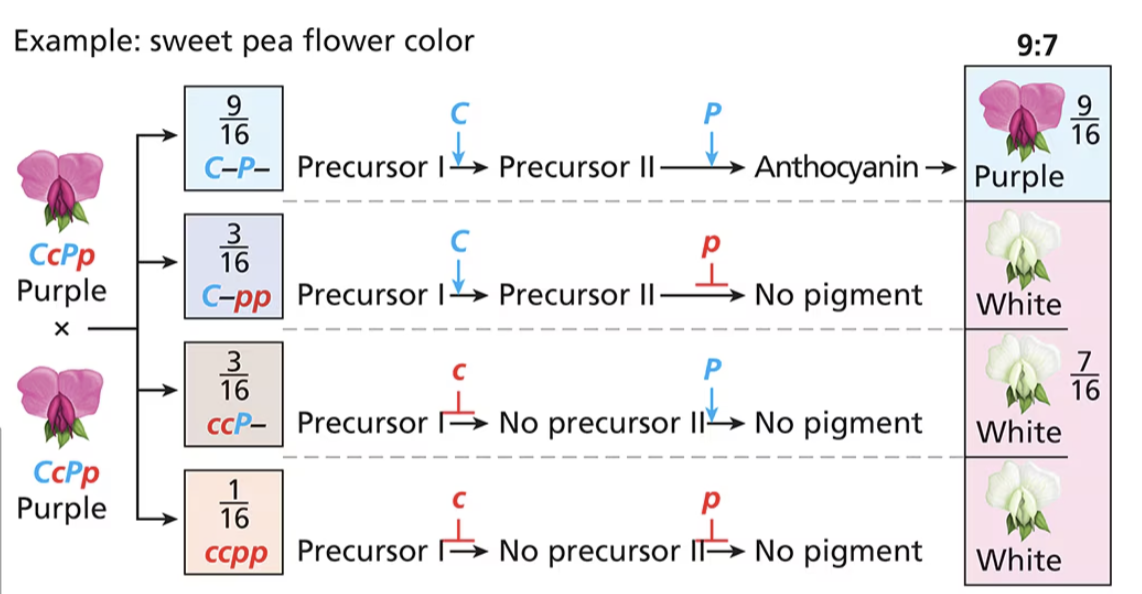
Complementary gene interaction
wild type action from both genes is required for the dominant phenotype
9:7
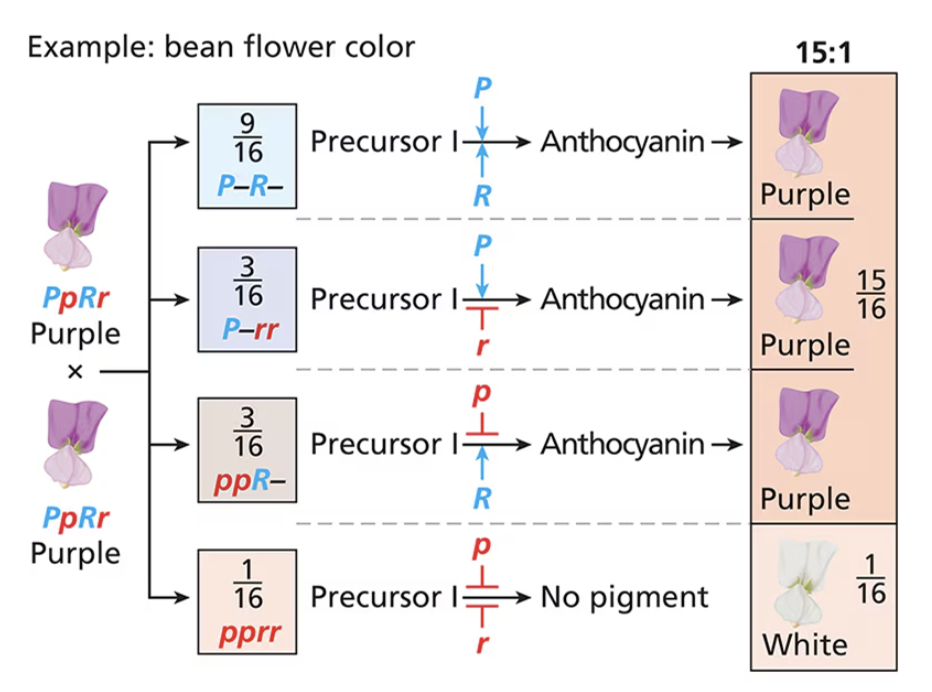
Duplicate gene action
any wild type action creates the dominant phenotype
15:1
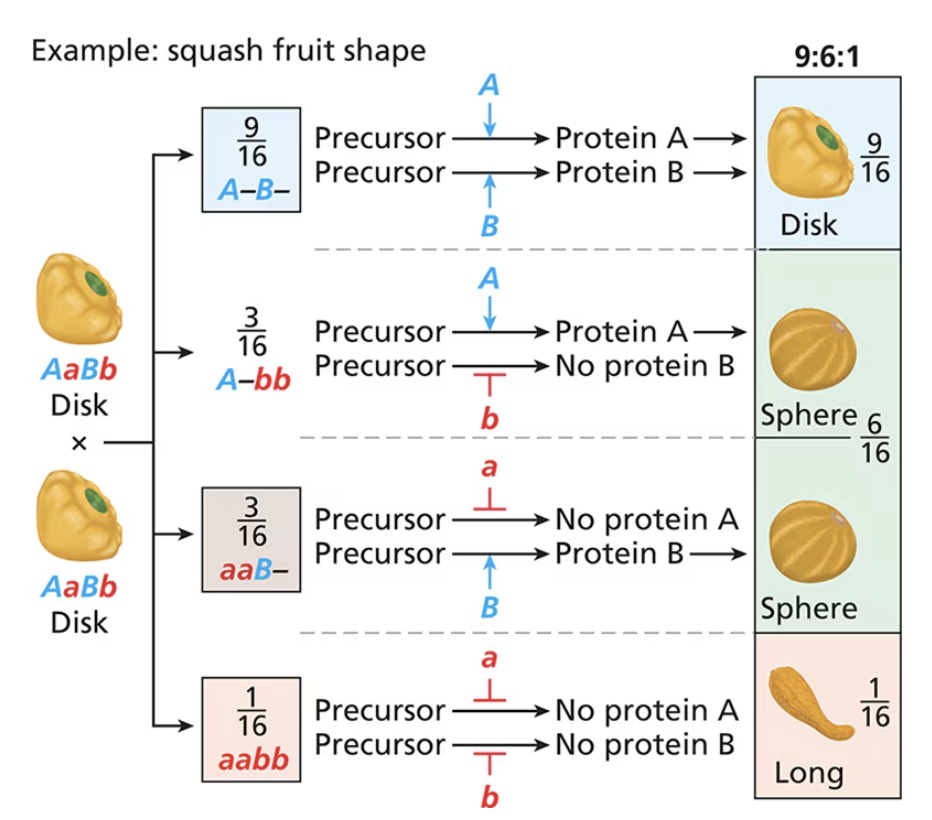
Dominant gene interaction
different phenotype for homozygous dominant, homozygous recessive, and heterozygotes
9:6:1
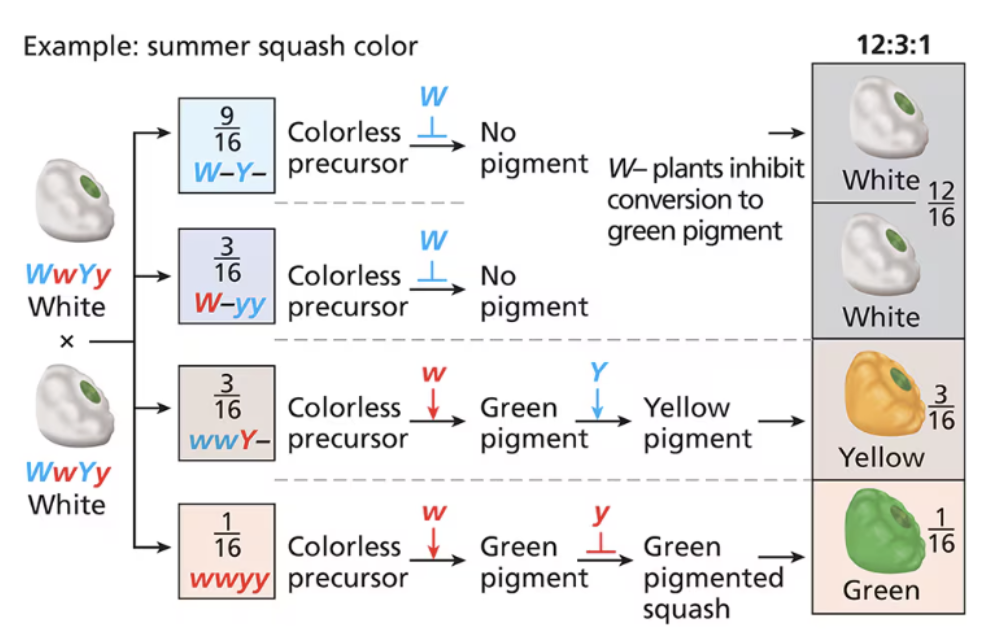
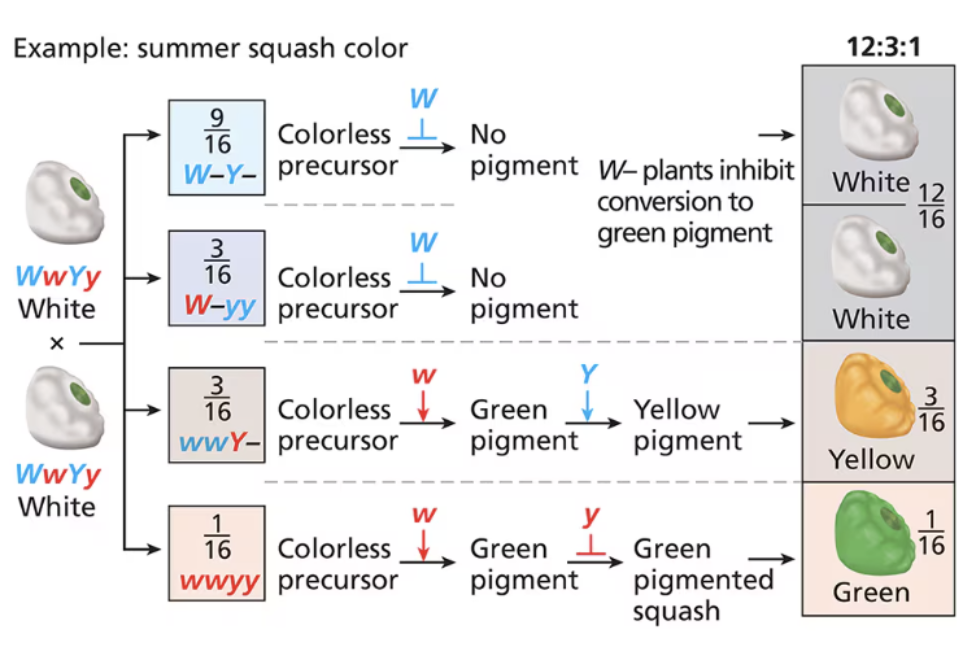
Dominant epistasis
A characteristic ratio of phenotypes produced by the interaction of two genes that control a trait in which a dominant allele of one gene masks or reduces the expression of alleles of a second gene
12:3:1
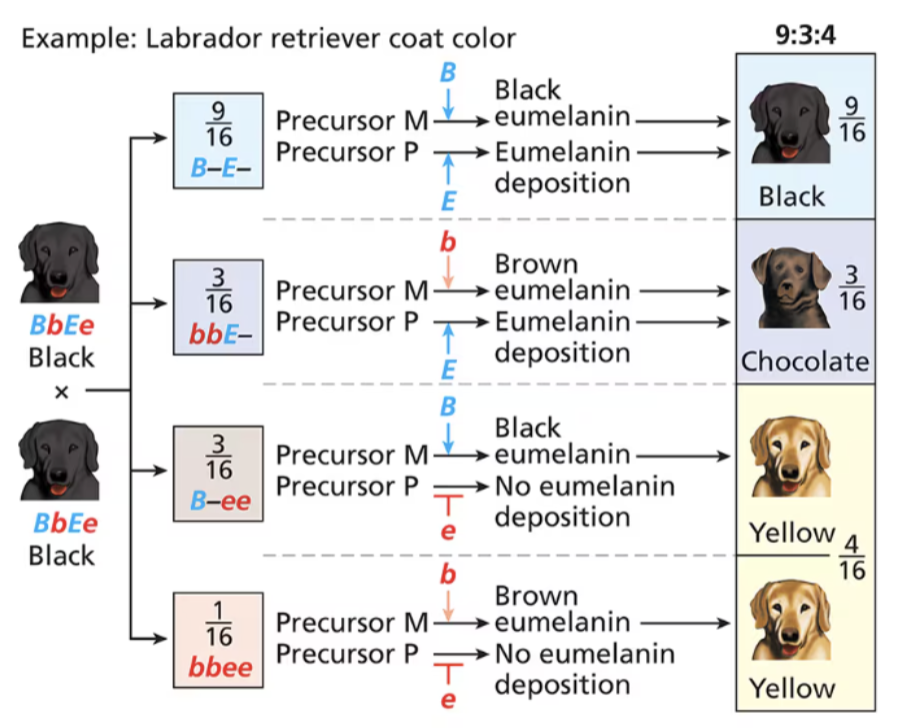
Recessive epistasis
A characteristic ratio of phenotypes produced by the interaction of two genes that control a trait in which alleles of one gene mask or reduce the expression of alleles of a second gene
9:3:4
Dominant suppression
the dominant allele of the first gene suppresses the expression of the second gene
13:3
Pathway
An ordered progression of gene activities that leads to a biological output
Complementation group
A group of mutations that affect the same gene
Complementation means two mutants are deficient in different functions
Failure to complement means two mutants are deficient in the same function - form a complementation group
Replica plate
A process in yeast or bacteria where some of the cells on one plate are transferred to another plate
Genetic dissection
separately test the ability of a mutant to execute each step of a biosynthetic pathway and use this data to assemble the steps of a pathway by determining the point at which the pathway is blocked in each mutant
One gene-one enzyme hypothesis
each gene produces an enzyme and each enzyme has a specific role in a biosynthetic pathway
Updated to include genes that produce transport/structural/regulatory proteins, RNAs, and proteins that join together
Screen
A process where mutants are identified out of large numbers of wild-type individuals after mutagenesis
Selection
A process where mutants are identified without any accompanying wild-type individuals after mutagenesis
Mutagenesis
When a mutagen is applied to organisms and mutations occur throughout the genomes of gametes and somatic cells
Mutagen
Any substance or DNA element that causes a mutation to the genome
Balancer chromosome
A chromosome with multiple inversions, an allele that confers a dominant phenotype, and a different allele that confers recessive lethality
Inverted segments prevent crossing over
Lethality prevents being homozygous for the balancer
Dominant mutation producing a visible phenotype so it can be tracked
Cloning by Complementation
Transformation of the mutant organism with plasmids expressing genes. Organisms whose phenotype is restored to wildtype (complemented) contain a plasmid with a wildtype version of the gene. The plasmid can be isolated and sequenced to identify the gene.
Whole-genome sequencing
Often, short-read sequencing of entire genomes from mutants and the wild-type strain to identify mutations
Transgenic
Organism that contains genetic material that was inserted by a scientists (generated in the lab outside the animal or in vitro); many times refers to expression of genes from a different organism.
CRISPR
(Clustered Regularly Interspaced Short Palindromic Repeats) Transcribed repetitive sequence that is processed into unique crRNAs acting in a bacterial or archaeal immune system.
Can be NHEJ or HR (CRISPR-Cas9)
CRISPR-Cas9
Complex of the Cas9 protein with tracrRNA and crRNA that acts to target invading nucleic acids in Staphylococcus. This system has been modified for use in gene editing.
Uses homologous recombination to add desired nucleotides
crRNA
Unique small RNAs derived from CRISPR loci that combine through complementary base pairing with tracrRNAs in the CRISPR-Cas complex.
RNAi
RNA interference, knockdown of gene expression using endogenous RNAse machinery
Forward genetics
generate random mutations and identify gene sequence
What no longer happens in the cell with the KO is the function of the gene
Reverse genetics
directed KO/KD based on what we know about other organisms
What no longer happens in the cell with the KO is the function of the gene
RNAi, CRISPR, HR
Synonymous mutation
no amino acid change, silent
Nonsynonymous
amino acid change, missense
Read-through mutation
conversion of a stop codon to an amino acid
Nonsense mutation
conversion to a stop codon