SBP Exam 1
 Call Kai
 Learn
Learn Practice Test
 Spaced Repetition
 Match
Match Flashcards
 Knowt Play
1/107

There's no tags or description
Looks like no tags are added yet.
Name | Mastery | Learn | Test | Matching | Spaced | Call with Kai | Chat |
|---|
No analytics yet
Send a link to your students to track their progress
108 Terms
Trees are ______ organisms.
complex
A tree is generall defined as a woody plant ____-____ft or more in height and characterized by a ____ ____ rather than several stems.
15-20, single trunk
Woods are divided into two broad categories: ________ and ______.
hardwoods, softwoods
_________ are in the subdivision angiospermae.
hardwoods
_____ are in the gymnospermae subdivision.
softwoods
_________ are characterized by the production of seeds within ovaries.
angiosperms
__________ produce seeds that lack a covering layer.
gymnosperms
Softwoods are characterized by their _____-like leaves.
needle
Hardwoods are characterized by their _____ leaves.
broad
(Considering hardwoods and softwoods) The ____ of cells, their ______ _____, and their _______ are different, the fundemental difference being that hardwoods contain a type of cell called a ____ _____.
type, relative number, arrangement, vessel element
Hardwoods are classified as ___-porous or ___-porous, depending upon the size and distribution of vessels in a cross-section.
ring, diffuse
Woods that form very large-diameter vessels part of a year and smaller ones thereafter are called ___-____.
ring-porous
Woods that form vessels of the same size throughout the year are classified as ____-_______.
diffuse-porous
Hardwoods are not necessarily ___. Softwoods are not necessarily ____.
hard, soft
Hardwood growing stock globally has been estimated to exist in volumes almost _____ that of softwoods.
double
North America, Russia, and Europe account for over ___% of the world’s softwood forests.
92
In the US, about ____ wood-producing and commercially important species reach tree size; only about ___ of those are softwoods.
100, 35
To a certain age, trees are ables to _____ themselves.
heal
(Autotrophs or Heterotrops)
Do not possess the ability to manufacture their own food
Get necessary organic nutrients from outside sources
heterotrophs
(Autotrophs or Heterotrops)
produce food/energy directly from the sun
absorb solar energy and converty it into glucose through a complex process called photosynthesis
extremely important for the environment
autotrophs
The majority of a tree’s weight (58.2%) lies in the _____.
trunk
Angiosperms (hardwoods) are brroken into two orders: _____ and _______.
monocots, dicots
(In the US) ______ dominated the forests of the deep South, far North, and the mountains of the West.
softwoods
(In the US) ______ occur across every major region of the US. However, they are dominant in the East, across the plains (central region) and in the VALLEYS of the Western mountains.
hardwoods
Hardwoods are mostly _____.
dicots
Though _______ like palm trees and bamboo are technically classified under hardwoods, they aren’t usually recognized as such.
monocots
Across the world, wood producing species exceed ________.
10,000
______ transfers water and nutrients from the _____ upward.
xylem, roots
______ tranfers glucose from the ____ downwards.
phloem, leaves
Each year, a new _____ ______ is created that increases the diameter of the tree— which allows it to heal injuries on the previous layer.
vascular cambium
If the tree doesn’t have a _____ ______, so no xylem, it will reach maximum size and stop repairing itself.
vascular cambium
The vascular cambium is made up of _____.
xylem
Trees are _____, which means they grow in all directions.
anisotropic
_________ cells, like Lumen, are long, thin, and hollow with perforated openings down the long sides.
tracheids
_______ cells are long, thin, and hollow with perforated openings.
lumen
Softwoods are mostly composed of ____ cells.
lumen
______, which are composed of a number of individual (blank) cells, provide for horizontal movement of substances in standing trees.
rays
A _______ cut is formed by cutting lumber long ways.
transverse
A __________ cut is made by cutting longitudinally along the radius (front the center).
radial
A ______ cut is made by cutting perpendicularly along the radius or tangent to the growth ring.
tangental
The layer between the xylem and phloem is called the _______.
cambium
The _______ is a thin sheath that forms a continuous layer throughout the entirety of the tree.
cambium
_______ provide horizontal movement within the tree.
rays
The regions in which cells divide repeatedly to form new cells are called ________ regions.
meristematic
The _____ ____ zone at the apex of the main stem growth zone is of special signficance because it controls, to some extent, the development of branches and its shoots.
apical meristem
The _____, or inner bark, is composed of one layer of cells that have thick, wax-covered outer walls serving as protection from moisture loss.
epidermis
During stem development in a seedling, cells change size and shape to eventually form an unbroken ring around the stem center. The tree will eventually outgrow this layer.. but it is called the ___________.
procambium
The inner layer of the procambium will turn into ____ _______.
primary xylem
The outer layer of the procambium will turn into ________ ______.
primary phloem
The ______ _______ is the final step in stem development that the procambium develops into.
vascular cambium
The xylem and phloem that the vascular cambium creates is correctly called ______ xylem and _____ phloem.
secondary
Cell division parallel to the stem surface (tangentally) results in either xylem or phloem that experiences _________ division.
periclinal
Cell division that happens along the radial axis of the stem is called ________ division.
anticlinal
The first thing to develop in the stem is the _____.
pith
______ is cells that are produced early in the year (Spring).
earlywood
________ is cells that are produced late in the year (Summer).
latewood
Earlywood forms when there is a ______ of water.
deficit
Latewood forms when there is a ______ of water.
wealth
Manufactured wood has three distinct surfaces (similar to natural wood): _____, ______, and ________.
radial, tangental, longitudinal
When the grain is perpendicular to the cut, it is ______.
radial
When the grain is parallel to the cut, it is ________.
tangental
When the you can see the arch of the rings in the cut, it is _____/______.
longitudinal/transverse

This cut is ______ sawn.
plain
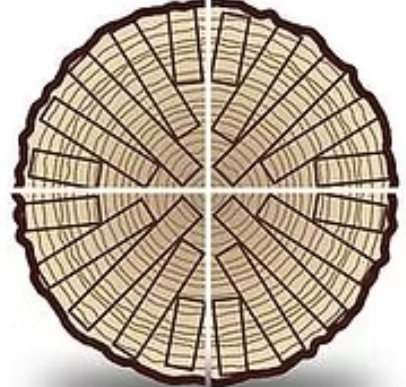
This cut is _____ sawn.
rift

This cut is ____ sawn.
quarter
In heartwood, cells are ____.
dead
In sapwood, cells are ____.
alive
Earlywood creates ____ rings, while latewood creates ____ rings.
lighter, darker
Earlywood has large pores make up of ____ ____.
big lumen
Latewood has tiny pores made up of _____ ____.
small lumen
The transition to latewood growth in the US is approximately ___ __.
July 6
________ growth is when an annual ring is not completed or false— likely due to wildfire damage, disease, or strange weather.
discontinuous
Heartwood begins to form in trees about ___-___ years old.
14-18
Many polyphenolic compounds in wood are easily removable, called _____.
extractives
Heartwood tends to be darker in color and often _____ resistant, though it is difficult to dry and chemically treat.
decay
____ are more visible in heartwood.
rays
Rays are _______ orientented planes of ______.
radially, weakness
Rays may be ___cellular or _____cellular.
homo, hetero
Rays may be ___, ____, or clustered together (_____).
narrow, wide, aggregate
Grain can have three main orientations: ____, _____, and ______.
straight, spiral, reverse spiral (interlocked)
______ grain orientation is typically preferred in lumber manufacturing.
straight
_____ are classified as a defect and are formed by branch growth.
knots
A ____ knot is a knot without any indicators of decay.
sound
An ____ knot has decay indicators around the outside and is still surrounded by healthy wood.
enclosed
An _____ knot has extreme decay indicators on the inner and outer rings.
unsound
The three major elements in wood are: ______, _______, and _______.
carbon, hydrogen, oxygen
The three chemical components of wood are: _____, _______, and ______.
cellulose, hemicellulose, lignin
_______ is a polysaccharide made only of glucose.
cellulose
_______ is a polysaccharide made up of a few types of sugars.
hemicellulose
____ is not a polysaccharide and is primarily alcohols.
lignin
Hardwoods and softwoods have different concentrations of _____ and _____.
hemicellulose, lignin

_______ is a long, linear chain of glucose units with beta linkage.
cellulose
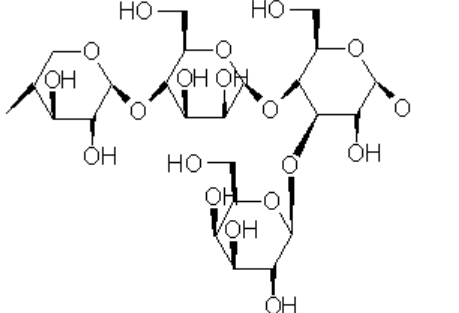
______ is a branch-style component made up of xylose, mannose, glucose, and galactose.
hemicellulose

_____ is a 3D structure of p-coumeryl alcohol, coniferyl alcohol, and sinapyl alcohol.
lignin
_________ ties the cellulose and lignin together so there’s no weak fractures—- strengthens the chemical bonds between them.
hemicellulose
________requires extremely high heat and high pressure conditions to transform from crystalline to amorphous.
cellulose
________ requires medium heat to transform from crystalline to amorphous.
starch
________ is extremely complex and only very few organisms can decay it.
lignin
_______’s main function is to bind cells and add rigidity to their structures.
lignin
Lignin has two main types: ______ and _______-____.
guaiacyl, guaiacyl-syringil