7 Parameters
 Call Kai
 Learn
Learn Practice Test
 Spaced Repetition
 Match
Match Flashcards
 Knowt Play
1/46

There's no tags or description
Looks like no tags are added yet.
Name | Mastery | Learn | Test | Matching | Spaced | Call with Kai | Chat |
|---|
No analytics yet
Send a link to your students to track their progress
47 Terms
Parameters
describe features of a sound wave.
The 7 Parameters
Period
Frequency
Amplitude
Power
Intensity
Wavelength
Speed
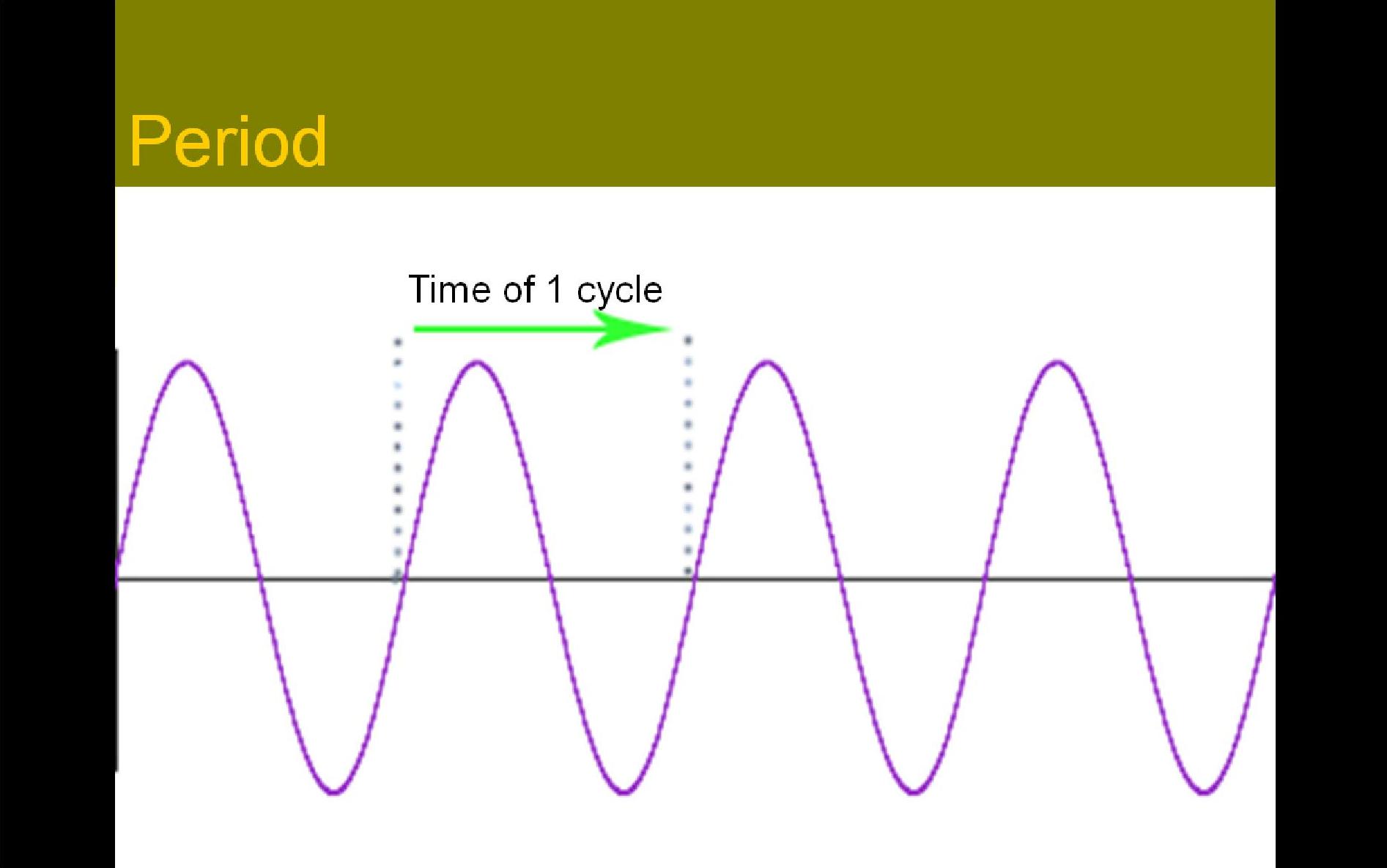
Period
The time it takes a wave to vibrate a single cycle, or the time from the start of one cycle to the start of the next cycle.
Period Units
Reported in units of time, such as microseconds (us), seconds, hours, or days.
Typical values of period
0.06 to 0.5 microseconds (us)
Period source is determined by:
Sound source only
Frequency
The number of particular events that occur in a specific duration of time.
Frequency units
Reported in units of per second, 1/second, hertz, or Hz. Hertz is another way to say “per second.”
Typical values of frequency
2 MHz to 15 MHz (in other words: 2 million to 15 million per second).
Frequency is determined by
Sound source only
Is Frequency adjustable?
No.
Infrasound
less than 20 Hz
Audible sound
Between 20 Hz and 20 kHz
Ultrasound
Greater than 20 kHz (sounds with frequencies so high humans cannot hear it).
Three “Bigness” Parameters
Three parameters describe the size, magnitude, or strength of the sound wave.
The three bigness parameters listed
Amplitude
Power
Intensity
Amplitude
The “bigness” of a wave. It is the difference between the maximum value and the average or undisturbed value of an acoustic variable.
Also the difference between the minimum value and the average value of the acoustic variable.
Amplitude units
Can have units of any of the acoustic variables and can be expressed in decibels (dB).
Amplitude typical values
ranges from 1 million pascals (1 MPa) to 3 million pascals (3 MPa)
Amplitude determined by
only by the sound source. However, it decreases as sound propagates through the body. The rate at which it decreases depends on the characteristics of both the sound wave and the medium.
Is the amplitude adjustable?
Yes, a control on a basic ultrasound system allows the sonographer to alter initial amplitude of a wave.
More about amplitude
it is measured from the middle, or undisturbed, value to the maximum value
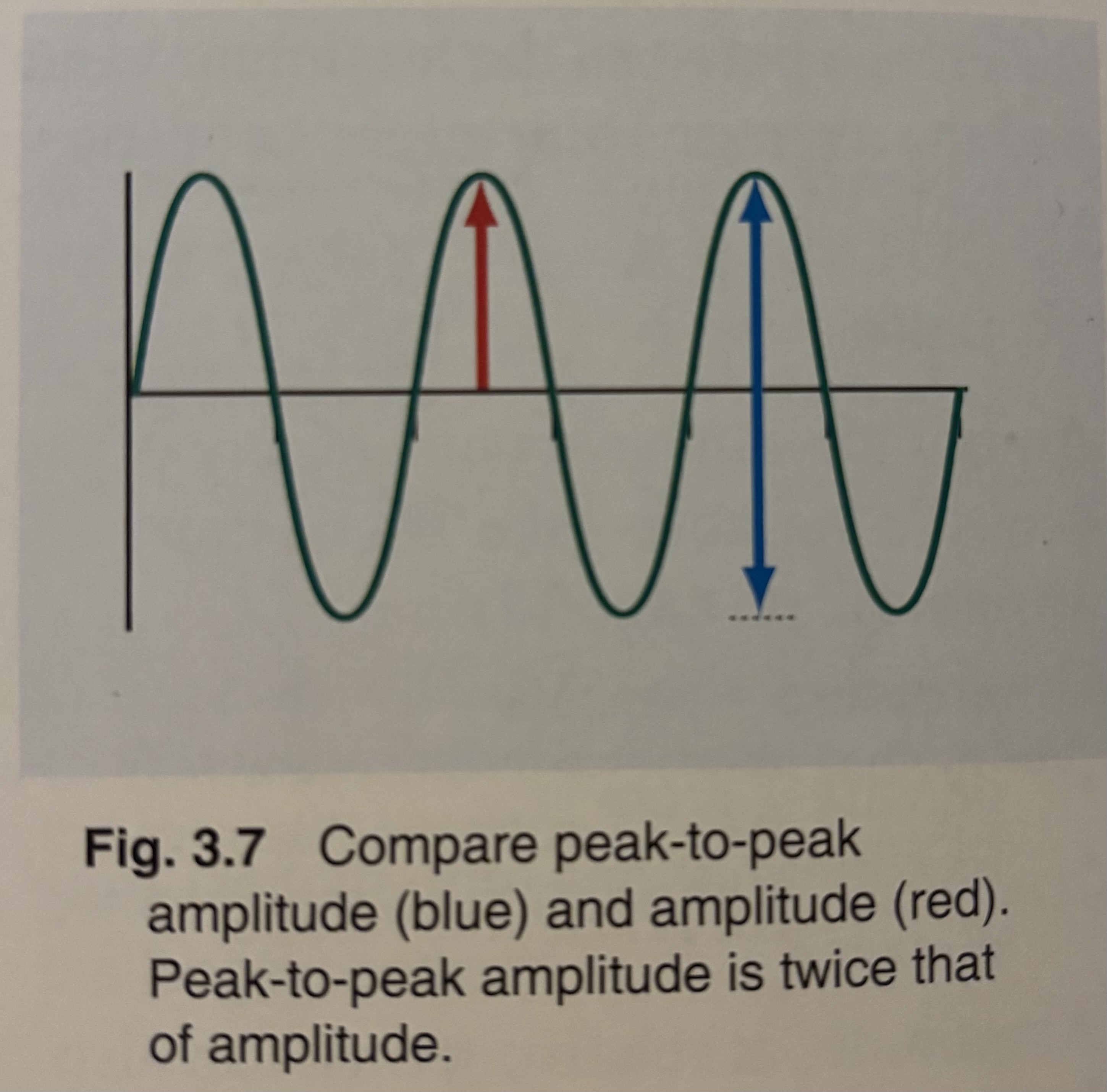
Peak-to-peak amplitude
The difference between the maximum and the minimum values of an acoustic variable. (it is twice the value of the amplitude)
Power
the rate of energy transfer or the rate at which work is performed. Also describes the “bigness” of a wave.
Power Units
has units of watts
Power typical values
range from 0.004 to 0.090 watts (4 to 90 milliwatts) depending on the diagnostic ultrasound technique.
Power determined by
Just like amplitude, initial power is determined by the sound source, the ultrasound system. It decreases as sound propagates through the body, the rate at which it decreases depends on the characteristic of the sound wave and medium.
Is power adjustable?
Yes, it can be changed.
How are amplitude and power related?
Both amplitude and power are parameters that describe the size, or magnitude of a wave. When power increases, so does amplitude. Similarly, when power decreases, amplitude decreases.
Mathematically power is..
proportional to the wave’s amplitude squared.
Intensity
The concentration of energy in a sound beam. Also describes the “bigness” of a wave. Relates to how the power in a wave spreads or is distributed in space. It depends on both the power in the beam and the area over which the power is applied.
Intensity Units
The units are watts/square centimeter, or W/cm2 (watts from power and cm2 from beam area.)
Intensity typical values
Intensity ranges from 0.01 to 300 W/cm2
Intensity determined by
only the sound source (the ultrasound system). It changes as teh sound propagates through the body. The rate at which it changes depends on the characteristics of both sound wave and the medium.
Is intensity adjustable?
Yes, it is adjustable.
Relationship between intensity and power
Intensity is proportional to power, so when a wave’s power is doubled, quartered, etc, the intensity is also doubled/quartered.
Relationship between intensity and amplitude
Intensity is proportional to the wave’s amplitude squared. When a wave’s amplitude is doubled, the intensity increases to four times its original value.
Wavelength
The distance or length of one complete cycle.
Wavelength Units
measured in units of mm, meters, or any other unit of length.
Wavelength typical values
in soft tissues it ranges from 0.1 to 0.8mm
Wavelength determined by
BOTH the source and the medium.(only parameter that is determined by both).
Is wavelength adjustable?
No, it is not.
Propagation speed
the rate at which a soundwave travels through a medium
Propagation speed units
measured in units of meters per second, mm/us, or any distance divided by time.
Propagation speed typical values
The speed of sound ranges from 500 m/s to 4000 m/s depending on the tissue through which its traveling.
Propagation speed determined by
only parameter determined by the medium through which the sound is traveling. Regardless of frequency, all speed travels at the same speed through any specific medium.
is speed adjustable?
No. It only changes when the wave travels from one medium to a different medium.