Summer '26 Finals Full OP Deck
 Call Kai
 Learn
Learn Practice Test
 Spaced Repetition
 Match
Match Flashcards
 Knowt Play
1/423

There's no tags or description
Looks like no tags are added yet.
Name | Mastery | Learn | Test | Matching | Spaced | Call with Kai | Chat |
|---|
No analytics yet
Send a link to your students to track their progress
424 Terms
Origin of serratus posterior superior
nuchal ligament, SPs C7-T3
Insertion of serratus posterior superior
superior borders of 2-5th ribs
Action of serratus posterior superior
proprioception (elevates ribs)
origin of serratus posterior inferior
SPs of T11-L2
insertion serratus posterior inferior
inferior borders of 8th-12th ribs near their angles
action serratus posteiror inferior
proprioception (depress ribs)
Origin of levator costarum
TVPs C7-T11
Insertion of levator costarum
subjacent ribs between tubercle and angle
Action of levator costarum
elevate ribs
Origin of internal intercostals
inferior border of ribs
Insertion of internal intercostals
superior border of ribs below
Action of internal intercostals
interosseous part depresses, interchondral part elevates during forced respiration
Origin of pectoralis major
clavicular head - anterior surface of medial half of clavicle; sternocostal head - anterior surface of sternum, superior 6 costal cartilages, aponeurosis of external oblique
Insertion of pectoralis major
lateral lip of intertubercular sulcus of humerus
Action of pectoralis major
adducts + IR humerus, draws scapula ant + inf; clavicular - flexes humerus, sternocostal - extends from flexed
Origin of subclavius
junction of 1st rib and its costal cartilage
Insertion of subclavius
inferior surface of middle third of clavicle
Action of subclavius
anchors and depresses clavicle
origin serratus anterior
external surfaces of lateral parts of 1st-8th ribs
insertion serratus anterior
anterior surface of medial border of scapula
action serratus anterior
protracts scapula and holds it against thoracic wall; rotates scapula
Origin of internal oblique
thoracolumbar fascia, anterior two thirds of iliac crest, CT deep to lateral third of inguinal ligament
Insertion of internal oblique
inferior borders of 10-12th ribs, linea alba, pecten pubis via conjoint tendon
Action of internal oblique
compresses and supports abdominal viscera, flexes + rotates trunk
Origin of rectus abdominis
pubic symphysis and pubic crest
Insertion of rectus abdominis
xiphoid process of 5th-7th costal cartilages
Action of rectus abdominis
flexes trunk (lumbar vertebrae), compresses abdominal viscera, stabilizes and controls pelvic tilt (antilordosis)
Origin of external intercostals
inferior border of ribs
Insertion of external intercostals
superior borders of ribs below
Action of external intercostals
elevates ribs during forced inspiration
Origin of latissimus dorsi
SPs T6-T12, thoracolumbar fascia, iliac crest, inferior 4 ribs
Insertion of latissimus dorsi
floor of intertubercular sulcus of humerus
Action of latissimus dorsi
extends + add + IR humerus; raises body during climbing
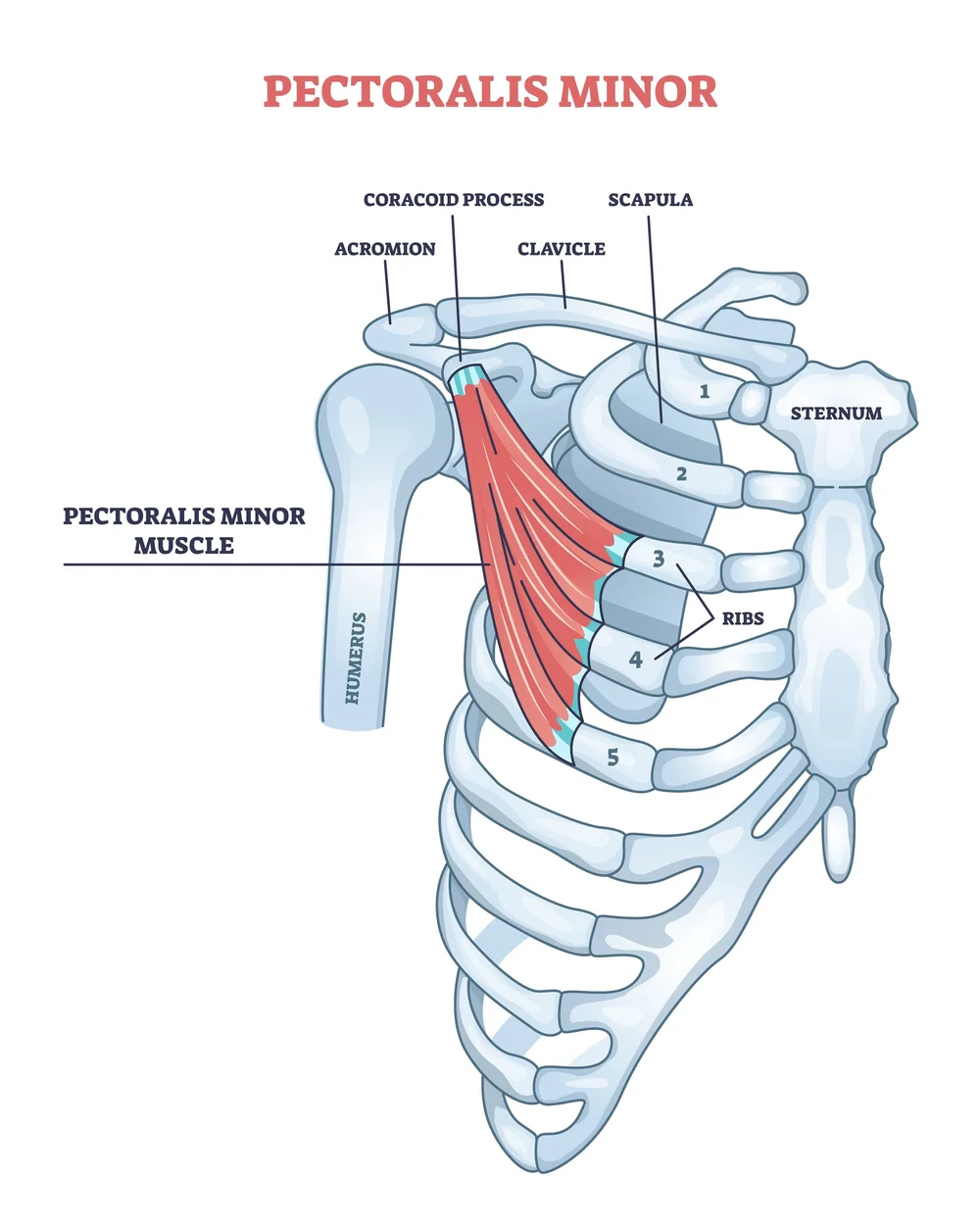
Origin of pectoralis minor
3-5th ribs near their costal cartilages
Insertion of pectoralis minor
medial border and superior surface of coracoid process of scapula
Action of pectoralis minor
stabilizes scapulae by drawing inf + ant
Origin of serratus anterior
external surfaces of lateral parts of 1-8th ribs
Insertion of serratus anterior
anterior surface of medial border of scapula
Action of serratus anterior
protracts + rotates scapula
Origin of external oblique
external surfaces of 5-12th ribs
Insertion of external oblique
linea alba, pubic tubercle, anterior half of iliac crest
Action of external oblique
compresses and supports abdominal viscera, flexes + rotates trunk
Attachments of inguinal ligament
ASIS to pubic tubercle
Inguinal ligament marks the inferior border of what muscle
external oblique
Inguinal ligament marks the superior border of what structure
femoral triangle
Origin of quadratus lumborum
medial half of inferior border of 12th ribs and tips of lumbar TVPs
Insertion of quadratus lumborum
iliolumbar ligament and internal lip of iliac crest
Action of quadratus lumborum
extends and laterally flexes vertebral column; fixes 12th rib during inspiration
Origin of transversus abdominis
internal surfaces of 7th-12th costal cartilages, thoracolumbar fascia, iliac crest, and CT deep to lateral third of inguinal ligament
Insertion of transversus abdominis
linea alba with aponeurosis of internal oblique, pubic crest, and pecten pubis via conjoint tendon
Action of transversus abdominis
compresses and supports abdominal viscera
Where is the hepatic flexure (right colic flexure)
deep to 9th/10th ribs, overlapped by inferior part of liver
What is the second part of the large interesting
ascending colon
Where is the ascending colon
passes superiorly on the right side of the abdominal cavity from the cecum to the right lobe of the liver
Name the four parts of the colon in order
ascending - transverse - descending - sigmoid
What is the third, longest, and most mobile part of the large intestine
transverse colon
Where is the transverse colon located
crosses the abdomen from right colic flexure to left colic flexure
How does the left colic flexure differ from the right
more superior, more acute, less mobile
Where is the splenic flexure (left colic flexure) located
inferior part of the left kidney and attaches to the diaphragm through phrenicocolic ligament
Where is the descending colon
between left colic flexure and left iliac fossa
What are the three parts of the sternum (top to bottom)
manubrium, sternal angle (angle of louis) body, xiphoid process
What rib has the scalene tubercle
1st rib
Where is the scalene tubercle
internal border of superior surface of the 1st rib
What articulation forms the vertebrosternal joints
first seven costal cartilages + sternum
What forms the costal margins
medial ends of 7th-10th costal cartilages
What articulation makes the costovertebral joints
ribs + vertebral bodies
What articulation makes the costotransverse joints
ribs + TVPs
What articulation makes the costochondral joints
ribs + costal cartilage
What articulation makes the sternocostal joints
costal cartilage + sternum
What are the joints of the thorax classified as
zygapophyseal / facet joints
What articulation makes the intervertebral joints
adjacent vertebral bodies bound together by IV discs
What articulation makes the interchondral joints
costal cartilages of adjacent ribs from 6th-9th
What articulation forms the sternoclavicular joint
sternal end of clavicle with manubrium of sternum and 1st costal cartilage
What articulation forms the manubriosternal joint
manubrium + body of sternum
What articulation forms the xiphisternal joint
xiphoid process + body of sternum
Where is the superior ramus of the pubis
just superior and lateral to pubic symphysis
Where is the ischial tuberosity
“sit bone” at inferoposterior aspect of ischium
Decreased passive forced shoulder flexion
length test latissimus dorsi
Decreased passive forced shoulder extension
length test anterior deltoid
Decreased passive forced shoulder abduction
length test coracobrachialis
Decreased passive forced shoulder adduction
length test middle deltoid
Decreased passive forced shoulder medial rotation
length test teres minor
Decreased passive forced shoulder lateral rotation
length test subscapularis
Decreased passive forced elbow flexion
length test triceps brachii
Decreased passive forced elbow extension
length test biceps brachii
Decreased passive forced elbow pronation
length test supinator
Decreased passive forced elbow supination
length test pronator teres
Decreased passive forced wrist flexion
length test extensor carpi ulnaris
Decreased passive forced wrist extension
length test flexor carpi ulnaris
Decreased passive forced wrist pronation
length test supinator
Decreased passive forced wrist supination
length test pronator teres
Decreased passive forced wrist radial deviation (abduction)
length test flexor carpi ulnaris
Decreased passive forced wrist ulnar deviation (adduction)
length test flexor carpi radialis
Decrease active resisted shoulder flexion
strength test anterior deltoid
Decrease active resisted shoulder extension
strength test latissimus dorsi
Decrease active resisted shoulder abduction
strength test middle deltoid
Decrease active resisted shoulder adduction
strength test coracobrachialis
Decrease active resisted shoulder medial rotation
strength test subscapularis
Decrease active resisted shoulder lateral rotation
strength test teres minor
Decrease active resisted elbow flexion
strength test biceps brachii