Introduction to the Viruses (4/10)
 Studied by 0 people
 Call Kai
 Learn
Learn Practice Test
 Spaced Repetition
 Match
Match Flashcards
 Knowt Play
1/34

Earn XP
Description and Tags
Zhou Lecture 3 (Lecture 21)
Name | Mastery | Learn | Test | Matching | Spaced |
|---|
No study sessions yet.
35 Terms
What are some types of viruses?
SARS-CoV-2 (severe acute respiraory syndrome)
west nile encephalitis virus
ebola
zika
hep A and intestinal infections: souther CA found in sea water near storm drains and sewage outlets (beach goers at risk)
what did louis pasteur do?
postulated that rabies was caused by living things smaller than bacteria
developed first vaccine for rabies
proposed term virus to denote this group of infectious agents
what was important in the year 1980 for virus research?
ivanovski and beijerinck: ID tobacco mosaic virus caused tobacco disease
Loeffler and Frosch: ID foot and mouth virus
agents could pass through porcelain filters designed to trap bacteria: virus filterable
what are viruses? what are the different views?
uniqeu group of biological entities that are specialized for every type of cell
one view: non-living things, cannot exist independent of the host cells
different view: living things, replicate and direct cellular processes
viruses among the biological spectrum
infectious particles (rather than organisms) as either active or inactive
what are unique properties of viruses?
obligate intracellular parasites
ultramicroscopic (smallest 20nm diameter)
not cells, compact, economical
do not independently fulfill characteristics of life
inactive outside of host cells
geometric, form crystals
basic structure: protein shells (capsid) surrounding nucleic acid core
DNA or RNA
viral surface with attachment molecules
hijacking host metabolic machinery for reproduction
lack most enzymes for life
size of viruses
very small: 2000 bacterial viruses fit into one bacteria
animal viruses: 20-450nm
electron microscope need to observe (5Mx magnfiication vs light microscope 2000x)
what are some methods to view viruses?
negative staining
Positive staining
Shadowcasting
negative staining
thin layers of opaque salt to outline shape against dark background and enhance tecture of the viral surface
positive staining
detects internal details of proteins and nucleic acids
shadowcasting
spread metallic vapor from a certain angle, metal coating over the surface approx the viral contours and shadow is cast on unexposed side
what are the parts of viruses necessary to invade and control host cells?
virus particle: covering and central core
covering: capsid and envelope
envelope not in all viruses
central core: nucleic acid molecule (RNA/DNA) and enzymes
what is the general structure of viruses?
capsid: protein shell that surround the nucleic acid in central core
capside + nucleic acid: nucleocapsid
envelope: some possess modified hose cell membrane that wraps outside of the nucleocapsid
viral capsid
geometric feature: protective outer shell
made of capsomers: spontaneously self-assemble into capsid
depending on the shape of capsomers, the assembled capsids are shaped either as icosahedreal or helical symmetry
Viruses are helical
symmetrical
helical capside: tobacco mosaic virus
rod shaped capsomers
form continuous helix
nucleic acid packed inside, nucleocapsid of naked virus is rigid
nucleocapsid of enveloped helical virus: more flexible - influenza, measles, and rabies
variations of virueses with helical nucleocapsids
naked helical virus: tobacco mosaic virus
enveloped helical virus: influenza virus
icosahedron
viral symmetry
3D, 20 sided object, 12 evenly spaced corners
constructed form single/multiple types of capsomers
variations in the # of capsomers in each virus (polio 32, adenovirus 240)
with or wo envelope
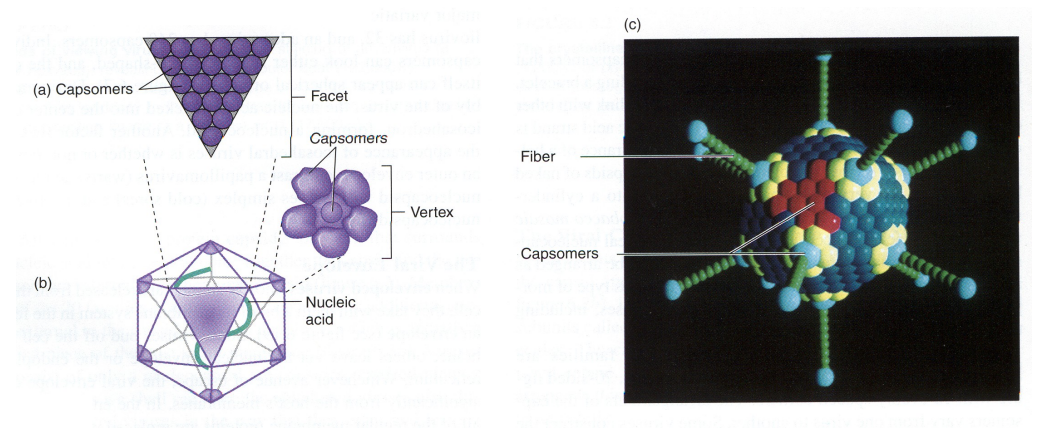
what are the 2 types of icosahedral viruses
papillomaviruses (warts) with no envelope
herpesvirus w enveloped icosahedron
what is a viral envelope and how does it differ from cell membranes?
enveloped viruses use host membrane to make envelopes: bud off the cell membrane, nuclear envelope or ER
differ:
viral proteins replace cellular proteins
viral glycoproteins positioned on the envelope for host cell attachment
What are the functions of viral capsid/envelope?
protection of nucleic acids
capsid of enteric(intestinal) viruses are resistant to acid and protein digesting enzymes of GI tract
host cell invasion: adsorption and introduction of viral DNA/RNA
contain antigenic elements for immune response
what are examples of complex viruses?
poxviruses: very large w DNA, lack regualr cpasid but have multiple layers of lipoproteins, coarse surface fibrils
bacteriophage: polyhedral head, helical tail , and fibers for attachment to the host cells
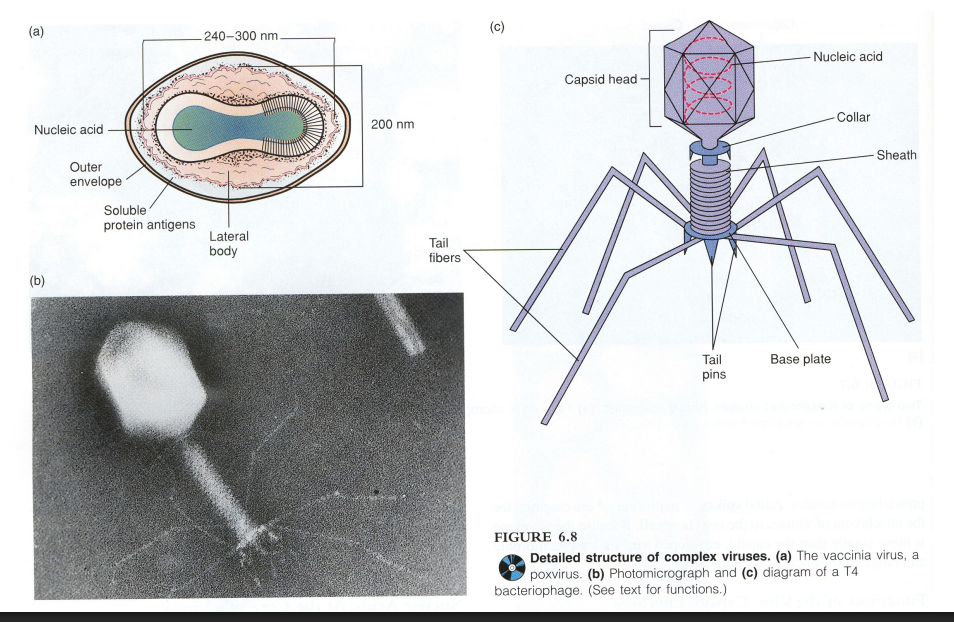
What are morphological features of common viruses?
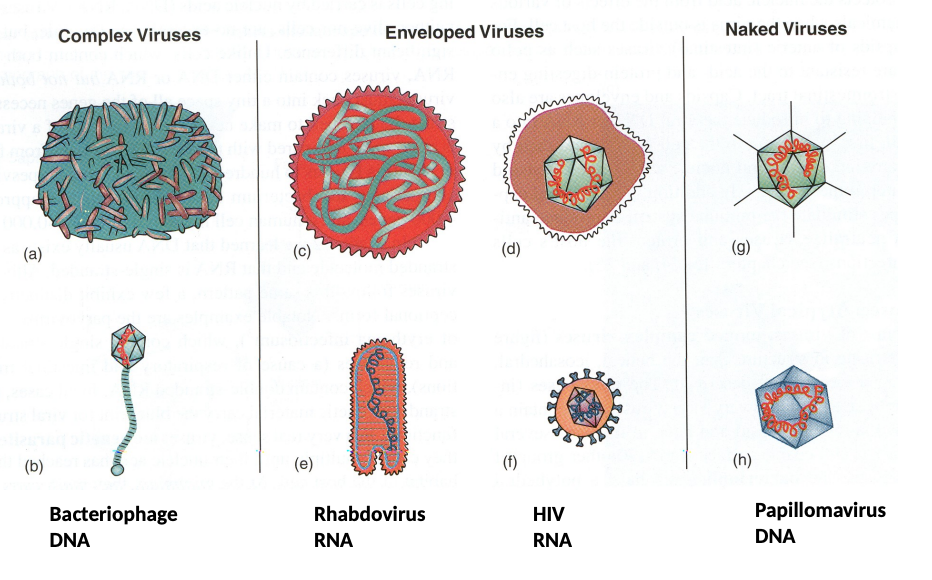
What is considered the core of a virus?
nucleic acids: DNA(ds) or RNA(ss)
small gneome from 4 genes in hep B virus to hundred of genes in herpesviruses
bacterium E. coli - 4k genes
human cell - 25k genes (C. elegans 20k)
some viruses contain ss DNA and ds RNA
what are other substances in the virus particle?
retroviruses: reverse transcriptase
specific polymerases to make DNA and RNA
tRNA: cellular machinery, metabolic enzymes packed in viral particles
Classification of Animal Viruses (DNA, RNA)
DNA viruses: 6 families
RNA virsues: 13 families
Family name: -viridae
Modes of Viral Multiplication
Adsorption: Virus attaches to host
Penetration: Viral DNA enters the bacterial cell.
Two Path Options: Lytic or Lysogenic Cycle
Lytic Cycle
Viral DNA takes over the bacterial machinery.
Cell enters eclipse phase: viral parts are made.
Assembly of complete new virions.
Maturation of viruses.
Lysis of the weakened cell → cell bursts.
Release of viruses to infect new cells.
Lysogenic Cycle
Viral DNA becomes latent as a prophage inside the bacterial chromosome.
Bacteria copies the viral DNA every time it divides.
Can switch into the lytic phase later when triggere
Multiplication cycle in bacteriophages
adsorption: tail fibers bind to specific bacterial surface receptors
injection of phage DNA into the bacteria by pushing inner tube through the bacteria wall into the bacteria
Phage DNA: direct synthesis of phage parts
capsid heads, parts of tail, new genome, enzyme that weakens cell in preparation of phage release
Spontaneous assembly to generate progeny phages
Lysogeny
silent virus infection
Temperate phages: do not lyse bacteria
viral DNA becomes prophage state > viral replication along bacterial DNA (lysogeny) without killing host
occasionally: viral genome can be activated > cell lysis
multiplication cycles of animal viruses