4.4 Waves
 Call Kai
 Learn
Learn Practice Test
 Spaced Repetition
 Match
Match Flashcards
 Knowt Play
1/40

Earn XP
Description and Tags
Name | Mastery | Learn | Test | Matching | Spaced | Call with Kai | Chat |
|---|
No analytics yet
Send a link to your students to track their progress
41 Terms
What is the relationship between intensity and amplitude
intensity ∝ amplitude²
Explain how Youngs double slit experiment provided the first evidence that light is a wave
If light was a particle, only 2 lines would be seen, but the light diffracts as jt passes through the slit. The waves then superpose as they overlap, producing areas of constructive and destructive interferance. These are wave properties.
Define coherent wave
Waves that have a constant phase difference and same frequency
Explain the principle of superposition
The net displacement is the sum of the individual displacements
Define path difference
Path difference is the difference in distance traveled by two coherent waves from their separate sources to a specific point where they meet
Determine the effect on the intensity when two waves of the same amplitude, and are perfectly in phase, interphere.
As the amplitude doubles, the intensity will increase by a factor 4 (2²)
Describe how the phase difference changes as you move away from the centeral maxima and towards the 1st maxima
It is 0 in the centre and it increases to 180° at the 1st order minima and 360° at the first order maxima
In Young's double slit experiment, explain why it is better to measure the seperation between multiple fringes and work out mean to determine x, rather than between adjacent fringes
This would reduce percentage uncertainty in measurements as the distance is greater
Why is it necessary to use a monochromatic light, along with a single slit and double slit to produce a stable interferance pattern for light?
They result in two sources of coherant light, and waves must be coherant for stable interference
In the double slit experiment, what effect does doubling the slit seperation have on the interferance pattern seen?
x halves
In the double slit experiment, what effect does doubling the distance between the slit and the screen have on the interferance pattern seen?
x doubles
In the double slit experiment, what effect does doubling the frequency of the light source have on the inrferance pattern seen?
wavelengths half therefore x halfs
Explain what is meant by diffraction of a wave
When wavefronts spread out after passing through a gap or around an obstacle
Define constructive interference
The point where two or more waves superpose and the resultant displacement is equal to the sum of the individual wave displacements
Define destructive interference
The point where two or more waves superpose in anti phase, so that the resultant displacement is smaller than the original waves
What quality must be constant for coherent waves?
Phase difference
What does it mean when the phase difference between waves is 180°?
The waves are in antiphase
State the relationship between intensity and amplitude
I ∝ amp²
What two terms can be used to describe the dark and bright fringes produced by waves?
Diffraction and interference
What formula should be used to solve λ when there is a double slit?
λ = ax / D
Explain the maxima and minima in variation of intensity
Maxima is when constructive interference occurs ∴ phase difference is zero & path difference = nλ
Minima is when destructive interference occurs ∴ phase difference is 180° & path difference = (n + 1⁄2)λ
The wavelength of a sound is 34cm. When two waves meet, distance from one loudspeaker is 200cm and the distance from another loudspeaker is 217cm. What type of interference is occurring?
217 - 200 = 17 ∴ path difference is 17 (half a wavelength). This means there is destructive interference
Define interference
When two coherent waves superpose
What is meant by the term coherent?
Constant phase difference & same basic frequency
What is the phase difference when 2 waves meet at a minimum?
180°
Define phase difference
Difference in angle between points on the same wave / similar points on two waves
Explain in terms of path difference why there are are bright and dark fringes.
At bright fringes: there is a path difference between slits and the screen is a whole / integer number of wavelengths (for constructive interference)
At dark fringes: path difference between slits and screen is an odd number of half wavelengths (for destructive interference)
Monochromatic light is directed onto a diffraction grating with 500 lines per mm.
The second order maxima is formed at an angle of 28° to the n = 0 maximum.
Calculate the wavelength of the monochromatic light directed at the diffraction grating.
Use the equation dsinθ = nλ
500 per mm → 500×10³ per m
(1 / 500×10³) sin28 = 2λ
λ = 4.7 × 10⁻⁷ m
What is d in the equation dsinθ = nλ?
The separation between slits
What is θ in the equation dsinθ = nλ?
The angle of diffraction
What is n in the equation dsinθ = nλ?
The order of diffraction
Define diffraction
Diffraction is the spreading out of a wave when it passes through a gap or round an obstacle.
How does diffraction maxima form with a diffraction grating?
Maxima are seen at particular angles where the waves superpose to form crests.
The distance from the slits to the screen is 5.6 m.
The slit separation, a, is 1.2 mm and the distance from the central maximum to the next maximum is 3.2 mm.
What is the wavelength of the light from the laser based on this data?
λ = ax/D = 6.9 x 10⁻⁷ m
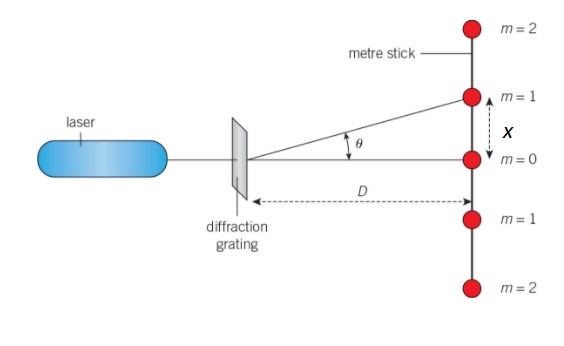
A diffraction grating arrangement is set up as shown.
The laser being used emits a monochromatic beam of 554 nm.
If the distance x is 24 cm and the distance D is 2.8 m then how many slits does the grating have per mm?
Using trigonometry, θ = tan–1 (0.24 m/2.8 m) θ = 4.9
Using nλ = dsinθ allows us to find the value for d = 6.5 x 10⁻⁶ m
So the number of lines per m will be the reciprocal of this, so it will be 154182
The number of lines per mm will therefore be 154
A monochromatic beam of light from a laser of wavelength 640 nm is directed onto a diffraction grating that has 550 lines per mm.
What is the difference in the angle between the n = 1 and n = 2 maxima for this arrangement?
Using nλ = dsinθ
For n = 1, θ = sin⁻¹(0.352) = 20.6°
For n = 2, θ = sin⁻¹(0.704) = 44.7°
So the difference in angle between the maxima is 44.7° – 20.6° = 24.1°
A diffraction grating has 640 lines per mm.
How many maxima will be observed, in total, when a monochromatic light source of wavelength 550 nm is directed onto the grating?
Highest order maximum is given by nₘₐₓ = s/λ.
nₘₐₓ = (1/6.4 × 10⁻⁵) / 5.50 x 10–7 = 2.8, so 2 is the greatest order
There will be 2 either side of the central maximum for n = 0, so there will be 5 maxima in total.
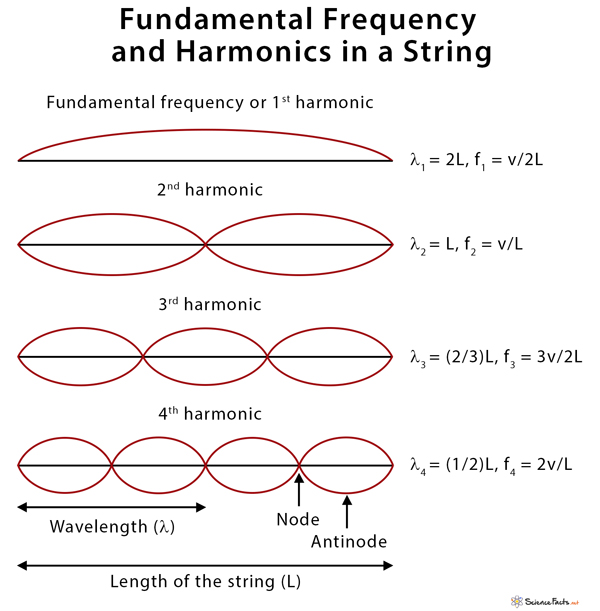
What is the formula for fundamental frequency?
f₀ = v/2L, where λ = 2L