3.0 Statistical Learning Prerequisites
 Call Kai
 Learn
Learn Practice Test
 Spaced Repetition
 Match
Match Flashcards
 Knowt Play
1/16

Earn XP
Description and Tags
Section 3.0 of Exam MAS-II
Name | Mastery | Learn | Test | Matching | Spaced | Call with Kai | Chat |
|---|
No analytics yet
Send a link to your students to track their progress
17 Terms
Define:
Response
Explanatory
Count
Continuous
Nominal
Ordinal
A variable of primary interest
A variable used to study the response variable
A quantitative variable usually valid on non-negative integers
A real-valued quantitative variable
A categorical/qualitative variable having categories without a meaningful or logical order
A categorical/qualitative variable having categories with a meaningful or logical order
Say what it is:
y, Y
x, X
Subscript i
n
Subscript j
p
f(x)
ε
ŷ, Ŷ, f̂(x)
Response variable
Explanatory variable
Index for observations
Number of observations
Index for variables except response
Number of variables except response
E[Y]
Error term
Estimate/Estimator of f(x)
Statistical Learning:
Supervised
Unsupervised
Has response variable
No response variable
Statistical Learning:
Regression
Classification
Quantitative response variable
Categorical response variable
Statistical Learning:
Parametric
Non-Parametric
Flexibility
Functional form of f̂ specified
Functional form of f̂ not specified
f̂’s ability to follow the data
Statistical Learning:
Training Data
Test Data
Observations used to train or obtain f̂
Observations not used to train or obtain f̂
Regression Equation

Regression Model Accuracy Equation
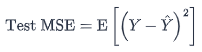
Estimate for Regression Test MSE Equation
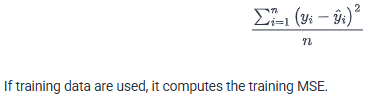
For fixed inputs x_1, ..., x_p, the test MSE can be written as

Bias-Variance Trade-Off:
What happens to test and training MSE with increasing flexibility
What low and high flexibility mean for bias and variance
As flexibility increases, the training MSE decreases, but the test MSE follows a u-shaped pattern.
Low flexibility leads to a method with low variance and high bias; high flexibility leads to a method with high variance and low bias.
Classification Equation

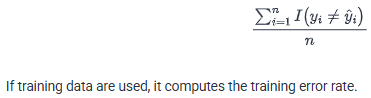
Classification Model Accuracy Equation

Estimate for Classification Test MSE Equation
Bayes Error Rate
Basically find the highest joint probability at each x value and take the complement of the sum

Cross-Validation: What does it do and what are the types?
Estimates the test MSE with available data.
Types:
Validation set approach
-fold cross-validation approach
LOOCV approach
Cross Validation: Issues with Validation set approach, and rank each method with respect to bias and variance
The validation set approach has unstable results and will tend to overestimate the test MSE. The two other approaches mitigate these issues.
With respect to bias, the validation set error has the most, followed by the -fold CV error, then the LOOCV error.
With respect to variance, the LOOCV error has the most, followed by the -fold CV error, then the validation set error.