Spectral Analysis
 Call Kai
 Learn
Learn Practice Test
 Spaced Repetition
 Match
Match Flashcards
 Knowt Play
1/30

There's no tags or description
Looks like no tags are added yet.
Name | Mastery | Learn | Test | Matching | Spaced | Call with Kai | Chat |
|---|
No analytics yet
Send a link to your students to track their progress
31 Terms
Spectral analysis
Separate individual velocities. Arranges flow velocities over time
Importance of Spectral Analysis
Important for diagnosing vascular stenosis
Technique used for spectral analysis?
Fast Fourier Transform.. separates doppler shift frequencies.
Spectral Anylisis is used by what dopplers?
Pulsed wave and color doppler
Spectral doppler display?
Velocities on verticle axis (y) and time on horizontal axis (x) as systole dystole
what is Laminar flow ?
Narrow spectral tracing with a clear spectral window where velocities are well-organized, indicative of a smooth flow.
What is a Spectral window ?
The black area under the spectral trace. Between the baseline and spetrum
What is turbulent flow?
Wide range of velocities and has spectral broadening. obileration of window.
Advantages of spectral analysis?
Selection of exact flow location to measure the velocities
What are disadvantages of spectral analysis?
Angle dependent and subject to aliasing
What is aliasing?
Aliasing is the misrepresentation of velocities due to undersampling the doppler shift
What does aliasing on a spectrum look like?
With higher velocities, it can be cut from the spectrum and be displayed on the other side of the baseline.
What is nyquist limit?
Upper limit of doppler shift that can be detected properly by pw (kind of like frequency)
What is nyquist limit equal to?
The Nyquist limit is equal to half of PRF which defines the maximum frequency that can be accurately sampled without aliasing.
What are two ways to correct aliasing?
Increase the nyquist limit (increase prf)
Decrease the doppler shift (Low frequency transducer, higher doppler angle)
use a continuous wave doppler
How do you increase PRF?
Increase the scale
What are two ways to decrease doppler shift
use a higher doppler angle
use a low frequency transducer
Spectrum in relation to the cardiac cycle include what ?
Systolic component and diastolic component
What makes up the systolic component?
In upstroke: sharp rise with high velocity in early systole
In peak systole: Highest velocity achieved by blood cells
In downstroke: Decrease in velocity
What does systolic component depend on?
myocardial Force of contraction
What does diastolic component depend on?
Peripheral resistance from the change in diameter of the arteriolies. (vasoconstriction and vasodiolation)
What are two diastolic components?
Early diastole
late diastole
What are three possibilities of early diastole ?
reverse flow
forward flow
no flow
What is a possibility of late diastole ?
No flow
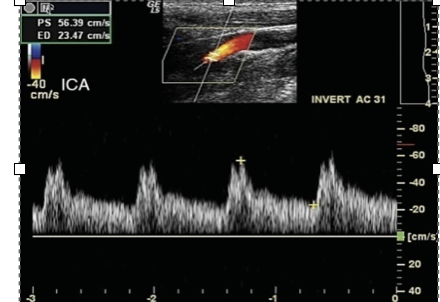
What is low resistant wave form/ low pulstality characteristics?
broad systolic peak/ continuous forward flow in diastole with good velocity
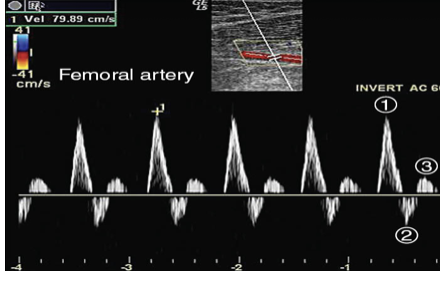
What are characteristics of high pulsatatlity or high resistant wave form?
Systolic peak: pointed narrow peak
Early diastole: reverse flow
late diastole: foward flow
Typical High wave form is ______
Triphasic
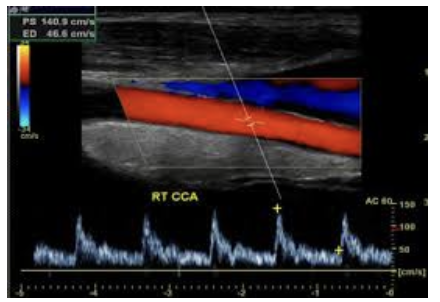
What are moderate resistant waveform characteristics?
high systolic peak
normal continous flow. no reverse flow in early diastole
What is stenosis ?
Focal narrowing of a blood vessel due to atherosclerosis leading to reduction of vessel lumen
What is the prestetonic stenosis?
Proximal to stenosis (before)
What changes occur in proximal stenosis ?