Handout packet 3 ( Exam 1)
 Call Kai
 Learn
Learn Practice Test
 Spaced Repetition
 Match
Match Flashcards
 Knowt Play
1/17

There's no tags or description
Looks like no tags are added yet.
Name | Mastery | Learn | Test | Matching | Spaced | Call with Kai | Chat |
|---|
No analytics yet
Send a link to your students to track their progress
18 Terms
Peripheral Cardiovascular adjustment- muscle blood flow
Muscle blood flow increases prior to exercise
Low intensity exercise leads to increased blood flow to oxidative muscle
High intensity exercise leads to increased blood flow to glycolytic muscle
Muscle blood flow can increase 100 fold
muscle blood flow _________ prior to exercise
Increases
Low intensity exercise leads to increased blood flow to
Oxidative muscles
high intensity exercise leads to increased blood flow to
Glycolytic muscles
Muscle blood flow can increase ___ fold
100
Functional sympatholysis
The body's natural process of reducing blood vessel constriction in active muscles during exercise to increase blood flow
A. Dilators act on SN to inhibit NE release
B. Dilators make alpha receptors less responsive to NE
C. Dilators act on vasculat smooth muscle to cause relaxation
Vasodilators produced by endothelial cells
Nitric oxide, prostaglandins, Endothelium-derived hyperpolarizing factor (EDHF)
Vasodilators produced by skeletal muscle cells
K+, H+, CO2, Adenosine
Oxygen extraction (a-v O2 difference)
O2 is used in ATP synthesis (note decreased venous o2

Cardiovascular control during exercise
Signal originates in brain (central command)
Signal originates in muscle (exercise pressor reflex
Central command _______________ activates muscle and cardiovascular system
Intent to exercise
Cardiovascular center decreases __________ nerve activity and increases ___________ nerve activity during exercise
parasympathetic, sympathetic
_____________ mechanism (from brain to cv system) to start to increase O2 delivery
Feed forward
Exercise pressor reflex originates in muscle
Group III nerves sense contractions
Group IV nerves sense metabolites
EPR is the “Feedback” mechanism to match O2 delivery to demand (signal from muscle)
Exercise pressor reflex
Baroreceptor located in aorta and carotid arteries
Baroreceptor send continuous feedback to cardiovascular control center
Goal: Adjust PNA and SNA to keep BP “constant” at level it needs to be during activity (BP always changing 120/80)
Baroreflex
Blood Pressure Response to Exercise
Systolic Blood pressure is pressure during left ventricular contraction (Determined by cardiac output= HR x SV (sv main determinant) )
Diastolic BP is pressure using Left ventricular relaxation (determined primarily by systemic vascular resistance, secondary Determinant is heart rate ) stays constant due to cancelation partially goes down since arteries are dilating but heart rate goes up)
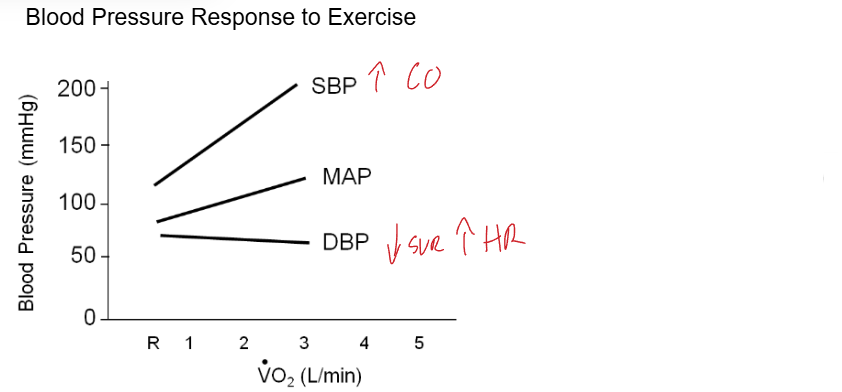
Blood Pressure Response to Exercise
blood pressure response to exercise chart
how can BP increase if you have baroreceptors
The Operating point is reset to a higher pressure during exercise (in hypertensive patient OP will drop lower at rest after exercise than their original resting for about 12 hours )