Nervous tissue
 Call Kai
 Learn
Learn Practice Test
 Spaced Repetition
 Match
Match Flashcards
 Knowt Play
1/68

There's no tags or description
Looks like no tags are added yet.
Name | Mastery | Learn | Test | Matching | Spaced | Call with Kai | Chat |
|---|
No analytics yet
Send a link to your students to track their progress
69 Terms
Somatic sensory
Carries sensory information from the skin, skeletal muscles, joints, and special senses to the CNS.
visceral sensory
Carries sensory information from internal organs (viscera) such as the stomach, heart, lungs, and bladder
somatic motor
Controls voluntary movement by sending signals from the CNS to skeletal muscles
visceral motor
Controls involuntary movement by sending signals to:
Smooth muscle
Cardiac muscle
Glands
(Also called the autonomic nervous system
What is the function of dendrites?
Receive incoming signals from other neurons or receptors.
What is the function of the cell body (soma)?
Contains the nucleus and carries out the neuron's metabolic activities.
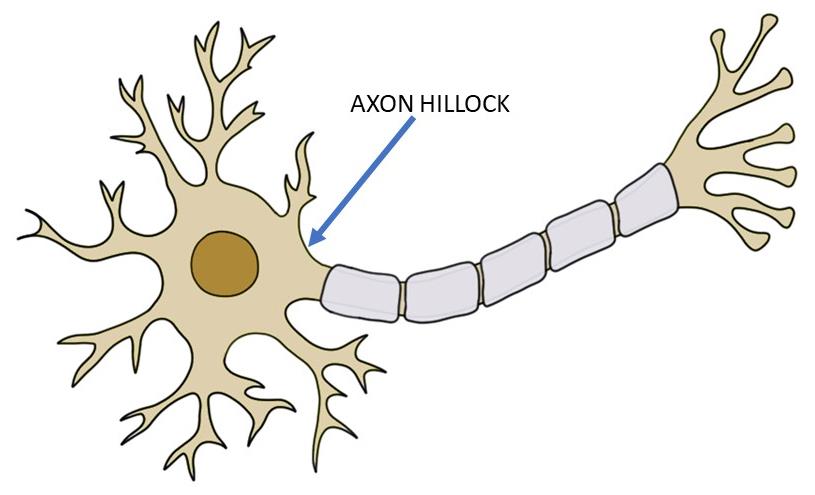
What is the axon hillock?
The site where action potentials begin if threshold is reached.
What is the function of the axon?
Carries action potentials away from the cell body.
What is the myelin sheath?
insulates the axon and speeds nerve impulse conduction.
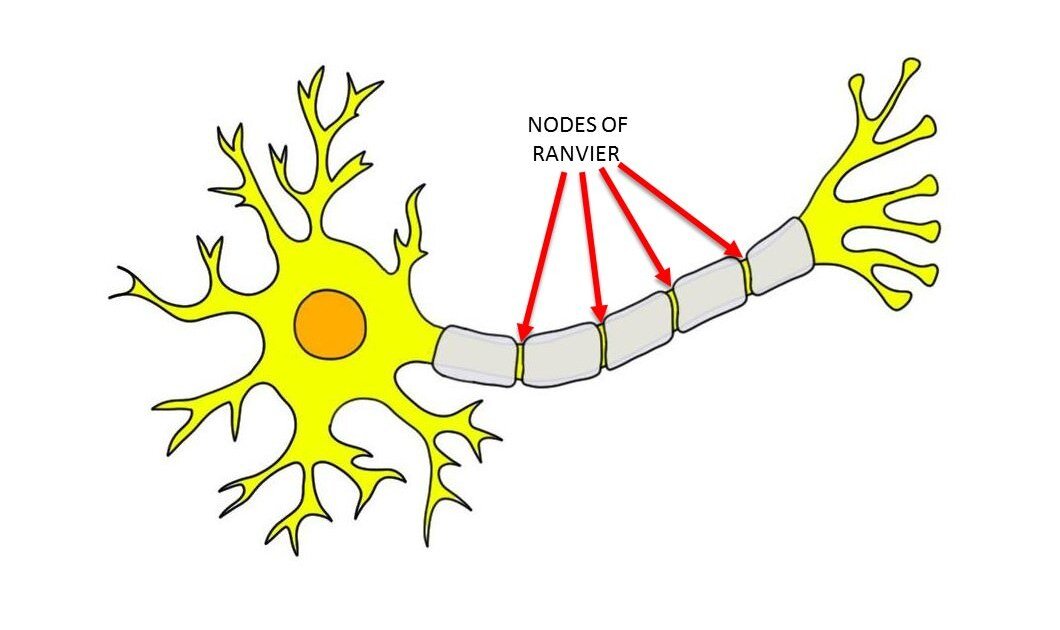
What are Nodes of Ranvier?
Gaps in the myelin where electrical impulses can jump from node to node
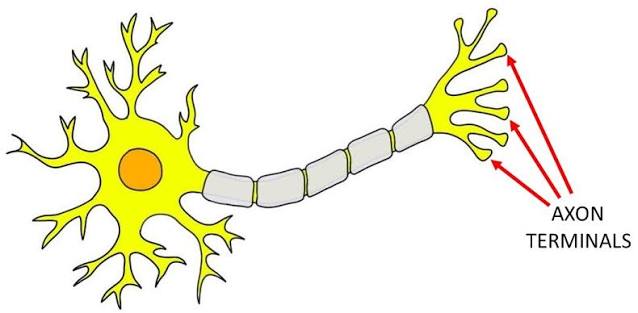
What is the function of axon terminals (synaptic end bulbs)?
Release neurotransmitters into the synapse.
types of glial cells in CNS
astrocytes, oligodendrocytes, microglia, ependymal cells
types of glial cells in PNS
schwann cells, satellite cells
Astrocytes
Support neurons, help maintain the blood-brain barrier, regulate extracellular ions (especially K+).
oligodendrocytes
Produce myelin in the CNS
microglia
Immune cells of the CNS; remove pathogens and debris
ependymal cells
Line brain ventricles and circulate cerebrospinal fluid (CSF)
Schwann cells
Produce myelin in the PNS.
satellite cells
supportive, non-neuronal cells located exclusively in the PNS
types of neurons
afferent, efferent, interneuron
afferent
Sensory neuron that carries information to the CNS
efferent neuron
Motor neuron that carries commands away from the CNS.
interneuron
Found entirely within the CNS; processes incoming sensory data before coordinating the appropriate motor response.
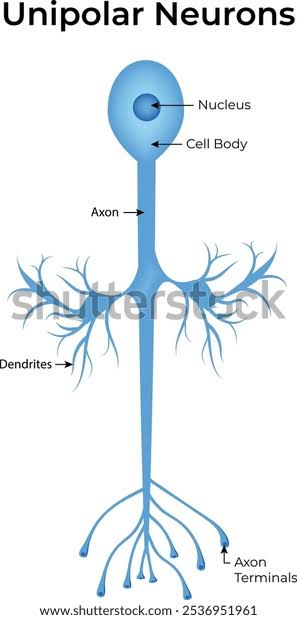
unipolar neuron
One process; mostly sensory neurons in the PNS.
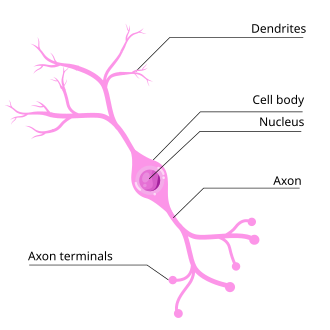
bipolar neuron
One axon and one dendrite; found in the retina, inner ear, and olfactory epithelium
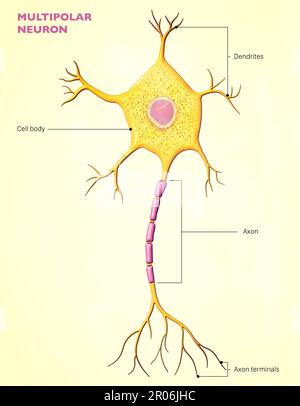
multipolar neuron
One axon and many dendrites; most common neuron type; usually motor neurons and interneurons
CNS
Brain and spinal cord.
PNS
all nerves outside the CNS
PNS sensory (afferent) division
Carries information to the CNS
PNS (motor) division
Carries commands from the CNS.
somatic nervous system
voluntary control of skeletal muscles
autonomic nervous system
Involuntary control of smooth muscle, cardiac muscle, and glands.
sympathetic division
Fight or flight.
parasympathetic division
Rest and digest.
Action potential
rapid, temporary electrical impulse that travels along a cell membrane
resting membrane potential
-70mV
what is threshold
-55mV
What happens during depolarization?
Voltage-gated Na⁺ channels open, Na⁺ enters the cell.
Na⁺ rushes into the neuron.
Membrane potential becomes more positive.
Voltage rises from -55 mV to about +30 mV.
Peak of action potential?
About +30 mV.
Na⁺ channels inactivate (close).
Voltage-gated K⁺ channels open.
What happens during repolarization?
Voltage-gated K⁺ channels open, K⁺ leaves the cell.
The membrane potential becomes negative again.
Returns toward -70 mV.
What is hyperpolarization?
K⁺ channels stay open slightly longer, making the membrane more negative than resting.
How is resting potential restored?
Leak channels and the Na⁺/K⁺ pump
What does the sodium-potassium pump do?
Uses ATP to move:
3 Na⁺ out
2 K⁺ in
Why is the Na⁺/K⁺ pump important?
Maintains ion gradients and resting membrane potential.
What does sodium do during an action potential?
Rushes into the cell causing depolarization.
What does potassium do?
Leaves the cell causing repolarization.
What is a graded potential?
Local change in membrane potential.
Variable strength
Can increase or decrease
Occurs on dendrites/cell body
differences in graded potential and action potential
Graded Potential | Action Potential |
Variable strength | All-or-none |
Can weaken | Does not weaken |
Local | Travels entire axon |
Dendrites & soma | Axon |
What is saltatory conduction?
Action potential "jumps" from one Node of Ranvier to the next on a myelinated axon
Why is saltatory conduction faster?
Only the nodes depolarize instead of the entire axon.
Absolute refractory period
No second action potential can occur regardless of stimulus.
Relative refractory period
Another action potential is possible, but only with a stronger-than-normal stimulus
What is a neurotransmitter?
Chemical messenger released by neurons to communicate with another cell.
What triggers neurotransmitter release?
Ca²⁺ enters the axon terminal through voltage-gated calcium channels
What neurotransmitter is released at the neuromuscular junction?
Acetylcholine (ACh)
Functions of acetylcholine
Skeletal muscle contraction
Parasympathetic nervous system
Learning and memory
Glutamate
major excitatory neurotransmitter
GABA
major inhibitory neurotransmitter
Glycine
Inhibitory neurotransmitter in the spinal cord.
Dopamine
Movement, motivation, reward
Norepinephrine
Alertness and sympathetic responses
serotonin
Mood, sleep, appetite
What is a cholinergic neuron?
Releases acetylcholine (ACh)
What is an adrenergic neuron?
Releases norepinephrine (NE) (or responds to epinephrine).
Action potential sequence
Resting membrane potential = -70 mV
Stimulus opens Na⁺ channels
Threshold reached (-55 mV)
Voltage-gated Na⁺ channels open
Na⁺ enters → Depolarization
Membrane reaches +30 mV
Na⁺ channels inactivate
Voltage-gated K⁺ channels open
K⁺ leaves → Repolarization
K⁺ continues leaving → Hyperpolarization
K⁺ channels close
Na⁺/K⁺ pump restores resting membrane potential
Action potential continues down the axon
Ca²⁺ enters the axon terminal → neurotransmitter release
What happens first during an action potential?
A stimulus causes depolarization.
Ligand-gated or mechanically gated Na⁺ channels open.
Na⁺ enters the cell.
If the membrane reaches -55 mV (threshold), an action potential begins
How does the action potential end?
When it reaches the axon terminals, voltage-gated Ca²⁺ channels open, causing neurotransmitters to be released into the synapse
voltage gated channels
open in response to cells membrane potential
ligand gated channel
opens when certain neurotransmitters bind to receptors