Presentation 12: Government Regulation of Platforms
 Call Kai
 Learn
Learn Practice Test
 Spaced Repetition
 Match
Match Flashcards
 Knowt Play
1/13

Earn XP
Description and Tags
Power relations in digital platform ecosystems & gvernment regulation of platform
Name | Mastery | Learn | Test | Matching | Spaced | Call with Kai | Chat |
|---|
No analytics yet
Send a link to your students to track their progress
14 Terms
Describe the case against regulation.
Government interventions could be misuse for reducing private company´s position and support government institution
e.g. regulatory actions against Uber to support governmental taxi industry
independent and honest judiciary (Justiz) could be a subject of manipulation and capture (Einflussnahme)
Describe the case for regulation/Four Scopes of platform regulation.
Purpose for regulation:
Labor laws: EU´s Platform Work Directive:
Misclassification of workers → are gig workers self-employed contractors or are they employees?
Trade-off : Worker flexibility through multi-homing vs. platform-induced look-in effects
National Control of information assets:
WWW (open internet) or Splitinternet? → Splitinternet = „parallel internets run as distinct, private and autonomous universes“
Great Firewall of China = centralised, top-down control of the internet → most platforms are forbidden
Data privacy and security:
GDPR (General Data Privacy Regulation)
Operates alongside DMA → focus on individuals
Compliance costs are negligible (geringfügig) for large platforms relative to their revenues → same costs create disadvantages for smaller rivals and new entrants
Example for need: Databrokers sell location data without sufficient (genug) control
Competition and fairness:
DMA = Digital Markets Act → Focus in the lecture
Why platform power challenges contestability (Wettbewerbsfähigkeit) and fairness?
Data advantages are selfreinforcing → More users generate better data, enabling better services, attracting even more users
Platform growth can lead to market dominance → Winner-takes-all dynamics lead to one or two platforms dominating entire markets
Market dominance creates high entry barriers → New competitors struggle to attract users because users and data are concentrated on dominant platforms
Power distribution and extractive opportunism → Unfair conditions and reduced decision-making for low-powered platform actors
→ Network effects → Quasi-monopolies → high entry barriers → Power asymmetries → Lower contestability → Need for Regulation ==> Markets of digital platforms do not self-correct. Government regulation is needed to promote contestability and fairness
Explain EU´s Platform Work Directive for labor law.
Misclassification of workers → are gig workers self-employed contractors or are they regular employees?
gigworkers: can switch between multiple platforms (e.g. drivers can accept job on Uber and lyft)
Trade-off : Worker flexibility through multi-homing vs. platform dependence/lock-in effects
gigworkers get specific directions for how to do their job → confusing
e.g. FedEx classified full-time workers as contractors (Auftragnehmer) rather than employees
Explain the EU general data protection regulation (GDPR) for data protection and security.
Scope: Applies to any company worldwide that processes the personal data of EU residents
Consumer Rights: Grants individuals the right to access, correct, and erase their personal data
Reporting: Mandates reporting of most data breaches to authorities within 72 hours
Data Protection Officers: Requires many organizations to appoint a DPO to oversee data compliance
Fines (Geldstrafe): Imposes (verhängen) severe penalties 8Strafen) for violations, up to €20 million or 4% of global annual turnover (Umsatz)
→ Platform governance complements platform regulation (e.g. showing a Cookie-Button when opening the app firstly)
Explain the Digital Market Act (DMA) for competition & fairness.
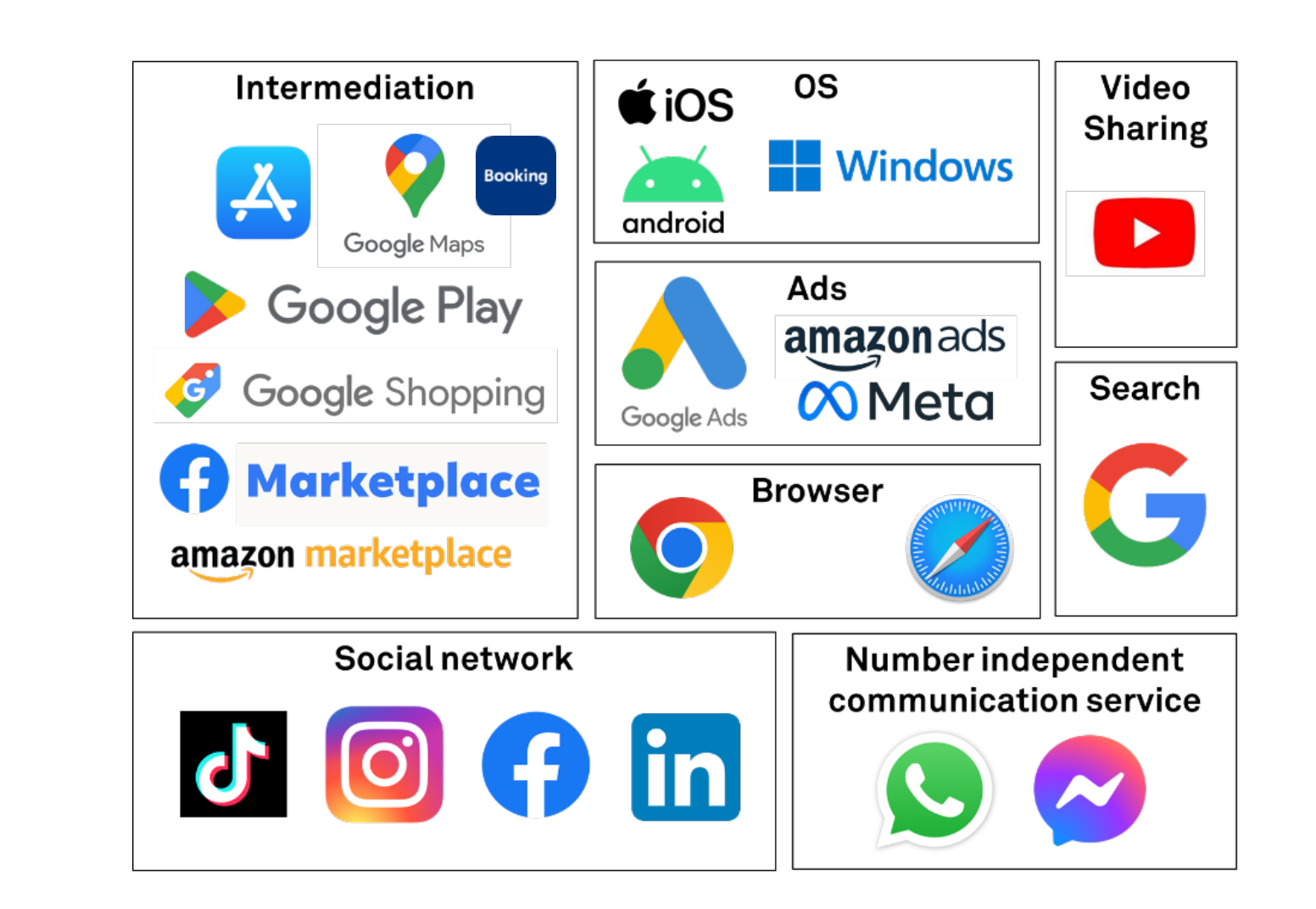
DMA defines who holds too much power
DMA estamblishes a set of clearly defined objective criteria to identify “gatekeepers”
Annual EU turnover (Jährlicher EU Umsatz) > 7,5 billion € OR market capitalization ≥ €75 billion AND > 45 million monthly active end-users AND ≥ 10.000 active complementors in the EU → Ex ante regulation: Predefined rules apply before harm (Schaden) occurs, unlike traditional antitrust (Kartellrecht) (ex post)
Obligations (Verpflichtungen) are fixed and ex-ante
Enforcement mechanisms are dynamic (system of ongoing decentralized control mechanims in collaboration with stakeholder)
only an EU regulation (e.g. Apple operates in the EU, so its must follow the DMA inside Europe)
Regulatory issues:
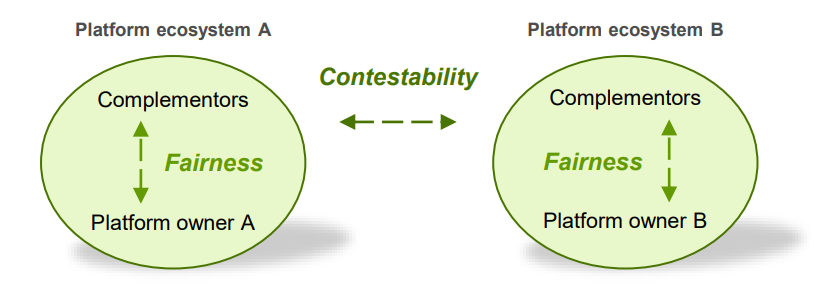
Fairness: DMA prevents gatekeepers from adopting unfair behavior vis-à-vis the business or end users that are dependent on gateway
Contestability (Wettbewerbsfähigkeit): DMA protects the contestability of core platform services (e.g. through interoperability, sideloading of alternative webbrowsers)
Explain DMA´s regulatory issues to rebalance power.
Fairness: preventing exploitation (Ausbeutung) within the ecosystem
Data Siloing: Gatekeepers cannot use complementors’ data to compete against them
Disintermediation: Complementors can contact customers directly and offer prices independently
Fair Ranking: Gatekeepers must not favor their own products over complementors’ offerings
Contestability: enabling competition between ecosystems
Data Sharing: Search engine gatekeepers must share search data with competing services
Sideloading: Users can install alternative app stores and apps outside gatekeeper’s platform
Interoperability: Dominant services must be technically compatible with competing services
→ Goal: increasing fairness and competition across and within digital platform ecosystems by targeting gatekeepers
Explain the requirement for platforms having a multisided accountability (mehrseitige Rechenschaftspflicht) to observe (einhalten) the DMA.
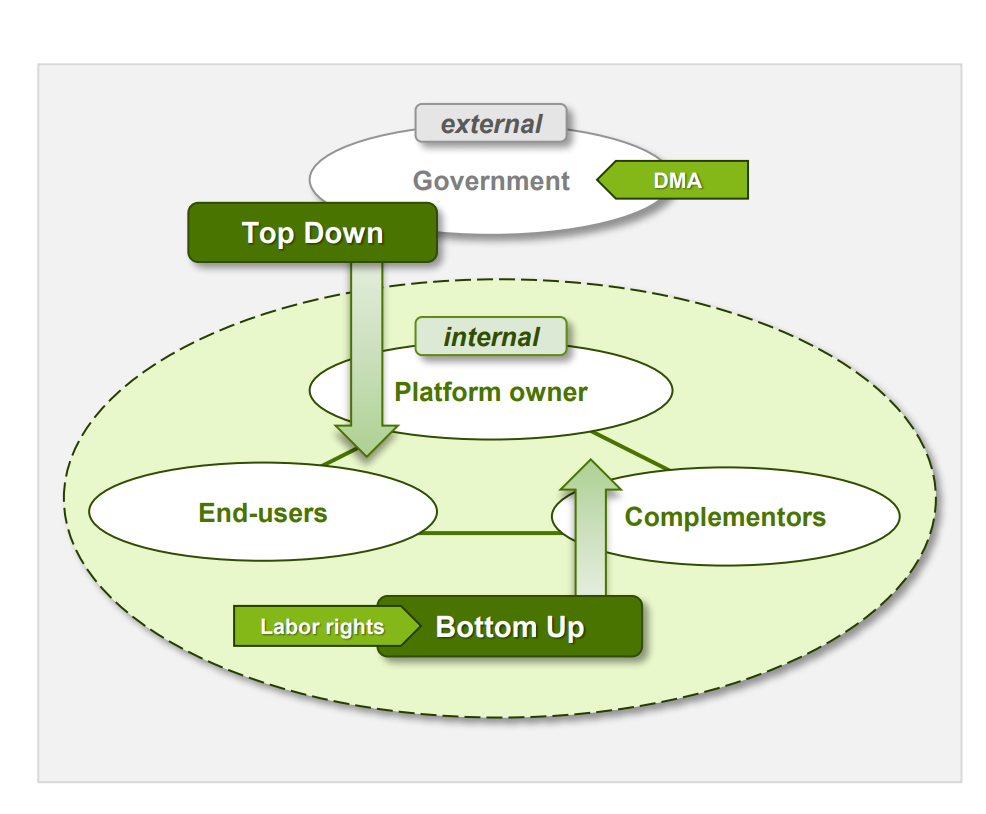
Top Down → Distributive Fairness:
External regulation: Government laws targeting (ins Visier nehmen) platform power (e.g., DMA)
Internal self-regulation: Platform’s own policies (e.g., Airbnb non-discrimination policy, Apple content guidelines)
➢ Limitation: Self-regulation serves to avoid (dienen zur vermeiden) stricter government regulation
Bottom Up → Procedural Fairness:
Context: Low-powered actors push back against platform power
Tactics: Collective mobilization, unions, cooperatives (e.g., #DeclineNow: Uber drivers declined rides for better conditions) → fighting for labor rights
➢ Limitation: Counter actions (Gegenwirkungen) from platform owner
→ both is needed for Maintaining a level playing field, preventing extractive opportunism and enforcing rule adequacy (Wahrung gleicher Wettbewerbsbedingungen, Verhinderung ausbeuterischen Opportunismus und Durchsetzung angemessener Regelungen)
How can platforms circumenvent regulations (Vorschriften umgehen)?
Theoretical: Chicago School Perspective:
Focus on consumer welfare (Wohl)
Markets usually self-correct through competition
➢ Government interventions should occur only when there is clear consumer harm (Schaden)
➢ Regulations may reduce innovation, efficiency and competition
Empirica: Supplier example: Delevery apps:
Uber Eats & DoorDash charged 30% commissions during COVID-19
Fees capped at 15% to protect small restaurants
Large chains & out-of-city restaurants were promoted instead
➢ Lower revenues for small restaurants + higher delivery fees for customers
➢ Most regulations are regional but platforms operate globally
→ Platforms are strategic actors: They don‘t just comply (sich fügen) , they adapt their algorithms to maintain (aufrechthalten) market power despite (trotz) regulation
→ Regulation can limit the market dominance of gatekeepers BUT naive regulation may hinder innovation or fail in practice because platform owners try to circumvent regulation
What are Trade-offs of platform regulation for fairness and contestability?
Trade-Off between Data Sharing & Data Siloing:
Data Sharing creates Fairness & contestability → Too much Data Sharing reduces innovation (thorugh lower competitive advantage, less incentive to invest in data)
Data Siloing creates Innovation → Too much Data Siloing reduces fairness & Contestability
Trade-offs can be seperated into:
Organizational:
Openness vs. Control
Fair competition vs. owner´s advantage
Technical:
Nesting (Verschachtelung) of platforms
Allowing sideloading vs. seamless (makelose) user experience (e.g. less quality, malware risk)
Economic:
Revenue models vs. direct access
Multi-homing vs. loyalty
Explain Apple under the DMA.
Apple got the first DMA fine (Geldstrafe) ever for restricting developers from directing (verweisen) users to outside the App Store
DMA for competition & fairness: DMA forces sideloading and interoperability
Trade-offs: Opening Apple‘s ecosystem increases fairness but reduces Apple‘s ability to guarantee a seamless user experience
Data privacy as strategic tool: Apple argues that a curated “Walled Garden” is the only way to effectively block malware and data abuse
→ Debate: Competition vs. Security & User Experience
Explain the core trade-offs of government regulation in digital platform ecosystems. Include an example.
The core challenge of platform regulation is balancing fairness and contestability against innovation and efficiency
Regulation aims to reduce the market power of dominant platforms (gatekeepers), but excessive regulation may reduce firms' incentives to innovate or invest
Trade-Offs:
Data Sharing vs. Data Siloing
Openness vs. Control
Multi-Homing vs. Loyalty
In your opinion, is the DMA more likely to promote innovation or slow it down? Explain your reasoning.-
Pro: DMA is likely to promote innovation in the long run by reducing gatekeeper power and increasing competition through measures such as interoperability and sideloading
Con: it may reduce innovation incentives for dominant platforms by limiting their ability to capture value
→ Overall, the DMA aims to balance innovation with fairness and contestability
Name the four objectives of platform regulation and explain how each of them is different or connected to the DMA.
Scopes of platform regulations:
Labor law: Protect platform workers (employment status, working conditions) → Platform Work Directive
National control of information assets: Control information infrastructure and digital sovereignty
Data privacy & security: Protect personal data → GDPR
Competition & Fairness: Promote contestability and limit gatekeeper power → DMA