Aplab Final
 Call Kai
 Learn
Learn Practice Test
 Spaced Repetition
 Match
Match Flashcards
 Knowt Play
1/200

There's no tags or description
Looks like no tags are added yet.
Name | Mastery | Learn | Test | Matching | Spaced | Call with Kai | Chat |
|---|
No analytics yet
Send a link to your students to track their progress
201 Terms
What distinguishes grey matter from white matter?
Grey matter contains nerve cell bodies, while white matter consists of myelinated axons.
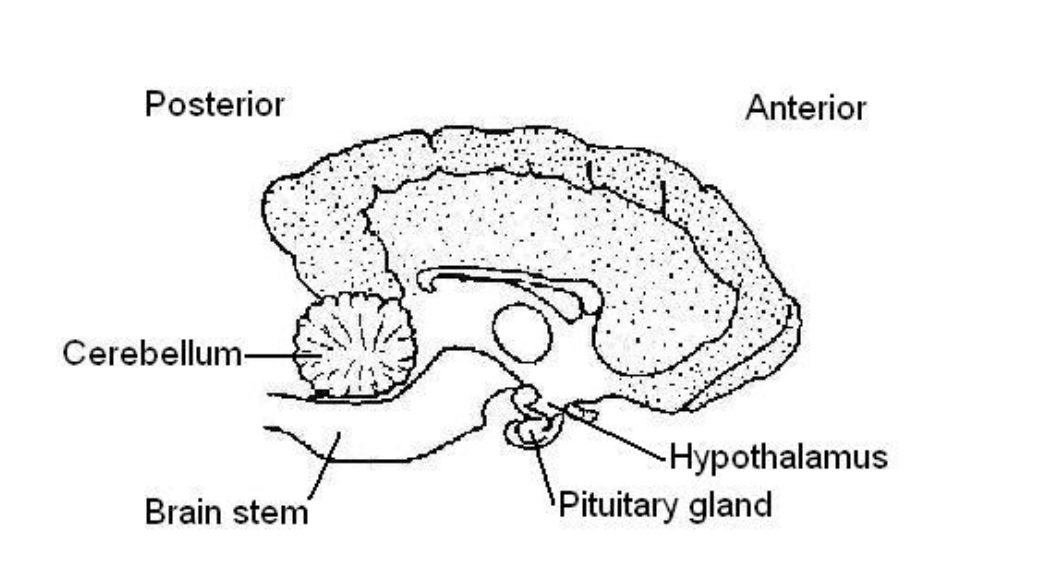
What are the four main parts of the brain?
Cerebrum, Cerebellum, Diencephalon, Brainstem.
What is the largest part of the brain in domestic animals?
The Cerebrum.
What is the function of the Corpus Callosum?
It connects the two halves of the cerebral cortex.
What are the primary functions of the Cerebrum?
High order behavior, learning, reasoning, intelligence, and sensory information processing.
What are gyri and sulci?
Gyri are folds (gyrus) and sulci are shallow grooves (sulcus) on the cerebral cortex.
What are the four lobes of the Cerebrum?
Frontal, Parietal, Occipital, Temporal.
What is the role of the Cerebellum?
It coordinates movement and complex reflexes, allowing for fine movement control.
What is the Diencephalon often referred to as?
The 'between brain'.
What are the main structures found in the Diencephalon?
The Thalamus, Hypothalamus, and Pituitary Gland.
What is the function of the Thalamus?
It acts as a relay station for regulating sensory input to the cerebrum.
What is the primary function of the Hypothalamus?
It communicates between the nervous and endocrine systems, regulating temperature, hunger, and thirst.
What is the Brainstem's primary role?
It serves as the connection between the brain and spinal cord and is involved in autonomic control.
What are the three main components of the Brainstem?
Medulla oblongata, Pons, Midbrain.
What are the Meninges?
A set of connective tissue layers surrounding the brain and spinal cord.
What are the three layers of the Meninges?
Dura mater, Arachnoid, Pia mater.
What is the function of Cerebrospinal Fluid (CSF)?
It cushions the brain and spinal cord and circulates between the layers of the meninges.
What does the Blood Brain Barrier (BBB) do?
It separates the blood supply in the brain from nervous tissue, preventing many substances from entering.
What are cranial nerves?
A special set of 12 peripheral nerves that originate directly from the brain.
What mnemonic can help remember the cranial nerves?
On old Olympus' towering top, a fine vocal German viewed some hops!
What is the significance of the phrase 'Some say marry money but my brother says bad business (to) marry money'?
It helps remember the sensory and motor functions of cranial nerves.
What is the function of the Olfactory nerve (I)?
Sense of smell
What is the primary function of the Optic nerve (II)?
Vision
What functions are associated with the Oculomotor nerve (III)?
Eye movement, pupil size, focusing the lens
What is the role of the Trochlear nerve (IV)?
Eye movement
What sensations does the Trigeminal nerve (V) provide?
Sensations from head and teeth, chewing
What is the function of the Abducent nerve (VI)?
Eye movement
What are the functions of the Facial nerve (VII)?
Face and scalp movement, salivation, taste, tears
What does the Vestibulocochlear nerve (VIII) control?
Balance and hearing
What are the functions of the Glossopharyngeal nerve (IX)?
Tongue movement, salivation, swallowing, and taste
What is the primary function of the Vagus nerve (X)?
Sensory from GI and respiratory tract, motor to larynx, pharynx, and parasympathetic motor to abdominal and thoracic organs
What does the Accessory nerve (XI) control?
Head movement, accessory motor with vagus
What is the function of the Hypoglossal nerve (XII)?
Tongue movement
What is the caudal continuation of the brain stem?
Spinal cord
What type of matter is reversed in the spinal cord compared to the brain?
Gray and white matter
What does gray matter in the spinal cord correspond to?
Medulla
What does white matter in the spinal cord correspond to?
Cortex
What do dorsal nerve roots contain?
Sensory fibers (AFFERENT)
What do ventral nerve roots contain?
Motor fibers (EFFERENT)
What is the role of dorsal horns in the spinal cord?
Contain sensory fibers to send signals to the brain (AFFERENT)
What is the function of ventral horns in the spinal cord?
Contain motor fibers to send signals to the spinal nerves of the body (EFFERENT)
What are the two divisions of the autonomic nervous system?
Sympathetic and Parasympathetic
What is the primary function of the parasympathetic nervous system?
Rest and digest
Where do parasympathetic nerves emerge from?
Brain and sacral regions (Cranial-Sacral System)
What is the primary function of the sympathetic nervous system?
Fight or flight
Where do sympathetic nerves emerge from?
Thoracic and lumbar areas (Thoracolumbar System)
What is the first neuron in the sequence of sympathetic and parasympathetic EFFERENT nerves called?
Preganglionic Neuron
What occurs at the autonomic ganglion?
There is a synapse with one or more neurons, which connect to the target organ.
What type of neuron originates from the brain or sacral region?
Parasympathetic postganglionic neuron
What is the characteristic length of preganglionic neurons in the parasympathetic system?
Much longer than postganglionic neurons
What region do sympathetic neurons originate from?
Thoracic or lumbar region
What is the characteristic length of postganglionic neurons in the sympathetic system?
Long postganglionic neurons to effector organs
What neurotransmitter is primarily associated with the sympathetic nervous system?
Catecholamines
What type of receptors are found in adrenergic neurons?
Adrenergic receptors
Name one type of adrenergic receptor and its function.
Alpha1- Adrenergic Receptor - affects vessels in GI tract, skin, and kidney
What neurotransmitter is primarily associated with the parasympathetic nervous system?
Acetylcholine
What type of receptors are found in cholinergic neurons?
Cholinergic receptors
What is the function of nicotinic receptors?
Found in postganglionic neurons of muscle tissue
What is the function of muscarinic receptors?
Found in postganglionic neurons of organ tissue
What is a reflex?
A rapid automatic response to protect the body
Differentiate between somatic and autonomic reflexes.
Somatic involves skeletal muscle; autonomic involves smooth muscle, cardiac, and endocrine systems
What is a flexor reflex?
A complicated reflex involving many muscle groups, such as in response to a needle stick
Can reflexes occur in hind limbs even with spinal injury?
Yes, if the spinal cord with the reflex arc is intact
What are dramatic reflexes used for?
To gauge spinal cord injury
What is the palpebral reflex?
A reflex involving the eyelid, mediated by CN V and CN VII
What is the pupillary light reflex?
Involves CN II and CN III, causing both pupils to constrict in response to light
What happens to reflexes if CNS messages to dampen cannot be received?
Reflexes may become hyperreflexive or hyporeflexive
What is the basic functioning unit of the nervous system?
Neuron
What are the supporting cells of the nervous system called?
Neuroglia or Glial Cells
How do neurons differ in appearance?
Neurons can differ in appearance but have a basic structure that remains consistent.
What are the three main parts of a neuron?
Soma (or perikaryon), dendrites, and axons.
What processes do dendrites and axons represent?
Dendrites are afferent processes (sensory receptors), while axons are efferent processes (sending signals to another neuron or effector cell).
What is myelin and its function?
Myelin is a fatty substance that insulates axons, increasing the speed of signal transmission.
What are the two types of matter in the nervous system?
White matter (myelinated axons) and gray matter (unmyelinated cell bodies and dendrites).
What are Nodes of Ranvier?
Tiny spaces between myelin sheaths where depolarization occurs.
What are the two main divisions of the nervous system?
Central Nervous System (CNS) and Peripheral Nervous System (PNS).
What does the CNS consist of?
The brain and spinal cord.
What is the function of afferent and efferent nerves?
Afferent nerves carry signals towards the CNS, while efferent nerves carry signals away from the CNS.
What are nerve tracts?
Bundles of axons in the nervous system.
What is the difference between autonomic and somatic functions?
Autonomic functions are involuntary (autopilot), while somatic functions are voluntary.
What is the resting membrane potential?
The electrical charge difference across the membrane of a resting neuron, where the inside is more negative than the outside.
What triggers depolarization in a neuron?
A stimulus that opens sodium (Na+) channels, allowing Na+ to enter the neuron.
What is the all-or-nothing principle in action potentials?
If a stimulus is strong enough to reach the threshold, an action potential will occur with uniform strength.
What happens during repolarization?
The sodium channels close and potassium (K+) channels open, allowing K+ to exit the neuron.
What is the role of neurotransmitters?
They are chemical messengers that transmit signals across the synaptic cleft between neurons.
What is the synaptic cleft?
The space between the presynaptic and postsynaptic neurons where neurotransmitters are released.
What are excitatory neurotransmitters?
Neurotransmitters that promote the continuation or initiation of an impulse.
What are inhibitory neurotransmitters?
Neurotransmitters that hyperpolarize the postsynaptic membrane, making it less likely to fire an action potential.
What is acetylcholine and its dual role?
Acetylcholine can be excitatory at muscle junctions (causing contraction) and inhibitory at parasympathetic junctions (slowing heart rate).
What are catecholamines and their function?
Catecholamines (like norepinephrine and epinephrine) are involved in the fight or flight response.
What is GABA?
Gamma-aminobutyric acid, an inhibitory neurotransmitter found in the brain.
What is the function of the sodium-potassium pump?
It maintains the resting membrane potential by moving 3 Na+ out of the neuron and 2 K+ into the neuron.
What is organophosphate toxicity?
A condition caused by inhibition of acetylcholinesterase, leading to an accumulation of acetylcholine.
homeostsis is regulated by
nervous and endocrine systems
the endocrine system is primarily governed by
hypothalamus
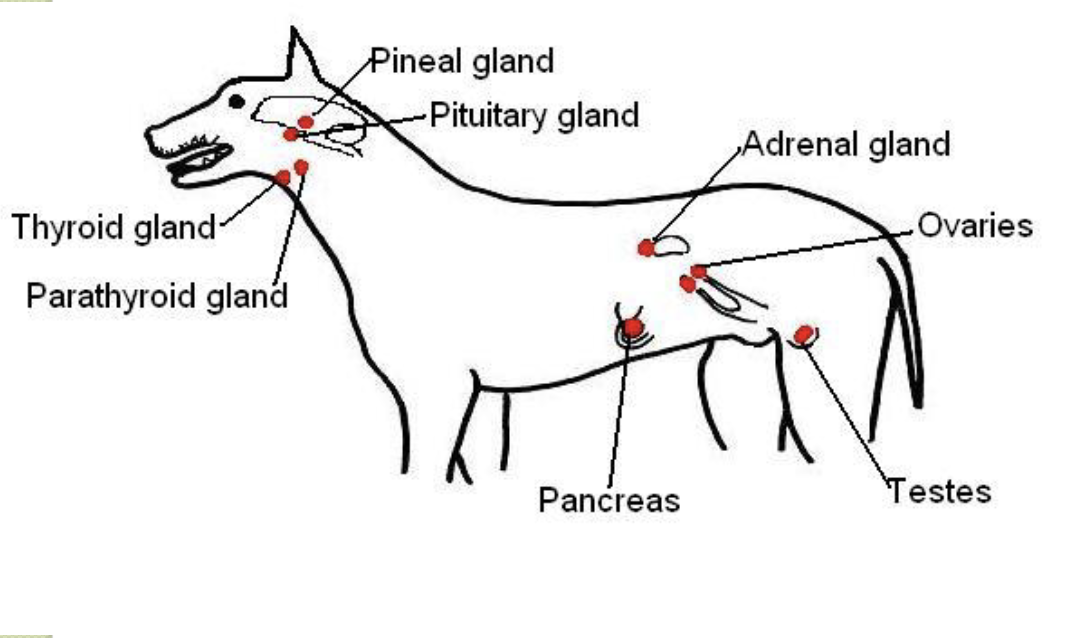
what organs are primarily endocrine organs
pituitary, pineal gland, thyroid, parathyroid, and adrenals
what organs are endocrine but have other functions
pancreas, testes, ovaries, placenta
what organs have small endocrine components
kidney, liver, thymus, heart, GI tract
what are the endocrine organs from cranial to caudal
pituitary gland
pineal gland
thyroid / parathyroid
pancreas
adrenal gland
ovaries
testes
anterior pituitary gland produces what hormones?
GH, TSH, LH, FSH, ACTH, prolactin, MSH