NASM Ch 7 Muscular Force
 Call Kai
 Learn
Learn Practice Test
 Spaced Repetition
 Match
Match Flashcards
 Knowt Play
1/124

There's no tags or description
Looks like no tags are added yet.
Name | Mastery | Learn | Test | Matching | Spaced | Call with Kai | Chat |
|---|
No analytics yet
Send a link to your students to track their progress
125 Terms
force
An influence applied by one object to another, which results in an acceleration or deceleration of the second object.
length-tension relationship
The resting length of a muscle and the tension the muscle can produce at this resting length.
resting length
The length of a muscle when it is not actively contracting or being stretched.
force
characterized by magnitude (how much) and direction (which way they are moving)
the actin and myosin filaments within the sarcomere have the greatest degree of overlap
Each muscle in the body has an optimal muscle length at which
Myosin forms the maximum number of connections with actin, allowing the muscle to produce its greatest force.
What happens when a muscle is at its optimal length?
Force production decreases at both extremes.
What happens to force production when a muscle is extremely shortened or extremely lengthened?
It has chronically low neural activation.
What is typically true about the neural activation of an overly lengthened muscle?
Actin and myosin overlap too much, leaving no room for further movement between the filaments.
Why does an overly shortened muscle produce less force?
It has chronically high neural activation and remains in a contracted state.
What is typically true about the neural activation of an overly shortened muscle?
When it is at its optimal length, where actin and myosin have the ideal amount of overlap.
When can a muscle produce the greatest amount of force?
muscle balance
When all muscles surrounding a joint have optimal length-tension relationships, allowing the joint to rest in a neutral position.
altered length-tension relationship
When a muscle’s resting length is too short or too long, reducing the amount of force it can produce.
reciprocal inhibition
When an agonist receives a signal to contract, its functional antagonist also receives an inhibitory signal allowing it to lengthen.
altered reciprocal inhibition
Occurs when an overactive agonist muscle decreases the neural drive to its functional antagonist.
muscle imbalance
When muscles on each side of a joint have altered length-tension relationships.
neutral position
The optimal resting position of a joint that allows it to function efficiently through its entire normal range of motion.
The antagonist relaxes and lengthens to allow movement.
What happens to the antagonist when the agonist contracts and shortens?
So movement can occur at the joint.
Why must the antagonist relax when the agonist contracts?
Neither side pulls harder than the other, keeping the joint in an optimal position.
What happens when all muscles surrounding a joint have optimal length-tension relationships?
They allow the most efficient movement.
What is the benefit of optimal length-tension relationships around a joint?
One side becomes overactive and pulls too much, while the other side becomes lengthened with reduced actin/myosin overlap, placing the joint in a suboptimal resting position.
What happens when muscles around a joint become imbalanced?
A joint being held in a suboptimal position due to muscle imbalances.
What causes poor posture?
The hip abductors (gluteus medius) become lengthened.
What happens if the hip adductors become shortened and overactive?
A knock-kneed posture.
What posture can result from shortened hip adductors and lengthened hip abductors?
It places unnecessary stress on the joints, leading to discomfort and an increased risk of injury.
Why is a knock-kneed posture a problem?
It has elevated neural activity and stays in a constant state of contraction.
What happens to a chronically overactive muscle?
It has inhibited neural drive and does not activate enough.
What happens to a chronically underactive muscle?
The overactive muscle pulls the joint too much in one direction, while the underactive muscle cannot resist the pull.
How do overactive and underactive muscles create a muscle imbalance?
To identify muscle imbalances.
Why are posture assessments performed?
Flexibility techniques to reduce muscle overactivity.
What technique is used for overactive muscles?
Strengthening techniques to improve neural activation.
What technique is used for underactive muscles?
To restore optimal length-tension relationships, balance around the joint, and a neutral joint position.
What is the goal of correcting muscle imbalances?
stretch-shortening cycle
Loading of a muscle eccentrically to prepare it for a rapid concentric contraction.
series elastic component
Springlike noncontractile component of muscle and tendon that stores elastic energy.
amortization phase
The transition from eccentric loading to concentric unloading during the stretch-shortening cycle.
stretch reflex
Neurological signal from the muscle spindle that causes a muscle to contract to prevent excessive lengthening.
integrated performance paradigm
To move with efficiency, forces must be dampened (eccentrically), stabilized (isometrically), and then accelerated (concentrically).
a rubber band
what is an example of the stretch-shortening cycle?
plyometric training
Use of the stretch-shortening cycle in exercise is the basis for _ , in which jump-landing tasks eccentrically load the muscles (the landing) to achieve a more explosive concentric contraction (the jump)
plyometric training
When executed properly, this type of training helps produce the necessary neural and muscular adaptations to improve speed, power, and sport-specific improvements
force-velocity curve
describes the inverse relationship between force and velocity and refers to a muscle’s ability to produce tension at differing contraction velocities.
Force production decreases.
What happens to force production as the velocity of a concentric muscle action increases?
Force production increases.
What happens to force production as the velocity of a concentric muscle action decreases?
Force production increases.
What happens to force production as the velocity of an eccentric muscle action increases?
The elastic components of the muscle and connective tissue help store and release energy, similar to the stretch-shortening cycle.
Why can a muscle produce more force during faster eccentric contractions?
The muscle is able to produce more force to decelerate movement.
What happens during a faster eccentric contraction?
The relationship between muscle contraction velocity and the amount of force produced during eccentric and concentric contractions.
What does the force-velocity curve show?
tendon
A fibrous connective tissue that connects muscle to bone.
force-couple relationship
The synergistic action of multiple muscles working together to produce movement around a joint.
shoulder abduction
the middle trapezius, lower trapezius, and serratus anterior all pull on the scapula (shoulder blade) in different directions to assist with
Muscles contract and pull on tendons, which pull on bones to create joint movement. Muscles can only pull, not push.
How do muscles create movement?
Proper length-tension relationships, joint motion (arthrokinematics), and force-couple relationships around the joints.
What is needed for the HMS to move efficiently?
middle trapezius
in shoulder abduction, which muscle stabilizes?
serratus anterior and lower trapezius
in shoulder abduction, which 2 muscles pull?
joint support systems
Muscular stabilization systems located in joints distal of the spine.
To stabilize the trunk and provide segmental stabilization of the spine.
What is the primary purpose of the local muscular system?
Rotatores, multifidus, transversus abdominis, diaphragm, pelvic floor, and quadratus lumborum.
What muscles make up the local muscular system of the core?
The stabilization system of the core.
What is another name for the local muscular system?
They can contract automatically in anticipation of movement through feed-forward activation.
How can local muscles activate during movement?
lower back pain
Evidence has shown that the feed-forward stabilization effect from the transversus abdominis and internal oblique musculature is delayed among people with
anterior tilting of the pelvis and low-back arch
intrinsic, core stabilizer muscles that are often underactive in individuals with overactive hip flexors cause what?
To create movement by acting as prime movers and transferring forces through the LPHC.
What is the primary function of the global muscular system?
Because it contains larger muscles that initiate movements like pushing, pulling, squatting, and walking.
Why is the global muscular system also called the movement system?
Rectus abdominis, erector spinae, and latissimus dorsi.
What are examples of global muscles?
To transfer forces through the LPHC, create efficient movement, and support the trunk and spine.
What is the main role of the global muscular system during movement?
Deep longitudinal, posterior oblique, anterior oblique, and lateral subsystems.
What are the four subsystems of the global muscular system?
They help coordinate movement and force-couple relationships. Without them, movement efficiency decreases and injury risk increases.
Why are the global muscular subsystems important?
No. Each subsystem is mirrored on the left and right sides of the body.
Are the global muscular subsystems only found on one side of the body?
lower leg, hamstrings, and lower back region
The deep longitudinal subsystem (DLS) includes muscles of the:
ground reaction forces during gait (walking, running).
lower leg and back muscles create a contracting tension to absorb and control:
biceps femoris (hamstring)
during or just prior to the heel strike phase of running, the long head of the _ contracts eccentrically to decelerate knee extension
lower back muscles (erector spinae)
Because the hamstrings attach at the pelvis, forces are transmitted up to the
erector spinae
DLS - red

biceps femoris
DLS - purple

tibialis anterior
DLS - orange
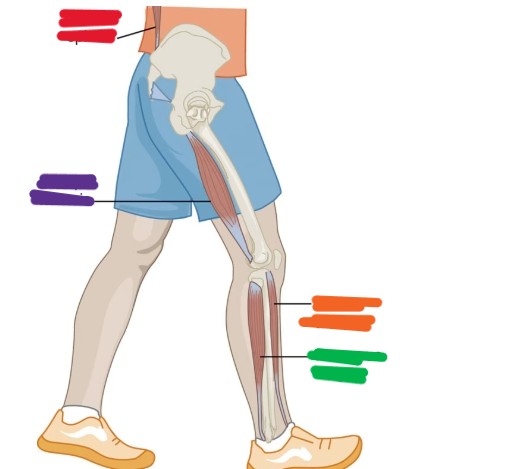
peroneus longus
DLS - green

latissimus dorsi, thoracolumbar fascia (connective tissue of the low-back), and contralateral gluteus maximus.
The posterior oblique subsystem (POS) is made up of the
latissimus dorsi
POS - red

sacroiliac joint
POS - pink

gluteus maximus
POS - green

To stabilize the sacroiliac joint and help transfer force through the body.
What is the main function of the posterior oblique subsystem (POS)?
Latissimus dorsi and the opposite-side gluteus maximus.
Which muscles make up the posterior oblique subsystem (POS)?
The muscles cross diagonally across the body, creating an X pattern that helps stabilize the sacroiliac joint.
Why is the posterior oblique subsystem called an “X” system?
During gait, especially before or during heel strike.
When does the POS work during walking?
To stabilize the trunk, pelvis, and hips while helping create rotational movement.
What is the main function of the anterior oblique subsystem (AOS)?
Obliques, adductors (inner thigh muscles), and hip external rotators.
Which muscles make up the anterior oblique subsystem (AOS)?
The obliques and opposite-side adductors create an X pattern across the front of the body.
Why is the anterior oblique subsystem called an “X” system?
They create rotational force and stability through a global force-couple relationship.
How do the POS and AOS work together?
external obliques
AOS -purple

adductors
AOS - blue

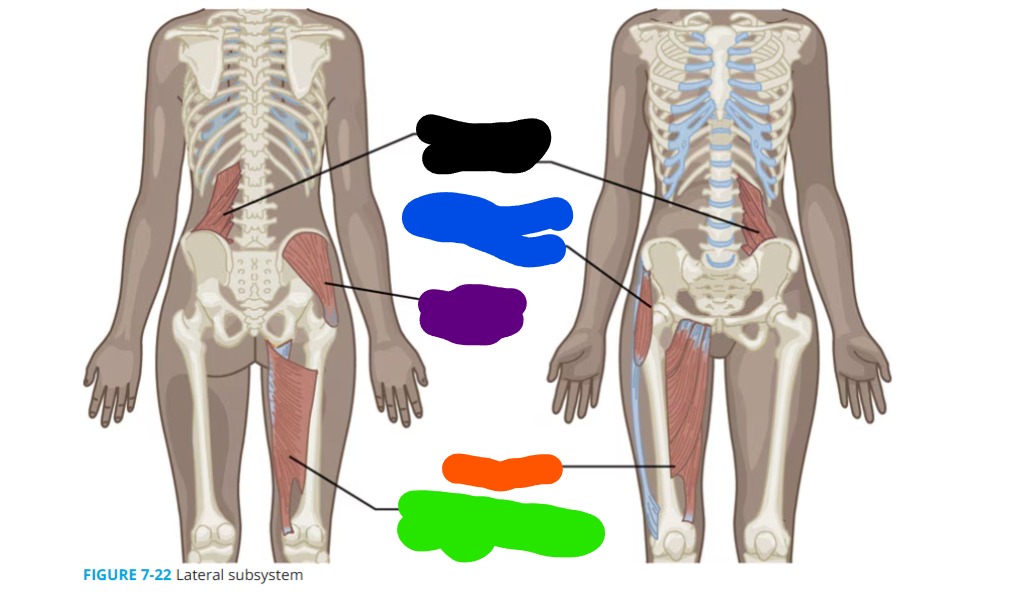
To provide side-to-side (frontal plane) stabilization of the LPHC during movement.
What is the main function of the lateral subsystem (LS)?
Gluteus medius, adductors, and the opposite-side quadratus lumborum.
Which muscles make up the lateral subsystem (LS)?
The frontal plane (side-to-side movements).
What plane of movement does the lateral subsystem control?
Activities with single-leg stance phases, such as walking, running, and lunges.
During what activities does the lateral subsystem work?
Unwanted hip and thigh adduction, such as the knees collapsing inward during a squat.
What does the lateral subsystem help prevent during movement?
Poor lower-extremity alignment, such as knees moving inward during a squat.
What is a sign of an improperly functioning lateral subsystem?
quadratus lumborum
LS - black

tensor fasciae latae (TFL)
LS - blue

gluteus medius
LS - purple