Ch. 1 & 2 Functional Kinesiology & Biomechanics
 Call Kai
 Learn
Learn Practice Test
 Spaced Repetition
 Match
Match Flashcards
 Knowt Play
1/70

There's no tags or description
Looks like no tags are added yet.
Name | Mastery | Learn | Test | Matching | Spaced | Call with Kai | Chat |
|---|
No analytics yet
Send a link to your students to track their progress
71 Terms
Kinesiology
- study of (human) movement
- has interaction with anatomy, biomechanics, and physiology
Kinematics
- motion of a body without regard to the forces or torques that produce the motion (how the body moves and what that looks like)
- we take out the drivers of the motion (muscles) and simply look at how the body moves
- can look at the whole body or a segment
Two Types of Motion
- translation
- rotation
- these relate to kinematics
Translation
- straight line: linear motion, part(s) move parallel to every other part of the body (movement that occurs in a straight line)
- curvilinear: not all translation is in a straight line (walking we track how the COG moves)
Rotation
- the rigid body moves in a circular path about a 'pivot' (looking at movement about a joint, a pivot point or axis of rotation)
- pivot = axis of rotation
- rotational motion occurs around axis
- no rotational motion occurs at axis
- movement is either active or passive
Active Movement
- muscular contraction
- movement is generated through a muscle contraction (eccentric, concentric, etc.)
Passive Movement
- other than muscle
- something else causes the movement (gravity, you got pushed, the person themselves don't cause the movement)
Osteokinematics
- motion of bones relative to 3 cardinal planes
- sagittal, frontal (coronal), and transverse (horizontal)
- bones rotate about a joint in a plane that is perpendicular to an axis of rotation (pivot point runs perpendicular to the plane of motion you're looking at)
Sagittal Plane
- right and left halves
- flexion/extension and dorsi/plantar flexion
- axis is anterior/posterior
- movement path is forward or backward, close to the midline (lunge, bicep curls, bench press)
Frontal (Coronal) Plane
- anterior and posterior portions
- abduction/adduction and ulnar/radial deviation
- axis is medial/lateral
- side to side movements (side lunge, lateral raises, jumping jacks, shuffling)
Transverse (Horizontal) Plane
- superior and inferior portions
- medial (internal) and lateral (external) rotation
- axis is superior/inferior
- movement path is a twisting motion around the body's midline, trunk rotation (trunk twists, russian twists, swinging a bat, throwing a ball
Degrees of Freedom
- number of movements allowed at a joint
- maximum of 3 degrees of angular freedom
1. flexion/extension
2. abduction/adduction
3. medial/lateral rotation
- this relates to kinematics
Open Kinetic Chain
- distal segment is not fixed, the proximal segment is fixed (kicking a ball)
Closed Kinetic Chain
- the distal segment is fixed, the proximal segment is not fixed
- ex: with a squat the foot is fixed on the ground, but there is still flex/ext through the knee
Arthrokinematics
- motion that occurs between articulating surfaces
- 3 different types (roll, slide, spin)
- we're looking at how the convex looks with the concave
- arthrokinemtics and osteokinematics happen together
Roll
- a type of arthokinematics
- multiple/multiple
- multiple points roll across multiple points (imagine the ball)
Slide
- a type of arthokinematics
- single/multiple
- one point is fixed, but it slides across multiple points
Spin
- a type of arthokinematics
- single/single
- one point sits on another and spins on one single point
Concave on Convex
- roll and slide occur in the same direction
Convex on Concave
- roll and slide happen in opposite directions (roll happens in 1 direction and slide happens in another direction)
Close Packed Positions (CPP) at a Joint
- articular surfaces have maximal congruency
- capsules and ligament are taut
- has the least amount of accessory movement
- usually near the end ROM
- joint surfaces are tightly packed together, they line up nicely, structures are tight, not much motion
Loose Packed Positions (LPP) at a Joint
- all other positions from CPP
- greatest amount of accessory movement
- usually greatest near mid-range ROM
- little more give to the joint, you can test integrity better (test a ligament by putting them in an LPP)
Kinetics
- describes the effects of forces on the body
- forces either move or stabilize a body, though if excessive it can cause injury
- several different types of forces (tension, compression, bending, shearing, torsion)
Tension
- a force on the body
- stretches something

Compression
- a force on the body
- pushes things down into each other (squish together)
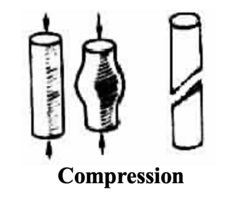
Bending
- a force on the body
- like bending/breaking a pencil

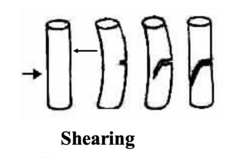
Shearing
- a force on the body
- shear stress -> combination of compression and bending
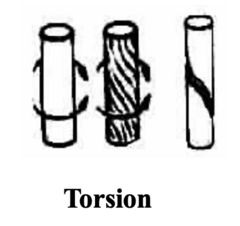
Torsion
- a force on the body
- twisting (like ringing out a washcloth)
Stress-Strain Curve
- shows the ability of a tissue to withstand forces
- shows how a biological tissue reacts to be stretched (tendon)
- strain: increase in length which results in stress
- stress: a way of describing force
Stress-Strain Curve Zones
- elastic zone: tissue is very tight and maintains shape
- plastic zone: some sustained changes to the tissue, once tissue goes plastic it never regains its normal length, we then stretch it so far we get micro failure and it eventually ruptures
- calculate relationship between stress and strain to get stiffness
Viscoelastic
- tissues that exhibit changes with time are considered viscoelastic
- viscoelastic means they have different characteristics
- characteristics of viscoelasticity: creep and rate of loading
Creep
- characteristic of viscoelasticity
- you apply a load to a structure and you maintain that load
- the length/orientation will change
- think of how the apple tree changes
Rate of Loading
- characteristic of viscoelasticity
- the faster the tissue is loaded, the faster it responds
- as the rate of loading increase, the stiffness of the tissue also increases
Viscoelastic Tissue
- tissues that have both elastic and viscous properties -> they influence amount and rate of passive tension
- viscosity and elasticity serve as damping mechanisms
Elasticity
- property of viscoelastic tissue
- muscle is able to store part of the energy used to create stretched state (can be useful in preventing injury)
- elasticity helps so tissue doesn't break each time we load it
Viscosity
- property of viscoelastic tissue
- rate dependent resistance encountered between 2 surfaces of fluid-like tissue
- slow loading gives the tissue time to adapt, fast loading means it changes fast
- there's rate dependency and a protective mechanism
Rate Dependency
- characteristic of viscosity
- internal resistance of muscle to elongation increases with rate of stretch
Protective Mechanism
- characteristic of viscosity
- prolongs the application of force to allow for gradual elongation
Internal and External Forces
- with kinetics, forces may be internal or external
- internal: "within the body", force from our muscles, muscles are torque producers
- external: "outside the body", gravity, imposed load, friction, we then have to do something in response to this
- forces may create translation (goes down) or rotation (axis of rotation)
Muscle Contraction Types
- muscle produces force via 3 types of contractions
- isometric: muscle stays the same length, but there is a contraction
- concentric: the muscle gets shorter with a contraction (flexion)
- eccentric: muscle gets longer with a contraction (extension)
Determining a Muscle's Action
- number of degrees of freedom
- identify the 'line of pull'
- determine the location of the 'line of pull' with respect to the 'axis of rotation'
- muscular actions may change with alternations in joint angle
Muscle and Joint Interaction
- where muscles fall in relation to the joint for orientation and to understand the axis of rotation
Muscular Action Terminology
- agonist: muscles are the prime movers and drivers
- antagonist: not the driver (like flexing the elbow, the triceps does work, but not the major driver of that action)
- synergists: synergy, muscles work together (multiple muscles flex the elbow
- force couple: muscles pulling in different directions causing rotation
Levers
- lever = rod suspended across a pivot or axis
- levers convert force into torque
- 'leverage' = relative moment arm length
- internal and external forces create torques via levers within the body
- 3 types of lever systems
First Class Lever
- the fulcrum/axis of rotation sits in the center (see-saw)
- axis of rotation between opposing forces
- IMA may or may not be > than EMA (> or
Second Class Lever
- axis of rotation is located at the end
- there's very few of these, operates like a wheelbarrow (like a calf raise)
- IMA > EMA (>1)
Third Class Lever
- axis of rotation located at the end
- we have a lot of these, most joints are these, slightly inefficient
- very small IMA, has a very long lever (holding a weight has a long lever, it's far from the axis of rotation)
- IMA < EMA (
Joints
- joint = junction or pivot point between bones
- joint functions: allows movement of the body, transfer/dissipate forces
- integrity of a joint will influence its quality of movement
- movement occurs at the joint, some joints don't move
Classification of Joints
- based on anatomic structure
- synarthroses
- diarthrosis
Synarthroses - Fibrous
- these joints tend to be really stable
- bones are held together by dense irregular CT
- rigid junction
- e.g. sutures of the skull; distal tib-fib joint
Synarthroses - Cartilaginous
- these have little more movement than synarthroses-fibrous
- bones held together by fibrocartilage
- restrained movements
- e.g. inter body joint of spine; pubic symphysis
Diarthorsis - Synovial Joint
- these joints tend to have the same parts
- synovial fluid, articular cartilage, capsule, synovial membrane, ligaments, blood vessels, sensory nerves
- e.g. intra-articular discs, labrum, fat pads, plicae
Synovial Joints
- these are based on mechanical analogy
Hinge Joint
- flexion/extension only
- elbow joint

Pivot Joint
- spin, radius spins, rotating around a fixed point
- bend elbow 90° and flip hands

Ellipsoid Joint
- restricted spin (flattened ball)
- 2 degree of freedom
- the wrist
- flexion/extension and radial/ulnar deviation

Ball and Socket Joint
- the hip and shoulder

Plane Joint
- sliding and gliding
- intercarpal bones (wrist)

Saddle Joint
- saddle has both concave and convex aspects to it, depends on which way you look at it
- sternoclavicular joint

Condyloid Joint
- flattened socket
- 2 degrees of freedom
- the knee
- the condyles of the femur are convex sitting on concave

Simplifying Classification
- 2 types
- ovoid: 1 partner is concave, the other is convex
- saddle: each partner has concave and convex characteristics to it
Connective Tissue Materials
- these are biological materials that form connective tissue within joints
- fibers (collagen, elastin)
- ground substance (glycosaminoglycans, water, solutes, this all fills stuff in)
- cells (osteoblasts break stuff down, osteoclasts build it up
- the proportion and arrangement of all this influences mechanical properties
Connective Tissue in Joint Structures
- these form the structure of joints
- dense CT
- articular cartilage
- fibrocartilage
- bone
Dense Connective Tissue
- capsule, fascia, ligaments/tendons
- high proportion of type 1 collagen
- orientation assists with resisting multiplanar forces
Articular Cartilage
- covers the ends of articulating bones in synovial joints
- 1-7mm thick, low coefficient of friction
- avascular and aneural
- high proportion of type 2 collagen and ground substance
- articular cartilage wears down causing OA
Fibrocartilage
- has properties of both dense irregular CT and articular cartilage
- ideal schock absorber
- labrum, menisci, intervertebral discs
- aneural, peripheral blood supply (the extent to which a structure has blood supply determines how it heals)
Bone
- provides levers and rigid support
- cancellous (spongy) bone, and compact (cortical) bone
- constant remodeling
- greatest strength when loaded via long axis
Connective Tissue Facts
- there's only so much load the tissues and bones can take before it breaks
- specific adaptations to imposed demands (SAID): the body can adapt to loads
- structures react differently depending on their make-up
- ligaments typically get stretched and if it goes too far it can rupture
- ground substance: how much give does it have
Effects of Aging
- process is highly individual, depends on type and frequency of activity, and medical and nutritional factors
- generally there's a decrease in rate of fiber and GAG replacement
- GAGs are smaller and less numerous (decreased hydration, decreased compressive strength, increase in adhesions)
- the key to slowing this all down is eating right and working out (by having a higher activity level, you have a better chance at preserving the quality of tissues)
Immobilization, Trauma, and Arthritis
- immobilization leads to decreased strength and quality of CT, loss occurs quicker than during recovery (use it or lose it)
- trauma can be acute or chronic which heal differently
- arthritis changes how quick we move and overall how we move (OA and RA)
Summary
- three different broad classifications of joints
- synovial joints provide varying amounts of motion and stability
- motions are complex and are influenced by the geometry
- injury can either be acute or chronic
- recovery is influenced by many factors including age, general health, blood supply, etc