The Stomach
 Call Kai
 Learn
Learn Practice Test
 Spaced Repetition
 Match
Match Flashcards
 Knowt Play
1/40

There's no tags or description
Looks like no tags are added yet.
Name | Mastery | Learn | Test | Matching | Spaced | Call with Kai | Chat |
|---|
No analytics yet
Send a link to your students to track their progress
41 Terms

Stomach
What is the stomach and where is it located
The stomach is a hollow muscular sac located in the left upper quadrant under the diaphgram
Funciton of the stomach (3) and what does it produce
Food storage, mechanical digestion by liquifying food, and begining chemical digestion of protein and fat
produces chyme
Chyme
acidic and soupy mixture of semi digested food produced by the stomach
What are the 4 regions of the stomach
cardiac region (cardia), fundic region (fundus), body, and pyloric region
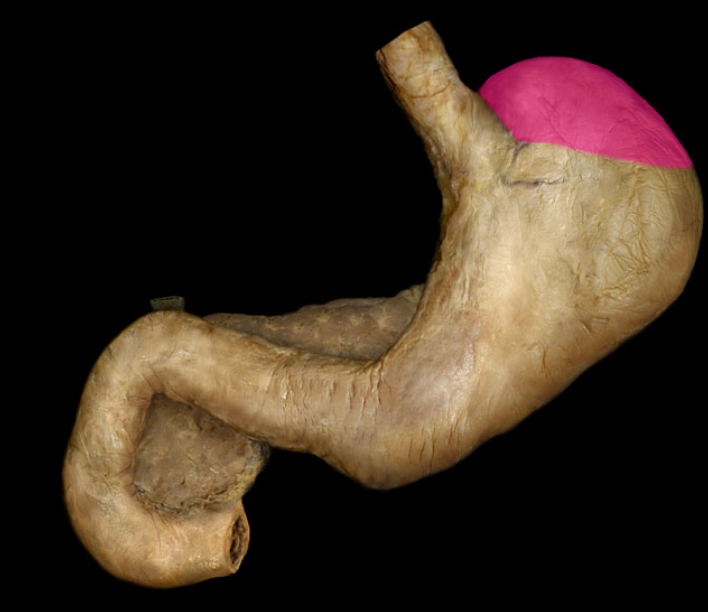
Fundus region of stomach

Body of stomach
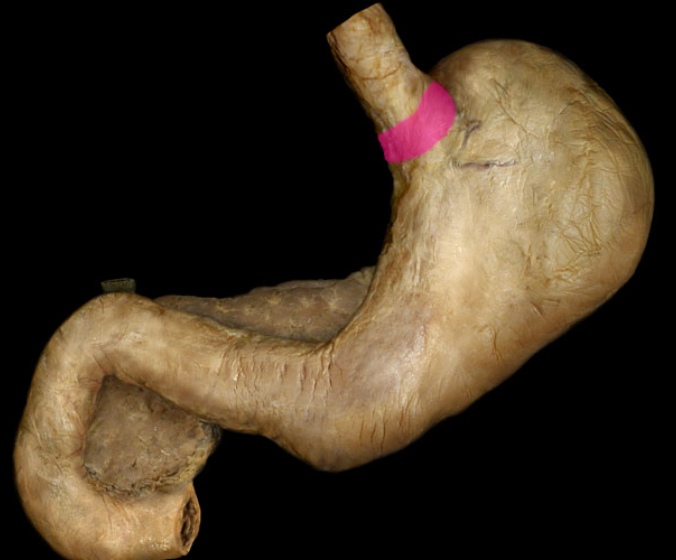
cardia of stomach

Phyloric region of stomach → connecst to the duodenum part of the small intestine
What are the two margins of the stomach
greater and lesser curvature
image is lesser curvature
greater curvature is the other side

Circulation - where does blood going to digestive organs come from
Stomach receives blood from the branches of the celiac trunk (from the aortic artery)
Circulation → where does blood from the stomach and intestine go
hepatic portal circulation → filtered through the liver before returnign to heart
How is the musclaris externa layer from the 4 basic layers (mucosa submucosa musclaris externa and serosa) different in the stomach
There are actually 3 layers instead of 2
before (outer longitudinal, inner circular)
in the stomach → outer longitudinal, middle circular, inner oblique) → stronger and better churning
Gastric rugae
folds of the mucosa and submucosa layer of the stomach → folds when stomach is empty and flattens when stomach is full to expand

Mucosa of the stomach produces what
mucus that traps bicarbonate rich fluid
Mucosa of stomach contains what
Gastric pits that lead into tubular glands

Gastric Pits and what do they have
Depressions on the gastric mucosa (deepest layer of the mucosa) → each has 2-3 tubular glands at the bottom
Gastric glands/ tubular glands
glands at the bottom of gastric pits that contain different cells that produce gastric juice
What are the three types of gastric glands
cardiac, pyloric, and gastric glands
What are the four gastric pit cell types (in the glands)
mucosa, parietal, chief, and enteroendocrine cells
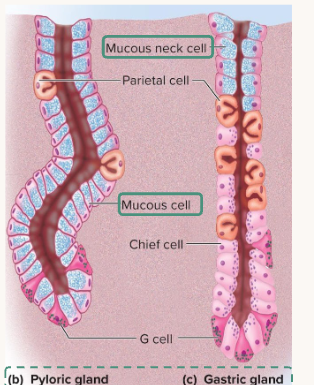
mucous cells secrete what + in which glands
secrete mucous
mainly in pyloric and cardiac gland
called mucosal neck cells in gastric glands because they get stuck at neck

What 3 things do parietal cells secrete
intrinsic factor, ghrelin, and HCl
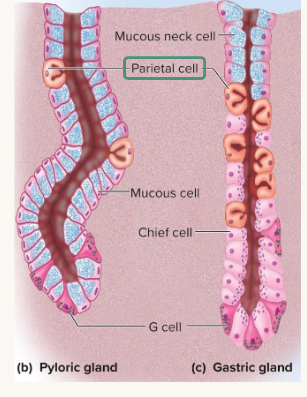
Which cell secretes this and what do each of these do
ghrelin, intrinsic factor, HCl
Parietal cells
Intrinsic factors→ allows small intestine to absorb vitamin b12
ghrelin - hunger hormone
HCl (really acidic)- denatures protein, kills bacteria, and activate pepsin
Chief cells - what do they secrete (2) which do what
Pepsinogen → pepsin → gets activated by HCl to take part in digestion of mainly protein
pepsin can activate more pepsin (positive feedback)
Gastric lipase → digests fat

Which glands are chief cells in
In the lower half of gastric glands - none in cardiac or pyloric gland

Enteroendocrine cells - also called what - release what
also called G cells
secrete chemical messengers
Paracrine - histamine and seretonin
Hormone - G cells (gastrin and somatostatin) that regulate mobility and secretion
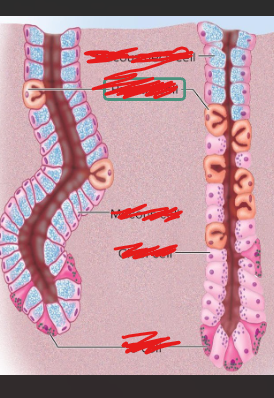
which cells are which (left is pyloric and right is gastric gland)
blue, light pink, dark pink, orange
blue - mucus, light pink is chief cell, dark pink is G (enteroendocrine) cell, and orange is parietal cell

which gland is which left and right
left is pyloric gland because it doesn’t have chief cells
right is gastric gland because it has all 4 cells and the mucous cells are at the neck
How does the stomach protect itself from gastric juice (pepsin, HCl) and not digest itself → 3 things
what happens if they fail
mucous (traps bicarboniate rich fluid under it), tight junctions, epithelial cell replacement
failure → inflmation / ulceration
What two system regulates gastric motility and secretion and what is the goal
endocrine and nervous system
increase gastric secretion and motility when there is food and limit them when there isn’t
What are the three phases that control gastric activity and what does it mean that thye are concurrent
cephallic, gastric, intestinal
concurrent - happening at the same time
Cephalic phase of gastric control
cephalic = head/ brain
stimulus comes from inside or outside GI tract like senses or thinking about food → CNS → hypothalamus → medulla oblongata → vagus nerve → enteric nervous system → stimulates gastric secretion
Gastric phase of gastric control
Presence of food in stomach = stimulus
stretches the stomach and activates short myenteric reflex (through myenteric plexus) and long vagovagal reflex (through vagus nerve)
this increases gastric secretion
ACh, histamine, gastrin
stimulates gastric secretion in the gastric phase (in stomach)
Receptive-Relaxation (Reflex-Mediated) Response
when swallowing → brain → vagus nerve tells stomach to relax to make room
resist stretching then relaxes
Gastric accomodation - stress relaxation response
allows muscle to stretch without contracting reflexively (immediately)
Enteric pacemaker cells (cells of cajul) → BER
cells in the stomach that produce basic electrical rhythm → produces peristaltic waves → push chyme from fundus to pylorus
some chyme gets pushed from pylorus of stomach to duodenum of small intestines while most of it gets sent back to the stomach (which helps with mixing)
Intestinal phase of gastric control
chyme enters duodenum of intestine and regulates the gastric activity through hormones and reflexes
Intestinal phase - stimulatory (what is it and what ar ethe two)
sends chyme down to intestines faster
vagovagal reflex
gastrin enzyme
Intestinal phase - inhibitory (what is it and what are the 3)
slows down gastric activity (chyme entering intestine slower)
entericgastric reflex
secretin
cck
Emesis + involve what center where
Vomitting - > protective reflex
involves emetic center in medulla
forces food out of stomach