M1: Introduction and Organizing Principles
 Call Kai
 Learn
Learn Practice Test
 Spaced Repetition
 Match
Match Flashcards
 Knowt Play
1/25

There's no tags or description
Looks like no tags are added yet.
Name | Mastery | Learn | Test | Matching | Spaced | Call with Kai | Chat |
|---|
No analytics yet
Send a link to your students to track their progress
26 Terms
What are biomolecules?
Building blocks for functional cells, tissues, and organs.

What is an example of a structure/function relationship in biology?
Mitochondria have specialized folds (cristae) that increase surface area for proteins involved in mitochondrial respiration.

What are the levels of biological organization?
Chemical level, cellular level, tissue level, organ level, organ system level, organism level.

What are the characteristics of life?
Energy production/consumption, growth/repair, reproduction, adaptation, response to stimuli, survival of the species.
What are the three components that all cells comprise?
A membrane, genetic material (e.g., DNA), and cytosolic fluid.
What are the four major categories of tissue?
Connective, epithelial, muscle, and nervous tissue.
What is the function of epithelial tissue?
Lines walls of open tubes and provides secretory and absorptive surfaces.
What is the role of connective tissue?
Provides support and integrity for other tissues/organs.
What are the three types of muscle tissue?
Skeletal (voluntary), smooth (involuntary), and cardiac (involuntary).
What is the primary function of the nervous tissue?
Provides long-distance communication within the body.
What organs are included in the integumentary system?
Skin, hair, nails, sweat, and oil glands.
What is the main function of the endocrine system?
Coordination of body functions through hormone secretion.
What is the anatomical position?
Standing upright, feet together, eyes facing forward, arms by the side, palms facing forward.
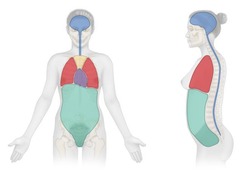
What does the cranial cavity contain?
The brain.
What is the function of the thoracic cavity?
Contains the trachea, bronchi, lungs, esophagus, heart, and thymus.
What is homeostasis?
Regulation of the body's internal environment to maintain stable conditions.
What is a homeostatic set point?
Established thresholds required for physiological processes to maintain balance.
What is the difference between negative and positive feedback?
Negative feedback returns to the homeostatic set point; positive feedback increases the original stimulus.
What is intracellular fluid (ICF)?
Fluid inside cells.

What can fluid imbalance lead to?
Dehydration of cells, imbalance in ion concentrations, and potential cell death.
What is the difference between homeostasis and equilibrium?
Homeostasis is a dynamic steady state, while equilibrium is a static condition.
What are the mechanisms of fluid movement in the body?
Colloid osmotic pressure and hydrostatic pressure.

What is the role of capillary filtration?
Regulates the movement of plasma and nutrients out of and into capillaries.
What is the function of the urinary system?
Filtration of blood and removal of waste.
What organs are part of the respiratory system?
Nasal passages, trachea, and lungs.
What is the primary function of the cardiovascular system?
Movement of blood throughout the body.
