Reflection and refraction
 Studied by 0 people
 Call Kai
 Learn
Learn Practice Test
 Spaced Repetition
 Match
Match Flashcards
 Knowt Play
1/3

There's no tags or description
Looks like no tags are added yet.
Name | Mastery | Learn | Test | Matching | Spaced |
|---|
No study sessions yet.
4 Terms
What 4 things could happen when a wave hits a boundary of a different material?
It can be transmitted straight through
The energy can be absorbed and it won’t transmitted
It can be reflected
It can refract
Give the method for the reflecting and refracting required practical
Take a piece of paper and draw a straight line down the centre
Use a protractor to the line at a right angle. Label this the normal
Place a glass block against the first line so that the normal is near the centre of it.
Draw a line around the perimeter or the glass block and turn off all the lights.
Use a raybox to direct a ray of light so it hits the block at the normal
At a certain angle we will be able to see a ray being reflected off the box and one being transmitted through. Draw all these lines
Use a protractor to measure all the important angles
Repeat the entire experiment with blocks of different materials
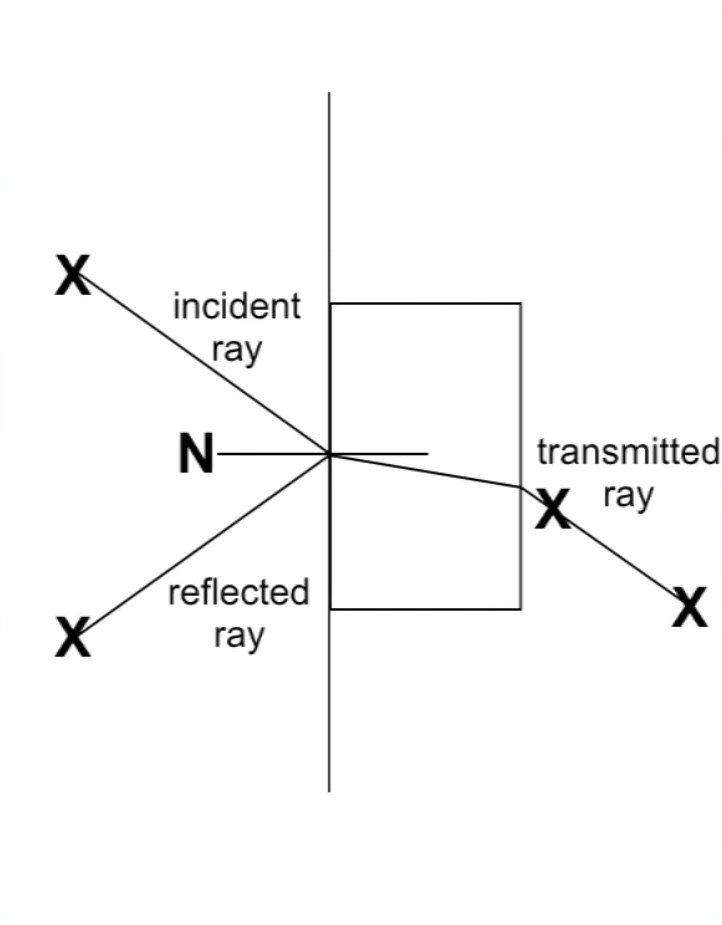
What will be the results?
The angles of incidence and the angle of reflection should be the same for whatever material.
The angles of refraction will be different depending on the material.
Angle of incidence =
Angle or reflection