Unit 10: Thermochemistry
 Call Kai
 Learn
Learn Practice Test
 Spaced Repetition
 Match
Match Flashcards
 Knowt Play
1/15

There's no tags or description
Looks like no tags are added yet.
Name | Mastery | Learn | Test | Matching | Spaced | Call with Kai | Chat |
|---|
No analytics yet
Send a link to your students to track their progress
16 Terms
bond enthalpy
energy required to break a bond
Reactants - Products
(The sum of )Σ (bonds broken) - Σ (bonds formed) =
△ H (change in heat)
Exothermic
- △ H
Energy released
Temperature increases
(surroundings) feels hot
Endothermic
+ △ H
Energy absorbed
Temperature decreases
(surroundings) feels cold
Writing thermochemical equations
1. Write the chemical equations from its words
2. Add the amount of energy on to the product or the reactant side
If energy is released, then it is a product, it is an exothermic reaction
If the energy is absorbed, then it is a reactant, it is an endothermic reaction
△ H is in KJ/mole rxn
Thermochemical equations and Stoichiometry
1. Using the energy attached to the balanced equation, solve for either the heat (kilojules) or the grams
Grams to amount of energy conversion
Grams --> Moles --> Kj
To get from Grams to Moles use molar mass
To get from Moles to Kj, use the △H provided in the thermochemical equation
Amount of Energy to grams conversion
Kj --> Moles --> Grams
To get from Kj to Moles use the △H provided in the thermochemical equation
To get from Moles to Grams, use the molar mass
Energy diagrams
Visual representation of energy changes in reactions.
Activated complex in energy diagrams
The highest point of energy that a reaction goes through/to
Activation Energy in energy diagrams
It is the amount of energy needed to start a reaction
to calculate this on the graph, activation complex - reactants
△ H in energy diagrams
To calculate this in energy diagrams, it is the products - the reactants
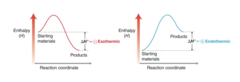
Exothermic vs. Endothermic reactions in energy diagrams
Endothermic reactions: the products are above the reactants and △ H > 0 and is positive
Exothermic reactions: the products are below the reactants and the △ H < 0 and is negative
Specific heat
the heat required to raise the temperature of one gram of a substance one degree celcius
Specific heat calculations
Q = m x C x ΔT
Q: heat/energy in joules (J)
m: mass (grams or kilograms)
C: specific heat (J/kilogram or g °C)
ΔT: change in temp; final - initial
Hess's Law
the overall enthalpy change in a reaction is equal to the sum of enthalpy changes for the individual steps in the process
Hess's Law steps
1. Use the 3 given balanced equations to make up your goal equation
1a. Modify given balanced equations (multiply, divide, flip) as well as do the same with the △ H that comes with it
1b. Add the newly created given equations together (cancelling out if opposite sides and bringing it down if the same side) to form the goal equatiion
Equation multiplied △ H multiplied
Equation flipped △ H negative
1c. As you add up the newly created given equations, add up the △ H