Lecture 14: Vascular Plants
 Call Kai
 Learn
Learn Practice Test
 Spaced Repetition
 Match
Match Flashcards
 Knowt Play
1/15

There's no tags or description
Looks like no tags are added yet.
Name | Mastery | Learn | Test | Matching | Spaced | Call with Kai | Chat |
|---|
No analytics yet
Send a link to your students to track their progress
16 Terms
Tracheophytes
Vascular plants
possess tracheids
major plant organs: stems, roots, leaves
Can be non-seed producing or seed-producing
Represent ~90% of all plant life
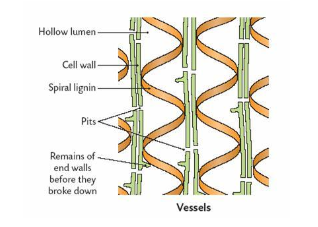
Thracheid
Elongated overlapping tubes with pits. Assists with structural support
Lignin
Provides stiff, structural support. Allows turgor pressure (vacuole can have death, normal, or turgor shape to know water needed)
Vascular tissue
Xylem and phloem to transport water, nutrients, and food throughout organism
Xylem
Moves water and dissolved minerals from the roots to the rest of the plant
moves in one direction

Phloem
Transports food produced by photosynthesis from the leaves to other parts of the plant
Moves in two directions

Stems
Produce leaves and sporangis
Contain phloem and xylem (also contains tracheids and lignin)
Roots
Specialized for uptake of water and minerals from the soil
Leaves
Photosynthetic function
Waxy cuticle
Prevents desiccation
adaptation to conserve water
Contains cutin
Cutin
Component of the cuticle; also helps block pathogens
Stomata
Pores that open and close to allow gas exchange while minimizing water loss
“guard” cells
Microphyll
(aka lycophyll)
Simplest, most ancient leaves
seen in lycophytes
only a single, unbranched strand of vascular tissue
Euphyll
(aka megaphyll)
Leaves that have multiple veins, usually branching one or more time in leaf
larger size is more advantageous
evolved in a series of steps
Rhizome
Characteristically horizontal stem of a plant that is usually found undergound, often sending out roots and shoorts out from nodes
present in lycophytes, pteridophytes, and angiosperms
Apical meristems
Regions of actively dividing plant cells that drive primary vertical growth