Short Asian Art Unit
0.0(0)
Studied by 1 person Call Kai
 Learn
Learn Practice Test
 Spaced Repetition
 Match
Match Flashcards
 Knowt Play
Card Sorting
1/60

Earn XP
Description and Tags
Last updated 7:38 PM on 3/7/23
Name | Mastery | Learn | Test | Matching | Spaced | Call with Kai | Chat |
|---|
No analytics yet
Send a link to your students to track their progress
61 Terms
1
New cards
Emphasized living ethically within societies boundaries
Taoism and Confucianism
2
New cards
Influenced Chinese religions and stressed living in harmony with nature and one another
Buddhism
3
New cards
How is architecture best expressed?
Religious temples, shrines, and rock temples
4
New cards
What was Indian painting often done in/for?
Miniatures for court patrons
5
New cards
What were the ancient belief systems that spread through Asia that later developed into Hinduism and Buddhism called?
Indic
6
New cards
What survived from china and India?
Ancient ceramics
7
New cards
Buddhism as a visual art form is reliant on what
Religious images and narratives
8
New cards
What was the key to the spread of artistic styles
Silk Road
9
New cards
Asian art shows…
The interconnectivity of regional schools in the wider world
10
New cards
Did Asian art heavily influence European art?
Yes
11
New cards
Indian life today
Layering of disparate populations to create a cosmopolitan culture. Fertile Ganges and Nile river.
12
New cards
Describe Indian rulers
Extremely generous in patronage to commission pieces that glorified themselves and enhance civil and religious life.
13
New cards
Indians are highly organized in their approach to artistic training
Train apprentices in workshops. One artist as team leader in bigger monuments. Ensured iconography agreed with texts and diagrams.
14
New cards
Dominant religion of Southeast Asia
Buddhism
15
New cards
What is the goal of every Buddhist
Reject worldly concerns and end the cycle of suffering and achieve oneness with the supreme spirit to escape endless cycle.
16
New cards
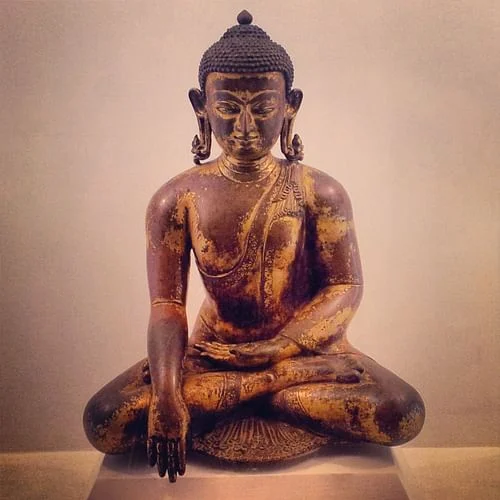
Who is the historical Buddha?
***Siddhartha Gautama***
17
New cards
Why is Siddhartha Gautama the most sacred
He was carved by Vishwakarma, a celestial architect. During his time there was only one strain of Buddhism which later evolved.
18
New cards
When was Buddhism founded
5th or 6th century
19
New cards
What was Jowo Rinpoche believed to be?
The physical representation of Siddhartha Gautama before he left this world. Believed to be the first and most accurate representation but this is highly unlikely. Believed to be brought to Tibet in 631 CE
20
New cards
Jowo Rinpoche materials
Gilt metals, semi precious stones, pearls, paint, various offerings.
21
New cards
Why was Jowo Rinpoche unusual?
Thought to be blessed by Buddha himself
22
New cards
Regeneration and fertility are often symbols depicted on images found in
Indian Temples
23
New cards
Audience response of Jowo Rinpoche
People leave gold and goods to gain Buddha’s blessing
24
New cards
Was Jowo Rinpoche modified?
Yes, but the pose is thought to be the same
25
New cards
Describe Jowo Rinpoche’s hands
Left hand in mundra of meditation and right hand is the gesture of calling the earth to witness. Shows moment of Buddha’s enlightenment
26
New cards
When was Afghanistan Buddha created and destroyed?
400-800 CE, 2001
27
New cards
Materials for Afghanistan Buddha
Cut rock with plaster and polychrome paint
28
New cards
How many rock cut Buddhas were there
Two rock cut Buddhas in Bamiyan Valley, Afghanistan
29
New cards
Difference between big Buddha and smaller Buddha
Smaller=Historical
Bigger=Universal
Bigger=Universal
30
New cards
Who did and didn’t destroy the Afghanistan Buddhas?
Genghis Khan destroyed everything but the Buddhas, and the Taliban destroyed them bc of iconoclastic reasons.
31
New cards
Why were there caves by the Afghanistan Buddhas?
For accommodations for people along the Silk Road. People could walk around the feet. Could see niche halo.
32
New cards
Where is the Afghanistan Buddhas located in relation to the Silk Road?
India and Southeast Asia. Goods and ideas were traded and these caves were a place to practice. One of the biggest sculptures of Buddha.
33
New cards
What styles did the Afghanistan Buddhas blend?
Hellenistic Greco-Roman, Central Asia, and Indian converging cultures.
34
New cards
Who made the Ardabil Carpet and out of what?
Maqsud of Kashan with silk and wool in 1540 ce
35
New cards
What was the function of the Ardabil Carpet
For prayer, found in a funerary mosque
36
New cards
Visual Analysis Points for Ardabil Carpet
Medallion in center represents dome with 16 pendants
Two lamps hang from these pendants, different sizes to show perspective or that only god is perfect.
Corner synches also have pendants to give the feeling of looking into a dome
Two lamps hang from these pendants, different sizes to show perspective or that only god is perfect.
Corner synches also have pendants to give the feeling of looking into a dome
37
New cards
Was the Ardabil carpet one of two?
Yes
38
New cards
Where does Islam art dominate
West Asia and South Europe
39
New cards
Who were the patrons in Islamic art
Royal and religious figures
40
New cards
What influences Islam art
Trade, economically and culturally, with surrounding traditions and regions
41
New cards
Where is Islam the dominant religion as it unites a diverse region and is spread through pilgrimages
North Africa, West Asia, and Spain
42
New cards
What does Islam art contain and not contain
Tessellation, calligraphy, arabesques but not figures
43
New cards
Islamic figuratively Art flourishes where?
Persian secular writings
44
New cards
Characteristics of Islamic Art
Avoid perspective, two-dimensional, and have arabesque and geometric designs
45
New cards
Whose message resonated deeply with Arabs in the seventh century?
The prophet Muhammad
46
New cards
The Islamic world expanded under who’s rule in Baghdad?
Abbasid Caliphate
47
New cards
Why is calligraphy highly valued in Islamic Art?
It was used to to transmit the texts revealed from God to Muhammad.
48
New cards
What materials were used for The Court of Gayumars?
Ink, gold on paper, opaque watercolor
49
New cards
What is The Court of Gayumars part of?
The Shahnama (Book of Kings) which is a Persian epic poem telling the ancient history of Persia with many folios and miniature paintings.
50
New cards
What was the point of the Shahnama?
To be read together and not collected individually.
51
New cards
Why is The Court of Gayumars unique to Islamic art?
It has figures, but other periods of iconoclasm were allowed.
52
New cards
What is depicted in the court of gayumars?
the king sits cross-legged as if levitating above his courtiers. THis is a depiction of the first Persian King, who ruled when people covered themselves in only leopard pelts
53
New cards
Does the court of gayumars show multiple perspectives or multiple minutes in time
Both
54
New cards
Why is the court of gayumars different than other Islamic pieces?
Calligraphy wasn’t the focal point and it blends the painting techniques of Tabriz and Herat
55
New cards
Time period for Court of Gayumars
1522 ce
56
New cards
Time period for Bahram Gur Fights the Karg
1310-1340 ce
57
New cards
Materials for Bahram Gur fights the Karg
Ink and watercolor, silver on paper, gold
58
New cards
Who is Bahram Gur and how is he represented?
An ancient Iranian king who represents the ideal king with a golden halo and crown. He fought the unicorn Karg on his trip to India.
59
New cards
How does Bahram Gur fights the Karg show crossover between cultures?
Bahram Gur is wearing european clothes
Paper is a Chinese invention from the 8th century
Local depictions of riding horses over slain opponents
Asian influence with twisted trees, overlapping forms, and asymmetrical compositions
Paper is a Chinese invention from the 8th century
Local depictions of riding horses over slain opponents
Asian influence with twisted trees, overlapping forms, and asymmetrical compositions
60
New cards
61
New cards