Visual and taste perception
 Call Kai
 Learn
Learn Practice Test
 Spaced Repetition
 Match
Match Flashcards
 Knowt Play
1/50

There's no tags or description
Looks like no tags are added yet.
Name | Mastery | Learn | Test | Matching | Spaced | Call with Kai | Chat |
|---|
No analytics yet
Send a link to your students to track their progress
51 Terms
Define attention
Attention refers to the process of focusing on specific stimuli in our sensory environment.
Define sustained attention and provide example
Sustained attention refers to the maintenance of attention on a specific stimulus or task for a continuous period of time without being distracted.
Examples: Studying for a test, reading a book
Define divided attention and provide an example
Divided attention involves distributing our attention so that two or more activities may be performed simultaneously.
Examples: Eating dinner whilst watching the news, watching Tv whilst doing homework.
Define selective attention and provide an example
Selective attention involves choosing and attending to a specific stimulus whilst at the same time excluding other stimuli. You select what you want to pay attention too and ignore less relevant stimuli.
Examples: Studying in a noisy room and choosing to focus on your books, reading a book on a noisy bus, choosing to focus your atttention on the book.
Define perception
The process of interpreting and giving meaning to sensory information such as smell, taste, etc.
2 types of perception studied:
VISUAL and TASTE perception
Define top down processing and provide an example
Involves starting at the top with higher level processing in the brain, work down from the whole to the details.
This is driven by mental processes, such as your knowledge, experiences & expectations. (What you expect to see, rather than your sensations)
Example: Deciphering details at night time, you decide what something is based on what you expect to see, rather than your sensations.
Define bottom up processing and provide an example
Involves starting at the bottom with raw sensory info that is sent up to the brain for high level mental processing.
This is driven by processing raw stimulus information that entirely relies on this sensory input. (You rely on your senses rather than your expectations)
Example: deciphering details at night time, you rely on sensory details then your experiences to interpret what you see.
Examples of top down processing in gustatory processing
Involves us drawing on our experience and expectations to shape our perceptions.
Example: if you sneak the smallest taste of your favourite dinner that’s cooking on the stove, you will perceive the full flavour and taste of that dish due to past experience and memories
Examples of bottom up processing in gustatory processing
Involves us using a range of salient sensory data, using our sense of smell as well as taste, to form our perceptions.
Example: if we were to taste the something cooking on the stove, we would combine the hot temperature felt in the small taste, the smell of the spices and the bubbling sounds to perceive the flavour.
Define visual perception
Visual perception refers to the brain's ability to receive, organise, and interpret what the eyes see.
Biological perspective to visual perception
Explains how we see and make sense of images through the physical structures of the eyes, nervous system, and brain.
3 factors of biological perspective to visual processing
Depth perception
Binocular depth cues
Monocular depth cues
Biological perspective to visual perception- Depth perception
The ability to accurately estimate the distance of objects and therefore perceive the world in 3 dimensions.
Biological perspective to visual perception- Binocular depth cues
Requires the use of both eyes working together in order to provide information to the brain about depth and distance.
2 types of cues: Retinal disparity, and convergence.
Define retinal disparity
Involves comparing the two images that reach the brain, one from the left eye and one from the right allowing the brain to figure out how far away the object is.
The brain overlaps the two images it receives, and the differences (disparity) between them provides the brain with information about the depth and distance of the object.
The greater the disparity the closer the image.
Define Convergence
Convergence is only based on the physical changes in the eyeballs and the muscles around the eye. (Ciliary muscles)
The closer an object is to our face, the more our eyes turn inwards towards the centre of our face to keep the object in focus.
The brain measures the amount of turning in, by monitoring the muscle movement around the eye, the greater the turning in the closer the object.
Biological perspective to visual perception- Monocular depth cues
Monocular depth cues require only one eye to send information to the brain to perceive depth.
Types of monocular depth cues: Accomodation, pictorial depth cues
Define accomodation
This depth cue involves the brain’s interpretation and measurement of the ciliary muscles, and the amount of contraction or relaxation taking place.
When an object is close the ciliary muscles contract, causing the lens to bulge, which in turn keeps the object in focus.
When an object is further away, the ciliary muscles relax, causing the lens to elongate, keeping the object in focus.
Define pictorial depth cues
Pictorial depth cues includes visual information used in flat, 2D drawings, paintings, or photographs to create the illusion of 3D space and distance.
Include:
Linear perspective
Relative size
Interposition
Texture gradient
Height in the visual field
Linear perspective
When parallel lines move away from the viewer, they give the impression of convergence, or coming together.
Here, we see the 2 parallel lines appearing to converge.

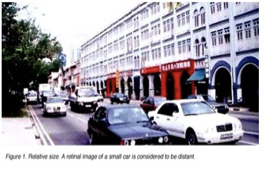
Relative size
This requires 2 similar objects to exist in the visual field. the brain perceives that the smaller version of the object must be further away.
this effect is particularly strong when we are familiar with the ‘normal’ size of the object. (if we know that 2 things are usually similar in size, then if one is smaller it must be further away.)
Here, since we aware that both cars must be similar in size, we know that since one car is noticeably smaller it must be further away.
Interposition
Interposition relies on the understanding that, if two objects overlap in our visual field, then the object that is in front must be closer and the object behind must be further away.
Here, we assume the sun is further away since it is blocked by the star.

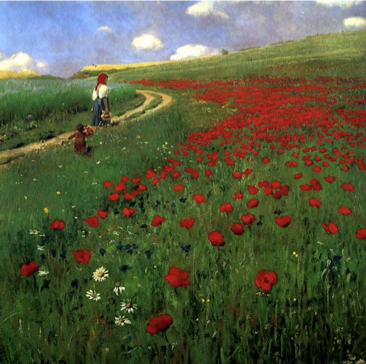
Texture gradient
Texture gradient refers to the amount of detail visible. The greater the detail the closer the object.
Here we can see more details in the bottom flowers, therefore they must be closer.
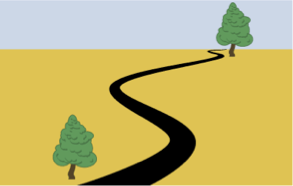
Height in the visual field
Height in the visual field requires us first to identify the horizon.
The closer an object appears to the horizon the further away it is.
Here, the tree that is higher up, and closer to the horizon must be further away.
Psychological perspective to visual perception
These are the rules that we apply to assist us to make consistant meaning to visual information.
We tend to use these rules without thinking about it (unconscious)
Factors of psychological perspective to visual perception- Gestalt principals.
These are a set of visual ‘rules’ which organise visual perceptual features and integrate them into connected patterns or whole forms.
Includes:
Figure ground
Closure
Similarity
Proximity
Figure ground
Involves us determining the existence and then shape of an object based on it’s outline or distinction from its surrounding environment.
We see an object as a figure against its background.
Camouflage occurs when the foreground (object) does not stand out against its background.
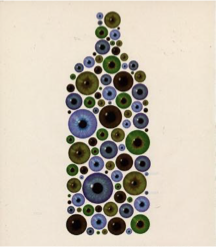
Closure
Involves the brain instinctively draws lines to close gaps and create a whole figure.
Here our brain makes out the image by connecting images and closing the gaps so that we can understand the figure.
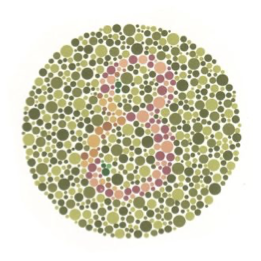
Similarity
Involves the brain grouping colours and shapes together based on their similarities and differences, so that we can distinguish an image.
Here, out brain groups the green circles and the yellow circles together so that we can perceive the image as the number 8.
Proximity
Involves the brain automatically grouping things as “belonging” together when they are close together.
Here out brain automatically groups the circles together as they are closer to each other,

Additional psychological factors affecting visual perception.
Perceptual set
Context
Motivation
Past experience/memory
Perceptual set
Our brains readiness to perceive something in a particular way based on our expectations (What we expect it to be), past experiences, and motivations.
Example: Young children report that McDonald's chips taste better when they come out of a branded McDonald's bag rather than a plain white bag, because their prior association creates an expectation of quality.
Context
Context refers to the setting or environment that a stimulus is viewed in and the influence it has on our perception.
Example: If you are in an airport and you see a bag, you may assume it has a bomb in it, however if you see a bag in a school, you may not think anything of it.
Motivation
The brains perception of an image can be influenced by their desires, meaning we see what they want to see rather than what is actually there.
Example: If you see a tackle at a football game and you are barracking for the player who tackled, you may think it is holding the ball, however if you are barracking for the other team you may think it is a high tackle.
Even though you both saw the same tackle you both interpret it differently based on what you want to see.
Past experience/memory
Our personal experiences may cause people to perceive stimuli in a particular way.
Example: If you see a painting of a dog, you may not think anything of it and perceive it normally, however someone who has been previously attacked by a dog may perceive the painting as scary.
Define perceptual constancies
Perceptual constancies refer to the tendency to perceive a stimulus as remaining constant, despite any changes that may occur to the image cast on the retina.
3 types of perceptual constancies
Size
Shape
Orientation
Size constancy
Size constancy involves the brains recognition that an object’s actual size remains the same despite changes in the size of the retinal image.
Example: If a friend walks away from you, they aren’t actually getting smaller, they are just increasing the distance between you and them.
Shape constancy
The tendency to perceive an object as maintaining its shape despite any change in shape of the retinal image of the object.
Example: If we see a door being opened, although it appears to change shape and be slimmer we know that the door if still the same size, it it just on a different angle.
Orientation constancy
Orientation constancy is the tendency to visually perceive the true orientation of objects in the environment even though the retinal image of the object may be at a different orientation.
Example: If we are hanging upside down on the monkey bars, we will see the world upside down, however we know that the orientation of the world is still the same, we are jut viewing it form a different angle.
Social factors of visual perception
Culture: External social environments influence the way we interact with others.
Experience with or in a particular culture can influence the way we process and interpret visual information.
Example of culture affecting visual perception- Rabbit/Duck image
According to a famous study conducted using this image, if you grew up in an English-speaking culture, or one in which words are read from left to right, you are more likely to have seen a rabbit first.
However, if you grew up in a culture that reads from right to left (as did the Hebrew-speaking participants in this study), you may be more likely to see the duck first.
Define gustation
Our perception of taste.
What are taste receptors?
These are the sensory receptors that detect chemical molecules that enable taste.
Taste receptors are located in the taste buds.
Biological perspective to gustation
Gustation (taste perception) is a multi-sensorial process that relies on information from both our taste buds and our sense of smell.
Includes:
Age
Genetics
illness
What are taste buds
Taste buds are sensory cells in the mouth and throat that send information to the brain for taste perception.
Age factor of biological perspective to gustation
As we age, we do not regenerate taste buds as quickly as they die, therefore sensitivity to taste diminishes gradually with age. (Explains why some older people find the taste of food to be bland)
Genetic factor of biological perspective to gustation
Our sensitivity to certain tastes is genetically determined.
Our genes can therefore influence how sensitive we are to bitterness, sweetness, umami or any other tastes.
Some people have more taste buds than normal and therefore an increased sensitivity to flavours.
Some have fewer taste buds than normal and therefore have a decreased sensitivity to flavours.
Illness factor of biological perspective to gustation
Often, our loss of taste is a common symptom of illness.
When we are ill, our sense of smell is reduced (from blocked nose, etc), meaning that our brains are not receiving the full range of selections that combine to give the food its flavour.
As a result, your food may taste bland, or totally different.
5 senses
BUSSS
Bitter
Umami
Sweet
Salty
Sour