Bio Lec. Ch.2: The Chemistry of Living Things — Elements, Atoms, Bonds, and Organic Molecules
 Call Kai
 Learn
Learn Practice Test
 Spaced Repetition
 Match
Match Flashcards
 Knowt Play
1/54

There's no tags or description
Looks like no tags are added yet.
Name | Mastery | Learn | Test | Matching | Spaced | Call with Kai | Chat |
|---|
No analytics yet
Send a link to your students to track their progress
55 Terms
What is chemistry?
The study of matter and energy.
Define matter.
Anything that has mass and occupies space.
What are elements?
Fundamental (pure) forms of matter that cannot be broken down to a simpler form.

What is an atom?
The smallest functional unit of an element.
What are the components of an atom?
Nucleus (containing protons and neutrons) and shells (containing electrons).
What are protons?
Subatomic particles with a positive charge and mass.
What are neutrons?
Subatomic particles with no charge and mass.
What are electrons?
Subatomic particles with a negative charge and no mass.
What is an atomic symbol?
One or two letters representing an element (e.g., Na for Sodium, O for Oxygen).
What is an atomic number?
The number of protons in an atom, which is constant for each element.
What is atomic mass?
Roughly equal to the number of protons plus neutrons in an atom.
What are isotopes?
Atoms of the same element that have a different number of neutrons.

What are radioisotopes?
Unstable isotopes that give off energy in the form of radiation and particles.
What are free radicals?
Atoms or molecules with one or more unpaired electrons, highly reactive and can damage proteins and DNA.
What is a molecule?
A stable association between two or more atoms.
What is potential energy?
Stored energy.
What is kinetic energy?
Energy in motion, doing work.
What are chemical bonds?
Attractive forces holding atoms together.
What are covalent bonds?
Bonds formed by sharing electrons between atoms.
What are ionic bonds?
Bonds between oppositely charged ions formed by the transfer of electrons.

What are hydrogen bonds?
Weak attractions between oppositely charged regions of polar molecules.

What elements make up about 99% of body weight?
Oxygen, Carbon, Hydrogen, Nitrogen, Calcium, Phosphorus.

Why is water important for living organisms?
It is an excellent solvent, regulates body temperature, and participates in essential chemical reactions.

What is a solvent?
A liquid in which other substances dissolve.
What are hydrophilic molecules?
Polar molecules that are attracted to water and interact easily with it.
What are hydrophobic molecules?
Nonpolar uncharged molecules that do not interact with or dissolve in water.
What is a hydrogen ion?
A single proton without an electron, one of the most important ions in the body.
What is an acid?
Any molecule that can donate hydrogen ions (H+), increasing hydrogen ion concentration in solution.
What is a base?
Any molecule that can accept hydrogen ions, decreasing hydrogen ion concentration in solutions.
What does the pH scale measure?
The hydrogen ion concentration (H+) in solution, indicating acidity or alkalinity.

What is the pH range for acidic solutions?
pH < 7
What is the pH of a neutral solution?
pH = 7
What is the pH range for basic solutions?
pH > 7
What are buffers?
Substances that minimize pH changes and help maintain stable pH in body fluids.
What is the role of carbonic acid and bicarbonate in the body?
They are important buffer pairs that help regulate blood pH.
What are organic molecules?
Molecules made of carbon and hydrogen, which may also contain nitrogen, oxygen, phosphorus, or sulfur.
What are the four types of organic molecules in organisms?
Carbohydrates, lipids, proteins, and nucleic acids.
What percentage of the body does carbon comprise by weight?
18%
What is dehydration synthesis?
A process that removes a water molecule to link molecular subunits (monomers) and build macromolecules (polymers).
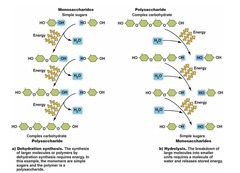
What is hydrolysis?
A process that adds a water molecule to break apart macromolecules (polymers), releasing energy.
What is the general formula for carbohydrates?
Cn(H2O)n
What are monosaccharides?
Simple sugars that serve as energy sources for cells, such as glucose, fructose, and galactose.
What are oligosaccharides?
Carbohydrates formed by linking more than one monosaccharide together.
What are polysaccharides?
Long chains of monosaccharides that serve as energy storage (like starch and glycogen) or structural support (like cellulose).
What are triglycerides?
Energy storage molecules composed of glycerol bonded to three fatty acids.

What are phospholipids?
Molecules that form the primary component of cell membranes, consisting of glycerol, two fatty acids, and a phosphate group.

What is the structure of steroids?
Composed of four carbon rings.
What are proteins made of?
Long chains of amino acids joined by peptide bonds.
What is the primary structure of a protein?
The amino acid sequence stabilized by peptide bonds.
What is denaturation?
The permanent disruption of protein structure, often caused by high temperature or changes in pH.
What are enzymes?
Proteins that function as biological catalysts to speed up chemical reactions without being consumed.

What are nucleic acids?
Polymers made of nucleotide monomers that store genetic information, including DNA and RNA.
What is the flow of genetic information?
DNA → RNA → Proteins
What is ATP?
Adenosine triphosphate, the universal energy source in cells, whose bonds contain potential energy.
How is ATP replenished?
By reattaching a phosphate group to ADP using energy released during cellular chemical reactions.