Organic Nucleophilic Substitution at Carbonyl Groups
 Call Kai
 Learn
Learn Practice Test
 Spaced Repetition
 Match
Match Flashcards
 Knowt Play
1/15

There's no tags or description
Looks like no tags are added yet.
Name | Mastery | Learn | Test | Matching | Spaced | Call with Kai | Chat |
|---|
No analytics yet
Send a link to your students to track their progress
16 Terms
What happens during nucleophilic substitution at carbonyl groups
carbonyl group is polarized (partially positive carbon) so nucleophiles bond as they would in addition, but a strong leaving group transforms the tetrahedral intermediate into a carbonyl again
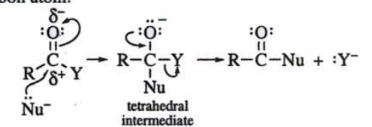
identify the mechanism
nucleophilic substitution at carbonyl
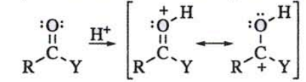
identify the mechanism
acid catalyzed protonation of carbonyl oxygen
Under acidic conditions what will increase the tendency of a deconstruction of a tetrahedral intermediate with a poor leaving group
protonation of the LG
acid catalyzed nucleophilic substitution at the carbonyl will have a BLANK in the intermediate, non acid catalyzed will have a BLANK in the intermediate
protonated oxygen, negatively charged oxygen
What is the order of reactivity with carboxylic acids of esters, amides, acyl halides, and acid anhydrides
acyl chloride > acid anhydride > ester > amide
transesterification requires what reagents
ROK, ROH (where R is the final carbon chain/substituent of the product)
If an aldehyde is produced as an intermediate in nucleophilic substitution at carbonyl carbon, what will occur when there is no good leacing group present
it will be reduced to a primary alcohol
If a ketone is produced as an intermediate in nucleophilic substitution at carbonyl carbon, what will occur when there is no good leacing group present
it will be reduced to a secondary alcohol
what is produced in the reaction of esters with grignard reagents and organolithium reagents
tertiary alcohol with two identical alkyl groups attached to the carbon atom bearing the hydroxyl group
Organocuprate reagents are necessary for the production of a ketone from BLANK because BLANK
esters, they only react with alkyl halides
the transformation of an acyl halide to a ketone required what kind of reagent
organometallic
If the final desired product is a ketone from an alkyl halide, what reagent will prevent the formation of a tertiary alcohol
lithium dialkylcuprates
Acyl chlorides will transform into an ester with what reagent
alcohols/ weak base
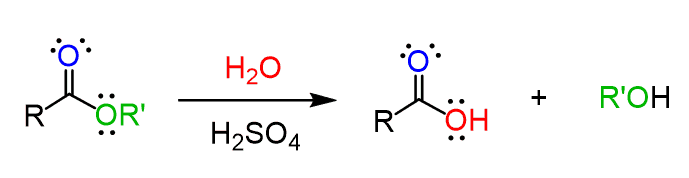
Identify the mechanism
acid catalyzed ester hydrolysis
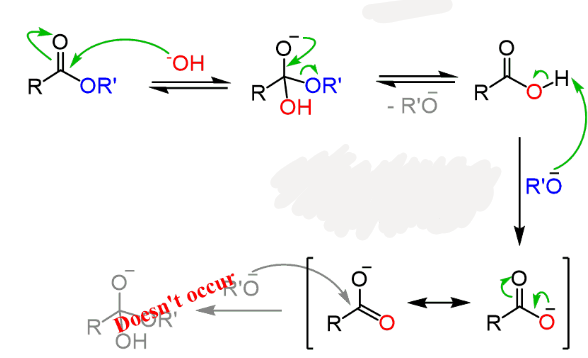
Identify the mechanism
base catalyzed ester hydrolysis