Alpha only content
 Call Kai
 Learn
Learn Practice Test
 Spaced Repetition
 Match
Match Flashcards
 Knowt Play
1/50

There's no tags or description
Looks like no tags are added yet.
Name | Mastery | Learn | Test | Matching | Spaced | Call with Kai | Chat |
|---|
No analytics yet
Send a link to your students to track their progress
51 Terms
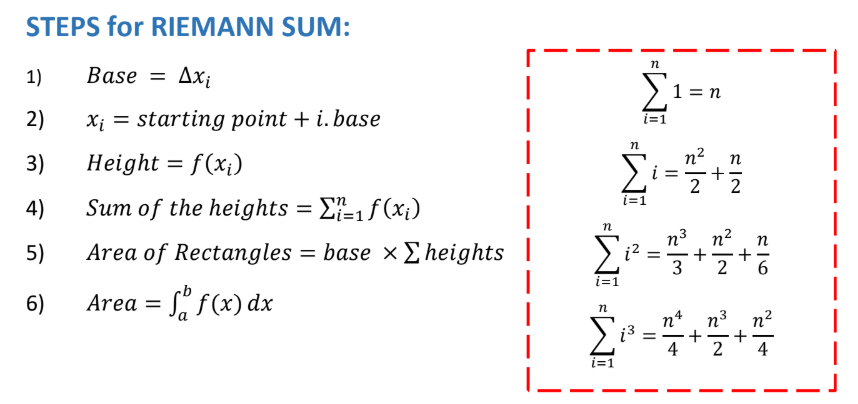
What are the steps of a Riemann sum?
Base: Δxi = (b-a)/n, b is upper limit and a is lower limit
Starting x: xi = a + (b-a)i/n
Height: f(xi) (calculate this until you have an answer in terms of n, i and constants)
Sum of all the heights: n∑[i=1] f(xi) (the i=1 goes below the summation and the n goes on top)
Area of n rectangles: Δxi × n∑[i=1] f(xi) (the i=1 goes below the summation and the n goes on top)
Area under the graph: a∫b f(x) dx = lim(n→∞)[ bases × ∑heights ]
What does the step: Base: Δxi = (b-a)/n, b is upper limit and a is lower limit actually look like?
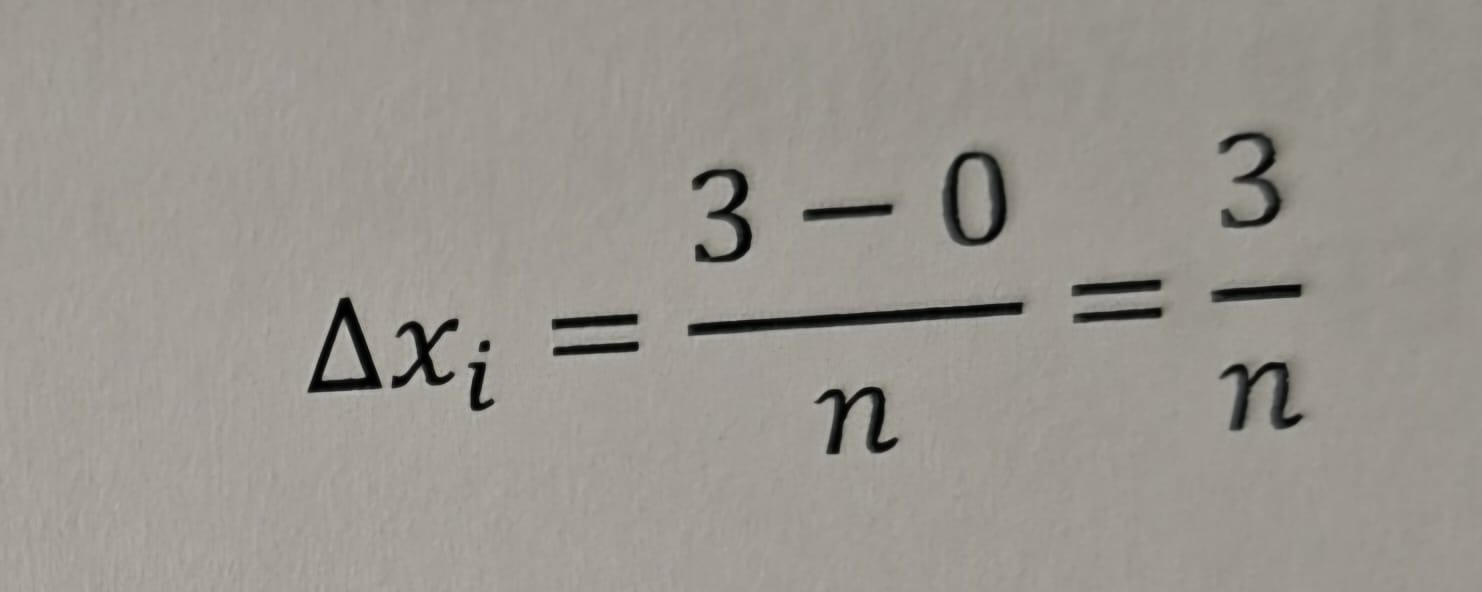
What does the step:Starting x: xi = a + (b-a)i/n actually look like?

Height: f(xi) (calculate this until you have an answer in terms of n, i and constants)

What does the step: Height: f(xi) (calculate this until you have an answer in terms of n, i and constants) actually look like?
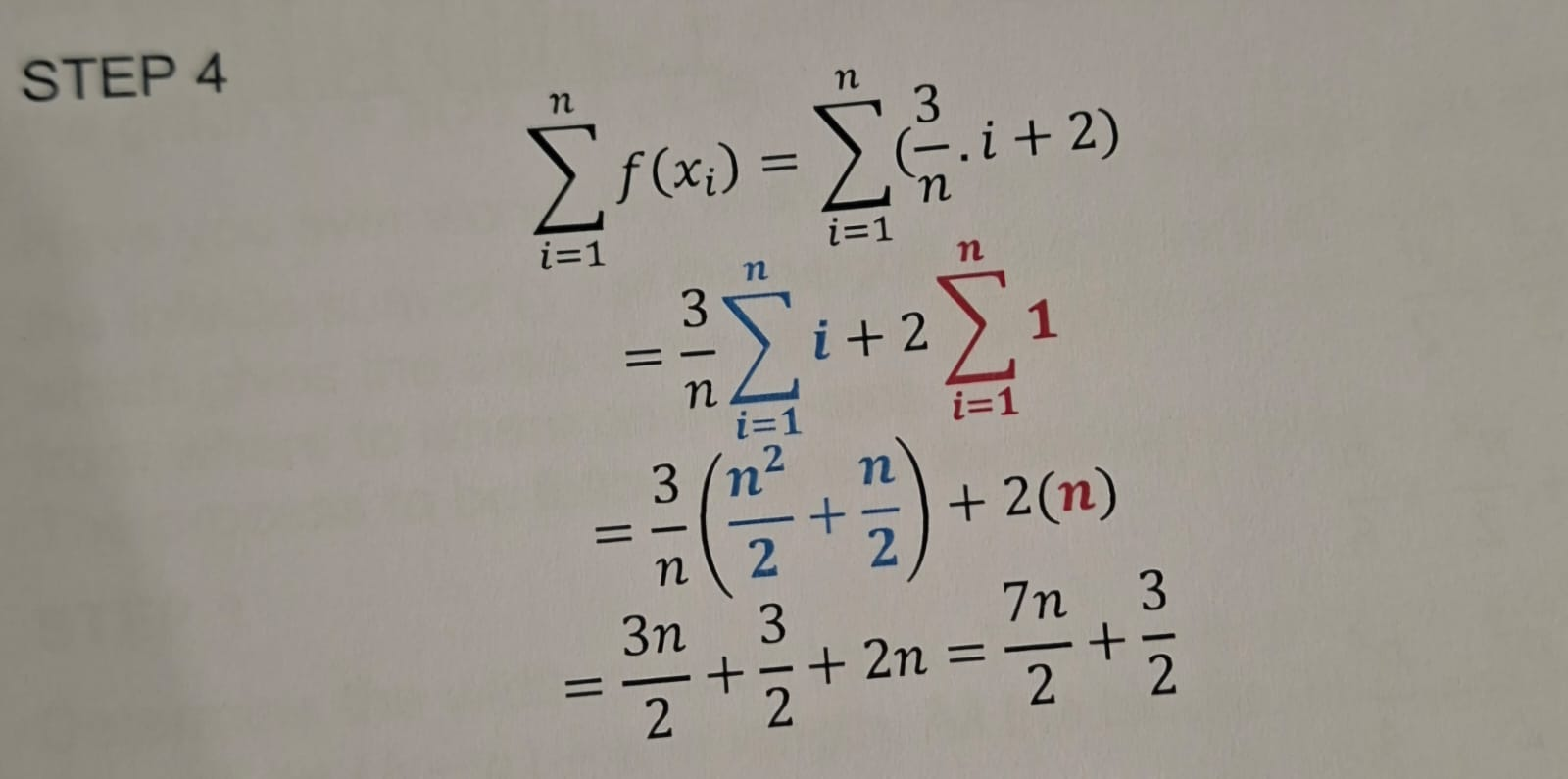
What does the step: Sum of all the heights: n∑[i=1] f(xi) (the i=1 goes below the summation and the n goes on top) actually look like?
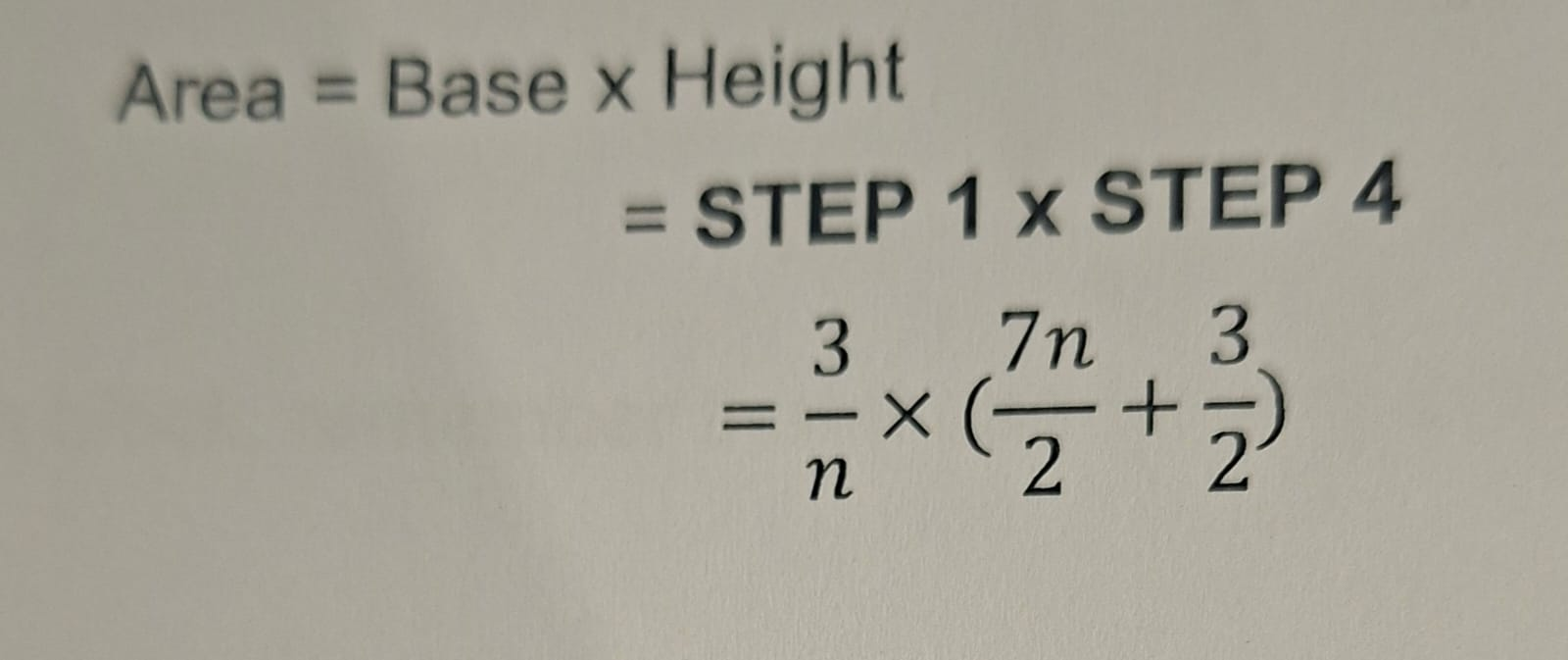
What does the step: Area under the graph: a∫b f(x) dx = lim(n→∞)[ bases × ∑heights ] actually look like?

What are the coefficients in the 3rd row / 2nd power of pascal’s triangle?
1 ; 2 ; 1
What are the coefficients in the 4th row / 3rd power of pascal’s triangle?
1 ; 3 ; 3 ; 1
What are the coefficients in the 5th row / 4th power of pascal’s triangle?
1 ; 4 ; 6 ; 4 ; 1
What are the coefficients in the 6th row / 5th power of pascal’s triangle?
1 ; 5 ; 10 ; 10 ; 5 ; 1
What are the coefficients in the 7th row / 6th power of pascal’s triangle?
1 ; 6 ; 15 ; 20 ; 15 ; 6 ; 1
Formula for a binomial expansion using pascals triangle
(a + b)n = anb0 + Can-1b1 + Can-2b2 … Ca1bn-1 + a0bn where C is the coefficient determined by pascal’s triangle
What is the formula of the binomial theorem (Not simplified)
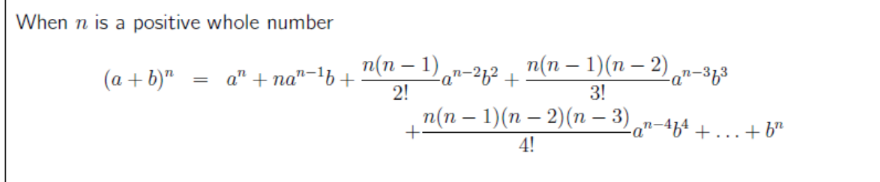
Binomial theorem simplified with combinations

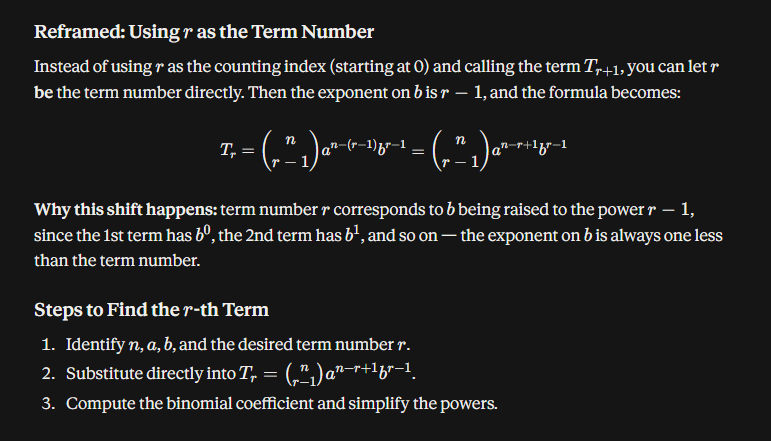
How to find the nth term with binomial theorem
Where:
r is the term number you want
n is the power binomial
a the first term in the binomial
b is the second term in the binomial
Steps for rieman sum (Notes)
How to multiply matrics
Multiply the 1st term in the first row of matrix 1 and the 1st term in the 1st column of matrix 2
Multiply the 2nd term in the first row of matrix 1 and the 2nd term in the 1st column of matrix 2
… repeat until 1st row and first column are done
Add these products, this the row 1 col 1 value in your new matrix
Multiply the 1st term in the first row of the matrix with the 1st term in the 2nd column of the matrix
Multiply the 2nd term in the first row of the matrix with the 2nd term in the 2nd column of the matrix
… repeat until 1st row and second column are done
Add these products, this is the row 1 col 2 value in your new matrix
Complete all the columns for row 1
Repeat the process for subsequent rows
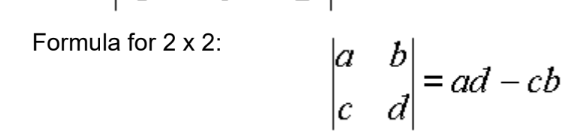
What is the determinant of a 2 by 2 matrix
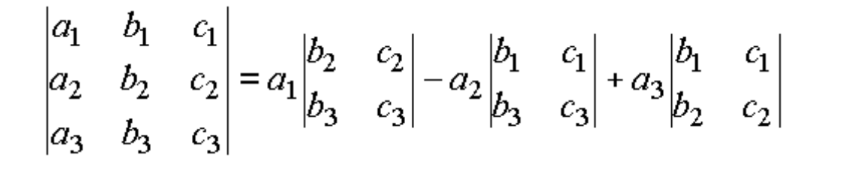
What is the determinant formula for a 3 × 3 matrix
How to solve systems of linear equations
Turn the coefficients of the multivariable into a matrix [A] and have another 1 column multirow matrix, all = to the constants
Determine A (Determinant of the matrix)
Apply Cramer’s rule to determine the determinant An
(Cramer’s rule being A1 is the determinant of the inverse matrix except the first column is replaced by the constants, A 2 is the determinant of the inverse matrix except the second column is replaced by the constants)
Apply A/A1 to determine x, A/A2 to determine Y, etc…
Formula of an inverse matrix
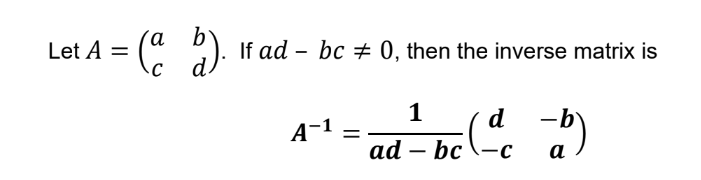
What is [A] x [A-1] in matrices?

POINT PRODUCT:
a . b = |a| x |b| x cos(THETA)
|a| = magnitude of vector
|b| = magnitude of vector
(THETA) is the angle between the 2 vectors
When are vectors perpindicular?
When their point product is = to zero
Directions of 3D vectors
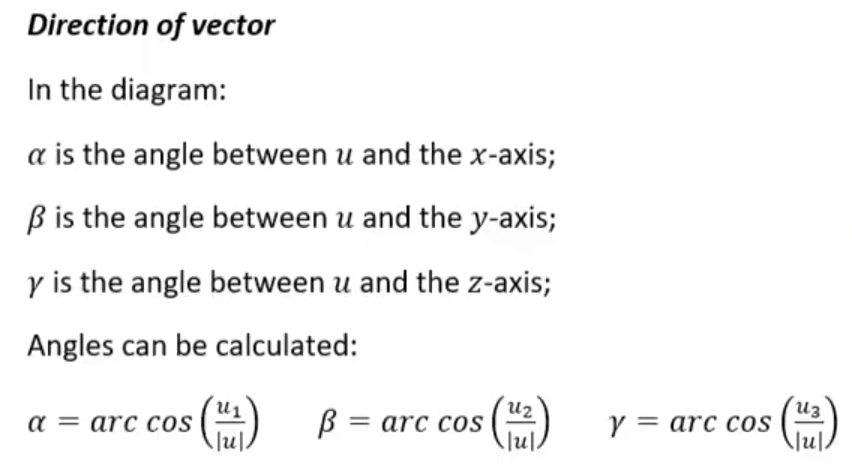
What is a unit vector
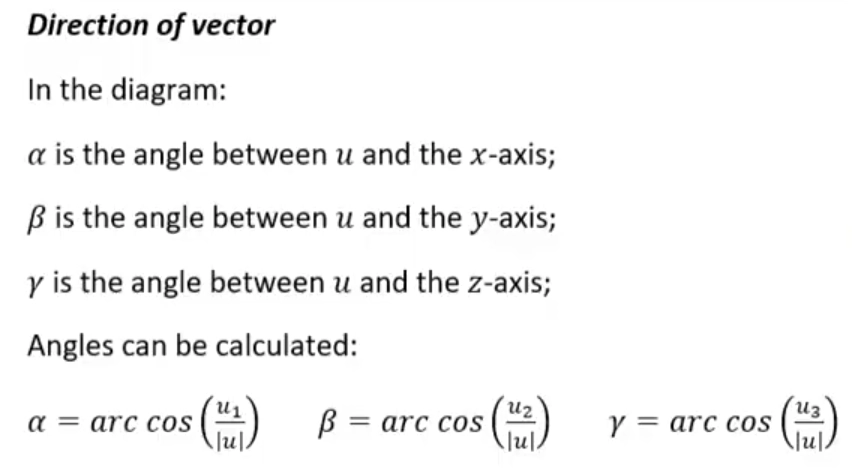
How to determine the angle between 2 2D vectors
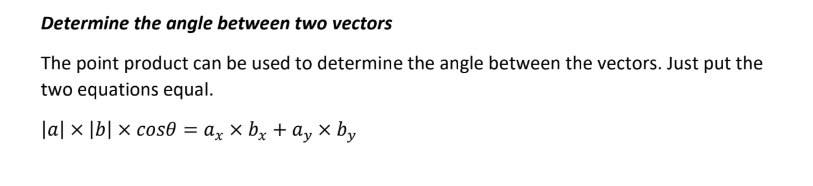
How to determine the magnitude of a 3D vector that is not at the origin
v = (x1 − x2; y1 − y2 ; z1 − z2)
What are the substitutes for the x,y and z axis in 3D vectors?
x axis = i
y axis = j
z axis = k
When are vectors equal?
Same magnitude and same direction
(For 3D this means having the same magnitude and the same direction cosigns)
Direction cosign - u1 / |u|
How can a 3D vector be written?
OP = V = (2;3;5) = 2i +3j + 5k
What is a unit vector
A vector with the same direction as another one, but with a total magnitude of 1
POINT PRODUCT of vectors (3D)

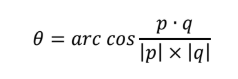
ANGLE BETWEEN TWO VECTORS (3D vectors)
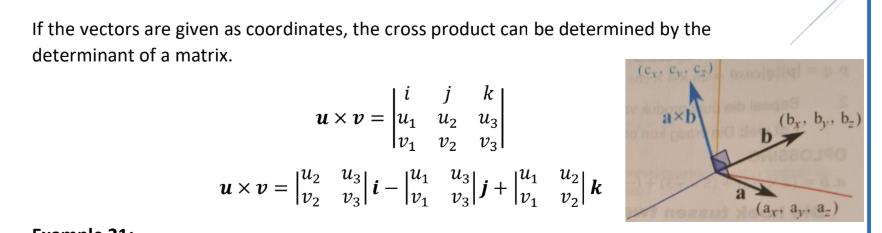
What is the cross product used for?
A perpendicular vector to the other 2 vectors the product consists of
How to determine the cross product of 2 3D vectors:
When are 2 vectors parallel in 3D vectors?
Two non-zero vectors a and b are parallel if and only if a × b = 0.
How to determine the area of a parallelogram formed by 2 vectors
The magnitude of the cross product a × b is the area of the parallelogram that is
formed by a and b.
What is z in complex numbers?
a + bi
What is z* in complex numbers?
a - bi
Technique of rectangular form of a complex number
a + bi where a corresponds to the length (Re) and b corresponds to the height (Im)
Technique of polar form of a complex number
Draw out the complex plain and draw the point using rectangular coordinates
Label everything and use Pythagoras to determine r
Use arctan or tan to determine the reference angle
Determine r. cis θ [meaning r. (cos θ + isin θ)]
What is r in complex numbers?
The modulus - the hypotenuse of the right angled triangle that the imaginary and real parts of a complex number form on a complex plain
What is θ in complex number polar form
The argument - the angle between the positive Real axis and the hypotenuse of the right angled triangle that the imaginary and real parts of a complex number form on a complex plain
How to convert polar form into exponential form

Multiplying of Complex Numbers

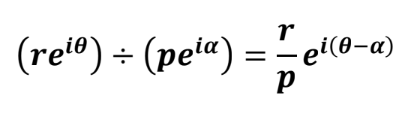
Division of Complex Numbers
De Moivre’s Theorem
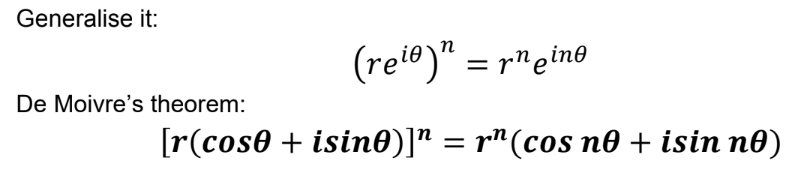
How to use De Moivre’s theorem
Us it to sidestep the binomial theorem for an expansion of a complex number
How does a sin or cos expansion of a coefficient before the variable use the binomial theorem?
Expand the trig term via de Moivre’s Theorem to have the coefficient acting as the exponent of a binomial term
Use the binomial theorem to expand the whole thing
Isolate either the real or imaginary side to complete the expansion