Estuaries + Quizes FINAL
 Studied by 0 people
 Call Kai
 Learn
Learn Practice Test
 Spaced Repetition
 Match
Match Flashcards
 Knowt Play
1/117

There's no tags or description
Looks like no tags are added yet.
Name | Mastery | Learn | Test | Matching | Spaced | Call with Kai |
|---|
No study sessions yet.
118 Terms
True estuarine fish
Species that spend their entire life cycle in estuaries.
Dependent marine fish
Marine fish species that require estuaries at some stage of their life cycle.
Nondependent marine fish
Species that do not require estuaries for any part of their life cycle but may still inhabit them.
Euryhaline
Fishes that can tolerate a wide range of salinities.
Ex:
diadromous fishes (fex: reshwater eels, herrings, shard)
true estuarial/ estuary resident species (ex: gobies)
Dependent marine/ estuary dependent species (ex: anchovies, drum)
Stenohaline
Fishes that can tolerate only a narrow range of salt concentrations.
Ex:
Freshwater ONLY species
(ex: poecilids (mosquito fish), chentrarchindae sunfishes, bass), etc)
nondependant marine species
(ex: pinfish, jackes, et.)
Benthic invertebrates
Organisms that live on the bottom of water bodies, playing a crucial role in the estuarine ecosystem.
ex: amphipods
Filtration
A process whereby certain organisms, like clams or oysters, filter out food particles from the water.
Anthropogenic effects
Environmental changes caused by human activity, particularly detrimental impacts on natural ecosystems.
Ecosystem resilience
The ability of an ecosystem to recover from disturbances or resist damage.
Estuary
A transitional environment where freshwater from rivers meets and mixes with saltwater from the ocean.
Euryhaline
Refers to organisms that can tolerate a wide range of salinities.
Stenohaline
Refers to organisms that can tolerate only a narrow range of salt concentrations.
Benthic invertebrates
Organisms that live on the bottom of water bodies, playing a crucial role in the estuarine ecosystem.
Example: Amphipods
Filtration
A process whereby certain organisms, like clams or oysters, filter out food particles from the water.
Anthropogenic effects
Environmental changes caused by human activity, particularly detrimental impacts on natural ecosystems.
Ecosystem resilience
The ability of an ecosystem to recover from disturbances or resist damage.
Diadromous fish
Definition: Fish that migrate between freshwater and saltwater during their life cycle.
Estuary Role: Utilized as migratory corridors or temporary feeding grounds.
Salinity Tolerance: Euryhaline (can tolerate a wide range of salinities).
Examples:
American Eel (Anguilla rostrata)
Various Salmon species (Oncorhynchus spp)
True estuarine fish / Resident estuarine species
Definition: Species that spend their entire life cycle in estuaries.
Salinity Tolerance: Demonstrate high tolerance to fluctuating salinity gradients, making them euryhaline.
Examples:
Diamond Killifish (Cyprinodon variegatus)
Common Mummichog (Fundulus heteroclitus)
Dependent marine fish / Marine spawners
Definition: Marine fish species that require estuaries at some stage of their life cycle.
Estuary Role: Often use estuaries as critical nursery grounds for their juvenile stages.
Benefits of Estuaries: Provide abundant food resources and protection from predators.
Salinity Tolerance: Euryhaline (can tolerate a wide range of salinities).
Examples:
Spotted Seatrout (Cynoscion nebulosus)
Atlantic Menhaden (Brevoortia tyrannus)
Nondependent marine fish / Marine stragglers
Definition: Species that do not require estuaries for any part of their life cycle but may still inhabit them.
Estuary Role: May enter estuaries for foraging or temporary shelter.
Life Cycle: Can complete their entire life cycle in marine environments.
Salinity Tolerance: Generally euryhaline, which allows them to venture into estuaries.
Examples:
Bluefish (Pomatomus saltatrix) adults
Various species of Black Sea Bass (Centropristis striata)
Freshwater stragglers / Freshwater adventitious
Definition: Freshwater species that may occasionally enter the upper, lower-salinity reaches of an estuary.
Estuary Requirement: Do not require estuarine environments for any part of their life cycle.
Salinity Tolerance: Typically less tolerant of salinity fluctuations than true estuarine species. Generally stenohaline to marine conditions but tolerant of low estuarine salinities.
Examples:
Largemouth Bass (Micropterus salmoides)
Bluegill (Lepomis macrochirus)
What does it mean for an organism to be Euryhaline?
An organism that can tolerate a wide range of salinities (salt concentrations).
They thrive in environments where salinity often changes, like estuaries.
Examples:
Diadromous fish: American Eel (Anguilla rostrata)
True estuarine fish: Diamond Killifish (Cyprinodon variegatus)
Dependent marine fish: Spotted Seatrout (Cynoscion nebulosus)
What does it mean for an organism to be Stenohaline?
An organism that can tolerate only a narrow range of salt concentrations.
They usually live in environments with stable salinity, such as purely freshwater or purely marine habitats.
Examples:
Most freshwater stragglers (which are generally stenohaline to marine conditions):
Largemouth Bass (Micropterus salmoides)
Bluegill (Lepomis macrochirus)
Cyprinodontidae (pup fishes)
Can live in diverse environments
- very high salinity and/or temp
Stenohaline marine fish species are more common near crab bank near the north side of charleston harbor estuary
true due to it has higher salinity in that area
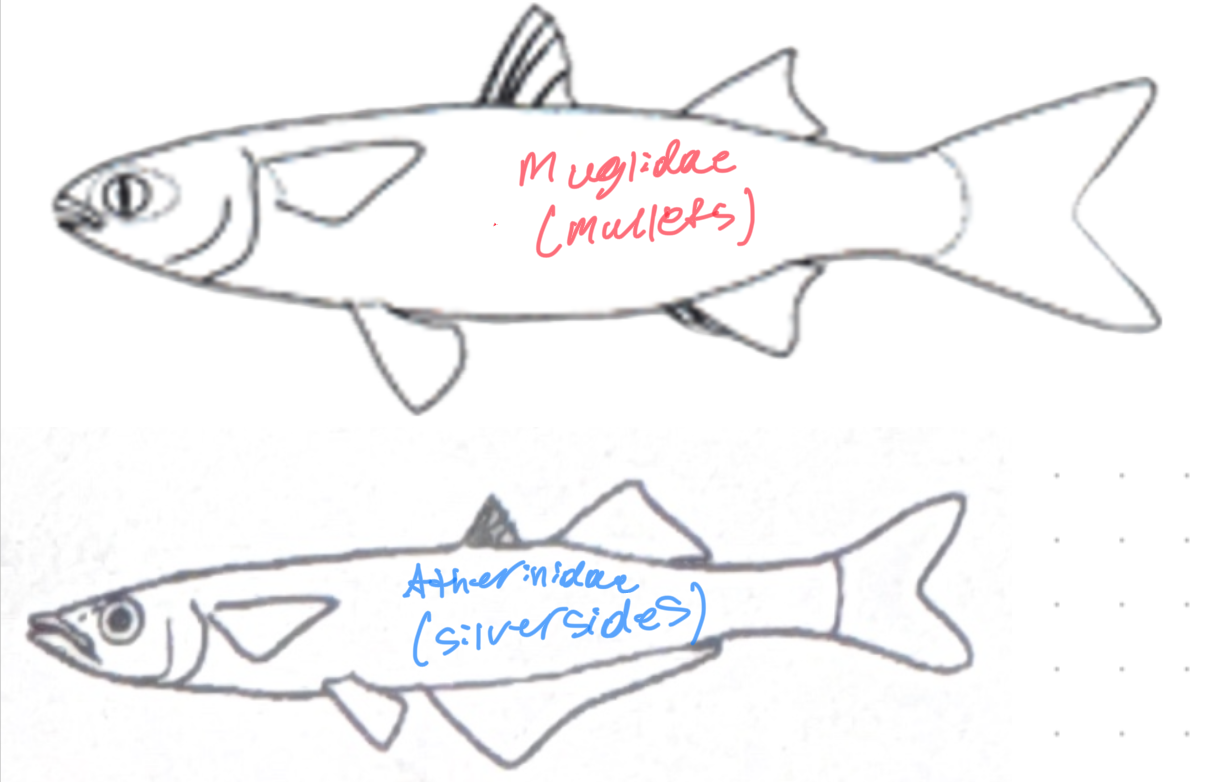
Examples of Fishes with spiny rayed dorsal seperated from soft rayed by a broad gap
Mullet (muglidae)
Atherinidae (silversides)
Ictalurids and minnows
stenohaline
freshwater
can inhabit esturaries but are primarily found in rivers and lakes.
Detritivorus fishes
a type of fish that feed on dead organic matter, known as detritus, such as dead plants, animal carcasses, and other debris
ex: mullets
What is Direct Development in fish?
No larval stage; juvenile develops directly from the egg.
What is Indirect Development in fish?
Includes a distinct larval stage; most fish species follow this pattern.
What is the ecological significance of fish larval stages typically occurring in the planktonic zone?
To reduce predation from benthic predators. Larvae vary widely in size and form, adapted for survival in early life stages.
Describe the Egg stage in fish development.
Divided into early, middle, and late embryonic development.
- Contains yolk which nourishes the embryo.
Fertilization typically external; eggs often pelagic (floating) in many marine species.
What defines the Larva stage in fish development?
Begins at hatching.
Ends at metamorphosis (transition into juvenile).
What are the subdivisions of the larval stage based on notochord development?
- Pre-flexion larva: Straight notochord.
- Flexion larva: Notochord begins dorsal bending.
- Post-flexion larva: Notochord bending complete.
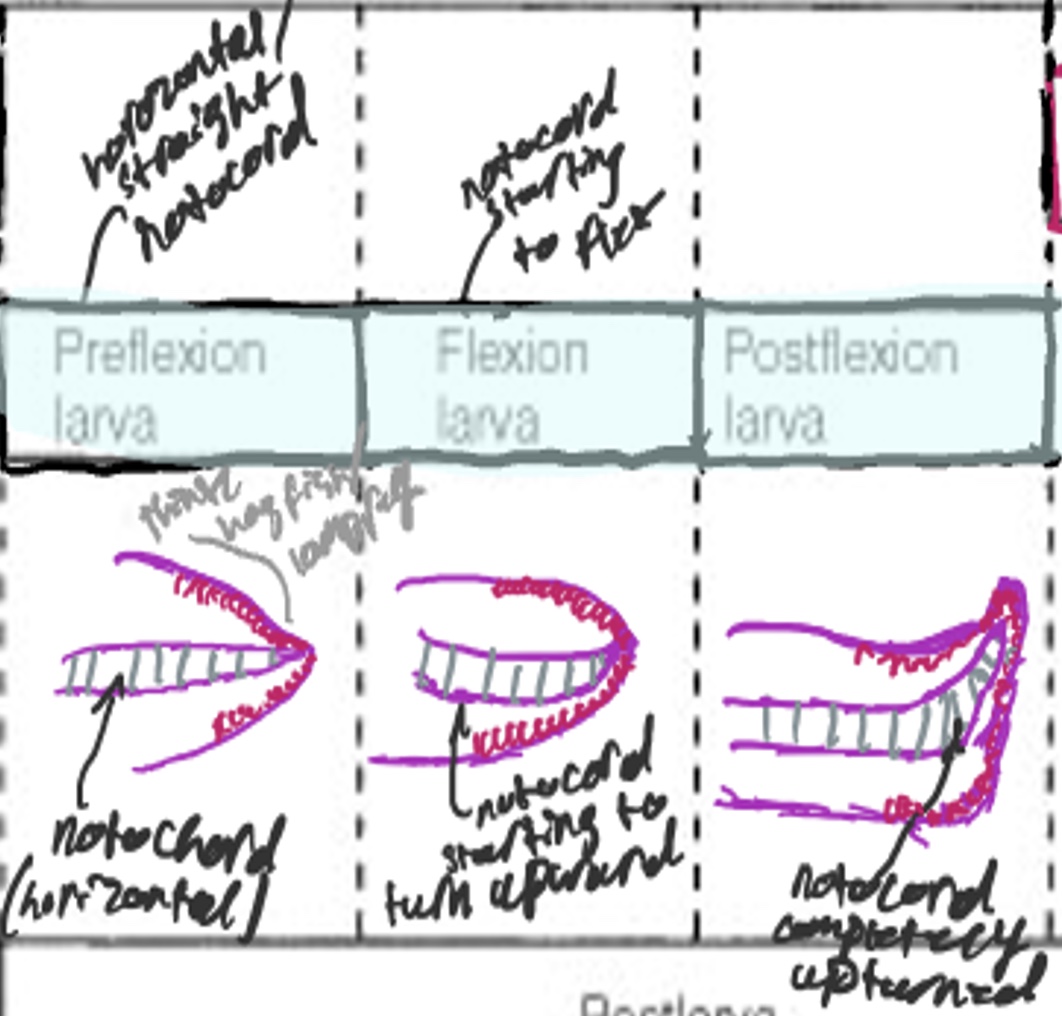
List key developmental traits observed during the larval stage.
- Undergoes fin ray development (not fully formed until end of larval stage).
- Initiation of squamation (scale coverage begins but completes later).
- Loss of larval-specific structures such as finfolds and stalked eyes.
- Early larval stages may not feed; rely on yolk reserves in yolk-sac larvae.
Describe the Juvenile stage in fish development.
Develops after metamorphosis.
- Body shape and pigmentation patterns evolve gradually toward adult form.
- Stronger swimming ability.
- In salmonids, juveniles are termed "fry" and later "smolt" when preparing for ocean migration.
What are Yolk-sac larvae?
Larvae that remain concealed in gravel substrate, absorbing yolk before becoming free-swimming.
- Notably found in salmonids.
- Early larval stages may not feed, relying on yolk reserves.
What is a Transformation larva?
The stage during metamorphosis when larval features are replaced with juvenile/adult features.
Describe the characteristics of eggs and larvae from Pelagic Spawners.
Eggs and larvae develop in open water.
- Eggs have low specific gravity due to oil content, allowing them to stay suspended in plankton.
- Larvae become free-swimming, feed in plankton, and drift until metamorphosis/settlement.
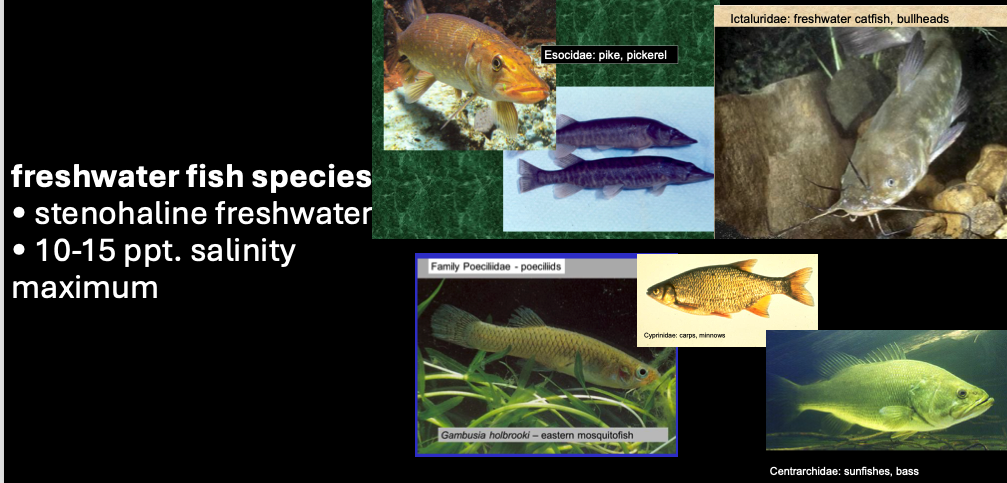
5 ecological classes of estuarine fishes
freshwater fish species
• stenohaline freshwater
diadromous (migrating through estuaries)
• euryhaline
True estuarine species (also known as estuary-resident species)
entire life cycle in estuary
euryhaline
Dependent marine fish species (meaning
estuary-dependent marine fish species)
• at least one stage of life cycle in estuary
• euryhaline
Nondependent marine species
• no part of life cycle needed to be in estuary
• stenohaline marine
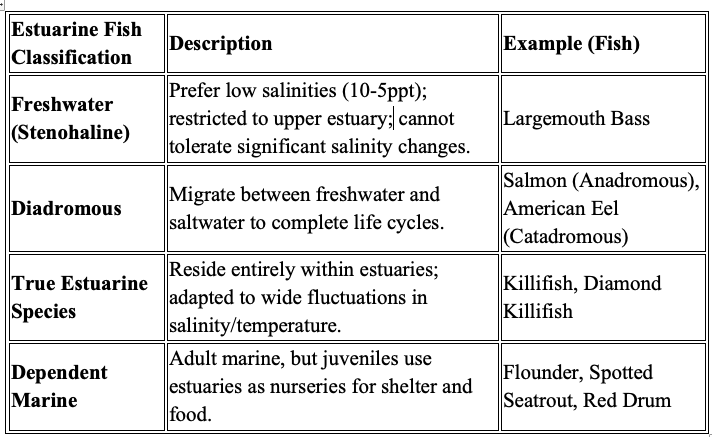
freshwater fish species
freshwater fish species
stenohaline freshwater
10-15 ppt. salinity maximum
ex:
Poeciliidae:
eastern mosquito fish (Gambusia holbrooki)
Ictaluridae: freshwater catfish &bullheads
Centrarchidae: Sunfishes & basses
Esocide: Pikes & Pickerel
Cyprinidae: Carps & Minnoes
diadromous (migrating through estuaries)
diadromous (migrating through estuaries)
Fish that migrate between freshwater and saltwater
euryhaline
Anguillidae: Freshwater eels
Clupeidae: herrings, shads
Aepenseridae: sturgeon
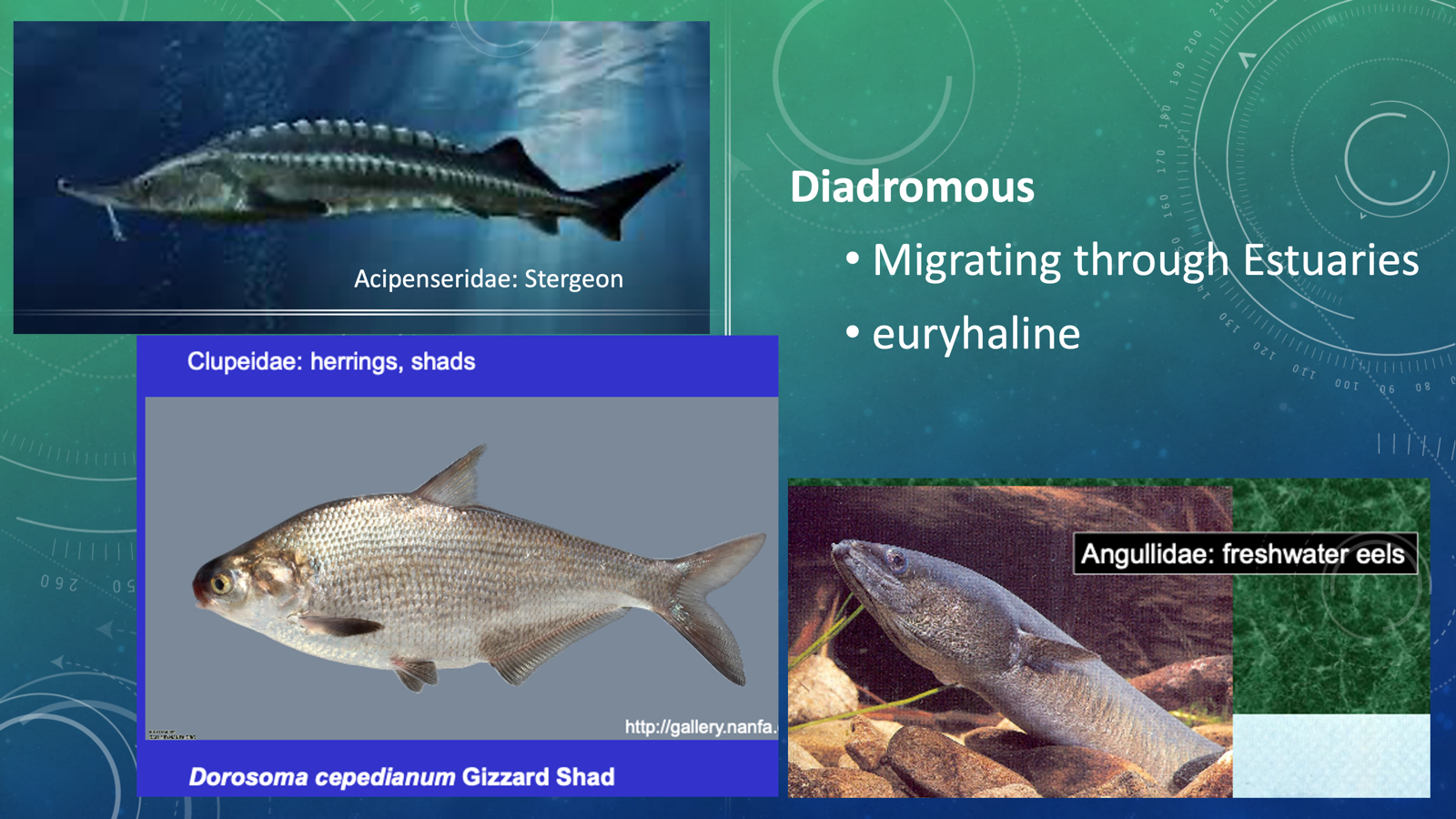
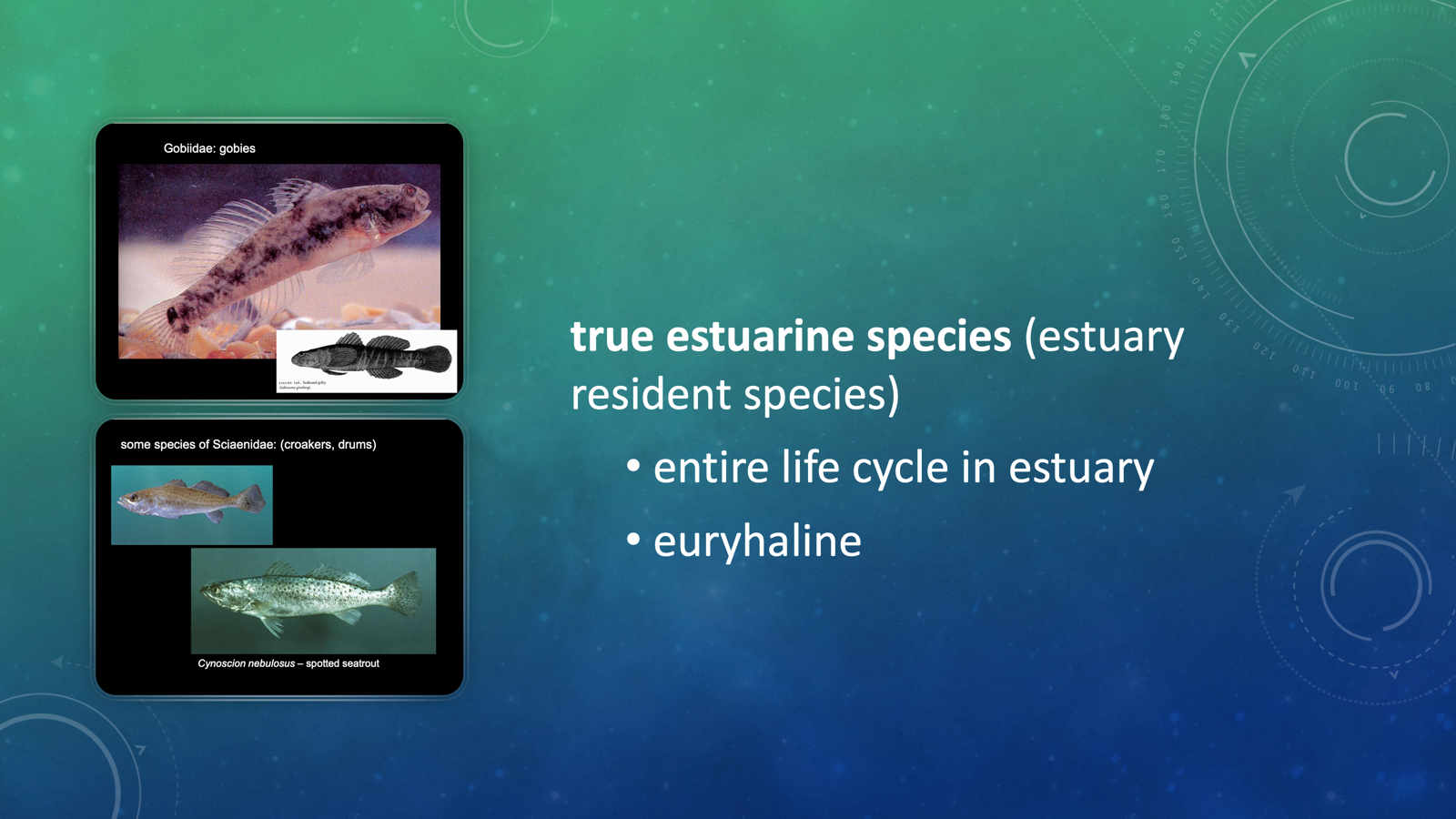
true estuarine species (also known as estuary-resident species)
True estuarine species (also known as estuary-resident species)
entire life cycle in estuary
euryhaline
ex:
Gobiidae: gobies
spotted seatrout
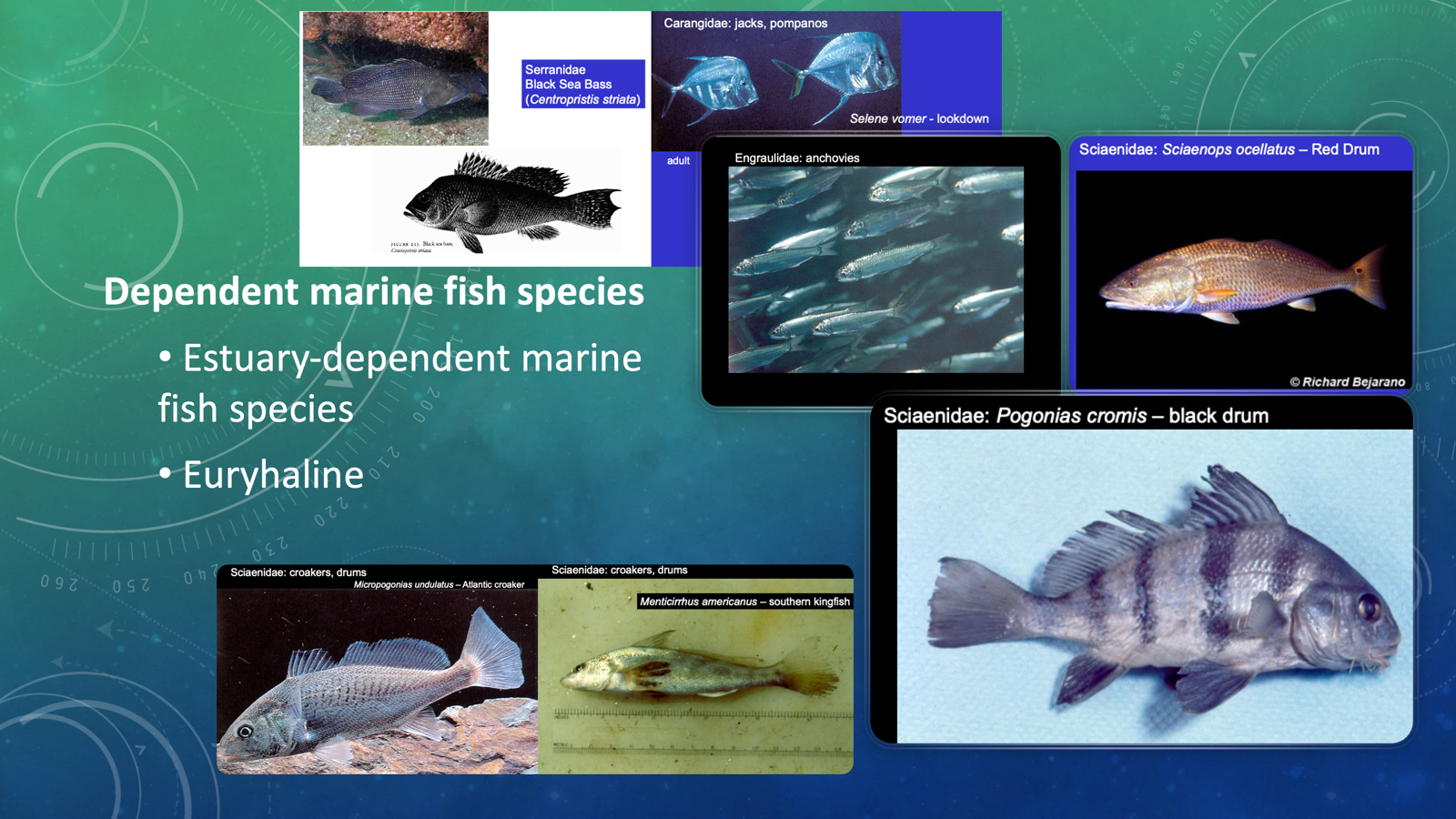
Dependent marine fish species
Dependent marine fish species (estuary-dependent marine fish species)
at least one stage of life cycle in estuary
euryhaline
Ex:
Engraulidae: anchovies
Sciaenidae: drums
Serranidae : Sea basses
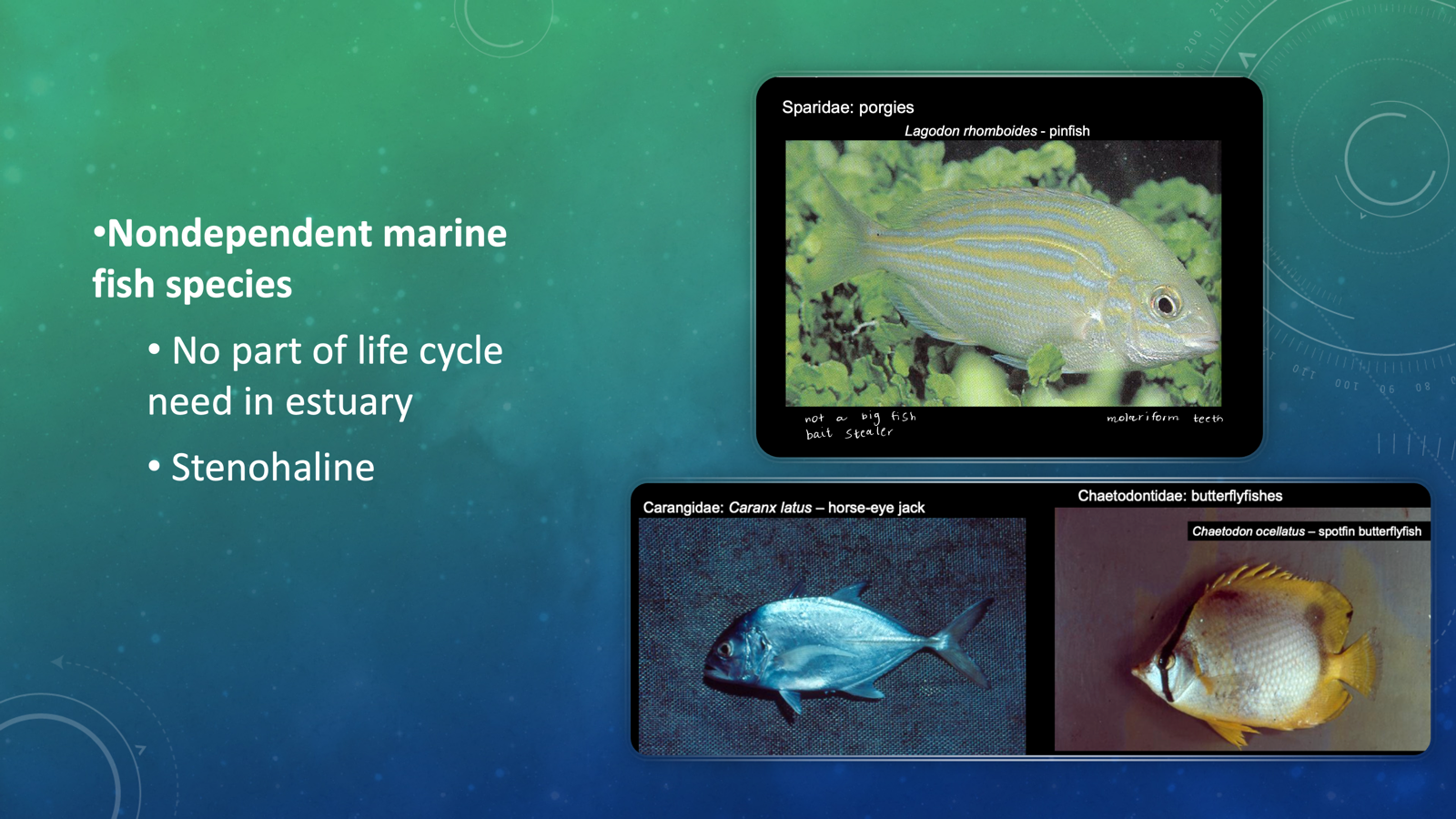
5. Nondependent marine species
Nondependent marine species
no part of life cycle needed to be in estuary
stenohaline marine
Ex:
Sparidae: porgies
pinfish
Carangidae: jacks
horse eye jack
Chaetodontidae: butterflyfishes
spotfin butterflyfish
Crab bank Vs South Channel
Crab bank = higher salinity
live bottom: colonial invertebrates, soft corals, sponges, and hydroid colonies all prefer high salinity
South Channel = more freshwater/ mid-salinity
Mid to low estuaries
Often dominated by spiny rayed fishes
Euryhaline
An organism that can tolerate a wide range of salinities (salt concentrations).
They thrive in environments where salinity often changes, like estuaries.
Can adapt physiologically to freshwater and marine environments as well as salt concentrations in between
Examples:
Diadromous fish: American Eel (AnguillarostrataAnguillarostrata)
True estuarine fish: Diamond Killifish (CyprinodonvariegatusCyprinodonvariegatus)
Dependent marine fish: Spotted Seatrout (CynoscionnebulosusCynoscionnebulosus)
Stenohaline
Salt dependent
can only handle a narrow range of salt concentrations.
They usually live in environments with stable salinity, such as purely freshwater or purely marine habitats.
Examples:
Most freshwater stragglers (which are generally stenohaline to marine conditions):
Largemouth Bass (MicropterussalmoidesMicropterussalmoides)
Bluegill (LepomismacrochirusLepomismacrochirus)
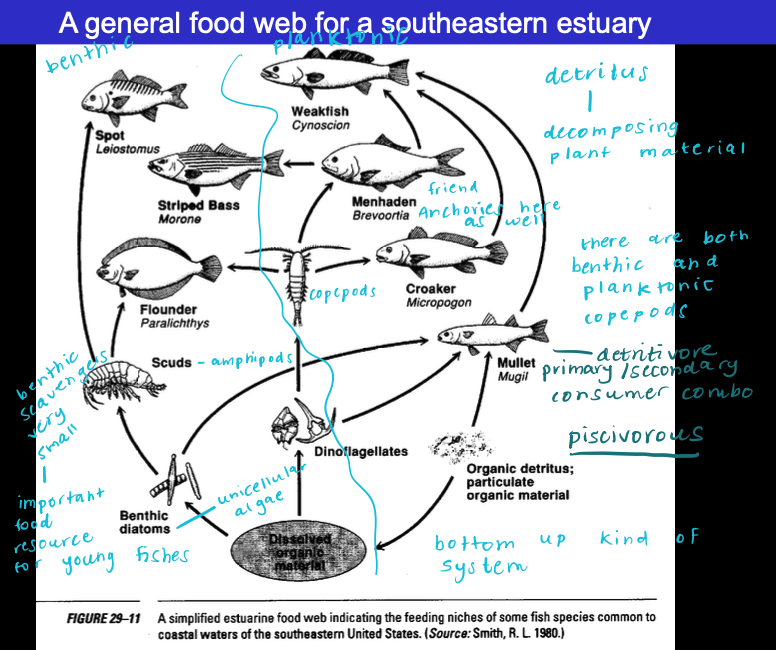
food web of a typical southeastern estuary
invertebrate activities give nutrient retention by estuary
filter-feeding zooplankton fed on by fishes
fecal matter returned to sediment
food for benthic invertebrates like amphipods, copepods, and polychaetes
also abundant clams, oysters which filter feed
filter-feeding fishes
Anadromous
Fish that migrates from freshwater to saltwater to spawn
Ex: Some species of Clupidae
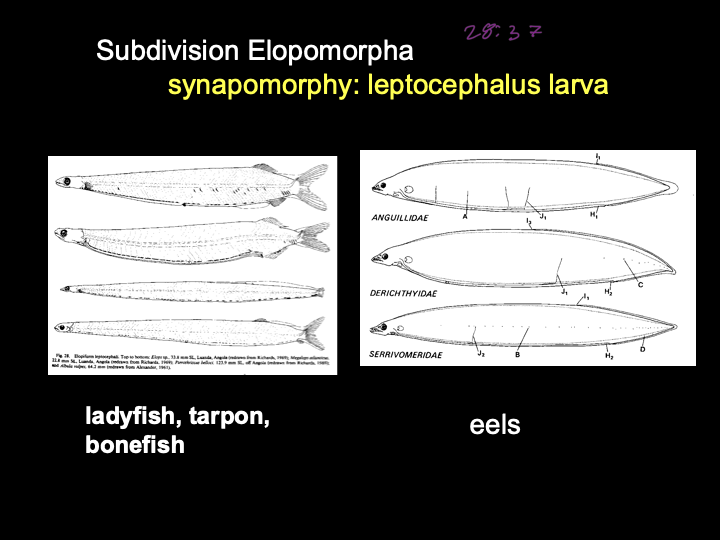
Leptocephalus Larval stage
Leptocephalus larvae are transparent, ribbon-like, and distinct from typical fish larvae, highlighting an
evolutionary adaptation.
Elopomorpha have a unique larval stage called Leptocephalus larva
ladyfish (elops)
Tarpon
Bonefish
Eels (order anguilliformes)
The Main function in which hypuals are involved
Locomotion
hypural support caudal fin rays and help with locomotion
Hypurals
Act as a base where the muscles of the caudal peduncle attach, allowing the movements of the tail fin that are necessary for:
Propulsion through the water (forward movement).
Steering and control of direction.
Balance and stability while swimming.
Helps with locomotion
Name a family that is EXCLUSIVELY Freshwater
Leucisidae - carps and minnows
Exclusively fresh water species
ex: yellowfin shiner
A kind of fish that lacks jaw teeth
Minnow
Sister group to Actinopterygii
Sarcopterygii (lobed finned fishes)
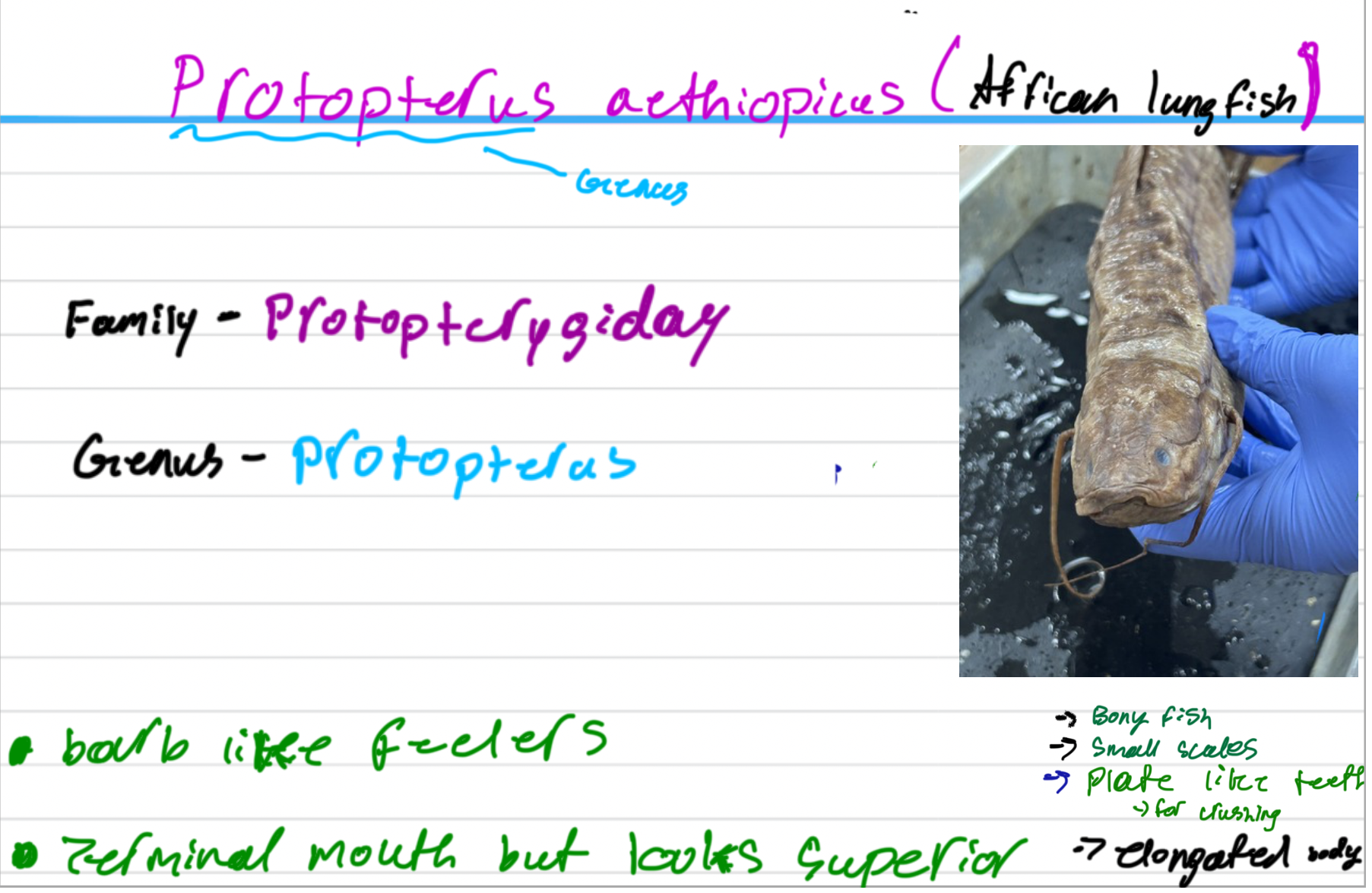
African Lungfish
has 2 gas bladders
allows it to breathe air.
The form of the caudal fin in Osteoglossomorphfishes
Homocercal
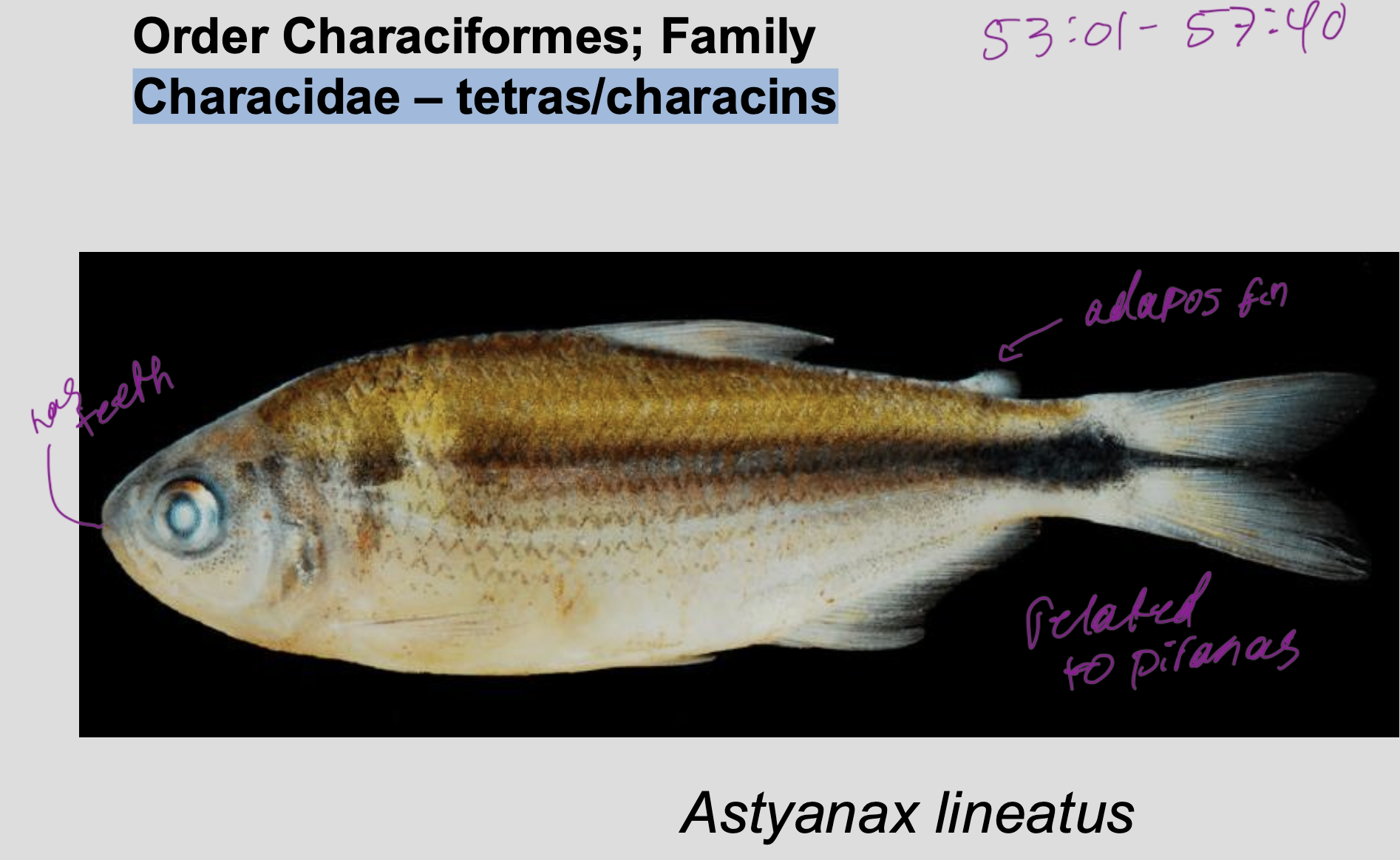
Specialized morphological feature of Characidae
presence of an adipose fin and the absence of barbels.
Characidae- tetras/characins
Characiniformes
Characids are related to piranhas
Teleostei
Premaxilla mobile (relative to cranium)
Urostyle and uroneurals present ; Caudal fin homocercal
Sturgeons and paddlefishes similarities
Both in the order Acipenseriformes
Inferior mouths
heterocercal tail
ganoid scales
flattened snout (rostrum) equipped with electroreceptors (ampullae)
Lantern fish
shallow living marine fish
produces own light
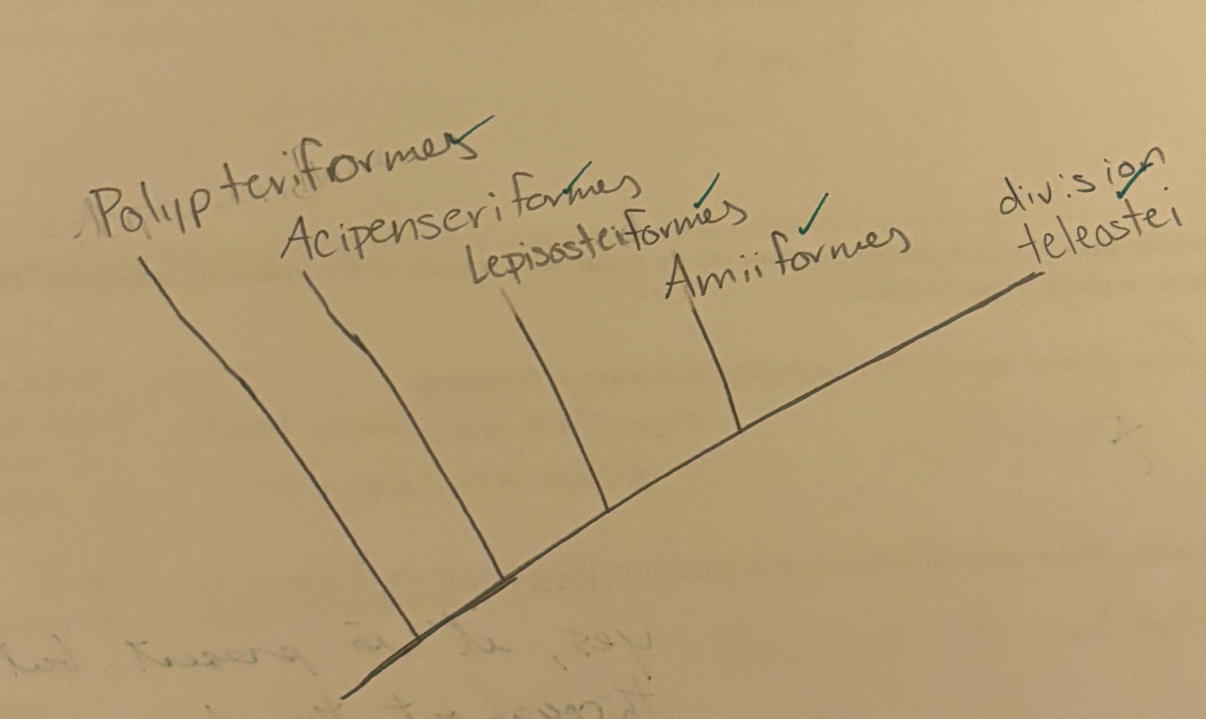
Cladogram showing the patters of relationshios amoung 4 basal orders of actinopterygii and DIvision Teleostei
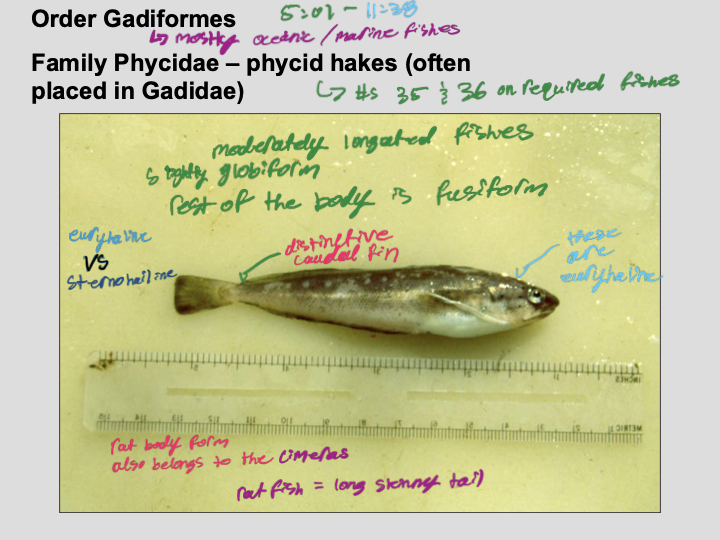
Gadiformes
phycid hakes (often in Gadidae)
Mostly oceanic/marine fishes
Eurohaline
rat body form
Moderatly elongated/slightly globiform
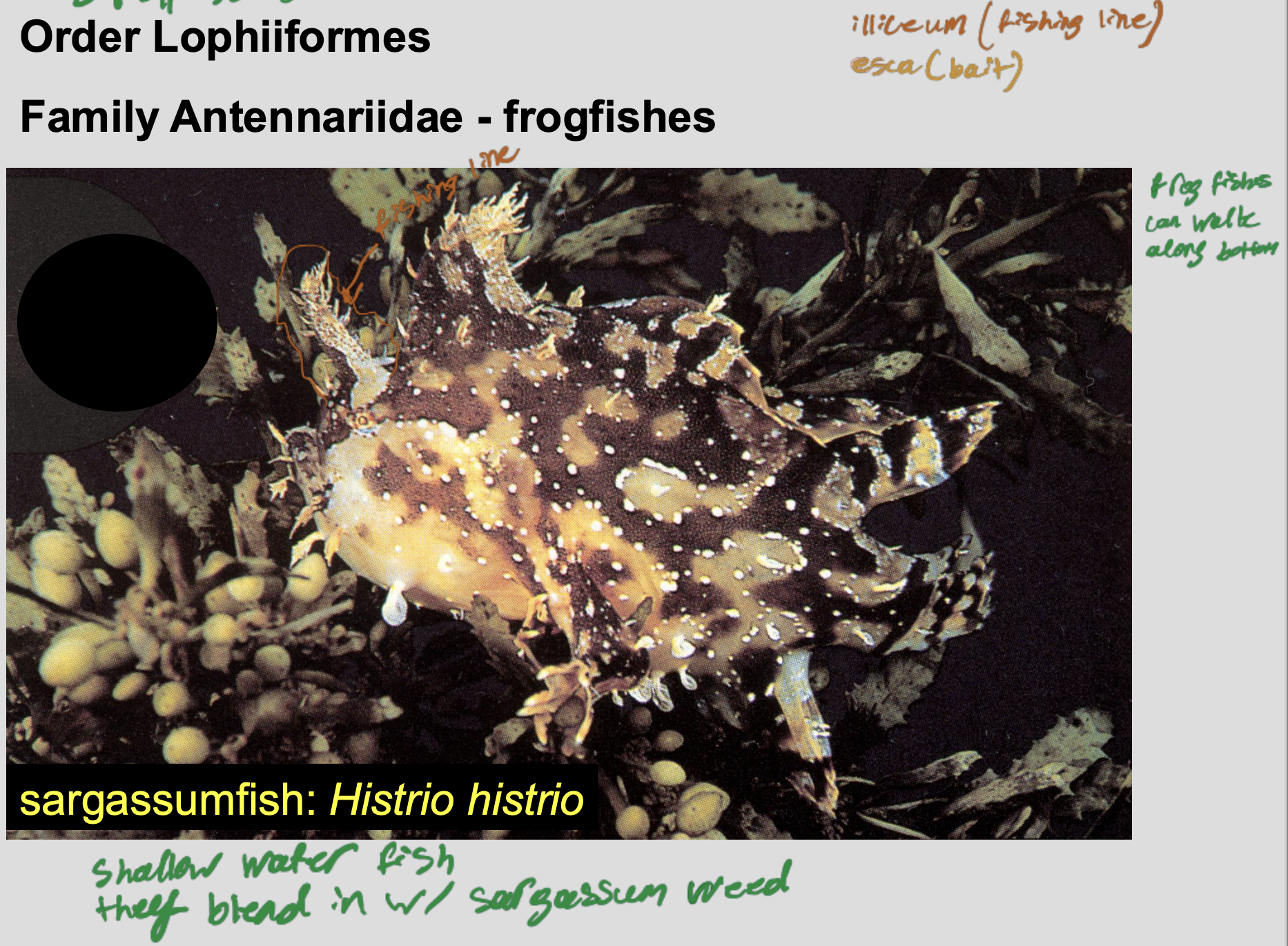
Frogfishes
Order Lophiiformes (Anglerfishes , batfishes, and Frogfishes)
Family Antennariidae
modified dorsal fin spine (illicium) acting as a “fishing rod” with a bait (esca) at the tip.
can walk along bottom
shallow water fish
Ex: sargassum (Histrio Histrio)
Anglerfishes
Order Lophiiformes
Family Antennariidae (Anglerfishes , batfishes, and Frogfishes)
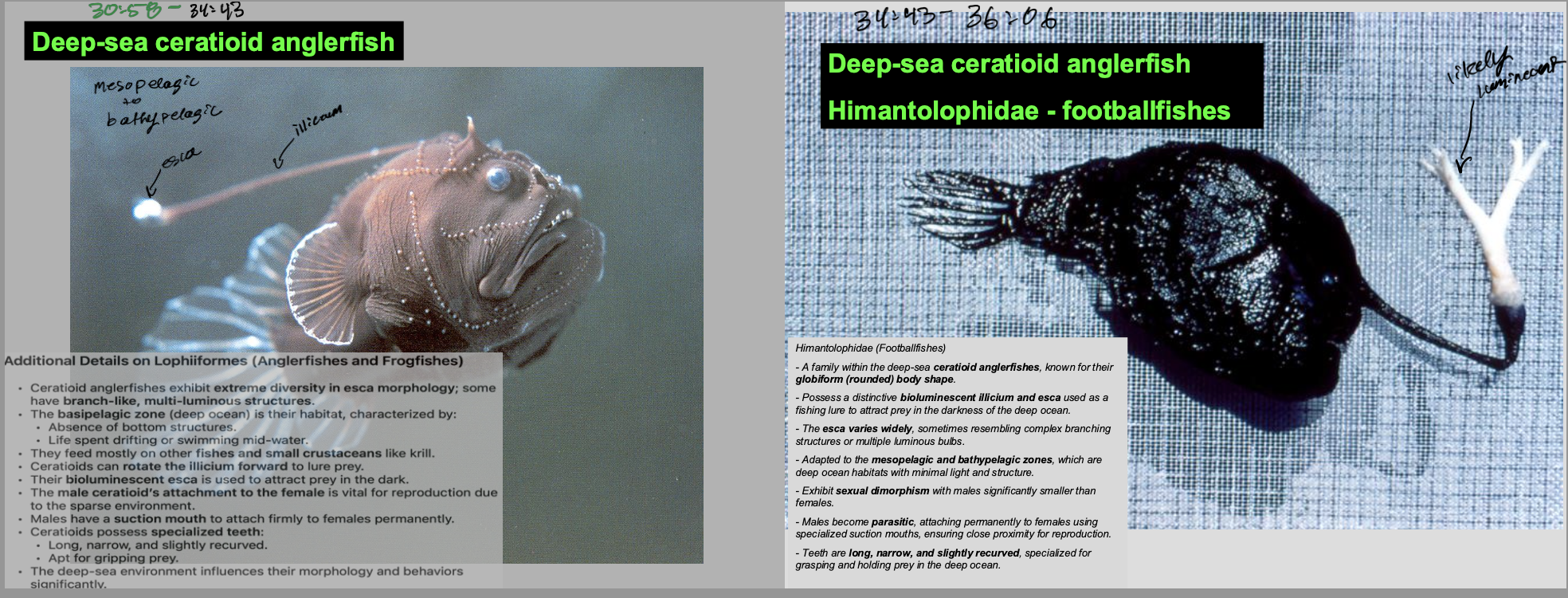
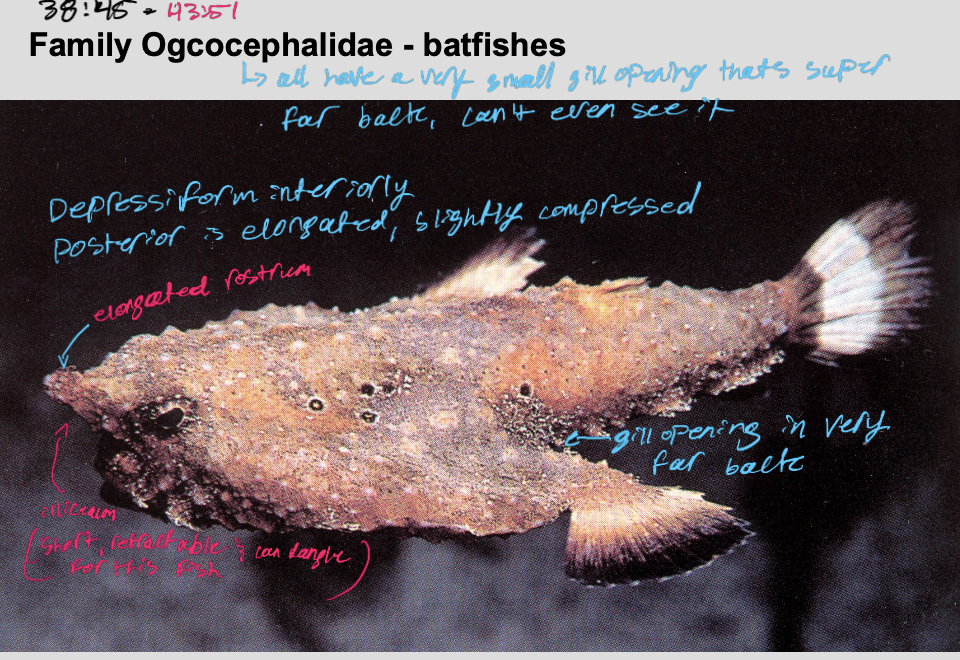
Ococephalidae
Order Lophiiformes (Anglerfishes , batfishes, and Frogfishes)
batfishes
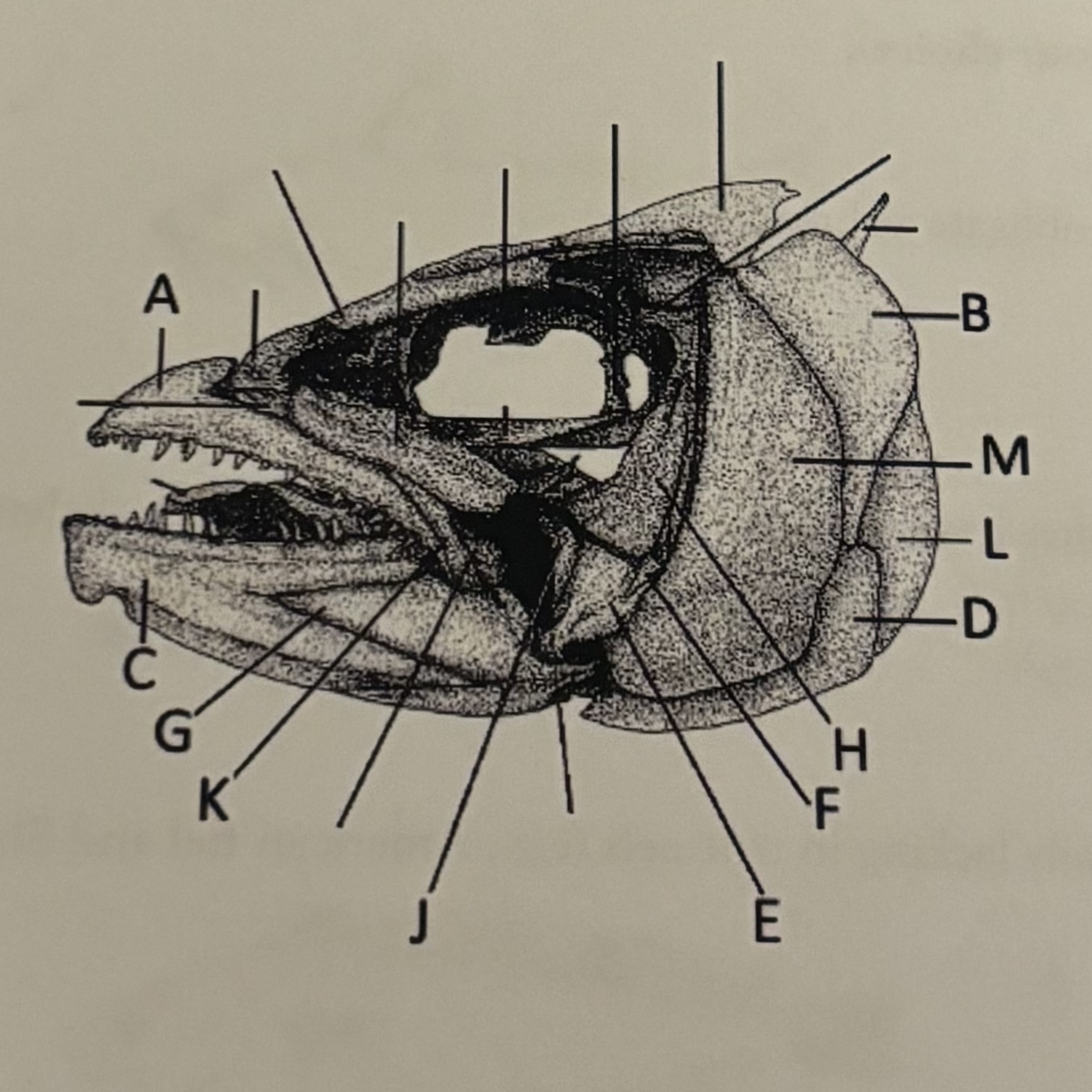
Australian lungfish are obligate air breathers (true or false)
FALSE
Lungfish can breath air but they do not HAVE to
Poecilids (how they live)
typically live amongst the vegitation and cover along the edges of streams or water bodies
Sturgeons and Lamprey groups similarities
both contain species with anadromous migration
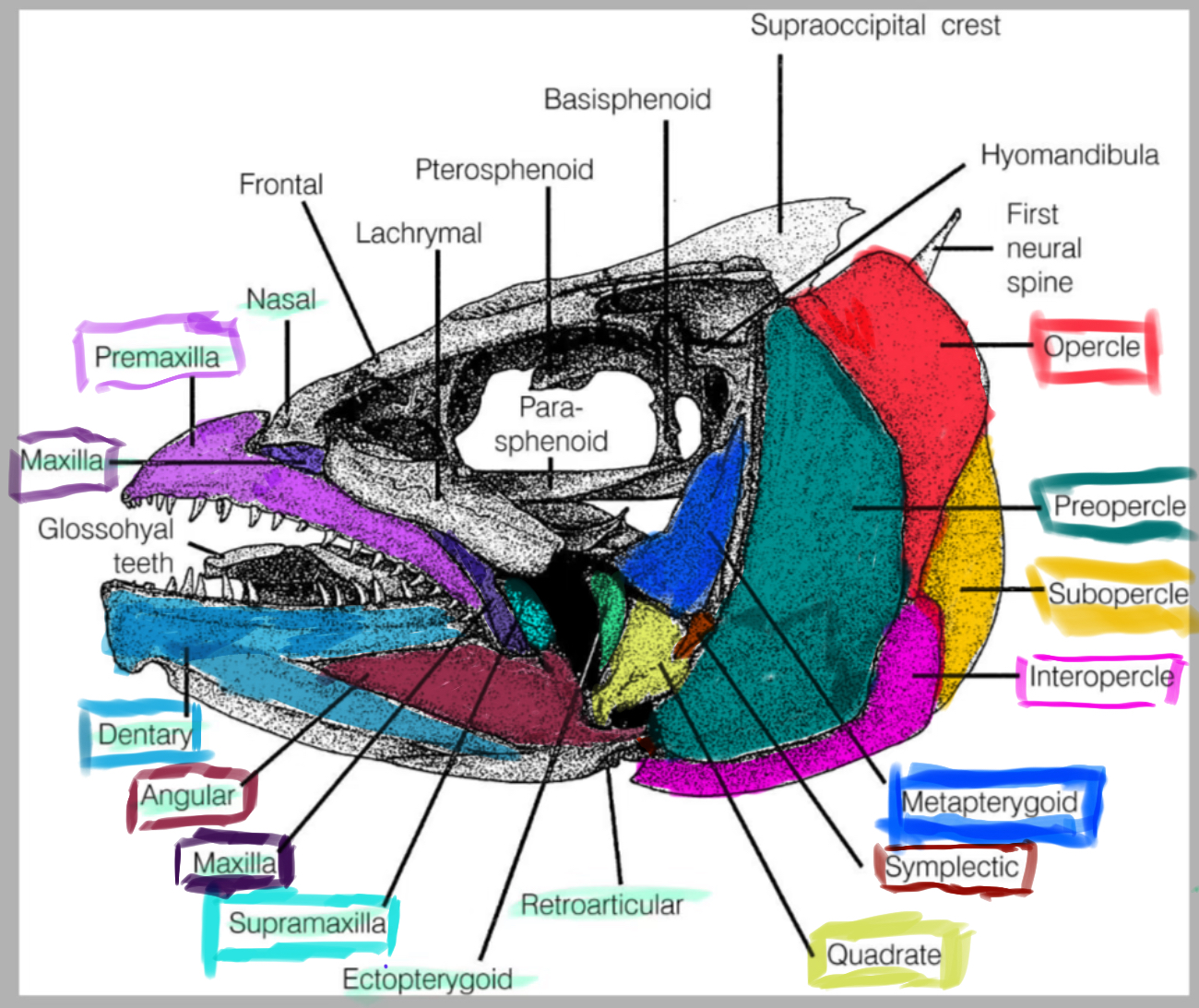
group of fishes that contains species w/ trilobed diphycercal caudal fin
Sarcopterygii (lobe finned fishes)
contains coelacanths have trilobed diphycercal caudal fin
Lungfish have diphycercal caudal fin
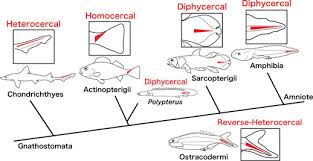
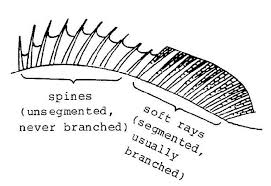
features of typical soft rays in bony fishes
Segmented and branched
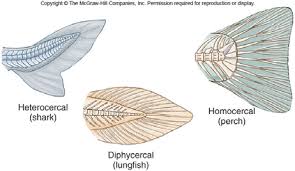
Diphycercal Caudal Fin
Symmetrical internally and externally, vertebral column extends to the tip; seen in lungfishes and coelacanths.
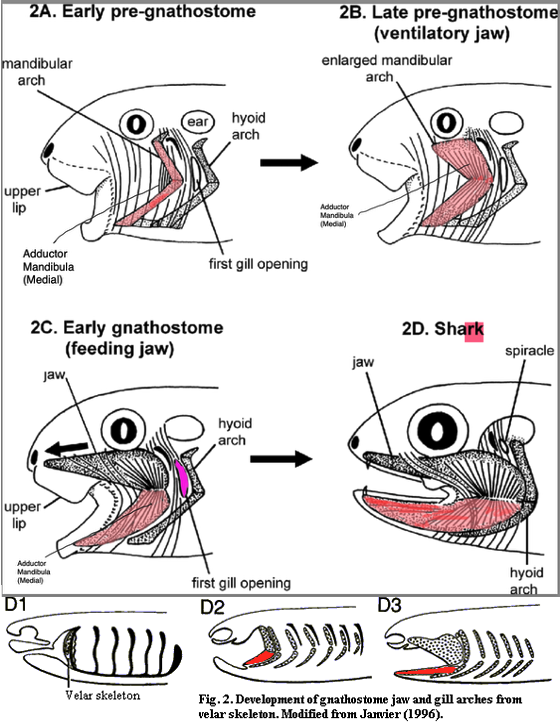
Gnathostomata is characterized by the presence of…..
jaws derived from branchial arches
jaws and paired appendages, including fins in fishes and limbs in tetrapods.
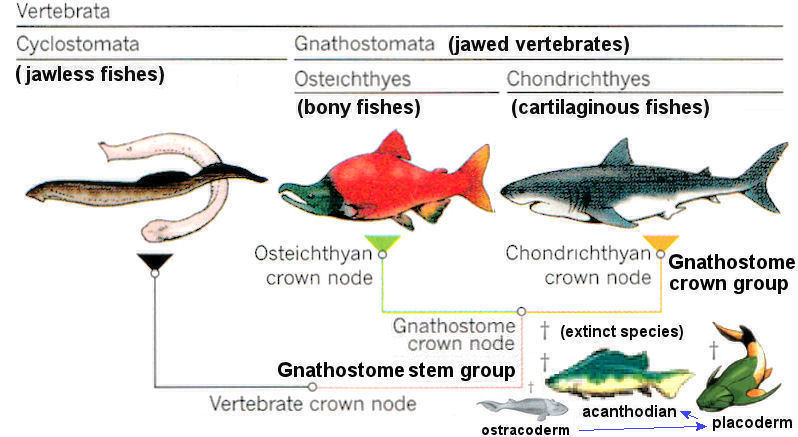
Gnathostomata
jawed vertebrates
includes all living bony fishes:
both ray-finned and lobe-finned, + tetrapods
cartilaginous fishes
and some extinct prehistoric fish (placoderms & acanthodians)
The most phylogenetically basal ("primitive") type of fishes
Myxiniformes (hagfish)
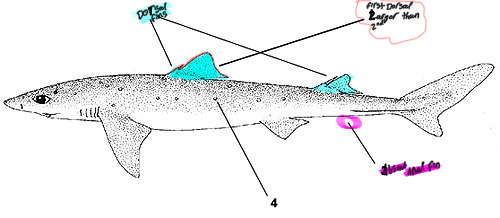
Squalidae
Dogfishes (shark species)
characterized by the lack of an anal fin
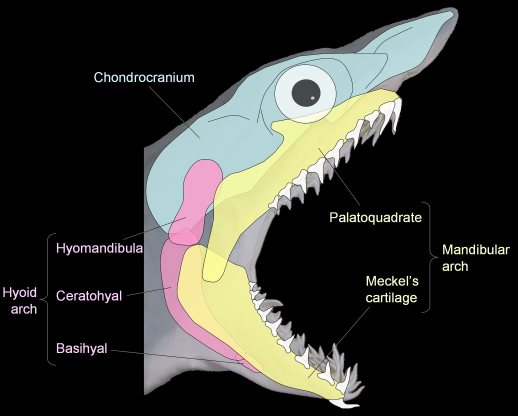
Which upper jaw structure in sharks and rays bears teeth
Palatoquadrate
Palatoquadrate
A cartilage structure in elasmobranchs that supports the upper jaw and bears teeth.
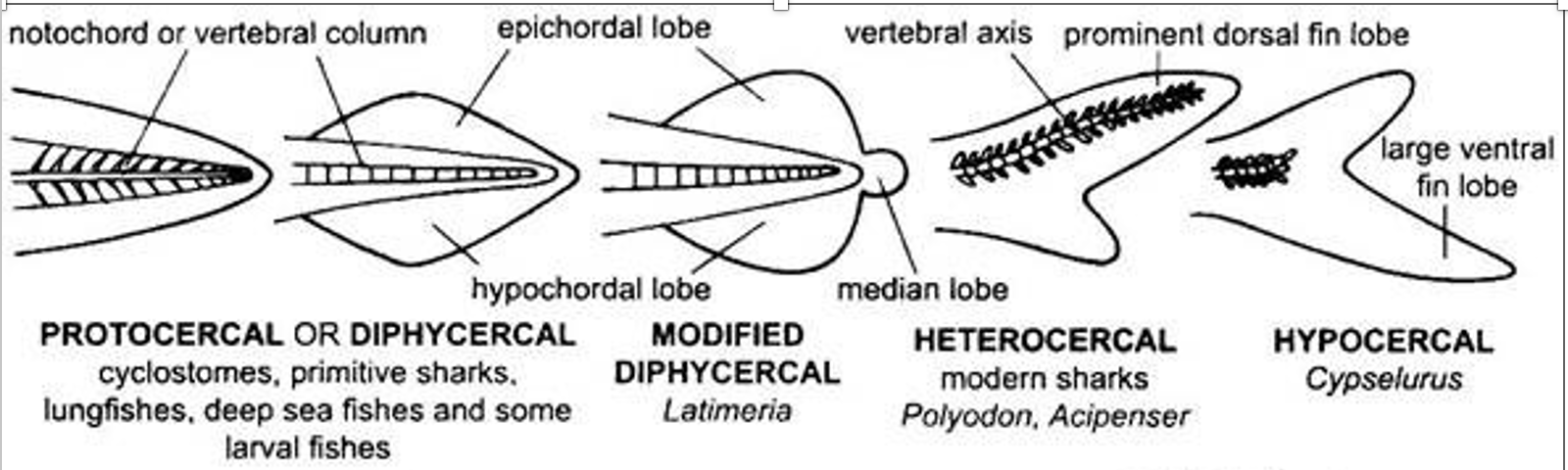
Features of a Lamprey
protocercal caudal fin
Notochord Retained throughout life!
Anadromy/anadromous (in some species)
Lampreys and hagfish = chordates
Jawless fishes = Agnatha

Protocercal caudal fin
Simple, unexpanded, and symmetrical
Vertebral column (notochord) extends to the tip of the tail w/o expanding
provides support without distinct lobes.
Lamprey notochord
A structural rod made of cartilage or bone
supports the body
serves as a primary skeletal element in lampreys.
Remains throughout life in lampreys
derived from the mesoderm
which group contains living species in which the intracranial joint is present
Sarcopterygii: Coelacanthiformes (coelacanths)
intracranial joint
separates jaw into two parts, allowing mouth to open extremely wide for feeding
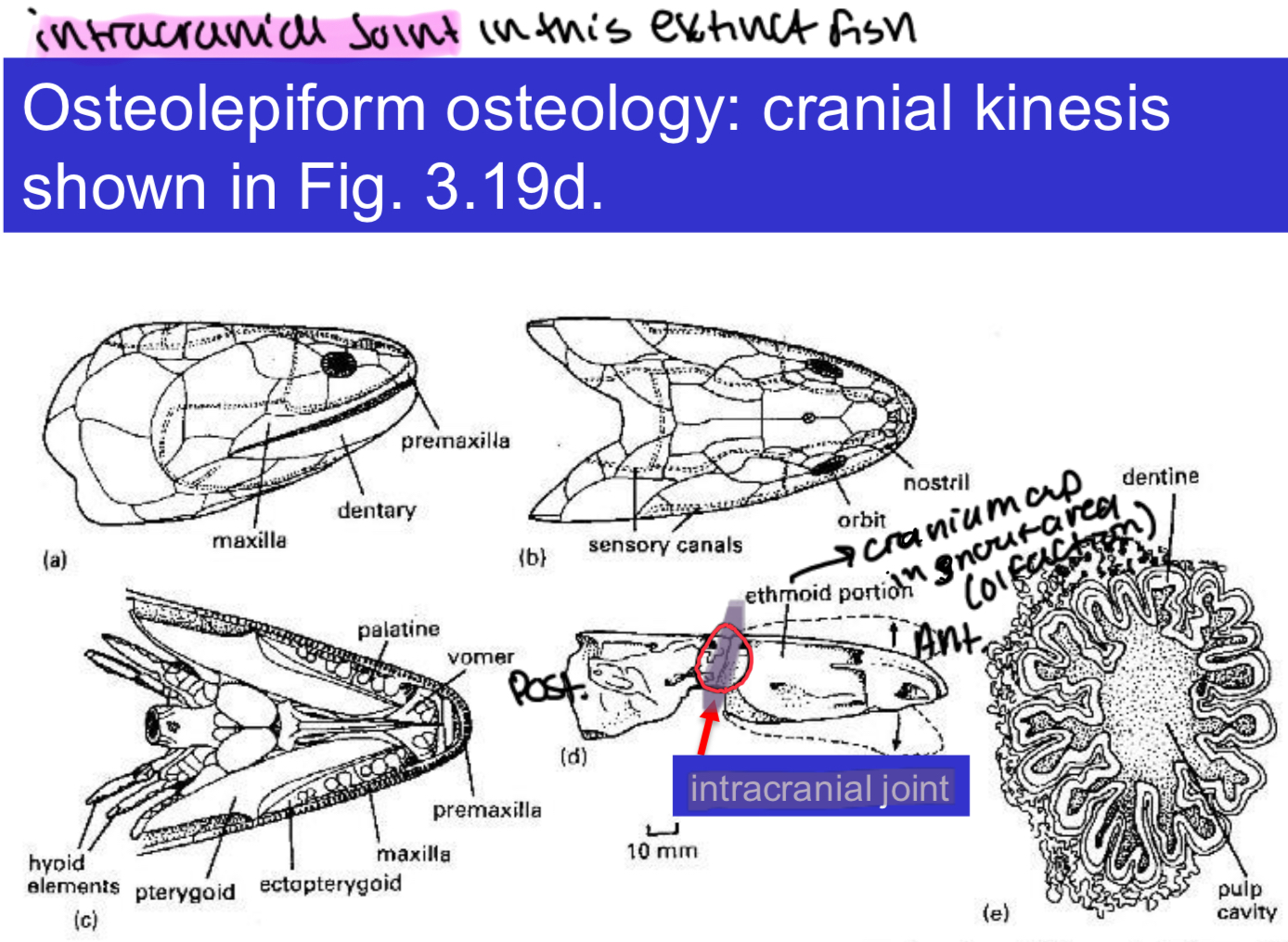
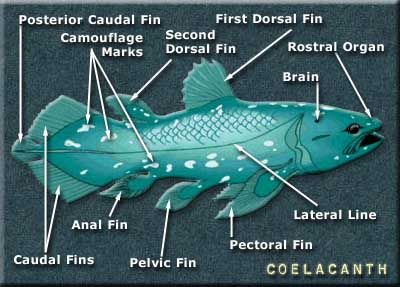
Coelacanthiformes
Order of lobe-finned fish known for their distinctive intracranial joint and ancient lineage.
Coelacanthiformes characteristics
sacropetergyii (lobe finne)
trilobed (3 lobed) diphycercal caudal fin
intracranial joint (allows mouth to open wider)
Absent choanae (2 internal nostrils/openings at the back of the nasal passage ; connects nasal cavity to nasopharynx)
only in Coelacanthiformes ; present in Lungfish
fin rays not branched
unconstricted unossified notochord
Actinopterygii
largest class of vertebrates
ray-finned fish characterized by:
Restricted to segmented rays
lepidotrichia (segmented bony fin rays), rather than fleshy lobes.
No internal nostrils (choanae)
scales ganoid (primitively), cycloid, or ctenoid (except in soft rayed)
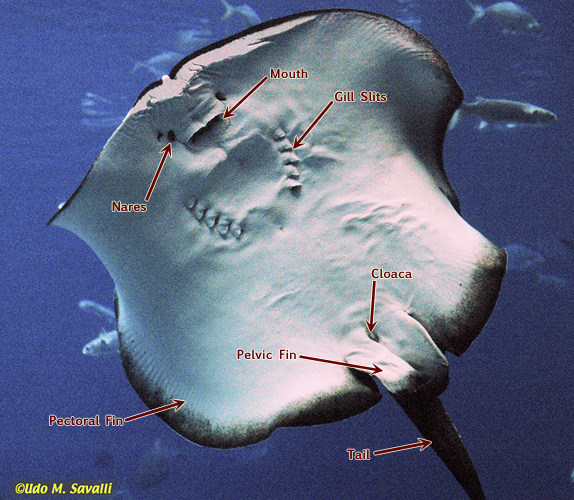
In batoids (rays, skates, and sawfish), the gill opening are located on the _________
ventral surface
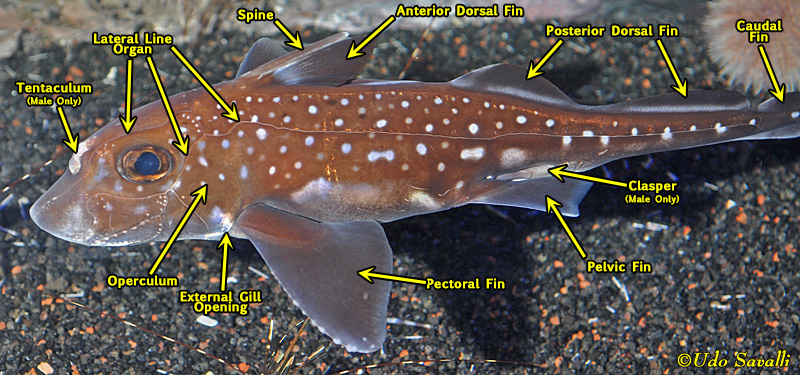
_____ is the number of external gill openings (on each side) in chimaeras
1 external gill opening ; the rest are covered by gill cover
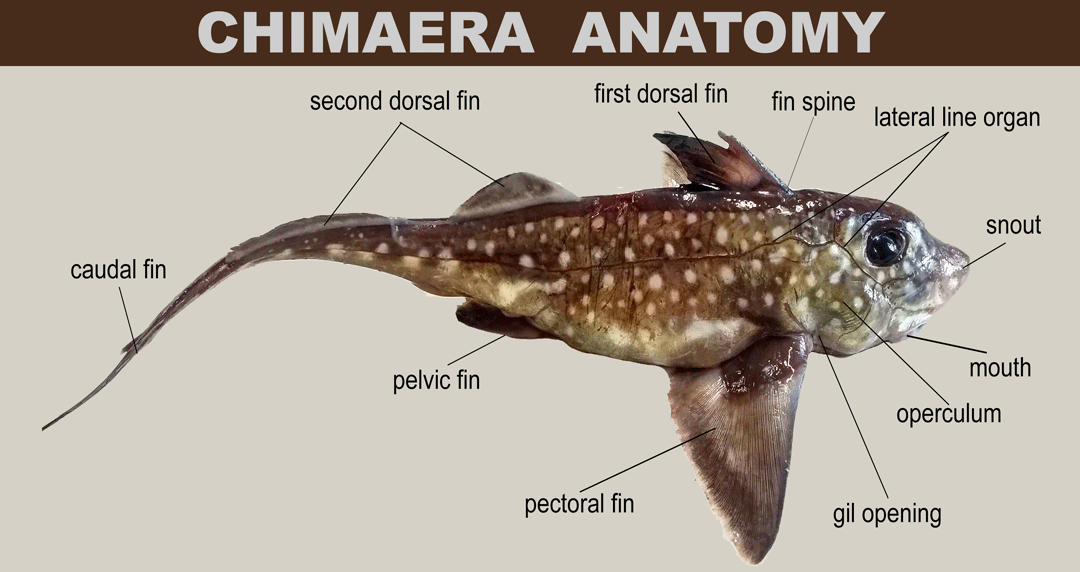
Chimaeras
Ratfishes
Class: Chondrichthyes (cartalagonous fishes)
subclass: Holocephali
Superior mouth
mouth position of surface oriented fishes

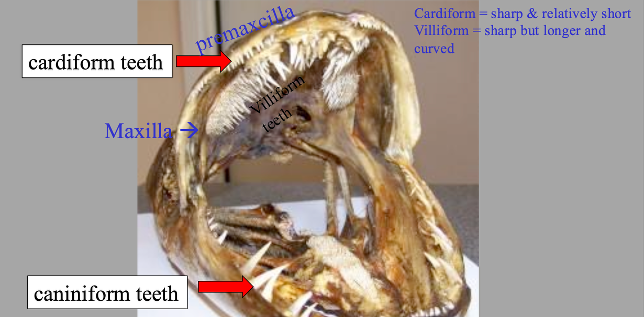
Jaw teeth in piscivorous fishes
Villiform Teeth:
Piscivorous Fish
Fish that eat other fish
carnivorous fish
Have villiform teeth
Villiform Teeth
skinny, sharp, elongated, needle - like teeth found in the mouths of predatory fish (Piscivorous Fish)
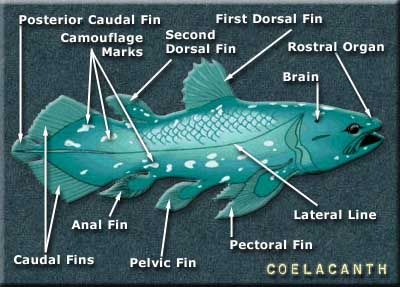
The pattern of geographical distribution of living Coelacanthidae (coelacanths)
in what parts of the world/oceans are living Coelacanthidae found?
Indian Ocean & Indonesia
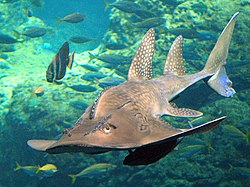
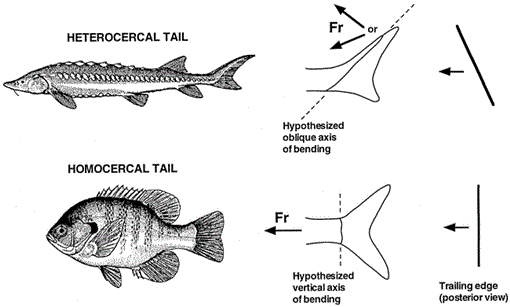
Guitarfish caudal fin type
Heterocercal tail with unequal lobes
Vertebral column extends into the upper lobe, making it longer and asymmetrical
Stingray caudal fin type
No Caudal fin
Hagfish caudal fin type
Protocercal caudal fin
A tail type where the vertebral column extends into the tail, and it lacks lobes.

Coelacanths caudal fin type
3-lobed Diphycercal caudal fin
