Sect 4 PPI - Renal Function
 Call Kai
 Learn
Learn Practice Test
 Spaced Repetition
 Match
Match Flashcards
 Knowt Play
1/55

There's no tags or description
Looks like no tags are added yet.
Name | Mastery | Learn | Test | Matching | Spaced | Call with Kai | Chat |
|---|
No analytics yet
Send a link to your students to track their progress
56 Terms
Kidneys
Reddish brown, bean shaped, 4-5in long
- 0.5% of adult body weight
- 25% of blood is being filtered
- 1,200ml/min
25%
What percent of blood is being filtered by the kidney?
1200ml/min
How much blood is being filtered by the kidney per min?
Both located slightly above the waistline in the posterior wall of the abdominal cavity, in a retroperitoneal position
Location of kidneys
true
T or F:
You only need 1 functioning kidney to perform all filtration
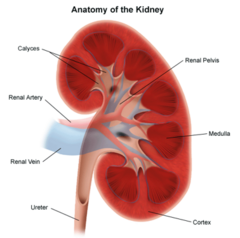
Renal Cortex, Renal Medulla, Renal Pelvis
3 parts of the kidney
Formation and Flow of urine
1. Bloodstream (Aorta/Renal artery/Renal afferent arterioles)
2. Glomerulus
3. Glomerular capsule
4. Renal tubules
5. Collecting ducts
6. Renal pelvis
7. Ureter
8. Urinary bladder
9. Urethera
10. Urinary meatus: urine is expelled
Renal Pyramids
Cone shaped structure containing straight parallel segments of nephrons
- 27 per kidney

Nephron
Functional unit of the kidney
- filters blood & produces urine

Renal Corpuscle
Consists of glomerulus and glomerular capsule

Glomerulus
Tangled blood capillaries (tuft)
Substances are pushed through multiple small pores in the capillaries into the glomerular capsule (Bowman's capsule) by hydrostatic pressure based on size and charge
Glomerular capsule
Thin-walled structure that surrounds the glomerulus and collects the substances filtered through the glomerulus
Renal Tubules
Composed of proximal convoluted tubules, the nephron loop (Loop of Henle), and distal convoluted tubules
located in medulla of kidneys

Collecting tubules and ducts
What other 2 structures are located in the medulla of the kidneys
Renal Calyces
System of drainage sinuses the connect the inner part of the kidney to the ureter (Major & Minor)
Minor → Major → Renal Pelvis → Ureters
Ureters
Slender muscular tubes apprx 10-12in long
Carries urine formed in the kidney to the urinary bladder

Urinary bladder
A hollow muscular organ that holds the urine until it is expelled

Uretha
The tube that carries urine outside the body
8-10in
How long is a male urethra?
1.5in
How long is a female urethra?
Urinary meatus
An external opening from which urine is expelled
Filtration, Reabsorption, Secretion
What are the 3 steps of urine formation?

Filtration
1st step of urine formation:
- fluids and dissolved substances are forced through the glomerulus by hydrostatic pressure into the glomerular capsule
- creates "glomerular filtrate"
RBCs and proteins
2 substances are too large to be filtered and remain in the blood
water, Na+, K+, glucose, urea
Most common constituents of GF
100-125ml/min
What is the normal Glomerular Filtrate Rate (GFR)?
Reabsorption
2nd step in urine formation:
- substances that body needs are reabsorbed by renal tubule system (some cross back into blood)
- ex: Glucose, Water, Electrolytes
- any other excess or unwanted substances remain to form urine
Renal Threshold
blood levels of a substance that are too high to allow any more to be reabsorbed
- if it exceeds, spills over into urine
175 mg/dL
What is the renal threshold of glucose?
Secretion
3rd step in urine formation
- substances are transferred from the blood (peritubular capillaries) back into renal tubules for excretion as urine
- fine-tuning before excretion
water
solvent that makes up 95% of substances in urine
95%
Water makes up ________% of the substances in urine
800-2000 ml/day
What is considered the normal range of daily output of urine?
Oliguria
too little urine production (
Diuresis
too much urine production due to a kidney disease (>3000 ml/day)
Anuria
absence of urination
Dysuria
difficult or painful urination
Nocturia
increased urination at night
Polyuria
too much urine production NOT due to a kidney disease (>3000 ml/day)
- due to: excess drinking, diabetes (due to increase water ingestion)
Azotemia
retention of nitrogen retaining products in the blood
- normally are filtered out if filtration working
- due to: medical condition OR high protein diet OR kidney problems
- not as severe
Uremia
urine in the blood
- all waste & toxins that should be expelled through urine is not being retained in blood
- very severe = end of stage renal failure
- see in pts on dialysis or kidney transplant
1. Glomerular Filtration
2. Renal blood flow and urine output
3. Tubular function
Assessment of renal function can be divided into 3 categories:
Assessment of Glomerular Filtration
Essential because this function best correlates with the ability of the kidneys to maintain the composition of body fluids (homeostasis)
Renal blood flow and urine output
- Kidneys receive 25% of cardiac output = 1200ml/min
- Blood flow must be sufficient for kidneys to maintain adequate homeostasis
- Daily output apprx. 800-2000ml/day (N: 1200-1500ml/day)
Tubular function
Measuring the concentration of the renal handling of substances normally secreted by the tubules can pinpoint any abnormalities in this system
Glomerular Filtration Rate (GFR)
the rate at which a substance is filtered from the blood of glomerular capillary into the urine filtrate of Bowman's space
overall renal disease
GF is a measurement of:
diminishing renal function & increasing severity of disease
Progressively decreasing GFR is an indicator of:
1 ml/min/year
As we age, GFR decreases by:
Clearance
a measurement of the excretion or removal of a chemical from the body
defined as the volume of plasma at which a measured amount of substance can be completely eliminated into the urine per unit of time
plasma concentration and its excretory rate
The clearance of a substance depends on (2):
GFR and renal plasma flow
The clearance of a substance depends on the plasma concentration and its excretory rate, which depends on (2):
filtered completely through the glomerulus and not reabsorbed through the nephron tubule
The best substance to use as a reference for glomerular clearance would be a chemical that is:
1. Constant production
2. Very tiny amounts reabsorbed
3. ~100% filtered out
3 criteria used for determining which analytes should be used for renal clearance testing
Clearance tests
the best lab tests currently available to detect mild to moderate glomerular damage
Creatinine
Common substance used for clearance tests used in the lab?