Part 3 - SMOOTH MUSCLE - AUTACOIDS
 Call Kai
 Learn
Learn Practice Test
 Spaced Repetition
 Match
Match Flashcards
 Knowt Play
1/138

Earn XP
Description and Tags
Proverbs 16:3
Name | Mastery | Learn | Test | Matching | Spaced | Call with Kai | Chat |
|---|
No analytics yet
Send a link to your students to track their progress
139 Terms
b. Localized hormones
AUTACOIDS are also known as ________.
a. Systemic hormones
b. Localized hormones
c. Endocrine stimulants
d. Skeletal muscle blockers
b. Near the site of action
The site of release of AUTACOIDS is ________.
a. Far from the site of action
b. Near the site of action
c. Inside endocrine glands only
d. Limited to the brain
b. Virtually all cells
AUTACOIDS are produced by ________.
a. Specific endocrine glands only
b. Virtually all cells
c. Skeletal muscles only
d. The adrenal medulla only
c. Systemic and produced by specific cells
AUTACOIDS - local & all cells
Endocrine- systemic & specific cells
AUTACOIDS differ from endocrine hormones because endocrine hormones are ________.
a. Localized and produced by all cells
b. Produced by virtually all cells
c. Systemic and produced by specific cells
d. Limited to the gastrointestinal tract
All
“BESH”
AUTACOID:
a. Histamine
b. Eicosanoids
c. Bradykinin
d. Serotonin
b. Mast cells
[HISTAMINE]
One major location of Histamine is ________.
a. Skeletal muscle only
b. Mast cells
c. Kidneys only
d. Thyroid gland
a. Basophils
[HISTAMINE]
Histamine is stored in ________.
a. Basophils
b. Hepatocytes
c. Osteocytes
d. Erythrocytes
a. Stomach
[HISTAMINE]
a. Stomach
b. Pancreas only
c. Adrenal cortex only
d. Bone marrow only
b. Central Nervous System (CNS)
[HISTAMINE]
Histamine is present in the ________.
a. Peripheral bones
b. Central Nervous System (CNS)
c. Skeletal joints only
d. Liver only
c. L-histidine
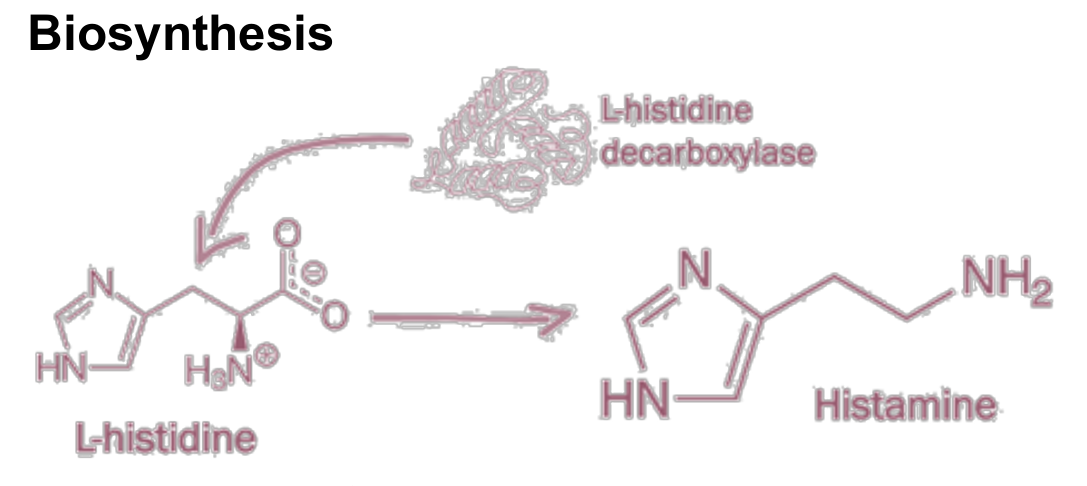
[HISTAMINE]
Histamine is synthesized from ________.
a. Tyrosine
b. Tryptophan
c. L-histidine
d. Glycine
c. L-histidine decarboxylase
[HISTAMINE]
The enzyme responsible for Histamine biosynthesis is ________.
a. Acetylcholinesterase
b. Monoamine oxidase
c. L-histidine decarboxylase
d. Tyrosine hydroxylase
b. L-histidine
[HISTAMINE]
Histamine is formed through the decarboxylation of ________.
a. Dopamine
b. L-histidine
c. Epinephrine
d. Acetylcholine
a. Ca²⁺-dependent and Ca²⁺-independent degranulation
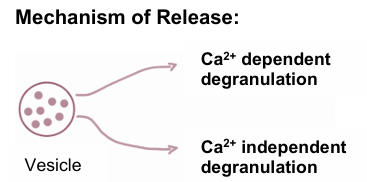
[HISTAMINE]
The mechanism of Histamine release includes ________.
a. Ca²⁺-dependent and Ca²⁺-independent degranulation
b. Adrenergic and cholinergic stimulation
c. Alpha and beta receptor activation
d. Endocrine and exocrine secretion
a. Ca²⁺-dependent degranulation
[HISTAMINE]
Induced by immunoglobulin E (IgE) fixation to mast cells
a. Ca²⁺-dependent degranulation
b. Ca²⁺-independent degranulation
a. Ca²⁺-dependent degranulation
[HISTAMINE]
Anaphylaxis
a. Ca²⁺-dependent degranulation
b. Ca²⁺-independent degranulation
b. Ca²⁺-independent degranulation
[HISTAMINE]
Induced by drugs
a. Ca²⁺-dependent degranulation
b. Ca²⁺-independent degranulation
b. Ca²⁺-independent degranulation
[HISTAMINE]
Anaphylactoid reaction
a. Ca²⁺-dependent degranulation
b. Ca²⁺-independent degranulation
All
“TAG Mo”
[HISTAMINE]
Drugs that can induce Ca²⁺-independent Histamine degranulation.
(Multiple Answers)
a. Morphine
b. Tubocurarine
c. Guanethedine
d. Amine Antibiotics
b. Binding histaminic receptors
[HISTAMINE]
The mechanism of action of Histamine is ________.
a. Blocking acetylcholine receptors
b. Binding histaminic receptors
c. Stimulating dopamine release
d. Inhibiting ion channels
a. Histaminic-1 (H1)
[HISTAMINE]
Vasodilation
a. Histaminic-1 (H1)
b. Histaminic-2 (H2)
c. Histaminic-3 (H3)
d. Histaminic-4 (H4)
a. Histaminic-1 (H1)
[HISTAMINE]
Bronchoconstriction
a. Histaminic-1 (H1)
b. Histaminic-2 (H2)
c. Histaminic-3 (H3)
d. Histaminic-4 (H4)
a. Histaminic-1 (H1)
[HISTAMINE]
Pain and itchiness
a. Histaminic-1 (H1)
b. Histaminic-2 (H2)
c. Histaminic-3 (H3)
d. Histaminic-4 (H4)
a. Histaminic-1 (H1)
[HISTAMINE]
Contraction of endothelial cells
a. Histaminic-1 (H1)
b. Histaminic-2 (H2)
c. Histaminic-3 (H3)
d. Histaminic-4 (H4)
a. Histaminic-1 (H1)
[HISTAMINE]
a. Histaminic-1 (H1)
b. Histaminic-2 (H2)
c. Histaminic-3 (H3)
d. Histaminic-4 (H4)
b. Histaminic-2 (H2)
[HISTAMINE]
Increase gastric acid production
a. Histaminic-1 (H1)
b. Histaminic-2 (H2)
c. Histaminic-3 (H3)
d. Histaminic-4 (H4)
b. Histaminic-2 (H2)
[HISTAMINE]
Enhances degranulation of histamine
a. Histaminic-1 (H1)
b. Histaminic-2 (H2)
c. Histaminic-3 (H3)
d. Histaminic-4 (H4)
c. Histaminic-3 (H3)
[HISTAMINE]
Decrease histamine release
a. Histaminic-1 (H1)
b. Histaminic-2 (H2)
c. Histaminic-3 (H3)
d. Histaminic-4 (H4)
d. Histaminic-4 (H4)
[HISTAMINE]
Chemotaxis
a. Histaminic-1 (H1)
b. Histaminic-2 (H2)
c. Histaminic-3 (H3)
d. Histaminic-4 (H4)
b. Histamine
[HISTAMINE]
___agonist no longer used clinically.
a. Betahistine
b. Histamine
c. Epinephrine
d. Impromidine
a. Pulmonary challenge test
[HISTAMINE]
An obsolete use of Histamine agonist is the ________.
a. Pulmonary challenge test
b. Management of Parkinsonism
c. Treatment of hyperacidity
d. Bronchodilation in COPD
b. Gastric secretory function
[HISTAMINE]
Histamine agonist was formerly used to test ________.
a. Skeletal muscle contraction
b. Gastric secretory function
c. Renal filtration rate
d. Dopamine release
H1 agonist ; H3 antagonist
[HISTAMINE]
Betahistine
(Multiple Answers)
a. H1 agonist
b. H2 agonist
c. H3 agonist
d. H4 agonist
a. Betahistine
[HISTAMINE]
Management of Meniere’s Disease associated with vertigo
a. Betahistine
b. Morphine
c. Tubocurarine
d. Neostigmine
a. Betahistine
[HISTAMINE]
Endolymph, presence of fluid in the inner ear, is managed by
a. Betahistine
b. Morphine
c. Tubocurarine
d. Neostigmine
a. Impromidine
[HISTAMINE]
________ is classified as investigational.
a. Impromidine
b. Betahistine
c. Epinephrine
d. Histamine
b. Epinephrine
[HISTAMINE]
_______ is a functional antagonist of Histamine.
a. Betahistine
b. Epinephrine
c. Antihistamine
d. Histamine
b. Pharmacologic
Functional Antagonists- Epinephrine
Pharmacologic Antagonists- Antihistamines
[HISTAMINE]
_______ antagonism of Histamine is produced by antihistamines.
a. Functional
b. Pharmacologic
a. Alpha (α)
Functional: Epinephrine
α- vasoconstriction
β- bronchodilation
[HISTAMINE]
___ receptor activation by Epinephrine produces vasoconstriction.
a. Alpha (α)
b. Beta (β)
c. Histaminic
d. Muscarinic
c. Beta (β)
Functional: Epinephrine
α- vasoconstriction
β- bronchodilation
[HISTAMINE]
_______ receptor activation by Epinephrine produces bronchodilation.
a. Alpha (α)
b. Histaminic
c. Beta (β)
d. Nicotinic
a. H1 antihistamines
anti-allergy
do not give for bronchial asthma
[HISTAMINE]
Use: allergic reaction, asthma
a. H1 antihistamines
b. H2 antihistamines
b. Lipophilic and can cross the Blood-Brain Barrier (BBB)
Correct:
c. Powerful central anticholinergics
d. Sedating agents
[HISTAMINE]
First-generation (classical) antihistamines are ________.
a. Hydrophilic and cannot cross the BBB
b. Lipophilic and can cross the Blood-Brain Barrier (BBB)
c. Limited to peripheral tissues only
d. Non-sedating agents only
c. Ethanolamines
[HISTAMINE]
______ antihistamines are considered the most sedating and most efficacious.
a. Piperazines
b. Alkylamines
c. Ethanolamines
d. Phenothiazines
a. Diphenhydramine
[HISTAMINE]
_____ is an ethanolamine antihistamine used in the management of Acute Dystonic Crisis.
a. Diphenhydramine
b. Hydroxyzine
c. Promethazine
d. Cetirizine
a. Doxylamine
[HISTAMINE]
______ is an ethanolamine used as a sleeping aid.
a. Doxylamine
b. Carbinoxamine
c. Chlorpheniramine
d. Meclizine
a. Pyrilamine
[HISTAMINE]
_______ is an Ethylenediamine that may cause moderate sedation and GI upset.
a. Pyrilamine
b. Cyclizine
c. Hydroxyzine
d. Brompheniramine
b. Motion sickness
[HISTAMINE]
Meclizine and Cyclizine are used for ________.
a. Hyperacidity
b. Motion sickness
c. Acute dystonic crisis
d. Serotonin syndrome only
a. Hydroxyzine
[HISTAMINE]
A prodrug whose active form is Cetirizine.
a. Hydroxyzine
b. Cyclizine
c. Promethazine
d. Tripelennamine
a. OTC cold medications
[HISTAMINE]
Brompheniramine and Chlorpheniramine are components of ________.
a. OTC cold medications
b. Antidepressants
c. Muscle relaxants
d. Antipsychotics
a. Promethazine
[HISTAMINE]
Used as a preanesthetic agent.
a. Promethazine
b. Hydroxyzine
c. Cyproheptadine
d. Doxylamine
a. Cyproheptadine
[HISTAMINE]
Also possesses antiserotonergic and anticholinergic activities used in management of serotonin syndrome
a. Cyproheptadine
b. Tripelennamine
c. Cyclizine
d. Doxylamine
b. Less lipophilic and less sedating
[HISTAMINE]
Second-generation antihistamines are ________.
a. More lipophilic and highly sedating
b. Less lipophilic and less sedating
c. Unable to act on histamine receptors
d. Powerful central anticholinergics
a. Less sedating
Piperidines- True, non-sedating
[HISTAMINE]
2nd generation Piperazines
a. Less sedating
b. True, non-sedating
b. True, non-sedating
Piperazines- Less sedating
[HISTAMINE]
2nd generation Piperidines
a. Less sedating
b. True, non-sedating
Piperazines ____a. Meclizine
Ethanolamines__b. Dimenhydrinate
Alkylamines ____c. Brompheniramine
Ethylenediamine_d. Pyrilamine
Ethanolamines __e. Diphenhydramine
Ethylenediamine _f. Tripelennamine
Ethanolamines __g. Carbinoxamine
Piperazines_____h. Hydroxyzine
Piperidine_______j. Cyproheptadine
Ethanolamines___k. Doxylamine
Piperazines______l. Cyclizine
Alkylamines_____m. Chlorpheniramine
Phenothiazine ___n. Promethazine
[HISTAMINE]
1st generation (classical)
Choices: Ethanolamines, Ethylenediamine, Piperazines, Alkylamines, Phenothiazine, or Piperidine
___a. Meclizine
___b. Dimenhydrinate
___c. Brompheniramine
___d. Pyrilamine
___e. Diphenhydramine
___f. Tripelennamine
___g. Carbinoxamine
___h. Hydroxyzine
___j. Cyproheptadine
___k. Doxylamine
___l. Cyclizine
___m. Chlorpheniramine
___n. Promethazine
II. Cetirizine
IV. Levocetirizine
[HISTAMINE]
2nd generation Antihistamine: Piperazines
I. Loratadine
II. Cetirizine
III. Desloratadine
IV. Levocetirizine
V. Fexofenadine
I. Loratadine
III. Desloratadine
V. Fexofenadine
[HISTAMINE]
2nd generation Antihistamine: Piperidines
I. Loratadine
II. Cetirizine
III. Desloratadine
IV. Levocetirizine
V. Fexofenadine
c. Cimetidine
Cimetidine (least potent)
Famotidine (most potent)
[HISTAMINE]
_______ is the least potent H₂ receptor antagonist.
a. Famotidine
b. Ranitidine
c. Cimetidine
d. Nizatidine
a. Famotidine
Cimetidine (least potent)
Famotidine (most potent)
[HISTAMINE]
_______ is the most potent H₂ receptor antagonist.
a. Famotidine
b. Cimetidine
c. Ranitidine
d. Nizatidine
b. Gastric and duodenal ulcers
-Nizatidine???
[HISTAMINE]
H₂ blockers promote healing of ________.
a. Motion sickness
b. Gastric and duodenal ulcers
c. Acute dystonic crisis
d. Parkinsonism
c. Zollinger-Ellison Syndrome
[HISTAMINE]
H₂ blockers are used for treatment of hypersecretory states such as ________.
a. Motion sickness
b. Parkinson disease
c. Zollinger-Ellison Syndrome
d. Diabetes mellitus
c. Cimetidine
[HISTAMINE]
______ is considered the prototype H₂ blocker.
a. Famotidine
b. Ranitidine
c. Cimetidine
d. Nizatidine
b. Enzyme inhibitor
[HISTAMINE]
Cimetidine acts as an ________, leading to drug interactions and toxicity.
a. Histamine agonist
b. Enzyme inhibitor
c. Enzyme inducer
d. CNS stimulant
b. Gynecomastia, loss of libido, and infertility
[HISTAMINE]
Cimetidine may cause antiandrogenic effects such as ________.
a. Myalgia and rhabdomyolysis
b. Gynecomastia, loss of libido, and infertility
c. Hyperactivity and insomnia
d. Bronchospasm and cough
c. Serotonin
______ is an autacoid found in enterochromaffin cells, platelets, stomach, and CNS.
a. Histamine
b. Bradykinin
c. Serotonin
d. Eicosanoids
c. L-tryptophan
[Serotonin]
Serotonin is synthesized from ________.
a. L-tyrosine
b. Glycine
c. L-tryptophan
d. Histidine
a. Hydroxylation
Serotonin = hydroxylation → decarboxylation
Histamine = decarboxylation agad
[Serotonin]
Biosynthesis of Serotonin involves ________ followed by decarboxylation.
a. Hydroxylation
b. Oxidation
c. Acetylation
d. Phosphorylation
a. 5-hydroxytryptamine
[Serotonin]
Serotonin (5-HT) is also known as ________.
a. 5-hydroxytryptamine
b. 5-hydroxytyrosine
c. 5-hydroxytryptophan
d. Dopamine hydroxylase
b. Interacts with serotonergic receptors
[Serotonin]
Serotonin MOA
a. Interacts with histaminic receptors
b. Interacts with serotonergic receptors
c. Interacts with nicotinic receptors
d. Interacts with adrenergic receptors
a. 5-HT1A
[SEROTONERGIC RECEPTORS]
Decrease cAMP
a. 5-HT1A
b. 5-HT1B/1D
c. 5-HT2
d. 5-HT3
e. 5-HT4
a. 5-HT1A
[SEROTONERGIC RECEPTORS]
mainly located in the presynaptic receptor in the CNS
a. 5-HT1A
b. 5-HT1B/1D
c. 5-HT2
d. 5-HT3
e. 5-HT4
a. 5-HT1A
[SEROTONERGIC RECEPTORS]
Function is for Autoregulation by inhibiting further release of serotonin
a. 5-HT1A
b. 5-HT1B/1D
c. 5-HT2
d. 5-HT3
e. 5-HT4
b. 5-HT1B/1D
-Not involved: blood vessels in the heart ❤ and in the skeletal muscles 💪🏼
[SEROTONERGIC RECEPTORS]
are found in vascular smooth muscles
a. 5-HT1A
b. 5-HT1B/1D
c. 5-HT2
d. 5-HT3
e. 5-HT4
b. 5-HT1B/1D
[SEROTONERGIC RECEPTORS]
produce vasoconstriction
a. 5-HT1A
b. 5-HT1B/1D
c. 5-HT2
d. 5-HT3
e. 5-HT4
c. 5-HT2
[SEROTONERGIC RECEPTORS]
Enhances phospholipase C activity
a. 5-HT1A
b. 5-HT1B/1D
c. 5-HT2
d. 5-HT3
e. 5-HT4
c. 5-HT2
[SEROTONERGIC RECEPTORS]
Smooth muscles (bronchi 🫁, blood vessels🩸, intestines⚕) → contraction
a. 5-HT1A
b. 5-HT1B/1D
c. 5-HT2
d. 5-HT3
e. 5-HT4
c. 5-HT2
[SEROTONERGIC RECEPTORS]
Platelets -> aggregation
a. 5-HT1A
b. 5-HT1B/1D
c. 5-HT2
d. 5-HT3
e. 5-HT4
c. 5-HT2
[SEROTONERGIC RECEPTORS]
CNS -> hallucination
a. 5-HT1A
b. 5-HT1B/1D
c. 5-HT2
d. 5-HT3
e. 5-HT4
d. 5-HT3
[SEROTONERGIC RECEPTORS]
Inotropic receptors
a. 5-HT1A
b. 5-HT1B/1D
c. 5-HT2
d. 5-HT3
e. 5-HT4
d. 5-HT3
[SEROTONERGIC RECEPTORS]
Chemoreceptor trigger zone -> nausea anc vomiting
a. 5-HT1A
b. 5-HT1B/1D
c. 5-HT2
d. 5-HT3
e. 5-HT4
e. 5-HT4
[SEROTONERGIC RECEPTORS]
Enhances cAMP
a. 5-HT1A
b. 5-HT1B/1D
c. 5-HT2
d. 5-HT3
e. 5-HT4
e. 5-HT4
[SEROTONERGIC RECEPTORS]
GIT -> peristalsis
a. 5-HT1A
b. 5-HT1B/1D
c. 5-HT2
d. 5-HT3
e. 5-HT4
a. Buspirone
[Serotonin Agonists]
______ is a partial 5-HT₁A agonist with anxiolytic effects.
a. Buspirone
b. Cyproheptadine
c. Ondansetron
d. Sumatriptan
a. Buspirone
[Serotonin Agonists]
______ acts as a partial agonist at 5-HT₁A receptors.
a. Buspirone
b. Prucalopride
c. Granisetron
d. Naratriptan
c. 2 weeks
[Serotonin Agonists]
The therapeutic effects of Buspirone usually appear after ________.
a. 24 hours
b. 3 days
c. 2 weeks
d. 1 month
b. 5-HT₁B/1D agonists
[Serotonin Agonists]
-triptans (e.g., Sumatriptan, Naratriptan, Zolmitriptan) are ________.
a. 5-HT₂ antagonists
b. 5-HT₁B/1D agonists
c. 5-HT₄ antagonists
d. 5-HT₃ blocker
d. -triptans (Sumatriptan, Naratriptan, Zolmitriptan)
[Serotonin Agonists]
Inhibits vasodilation of cerebral blood vessels
a. Buspirone
b. Prucalopride
c. Granisetron
d. -triptans
d. -triptans (Sumatriptan, Naratriptan, Zolmitriptan)
[Serotonin Agonists]
Inhibits inflammation of meninges
a. Buspirone
b. Prucalopride
c. Granisetron
d. -triptans
d. -triptans (Sumatriptan, Naratriptan, Zolmitriptan)
[Serotonin Agonists]
Use: Anti-migraine Agents
a. Buspirone
b. Prucalopride
c. Granisetron
d. -triptans
d. -triptans (Sumatriptan, Naratriptan, Zolmitriptan)
-5-HT1B/1D = Vasoconstriction = inc BP
[Serotonin Agonists]
A/E: Increase in blood pressure
a. Buspirone
b. Prucalopride
c. Granisetron
d. -triptans
a. Partial 5-HT4 agonists
-Cisapride, Tegaserod
[Serotonin Agonists]
Management of irritable bowel syndrome with predominant constipation
a. Partial 5-HT4 agonists
b. Full 5-HT4 agonists
a. Partial 5-HT4 agonists
[Serotonin Agonists]
Cisapride
a. Partial 5-HT4 agonists
b. Full 5-HT4 agonists
a. Partial 5-HT4 agonists
[Serotonin Agonists]
Tegaserod
a. Partial 5-HT4 agonists
b. Full 5-HT4 agonists
b. Full 5-HT4 agonists
[Serotonin Agonists]
Prucalopride
a. Partial 5-HT4 agonists
b. Full 5-HT4 agonists
a. Blocks 5-HT1 and 5-HT2 receptors
[Serotonin Antagonists]
Cyproheptadine
a. Blocks 5-HT1 and 5-HT2 receptors
b. Block 5-HT3 receptors
c. Prevention/ Treatment of chemotherapy
b. Antihistaminic
[Serotonin Antagonists]
Cyproheptadine
a. Block 5-HT3 receptors
b. Antihistaminic
c. Prevention/ Treatment of chemotherapy
a. Anticholinergic
[Serotonin Antagonists]
Cyproheptadine
a. Anticholinergic
b. Block 5-HT3 receptors
c. Prevention/ Treatment of chemotherapy
b. Block 5-HT3 receptors
[Serotonin Antagonists]
-setrons: Ondansetron Granisetron Palonosetron
a. Anticholinergic
b. Block 5-HT3 receptors
c. Blocks 5-HT1 and 5-HT2 receptors
c. Prevention/ Treatment of chemotherapy- induced nausea and vomiting
[Serotonin Antagonists]
-setrons: Ondansetron Granisetron Palonosetron
a. Anticholinergic
b. Antihistaminic
c. Prevention/ Treatment of chemotherapy- induced nausea and vomiting
b. Claviceps purpurea (Ergoline)
[ERGOTS ALKALOID]
Ergot alkaloids are derived from ________.
a. Bacteria
b. Claviceps purpurea
c. Platelets
d. Enterochromaffin cells
b. Dopamine (DA), norepinephrine (NE), and serotonin (5-HT)
[ERGOTS ALKALOID]
Ergot alkaloids have strong structural similarity to ________.
a. Acetylcholine, histamine, and GABA
b. Dopamine (DA), norepinephrine (NE), and serotonin (5-HT)
c. Insulin, glucagon, and cortisol
d. Nicotine, muscarine, and epinephrine