SUPA Forensics Midterm
 Call Kai
 Learn
Learn Practice Test
 Spaced Repetition
 Match
Match Flashcards
 Knowt Play
1/84

There's no tags or description
Looks like no tags are added yet.
Name | Mastery | Learn | Test | Matching | Spaced | Call with Kai | Chat |
|---|
No analytics yet
Send a link to your students to track their progress
85 Terms
4th Amendment
“The right of the people to be secure in their persons, houses, papers, and effects, against unreasonable searches and seizures, shall not be violated, and no Warrants shall issue, but upon probable cause, supported by Oath or affirmation, and particularly describing the place to be searched, and the persons or things to be seized.”
Process of Search and Seizure
A judge must approve any search and seizure of items
In order to get approval to search and seize items, an investigator must submit a search warrant to be read and signed by the judge
Warrant is needed for biological samples → a discarded article is fair game, though
The warrant must show probable cause: the current evidence and reasoning that demonstrates a likelihood that the item related to the incident will be in possession of the person
It must specify:
The item(s) sought
The location to be searched
The time the search will be executed
Exclusionary Rule
Any evidence gathered without a warrant or a justified warrantless search reason is inadmissible
Ex. The locked trunk of a vehicle is illegally searched and an unregistered firearm is found
Fruit of the Poisonous Tree Doctrine
Any evidence developed from illegally obtained evidence is inadmissible
Ex. An address book is found in an illegally opened trunk, which contains the address of someone who is suspected of trafficking weapons. Anything found at that address (even if there is a warrant) is inadmissible because no probable cause would’ve existed without the illegally found evidence
Private Security Guards Exception
They are employed by a private entity, and a citizen has a choice to interact with that entity
Private security guards are allowed to do a warrantless search and notify law enforcement of any findings (which is probable cause for law enforcement to get a warrant)
Warrantless Searches (Exceptions to the 4th Amendment)
Consent
Must be given by a legal adult
The area has to be under their legitimate control
Always best to get consent in writing
Ex. College dorm suites, tenants in a rented residence (not landlord)
Plain view
With anything easily visible by a passerby
There is no expectation of privacy
Item may be searched and seized without a warrant
Ex. Transparent bags, dashboard/seats of cars
Legal Arrests
As a safety precaution
The suspect may be patted down and relieved of possessions that are illegal/pose a threat to an officer
This extends to the suspect’s “area of control”
Emergency Circumstances - Mincey v. Arizona
Case: Evidence collected without a warrant in a raid where officers were shot
Those officers couldn’t investigate/search the house
Officers may enter a structure without a warrant if there is an objectively reasonable belief that danger is imminent and harm is about to occur
Prevent Destruction of Evidence - Michigan v. Tyler
Case: Evidence was seized during a fire
Firefighters re-entered and collected more evidence
Officers may enter a structure without a warrant to prevent the destruction of evidence if evidence is about to be lose
Only for limited duration
Volatile liquids (Accelerate evaporation)
“Stop and Frisk” - Terry v. Ohio
An officer may stop a suspect on the street and frisk them without probable cause to arrest, if the police officer has a reasonable/articulable suspicion that the person has committed, is committing, or is about to commit a crime and has a reasonable belief that the person “may be armed and presently dangerous"
First Responder
The first law enforcement individual on the scene
The First Responder’s Responsibilities
Sequence of decisions is driven by protecting people from bodily harm (safety first)
1. Call for backup
Keep team informed of any needs/changes on the scene
Ex. Getting an ambulance or other specialist (bomb, hostage)
2a. Aid injured victims until medical personnel arrive
2b. Apprehend a dangerous suspect
Someone who could cause more bodily injury if left unchecked
Use of force applies
3. Render the scene/location safe
In the case of a leak, spill, or fire
Move bystanders away to safety
Move items to contain a spill (Ex. move gas cans away from a path of fire)
4. Secure the scene
Physically define the boundaries by roping/marking it off with crime scene tape
Protect it from alteration
Position officers to protect the perimeter
Redirect any traffic (foot, vehicular) around the area
Restrict movement of anyone into/out of scene
5. Document the scene
Capture the original state of the scene in as much detail as possible
Notes, rough sketches, photos, contact info for potential witnesses
Use of Force
Officers will only use force when it is objectively reasonable and necessary and officers are obligated with intervening with any officer that oversteps the boundary
Always based on officer training and experience
Levels of Escalation:
Constructive Authority - Officer uses verbal commands, gestures, warnings, and unholsters weapon
Physical Contact - To help officer accomplish a legal objective (guiding subject into police vehicle, handcuffing a subject)
Physical Force - When someone actively resists authority or harms a person/property (ex. wrestling subject to ground, using wrist locks)
Mechanical Force - Some device or substance, other than a firearm, to overcome subject resistance (ex. baton, canine, chemical sprays, taser)
Deadly Force - Purpose of causing death or serious bodily harm (ex. firearm)
When are police authorized to use force?
To overcome resistance directed at the officer
To protect the officer or a 3rd party from unlawful force
To protect property
To effect other lawful objectives, such as to make an arrest
When are police authorized to use Deadly Force?
When the officer believes that such action is immediately necessary to protect the officer or another person from imminent danger of death
To prevent the escape of a fleeing subject
Suspect must have just attempted to kill/did kill someone AND
Will pose a threat of death to someone if they escape AND
The use of deadly force poses no risk to innocent people
The goal of using a firearm is to neutralize the threat, and the target is the torso
Imminent Danger
If no action is taken, there will be a threat to someone’s life (does not have to be instantaneous)
Substantial Risk
Exists when law enforcement disregards that innocent people might be harmed
Ex. firing a weapon in a confined space
Steps of securing the scene
Prevent unrelated bystanders from entering the scene
They could remove items from the scene, add items to the scene (which could mislead investigators into wasting resources pursuing the wrong path), and alter the arrangement of items at the scene (which misleads the reconstruction of events)
Prevent related bystanders from entering the scene
They could remove items from the scene, add items to the scene (which could mislead investigators into wasting resources pursuing the wrong path), and alter the arrangement of items at the scene (which misleads the reconstruction of events)
They could have a motive to intentionally tamper with the scene
Never allow a suspect back on the scene
They could remove items from the scene, add items to the scene (which could mislead investigators into wasting resources pursuing the wrong path), and alter the arrangement of items at the scene (which misleads the reconstruction of events)
They could have a motive to intentionally tamper with the scene
Creates a question of time (it becomes unclear when evidence linking the suspect to the scene was deposited)
Prevent law enforcement without an assigned task from entering the scene
Anyone who works the scene must sign in/out
Must have their known samples collected and stored for comparison
Communicate certain information to the media
Tell public about imminent threat
Don’t share private information or allow the public to know too much
Crime Scene Coordinator
The person overseeing the systematic processing of the scene and its evidence
How should a CSI team enter and exit a scene?
Through 1 route
However the first responder entered the scene is how all CSI personnel enter and exit
Done so that the scene will be as undisturbed as possible
Sequence of Tasks of the CSI team
Document the scene
In more detail than first responder
Notes, sketches, video, photo, audio
They can’t rush - they only get one chance to do it right
Recognize evidence
Mark each item separately
Use sequential, numbered evidence markers
Search the scene
Helps to hypothesize what might be found
Different search patterns based on scene
Collect, package, and label evidence
Every item gets its own container
Transport to Evidence Storage/Lab
Importance of documenting the scene completely
For memory
People don’t always recall details
People may not have been at the scene
Cases can take a long time to solve
Legal purposes
Can back up/prove claims in court
Scientific purposes
Unexpected test results can be explained
What should be included in notes of a scene?
Smells/odors
Lights (on/off)
Doors (open/shut)
Date/time
Location (where)
Items
Position (how it’s oriented)
Address
Investigators present
Measurements
Brand
Color
Weather/temp.
Condition
Remember that strikethrough marks are better than white out because it shows history
Sketches
The rough and finished sketch should have the same information, but finished sketches are done to scale and have a legend/key
A cross projection sketch represents all surfaces
What photos should be taken at a scene?
Overall scene
Items up close
Different angles
Different filters (especially for fluorescent reagents to detect other evidence)
Always include a SCALE
Capture transient details first (anything liable to change quickly in the scene)
Relevant Items
Things connected to the incident or to the people/places/objects associated with the incident
Background Items
Something not related to the incident, but simply a part of the natural/normal environment
Relevant Background Items
Not directly related to the incident, but needed as a control/reference sample to compare back to other evidence or to corroborate/refute an alibi
Ex. Arsenic in soil → Graveyard soil would be relevant background item
Search Patterns
Strip/line
Grid
Spiral
Wheel/ray
Quadrant/zone
Goals of packaging evidence
To prevent inadvertent (unintentional) change
Contamination - transfer of material from one piece of evidence to another piece of evidence, Locard’s Exchange Principle
Physical damage - breaking, phase change (melting, evaporating)
Chemical damage - anything that changes molecular bonding (oxidation, UV light, heat)
Biological damage - microbial growth/decomposition → bacteria/fungi break bonds and add DNA
To prevent intentional tampering
Volatile (easily evaporating) items go in metal air-tight paint can
For wet biological samples, swab and then let item dry before putting into a paper bag/box to allow air flow
Goals of handling evidence
Maintain chain of custody
Store and transport evidence in climate controlled conditions
Chain of Custody
Overlapping log of who had possession of the evidence item at each point between crime scene and courtroom
Secured through evidence tape, sign in/out logs, and locked storage locations
Forensic Science
Science applied to matters of law
Establishes the facts of the crime - who, when, where, what, why, how
Corroborates (verifies) the accuracy of testimonial evidence
May be able to confirm what something is, but now always how it came to be there
Criminal Law vs. Civil Law
Criminal Law
Regulates society as a whole (government represents society)
Suit initiated by prosecution
Penalties: jail, parole, probation, prison, community service, house arrest, fines
The prosecutor must prove guilt beyond a reasonable doubt
Cases: murder, terrorism, robbery, assault, kidnapping, battery
Civil Law
Regulates disputes between individuals and/or companies
Suit initiated by plaintiff
Penalties: fines/restitution/remediation, punitive damages/punishment
The plaintiff must prove by the preponderance of the evidence (that it’s more likely than not) and defendant will be found liable
Cases: fraud, divorce, money laundering, child custody, embezzlement, car collision
Physical vs. Testimonial Evidence
Physical Evidence: Tangible material that can assist the trier of fact in understanding events in question and relationship of people to events in question
Testimonial Evidence: A statement made by a witness, either orally or in writing, that is presented in court as proof of a claim
Sources of inaccuracy/vulnerability in testimonial evidence
People are not reliable recorders/reporters of events because the brain is constructive, adding and changing details, and many of those details are filtered through our own personal experiences and biases
Stress, medical conditions, medications, drugs, trauma, lying, and word choice of investigators can influence testimony
Unknown vs. Known samples
Unknown (questioned/crime scene)
Items that were “happened upon” in the process of investigating the event
Their origin is not clear or certain or proven
Ex. blood, shoe print, hair strands
Known (reference/standard/control)
Item collected/sought out/looked up on purpose from its original source, in order to compare the unknown back to it to establish the origin of the unknown
Ex. DNA swab from original source
Locard Exchange Principle
Every contact leaves a trace
Establishes linkage
7 ways that Physical Evidence can be used
Identify - What is it?
Compare back to a known reference library of drug chemicals and formulations
Comparison - From where did the material originate?
Put 2 samples (usually a known and an unknown) side by side to compare their features/molecules present and absent, quantities of molecules, location/position
Can result in Dissociation, Individualization, Classification
Linkage - Evidence that shows 2 items were in contact with one another
Based on the Locard Exchange Principle
Corroborate - Testimonial evidence of a witness, victim, suspect
Can verify/support or refute/disprove claims
Reconstruct/Reenact - How did the events take place? Where? What position? When? In what order?
Ex. GPS history, camera footage, blood spatter, blood trajectories
Establish M.O. - How a crime is committed/mode of operations
Most useful for repeated crimes
Useful to warn the public or link seemingly unrelated crimes
Investigative Lead - Last resort of what to do it evidence and shows who/where to go next for more information
Individualization vs. Classification
Individualization: As close to 100% certain as a scientist would ever say, that the 2 samples almost definitely did come from the same origin/source
DNA, unique tool marks
Classification: It is possible, but not certain, that the 2 samples came from the same origin/source; this source can’t be ruled out as a possibility
It can narrow down to a specific group of people or smaller subset of possibilities
Shed hair, blood type, shoe print, any manufactured product
Disassociation
These 2 samples (a known and unknown) could not have come from the same origin
Can rule out suspects and saves time, money, and resources
Jigsaw Fit
Can be used to individualize paper, clothing, glass, egg shells
Why scientists do not use “match”
“Match” assumes individualization
Legal Precedent
Legal standard/what has been decided in the past
Frye v. United States
Defendant takes and passes a polygraph test claiming innocence but trial court excludes this from being admitted
Defendant is convicted and appeals the conviction
The Court of Appeals of the District of Columbia upholds the ruling
Scientific evidence must be “sufficiently established to have gained general acceptance in the particular field in which it belongs” to be admitted into court
Daubert v. Merrell
It was alleged that a drug used to treat morning sickness, Bendectin, was causing birth defects (it was acting as a teratogen)
The manufacturer of the drug (defendant) presented an expert witness who said none of existing scientific literature supported a cause-effect relationship
Plaintiffs presented other expert witnesses who cited non-published/non-peer reviewed data and new analyses of previously published data to support a cause-effect relationship
Lower court ruled plaintiff evidence inadmissible
Daubert appealed to the Supreme Court
Supreme Court upheld the ruling but laid out the Daubert Standard
Daubert Standard
Evidence must be relevant to the case
The judge is the gatekeeper of what evidence is allowed in or not
Evidence must be grounded in scientific knowledge, gained through reliable methods:
Tested technique, verifiable by others
Peer-reviewed/published
Known or potential error rate
Standardized protocol/threshold for conclusions
Widespread acceptance (Frye)
Kumho Tire Co. v. Carmichael
Carmichael sued Kumho when a tire blew out and killed 1 person and injured more
Plaintiff’s expert witness confirmed the blow out was a result of a defect
Court ruled this evidence inadmissible because his methodology didn’t meet the Daubert standard
Confirmed that people with technological expertise/experience can serve as an expert witness, but methods they use must still meet the Daubert Standard
Graphology vs. Handwriting Comparison
Graphology: The study of handwriting to interpret personality traits
Handwriting Comparison: Used to compare writing samples to determine who wrote something
Both very unreliable!!!
But handwriting comparison is still allowed to be admitted into evidence in some places
Deductive vs. Inductive/Empirical reasoning
Deductive Reasoning: Using a known principle (e.g., "all suspects with this DNA are excluded") to reach a certain conclusion about a specific suspect
General → Specific
Inductive/Empirical Reasoning: Observing multiple similar crime scenes to form a broader theory that a single person committed them
Specific → General
First Documented Uses of Fingerprints
To certify business transactions and sign important documents in China, Japan, and Babylon
Used as personal identifiers
Anthropometry
A system used to identify a person based on measurements of body parts and other features
Aka “Bertillonage” system → Included 13 different measurements
Less reliable than other methods
People can have the same set of measurements
Measurements can change
Body measurements aren’t left at a crime scene typically
Requires very standardized measurement techniques
Proof of Principle - Leavenworth Prison
Will West was a man accused of being a repeat offender because someone with the name of William West had almost the same set of body measurements as him
His incarceration at Leavenworth Prison was a “proof of principle” because fingerprints were what differentiated the 2 men
When are fingerprints formed in humans?
The third to sixth month of fetal development
Biological function of fingerprints
They enhance grip, improve touch sensitivity, and increase skin elasticity
Where in the skin do fingerprints originate from?
Between epidermis and dermis
Dermal papillae
Why and how can fingerprints be eroded/altered?
Naturally
Aging
Injury
Medical conditions
Environmental factors
Medications
Purposefully
Deep cuts
Burns
Abrasions
Skin grafts
There needs to be 1-2 mm of damage to completely get rid of prints
Challenges to fingerprint evidence admissibility in court
The process of fingerprint comparison wasn’t standardized enough to meet the Daubert Standard
It hasn’t been proven that fingerprints are individual to a person
Fingerprints are admissible in court and are generally accepted as reliable, though
Loops
60-65%
Ridges that enter from 1 side, make a u-turn, and exit from the same side they entered
1 delta
Includes radial and ulnar loops
Whorls
30-35%
Ridges that form a circular shape, wrapping around fully circular or spiral
2 deltas
Includes plain whorl, central pocket whorl, double loop whorl, and accidental whorl
Arches
5%
Ridges enter from one side and leave the opposite side without any doubling back/circling
0 deltas
Includes plain and tented arch
Radial Loops
Looped ridges enter and exit on the side of the finger closest to the thumb
Ulnar Loops
Looped ridges enter and exit on the side of the finger closest to the pinky
Plain whorl
Circular ridges go below the line connecting the 2 deltas
Central Pocket Whorl
Circular ridges remain above the line connecting the deltas
Double Loop Whorl
Intertwined loop shapes (makes an S shape)
Accidental Whorl
A combination of different types
Plain Arch
Not a sharp angle
Tented Arch
Steep/sharp angle to the ridges
Henry System of Classification
If it’s a whorl, it gets points. If not, it doesn’t get points
R. Index / R. Thumb + R. Ring / R. Middle + L. Thumb / R. Little + L. Middle / L. Index + L. Little / L. Ring + 1 / 1
Remember that the R. Thumb is the first one on the bottom because most people are righties and the thumb is the closest finger to the bottom/ground
Point values are like a bracket
16 / 16 + 8 / 8 + 4 / 4 + 2 / 2 + 1 /1 + 1 / 1
How to individualize a print
Find the same 12-16 points of ridge details in the same relative locations on both the unknown and known prints
Always begin with the unknown print!
Ridge Characteristics/Minutiae
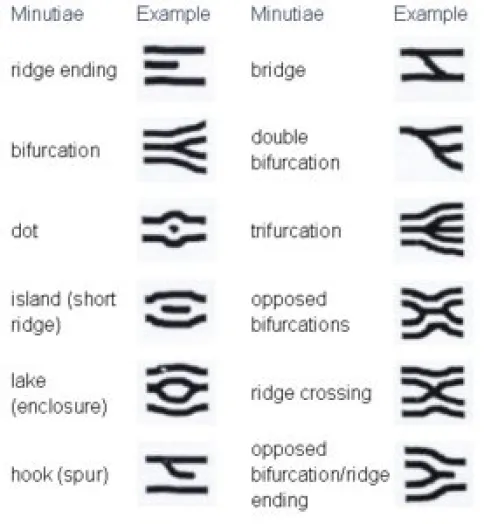
Latent fingerprint residue components
Water (98.5%)
Solids (1.5%)
Organic (1%) → carbon, hydrogen, oxygen, nitrogen
Fatty acids, amino acids, glucose, lactic acid, isoagglutinogen, ammonia, urea
Inorganic (0.5%)
Cations (+) → Na+, Ca++, K+
Anions (-) → Cl-, CO3 -2, PO4 -3
Types of fingerprints left on surfaces
Patent print → Fingerprints on hard surfaces which are visible (can be photographed without the aid of chemicals)
Latent print → Fingerprints made by the body’s oils and sweat remaining on hard surfaces after contact (not visible)
Plastic print → Three-dimensional fingerprints left on soft surfaces such as wax or wet paint (can be photographed without the use of additional techniques)
Approaches for the detection of latent prints
Physical → mechanically pushing material against ridge
Chemical→ create bonds
Light-based → alone or in conjunction with a chemical method
Powders used for fingerprint detection
Standard powder dusting
Mechanically adheres fine powder particles to the natural oils and moisture left behind by ridges of latent fingerprints, resulting in a visible ridge pattern on the surface. The color of the resulting print is the same color as the powder used (typically, a black or neon colored powder is used). The contrast of colored powder stuck to the ridge oils, as compared to the surface should result in a visible ridge pattern.
Magnetic powder dusting
Uses a non-contact wand and magnetic powder to adhere powder to the surface and print. Fingerprint powders are ideal for smooth, nonporous surfaces like glass, plastic, and wood. This ensures powder will not be absorbed by the surface, will not absorb the fingerprint’s natural oils, and will not gather in surface indentations.
How to get the most complete, clear ink print
Don’t press too hard or too light
Do a complete roll from one side of the fingernail to the other
Don’t roll the finger over multiple times
How to dust and lift latent prints most effectively
Apply the powder gently with a brush or magnetic wand, develop the print until just visible, and photograph it
Chemical Detection Techniques
Ninhydrin: Reacts with amino acids in prints to produce purple (Ruhemann's purple) marks, ideal for porous surfaces like paper
Iodine Fuming: Iodine vapor reacts with fatty oils in prints, temporarily staining them brown/yellow; useful for porous items but requires immediate photography as prints fade
Cyanoacrylate Fuming: Vapors bond to print residue (oils/moisture) on non-porous items (glass, metal), hardening them for subsequent powder or dye application, providing enhanced contrast
How to reveal latent prints using chemical methods properly
Always cover fumes to avoid inhaling chemicals
Process items in the proper sequence (e.g., chemical treatment before dusting)
Photograph all developed prints before lifting or further processing.
Surfaces and their appropriate techniques
Porous surfaces (e.g., paper, cardboard, raw wood) absorb water and water-soluble components (amino acids) from the sweat within minutes
Ninhydrin technique should be used
Non-porous surfaces (e.g., glass, plastic, metal, rubber) do not absorb residue; the print remains on the outermost surface
Powder dusting and super glue fuming
Semi-porous surfaces (e.g., glossy magazines, waxed paper, varnished wood) both absorb and resist residue, requiring a hybrid approach
What variables may influence the success of recovering a latent print?
Environmental factors (humidity, temperature, air, light), the surface type (porous/non-porous, texture), the deposition dynamics (pressure, duration, cleanliness of the finger), and the time elapsed
Standards for concluding prints to be an individualization
There is not a specific minimum minutiae count in the U.S. It depends on the size and quality of the Unknown print and is left up to the examiner's discretion
ACE-V process
Analysis- Is this latent print of high enough quality to even begin a comparison?
Comparison- The Unknown and Known side-by-side, looking for features of the Unknown found in the Known
Evaluation- Conclusion based on comparison above; examiner is always starting from a position of trying to show an exclusion
Verification- Another examiner repeats the full ACE process
The three possible conclusions a fingerprint examiner can reach following a comparison
Individualization, Exclusion, Inconclusive
Blind Verification
The examiner performing the Verification should be "blind" and have no knowledge of the first examiner's Conclusion.
How is the error rate in fingerprint comparison calculated?
Can not be done in a real case
Fake cases put into lab work that fingerprint examiners do to test if the examiners are doing their work well
Error Rate = [the number of incorrect conclusions made by the examiner]/[the total number of mock cases processed]
What is the difference between a false positive and a false negative in fingerprint comparison?
False negative - The examiner said that it was an exclusion, but it wasn’t
False positive - The examiner said that it was an identification, but it wasn’t
False Positive Error Rate = [the number of incorrect Individualizations made by the examiner]/[the total number of mock cases processed]
False Negative Error Rate = [the number of incorrect Exclusions made by the examiner]/[the total number of mock cases processed]
Brandon Mayfield Case
Brandon Mayfield is an American lawyer who was incorrectly detained in connection with the 2004 Madrid train bombings on the basis of a faulty fingerprint match
Mayfield's case underscored the need for rigorous scrutiny of forensic evidence in legal proceedings. It prompted discussions on the limitations of fingerprint analysis and the potential for errors, impacting how such evidence is presented in court