Nervous System Cells The Action Potential Synapses Neurotransmitters and Behavior
 Studied by 0 people
 Call with Kai
 Learn
Learn Practice Test
 Spaced Repetition
 Match
Match Flashcards
 Knowt Play
1/61

There's no tags or description
Looks like no tags are added yet.
Name | Mastery | Learn | Test | Matching | Spaced | Call with Kai |
|---|
No study sessions yet.
62 Terms
Physiological explanation
describes the mechanisms that produce a behavior.
Evolutionary explanation
relates behavior to the evolutionary history of the species.
Developmental (or ontogenetic) explanation
deals with changes over age.
No animal or person is literally born with a behavior.
neurons (NOO-rons)
Brain consists of an enormous number of separate cells
glia (GLEE-uh)
- The nervous system also contains other kinds of cells.
- which support the neurons in many ways such as by insulating them, synchronizing activity among neighboring neurons, and removing waste products.
Sensory neurons
carry information from the sense organs to the central nervous system, where neurons compare it to past information and exchange information with other neurons.
cell body
dendrites
axon
A neuron consists of 3 parts:
cell body
contains the nucleus of the cell.

The dendrites
- (from a Greek word meaning "tree").
- are widely branching structures that receive input from other neurons.

axon
- is a single, long, thin, straight fiber with branches near its tip.
- Some vertebrate axons are covered with myelin, an insulating sheath that speeds up the transmission of impulses along an axon.
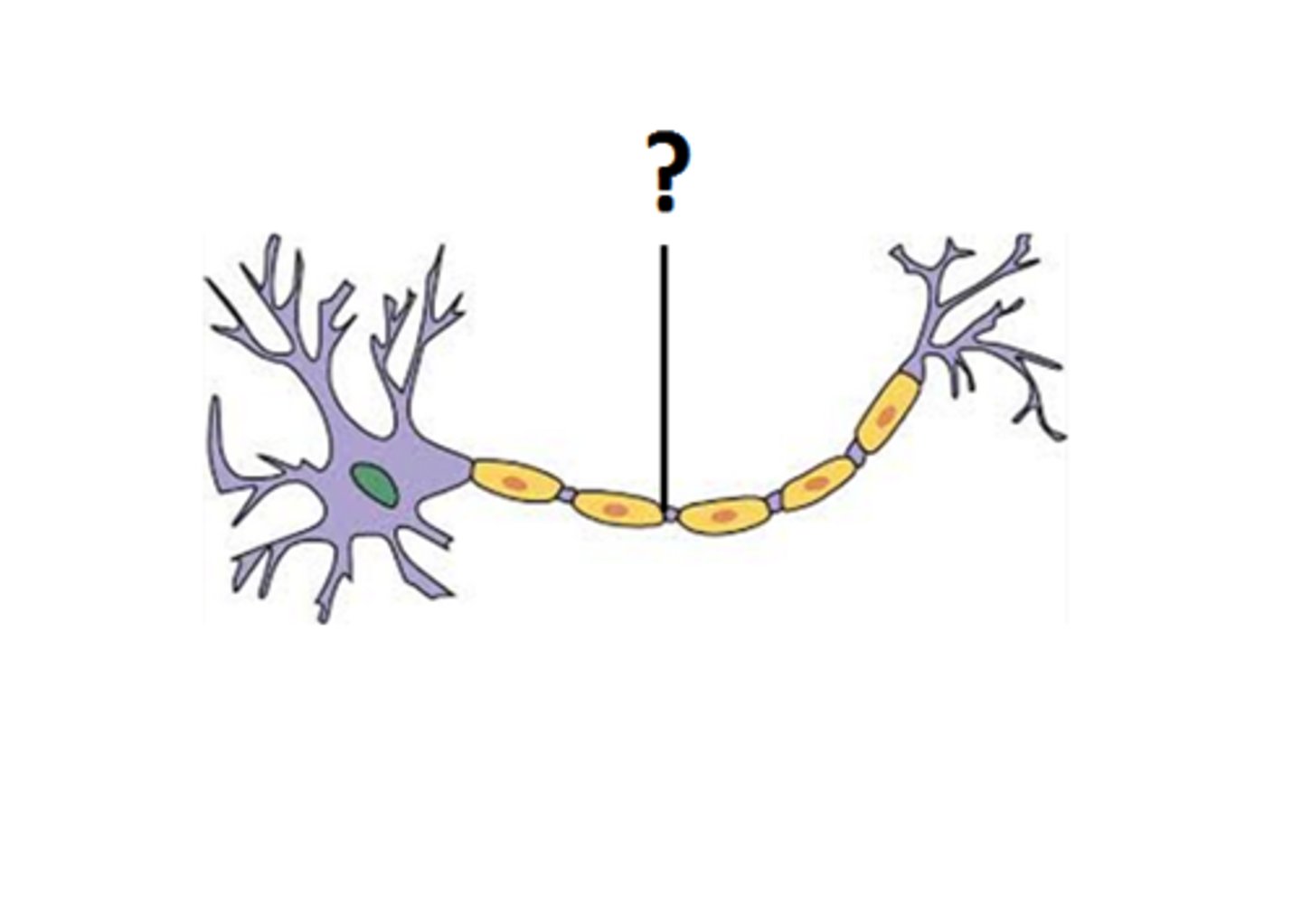
action potential
Axons convey information by a combination of electrical and chemical processes called an?
all-or-none law
An action potential is a yes-no or on-off message, like a standard light switch (without a dimmer).
synapse
- the specialized junction between one neuron and another a neuron releases a chemical that either excites or inhibits the next neuron.
-That is, the chemical makes the next neuron either more or less likely to produce an action potential.
presynaptic ending, or terminal bouton
A typical axon has several branches, each ending with a little bulge
neurotransmitter
- When an action potential reaches the terminal bouton, it is released.
- a chemical that activates receptors on other neurons.
postsynaptic neuron
- The neurotransmitter molecules diffuse across a narrow gap to receptors
- the neuron on the receiving end of the synapse.
glutamate
- the brain's main excitatory transmitter, present at most synapses.
- essential for almost all brain activities, including learning.
comment: strokes kill neurons mostly by overstimulation due to excess release of glutamate.
GABA (gamma-amino-butyric acid)
- the brain's main inhibitory transmitter.
comment: antianxiety drugs and antiepileptic drugs increase activity at GABA synapses.
acetylcholine
- increases brain arousal.
comment: is also released by motor neurons to stimulate skeletal muscles.
Dopamine
- one path is important for movement (damaged in Parkinson's disease). Another path is important for memory and cognition.
comment: most antipsychotic drugs decrease activity at dopamine synapses. L-DOPA, used for Parkinson's disease, increases the availability of dopamine.
serotonin
modifies many types of motivated and emotional behavior.
comment: most antidepressant drugs prolong activity at serotonin synapses.
Norepinephrine
enhances storage of memory of emotional or otherwise meaningful events.
comment: all or nearly all axons releasing ______ originate from one small brain area, called the LOCUS COERULEUS.
Histamine
increase arousal and alertness.
comment: Antihistamines (for allergies) block histamine and therefore lead to drowsiness.
Endorphins
decrease pain and increase pleasure.
comment: Morphine and heroin stimulate the same receptors.
nitric oxide
dilates blood vessels in the most active brain areas.
comment: the only known transmitter that is a gas.
Anandamide, 2AG
sent by the postsynaptic neuron back to the presynaptic neuron to decrease further release of transmitters.
comment: THC, the active chemical in marijuana, stimulates these same presynaptic receptors.
Stimulants
are drugs that increase energy,
alertness, and activity.
- Amphetamine, methamphetamine, and cocaine prevent neurons from reabsorbing dopamine or serotonin after releasing them.
- As a result, they prolong the effects of those transmitters at their receptors.
Depressants
are drugs that decrease arousal, such as alcohol and anxiolytics (anxiety-
reducing drugs).
Alcohol
- is a class of molecules that includes
methanol, ethanol, propyl alcohol (rubbing alcohol), and others.
- is a depressant that acts as a
relaxant at moderate doses.
Psychoactive drugs
- have analogous effects on behavior.
- They enhance certain experiences,
weaken others, and garble thinking and speech by their effects on synapses.
Anxiolytic drugs or tranquilizers
help people relax. The most common examples are benzodiazepines, including diazepam (Valium) and alprazolam (Xanax).
Narcotics
are drugs that produce drowsiness, insensitivity to pain, and decreased responsiveness.
opiates
- are either natural drugs derived from the opium poppy or synthetic drugs with a chemical structure resembling natural opiates.
- such as morphine, heroin, methadone, and codeine bind to specific receptors in the brain The discovery of neurotransmitter receptors demonstrated that opiates block pain in the brain, not in the skin.
endorphins
- the brain produces several chemicals that bind to the opiate receptors.
- inhibit chronic pain. The brain also releases during pleasant experiences, such as the "runner's high" or the chill you feel down your back when you hear especially thrilling music.
Marijuana (cannabis)
- is difficult to classify.
- It is certainly not a stimulant. It has a calming effect but not like that of alcohol or tranquilizers.
- It softens pain but not as powerfully as opiates.
hallucinogens
- Drugs that induce sensory distortions.
- Many of these drugs are derived from mushrooms or plants, and others are manufactured.
central nervous system
- consists of the brain and the spinal cord.
- communicates with the rest of the body by the peripheral nervous system.
- system, which consists of bundles of nerves between the spinal cord and the rest of the body.
- begins its embryological development as a tube with three lumps.
somatic nervous system
which connects to the skin and muscles
autonomic nervous system
- which connects to the heart, stomach, and other organs.
- closely associated with the spinal cord, controls the internal organs such as the heart.
- The term autonomic means involuntary, or automatic, in the sense that we have little voluntary control of it.
- influences the endocrine system, a set of glands that produce hormones and release them into the blood.
forebrain
midbrain
hindbrain
(3) lumps
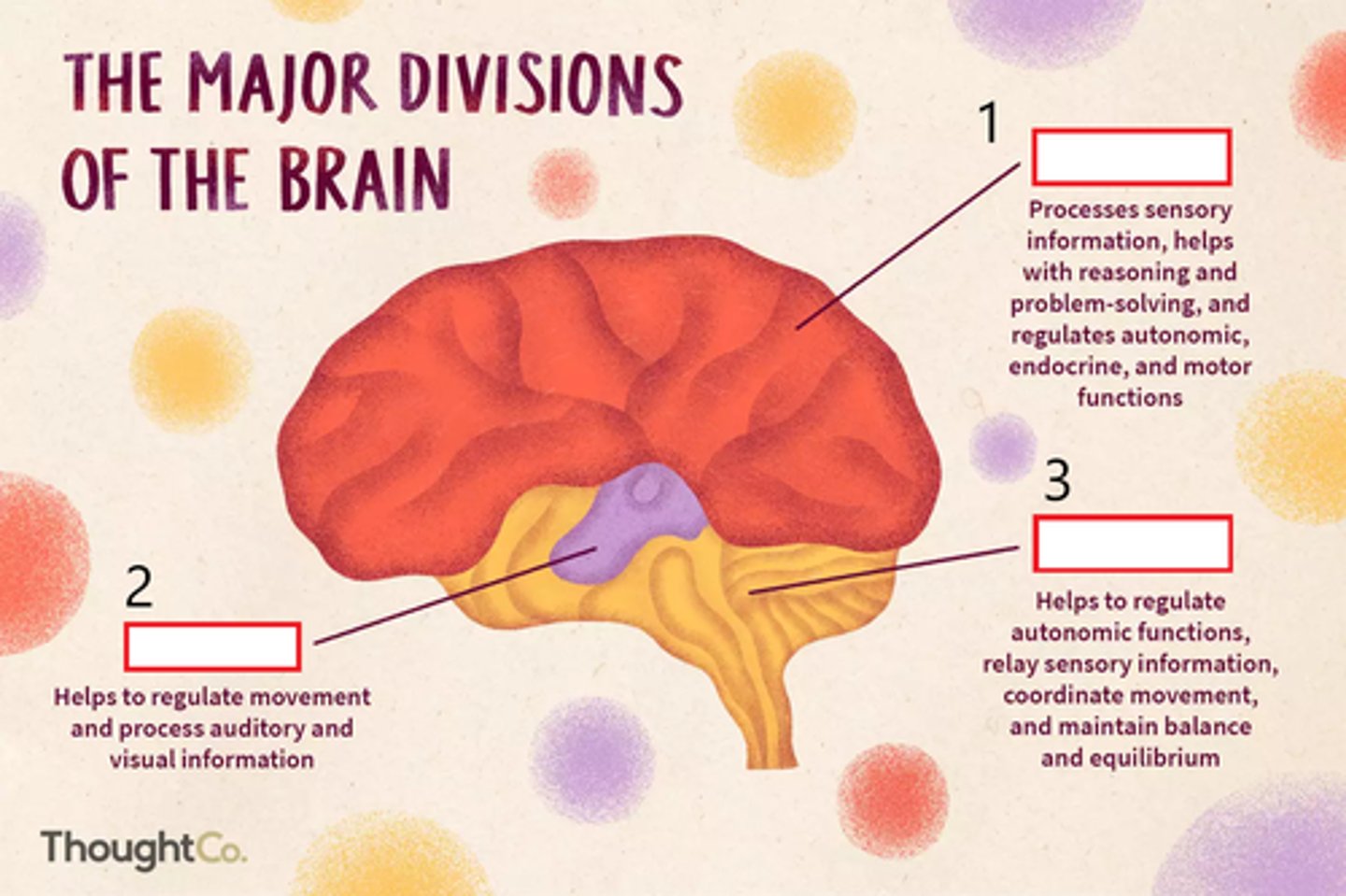
forebrain
- consists of two hemispheres, left and right.
- Each hemisphere controls sensation and movement on the opposite side of the body.
cerebral cortex
- The outer covering of the forebrain.
- is especially prominent in humans.
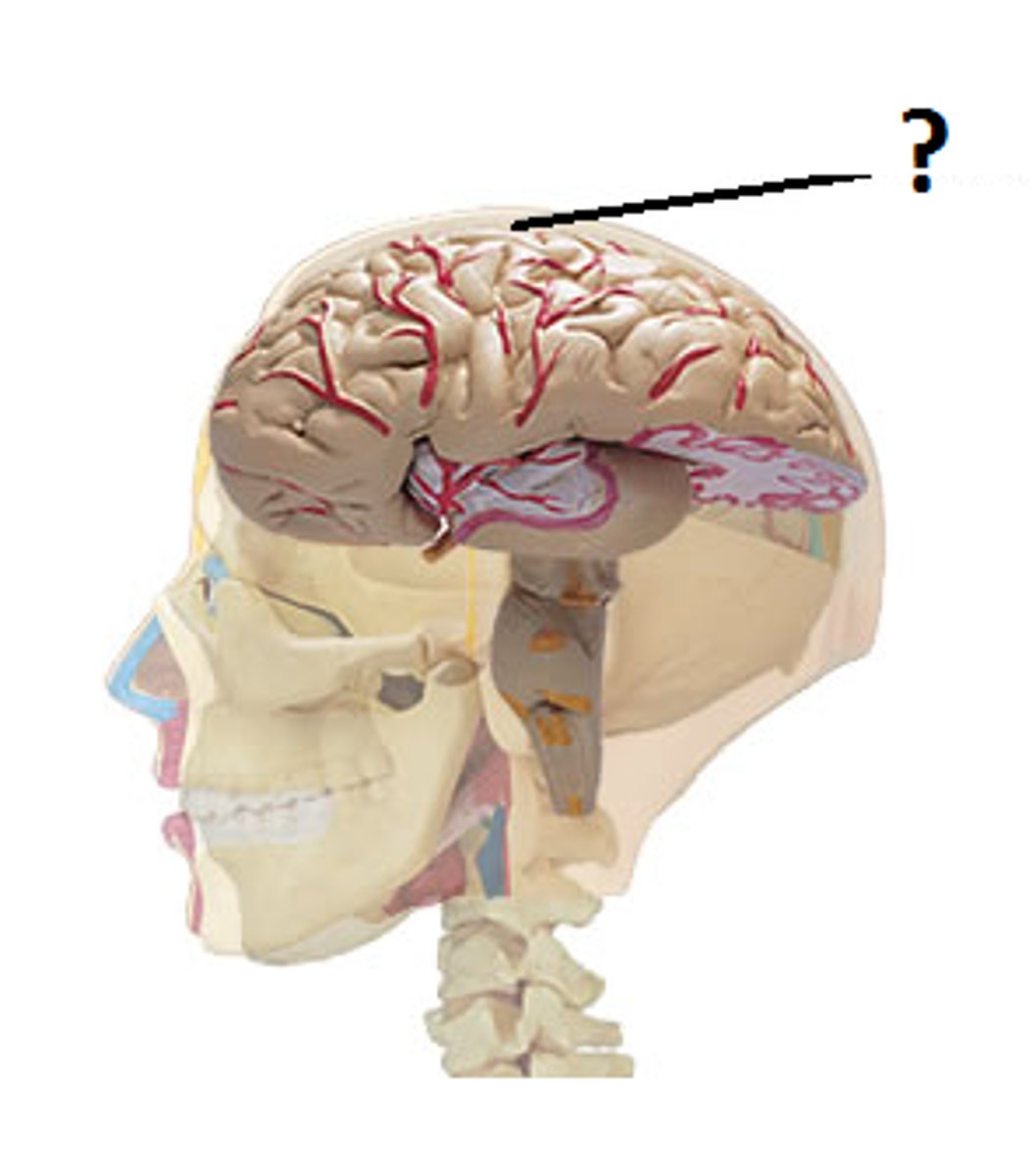
occipital
parietal
temporal
frontal
terms of four lobes
amygdala
- a subcortical structure deep within the temporal lobe, responds strongly to emotional situations.
- People with damage to the amygdala are slow to process emotional information, such as facial expressions and descriptions of emotional situations.
hypothalamus
located just below the thalamus, is important for hunger, thirst temperature regulation sex, and other motivated behaviors.
medulla
The cerebral cortex does not directly
control the muscles. It sends some of
its output to the pons and (parts of the hindbrain), which control the muscles of the head (e.g., for chewing, swallowing, breathing, and talking).
spinal cord
which controls the muscles from the neck down.
reflex
is a rapid, automatic response to a stimulus, such as unconscious adjustments of your legs while you are walking or quickly jerking your hand away from something hot.
cerebellum
(Latin for "little brain"), part of the hindbrain, is important for any behavior that requires aim or timing, such as tapping out a rhythm, judging which of two visual stimuli is moving faster, and
judging whether one musical tempo
is faster or slower than another.
electroencephalograph (EEG)
uses electrodes on the scalp to record rapid changes in brain electrical activity.
magnetoencephalograph (MEG)
records magnetic changes.
Positron-emission tomography (PET)
records radioactivity of various brain areas emitted from injected chemicals.
Functional magnetic resonance imaging (fMRI)
uses magnetic detectors outside the head to compare the amounts of hemoglobin with and without oxygen in different brain areas.
sympathetic nervous system
parasympathetic nervous system
The autonomic nervous system has 2
parts:
The sympathetic nervous system
- controlled by a chain of cells lying just outside the spinal cord, increases heart rate, breathing rate, sweating, and other processes that are important for vigorous fight-or-flight activities.
- It inhibits digestion, sexual arousal, and other activities not important to an emergency situation.
parasympathetic nervous system
controlled by cells at the top and bottom levels of the spinal cord, decreases heart rate, increases digestive activities, and in general, promotes activities of the body that take place during rest and relaxation.
Hormones
- controlled by the hypothalamus and pituitary gland, which also regulate the other endocrine organs.
- are chemicals released by glands and conveyed via the blood to alter activity in various organs.
- Some hormonal effects are brief, such as a change in heart rate or blood pressure. In other cases, it prepares a body for pregnancy, migration, hibernation, or long-lasting activities.
- A woman's menstrual cycle depends on hormones, and so does the onset of puberty.
plasticity
Brain structure shows considerable ___.
that is, change as a result of experience.
stem cells
For many decades, researchers believed that the nervous system produced no new neurons after early infancy. Later researchers found that undifferentiated cells called _________ can develop into additional neurons in certain brain areas.
corpus callosum
The two hemispheres constantly
exchange information. If you feel
something with the left hand and
something else with the right
hand, you can tell whether they
are made of the same material
because the hemispheres pass
information back and forth
through the corpus callosum, a
set of axons that connect the left
and right hemispheres of the
cerebral cortex.
epilepsy
a condition in which cells somewhere in the brain emit abnormal rhythmic, spontaneous impulses.
binding problem.
The question of how separate brain areas combine forces to produce a unified perception of a single object