(4) Trauma Instruction Pt. II
 Call Kai
 Learn
Learn Practice Test
 Spaced Repetition
 Match
Match Flashcards
 Knowt Play
1/30

There's no tags or description
Looks like no tags are added yet.
Name | Mastery | Learn | Test | Matching | Spaced | Call with Kai | Chat |
|---|
No analytics yet
Send a link to your students to track their progress
31 Terms
directly proximal to the initial TQ
What if a second TQ is needed? Where is it applied?
1.5
Width of improvised TQ should we how many inches minimum?
Junctional wounds
Where can we not apply a TQ?
Base of the neck; armpits; groin
T
T or F?
Do not pack the abdomen/vagina.
junctional wounds
Use hemostatic guaze to pack:
First degree
Which type of burn?
superficial
redness
pain
Second degree
Which type of burn?
partial thickness
pus-filled blisters
Third degree
Which type of burn?
Full thickness
Thick charred core with blisters and redness around it
Fourth degree
Which type of burn?
Below subcutaneous
You may see bone
second and third degree burns
Rule of Nines only applies to which type(s) of burn(s)?
1%
The size of the pt’s palm when utilizing the Palmer Method is about what %?
T
T or F?
Rule of Nines does NOT apply to first degree burns.
Rule of Nines
The picture shows what?
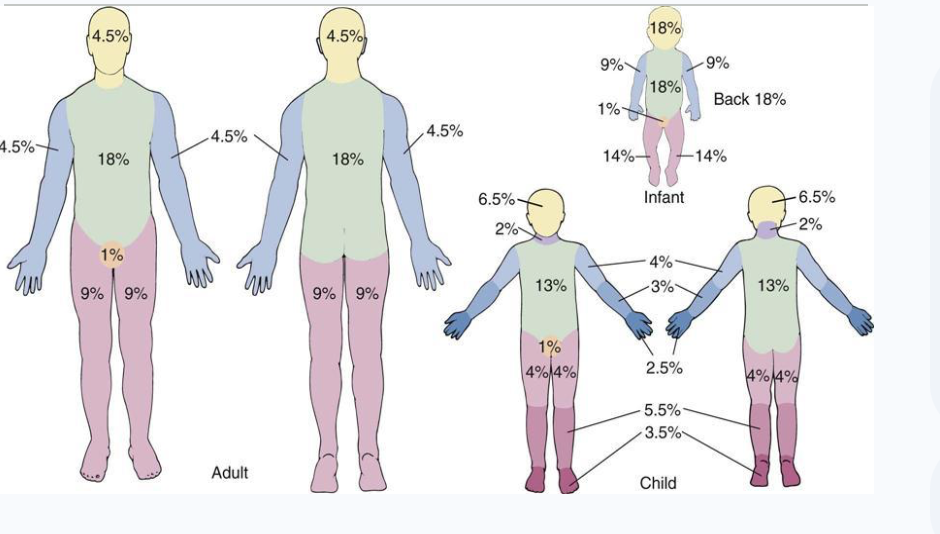
Moist gauze
If the severity of burns is under 10%, which gauze type should be used?
dry gauze
If the severity of burns is greater than 10%, use which gauze type?
hypothermia
Burn pts are at risk for:
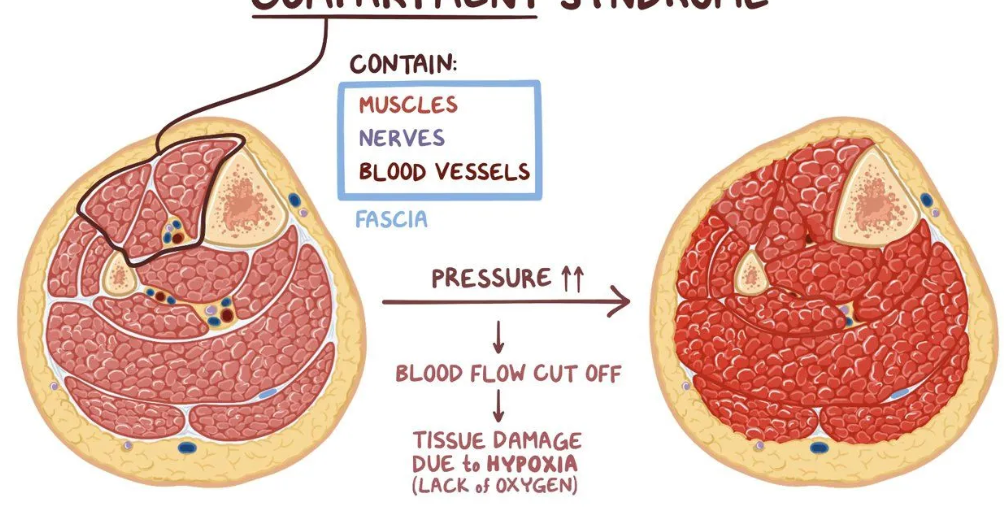
Compartment syndrome
Due to internal hemorrhage, crush injuries, or etiologies causing swelling-like burns
Circumferential burns
burns around the circumference of limb or body part
acts like a TQ
Pain, Pallor, Paralysis, Pressure, Paresthesia, Pulseless, Poikilothermia
What are the 7 P’s?
Primary
Which type of blast injury?
Overpressurization of blast wave with organs
Ruptured eardrum, blast lung, abdominal hemorrhage/perforation, concussion, globe (eye) rupture
Secondary
Which type of blast injury?
Flying debris, bomb fragments
Penetrating ballistic fragmentation and blunt injuries. Eye penetrations
Tertiary
Which type of blast injury?
Body being thrown by blast wind
Fractures, deformities
Quaternary
Which type of blast injury?
Injuries and illnesses related to the explosion that were not included in primary, secondary, and, tertiary
Exacerbation of existing complications
airway or our ability to perform compressions
We do NOT remove impaled objects unless they impede:
both
If there is a pt with an impaled eye, do we cover one or both eye(s)?
moist
If you obtain an amuptee pt’s limb or digit, then wrap in ______ gauze and place on ice or cold pack.
T
T or F?
If patient has missing tooth, attempt to replant it after rinsing debris. If unable, then place it in cup/bag of milk, patient’s saliva, or saline and transport.
before and after
When splinting, at which time(s) do we assess PMS?
4
How many triangle bandages do we use for a joint splint (A splint)?
helmet
For motorcycle accidents, what do we bring with us to the hospital?
Kendrick Extrication Device (KED)
Stable extrication procedure (no threat within environment or to ABCs)
Mnemonic for order of straps:
My Baby Looks Totally Hot [Middle, Bottom, Legs, Top, Head