electro EMG studies
 Call Kai
 Learn
Learn Practice Test
 Spaced Repetition
 Match
Match Flashcards
 Knowt Play
1/31

There's no tags or description
Looks like no tags are added yet.
Name | Mastery | Learn | Test | Matching | Spaced | Call with Kai | Chat |
|---|
No analytics yet
Send a link to your students to track their progress
32 Terms
EMG can identify the orign of the weakness such as
- muscle
- nerve (fiber types, pathology, temporal course)
- NMJ
cell body location of sensory vs motor neurons
- sensory: DRG (outside CNS)
- motor: anterior horn cell (inside CNS)
dendrite function
carry impulses to cell body from other neurons
axon function
carry impulses to other sites
what is the function of myelin
helps nerves propagate an AP faster
- myelin sheath functions as insulator of the axon
conduction velocity is directly related to
internodal length and efficiency of myelin insulation
demyelination results from
**loss or dysfunction of the myelin sheath
-usually seen most often in entrapment or compressive neuropathies
- may also occur with some genetic conditions (Charcot-Marie-Tooth), some toxic (diphtheria), or from a immunologic attack on the myelin (GBS)
axonal loss may be seen after
- physical disruption of the nerve or as a result of numerous toxic, metabolic, or genetic conditions that can damage the metabolic machinery of the axon
what is worse: demyelination or axonal loss?
axonal loss
epineurium vs perineurium vs endonerium
- epi: outer covering of the nerve
- peri: covering of the nerve fascicle
- endo: protective cover of individual nerve fibers
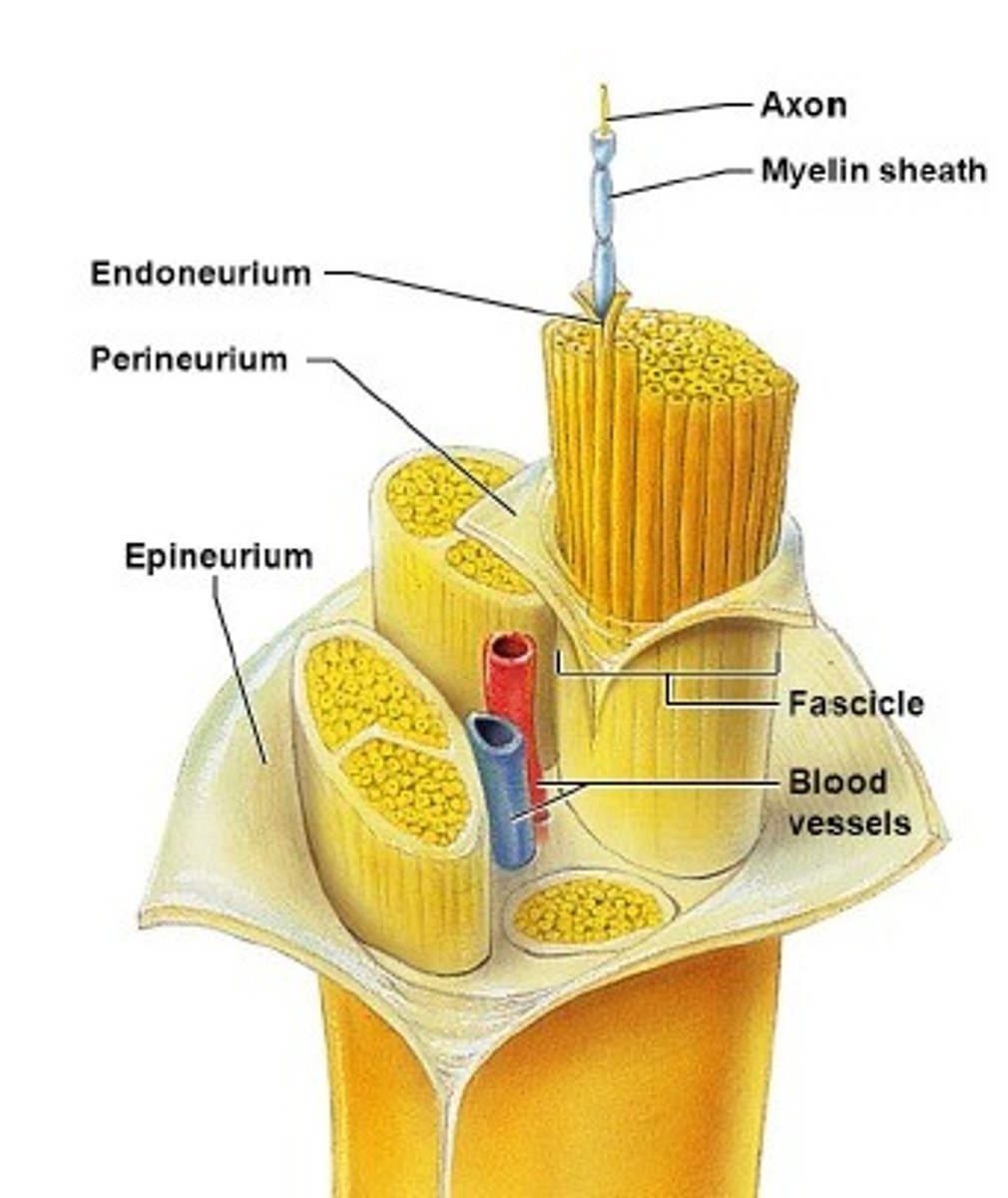
what happens at the neuromuscular junction
- When the nerve impulse reaches the axon terminals, ACH is released and diffuses across the synaptic cleft
- if enough ACH is released, the cell becomes excited, therefore an action potential occurs
- The action potential causes muscle contraction
what diseases are associated with neuromuscular junction problems?
- Botulism
- Myasthenia Gravis
why refer for EDX
- problems in the nerves or muscle physiology can be objectively measured electrically
- Peripheral nerve injury can be localized or generalized
- estimate the severity of the injury
- detect injury progression or regression
- aide in establishing appropriate treatment plan
- identify other causes or factors
what abnormal findings from a neuromotor screen suggest using EDX?
- weakness
- parathesias
- altered MSRs
- pain/myalgia/fatigue
- gait/balance disorders
- cramps/fasciculations
_____ → time from stimulation to muscle response (speed of response); measured in mseconds
latency
what is delayed latency?
the "O" (onset latency) appears later than usual
_____ → number of activated muscle/nerve fibers or size of response; measured in millivolts (CMAP) or microvolts (SNAP)
amplitude
if there is decreased amplitude what may be the problem
myonal or axonal injury (anterior horn cell body or axon, Schwann cells, NMJ, or muscle itself)
what is the conduction velocity
how fast the action potential moves down the axon (m/sec)
the CMAP represents
the summation of all the underlying muscle fiber AP
- corresponds to the integrity of the motor unit
since the cell body of motor nerves is located in the anterior horn of the SC, the motor nerve conduction is abnormal in both
preganglionic and postganglionic injuries
the SNAP (sensory nerve action potential) represents the
summation of all the underlying sensory fiber action potentials
t/f: the sensory nerve will always be normal in nerve root problems
true - DRG is not affected (preganglionic)
peripheral sensory nerve testing allows differentiate between
- preganglionic disorders (radiculopathies, cauda equina lesions) and
- postganglionic disorders (neuropathies, plexopathies)
EMG spontaneous muscle activity
electrical activity present when the muscle is at rest and the electrode is not being moved
normal muscle should be ____ after the needle is inserted
silent (unless inserted near NMJ/endplate)
- abnormal: positive sharp waves (PSWs) or fibrillation potentials
fibrillations result from
motor axonal loss that is not balanced by reinnervation
- low amp: occured in the pasy
- high amp: ongoing
EMG insertional activity
the electrical activity present as the electrode is passed through muscle cells
insertional activity may be increased by
conditions causing membrane instability such as neuropathies, radiculopathies, and inflammatory myopathies
what is MUAP
looking at one motor unit & recording voluntary recruitment of motor unit AP
if there is a giant polyphasic motor unit potential what caused this?
collateral sprouting for nerve healing
reduced vs increased recruitment
- reduced: motor axonal loss due to focal demyelination or conduction block
- increased: myopathy