Human Anatomy & Physiology Midterm Review
 Call Kai
 Learn
Learn Practice Test
 Spaced Repetition
 Match
Match Flashcards
 Knowt Play
1/61

There's no tags or description
Looks like no tags are added yet.
Name | Mastery | Learn | Test | Matching | Spaced | Call with Kai | Chat |
|---|
No analytics yet
Send a link to your students to track their progress
62 Terms
Which statement is TRUE?
a. The thoracic cavity is distal to the abdominopelvic region.
b. The left lumbar region is anterior to the left iliac region.
c. The epigastric region is medial to the right hypochondriac region.
d. The epigastric region is inferior to the hypogastric region.
The epigastric region is medial to the right hypochondriac region.
Which organ is found predominantly in the epigastric region?
a. left kidney
b. urinary bladder
c. stomach
d. rectum
stomach
What part of the microscope will allow the maximum amount of light to pass through the slide?
a. substage light
b. iris diaphragm
c. fine adjustment knob
d. condenser
iris diaphragm
The field diameter for the low-powered objective is _____ the field diameter for the scanning objective lens.
a. less than
b. greater than
c. equal to
less than
How do the three types of cartilage differ from each other?
a. Lacunae are found only in hyaline cartilage.
b. Chondrocytes build the fibers in hyaline cartilage but fibroblasts build the fibers in elastic and fibrocartilage.
c. Quantity of the three fiber types is different in the three cartilages.
d. Fibrocartilage is the only type used in creating the embryonic skeleton.
Quantity of the three fiber types is different in the three cartilages.
Which tissue contains only ONE of the protein fibers associated with connective tissue?
a. elastic cartilage
b. reticular connective tissue
c. areolar connective tissue
d. dense regular connective tissue
reticular connective tissue
Which structure is found in the dermis?
a. dendritic cell
b. keratinocyte
c. melanocyte
d. sweat gland
sweat gland
What is the primary type of tissue is found in the reticular layer of the dermis?
a. stratified squamous epithelium
b. areolar connective tissue proper
c. adipose
d. dense irregular connective tissue proper
dense irregular connective tissue proper
Which statement is true regarding hair?
a. The hair root is located in the epidermis.
b. The cells are non-keratinized to maintain softness.
c. The cells found in the hair that extends out of the skin are living.
d. The cells found in the shaft are dead.
The cells found in the shaft are dead.
Where are apocrine glands found?
a. palms of hands
b. forehead
c. the axilla
d. on the scalp
the axilla
Which cartilage forms the epiphyseal plate?
a. hyaline
b. elastic
c. fibrocartilage
d. areolar cartilage
hyaline
Once oxygenated blood passes through the central canal of the osteon, what structure/vessel will it enter next?
a. perforating canals
b. periosteum
c. canaliculi
d. endosteum
canaliculi
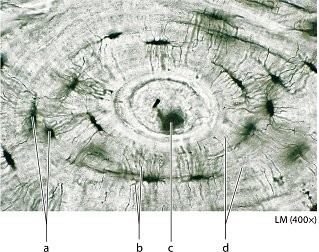
Identify the structure labeled “d".”
a. central canal
b. lacuna
c. canaliculi
d. lamella
lamella
How does the effector restore homeostasis in a negative feedback loop?
a. The effector causes a rapid change in a variable.
b. The effector amplifies the response, but does not continue indefinitely.
c. The effector increases and reinforces the initial stimulus.
d. The effector opposes the initial stimulus and shuts off when conditions return to the normal range.
The effector opposes the initial stimulus and shuts off when conditions return to the normal range.
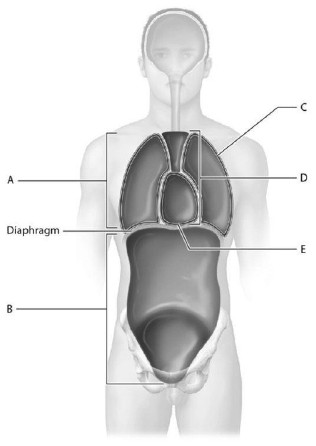
Match the following with the correct body cavity or subdivision.
Identify the cavity that houses the heart.
E
Which two organ systems include the pancreas as a component?
a. endocrine and lymphatic systems
b. respiratory and cardiovascular systems
c. digestive and urinary systems
d. digestive and endocrine systems
digestive and endocrine systems
A carbohydrate chain attached by covalent bonds to a protein in the cell membrane is called a:
a. glycolipid
b. glycoprotein
c. glycogen
d. galactose
glycoprotein
The Na+/K+ pump transports three sodium ions out of the cell for every two potassium ions moved into the cell. This is an example of:
a. a uniport pump
b. a symport pump
c. facilitated diffusion
d. an antiport pump
an antiport pump
The reactions of oxidative catabolism, or aerobic respiration, can occur in the mitochondrion only in the presence of:
a. alkaline pH
b. hydrogen ions
c. carbon dioxide
d. oxygen
oxygen
If a chemotherapy drug prevents the mitotic spindle from forming during the M phase of the cell cycle, then what specific phase has been disrupted?
a. metaphase
b. telophase
c. prophase
d. anaphase
prophase
Which of the following is NOT a location of reticular tissue?
a. lymph nodes
b. bone marrow
c. tendons
d. spleen
tendons
Which unicellular gland is responsible for mucus secretion?
a. adipocyte
b. goblet cell
c. mast cell
d. fibroblast
goblet cell
Synovial membranes:
a. line the cavities surrounding freely movable joints
b. are hard due to the presence of keratin
c. line the passages of hollow organs that open to the outside of the body
d. line the pleural, pericardial, and peritoneal body cavities
line the cavities surrounding freely movable joints
Which of the following is NOT a type of connective tissue proper?
a. dense connective tissue
b. hyaline cartilage
c. adipose tissue
d. loose connective tissue
hyaline cartilage
The ECM of blood is known as:
a. osteoid
b. bone marrow
c. plasma
d. lacunae
plasma
The free surface of an epithelial tissue is the:
a. apical surface
b. basement membrane
c. reticular lamina
d. basal lamina
apical surface
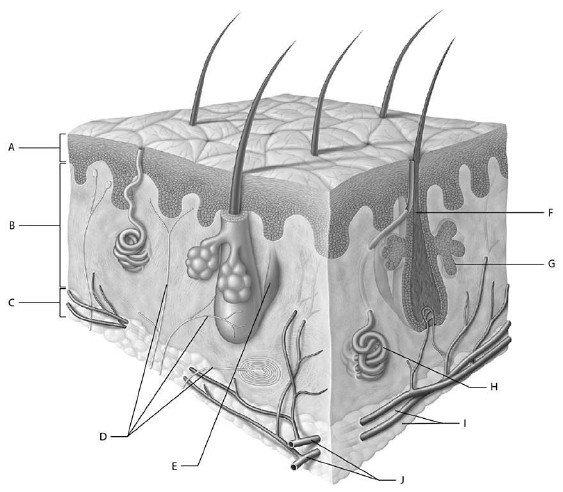
Match the following information with the skin image.
Letters may be used more than once or not at all.
Lamellated (Pacinian) corpuscles are situated in this skin layer
B
The least common - but most dangerous - skin cancer is:
a. squamous cell carcinoma
b. small cell carcinoma
c. basal cell carcinoma
d. malignant melanoma
malignant melanoma
What tissue composes the epidermis of the skin?
a. nonkeratinized simple squamous epithelium
b. keratinized stratified squamous epithelium
c. transitional epithelium
d. nonkeratinized stratified squamous epithelium
keratinized stratified squamous epithelium
Which of the following cells are arranged in layers, or strata, in the epidermis?
a. dendritic (Langerhans) cell
b. keratinocyte
c. melanocyte
d. tactile cell
keratinocyte
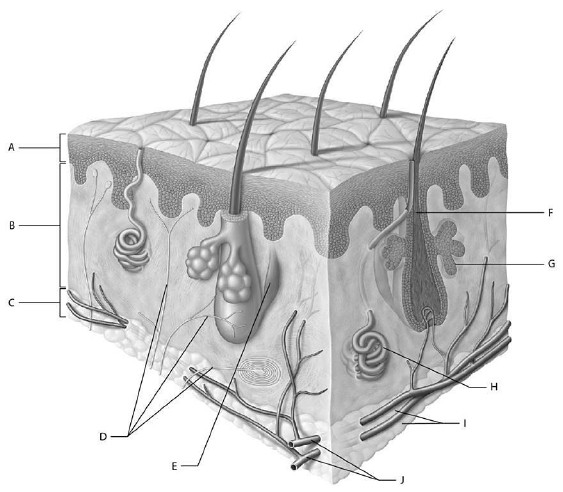
Match the following information with the skin image.
Letters may be used more than once or not at all.
Avascular skin layer
A
Trauma to stratum basale would NOT interfere with the skin’s ability to:
a. produce melanin
b. shed dead cells
c. produce vitamin D
d. grow
shed dead cells
What prompts the closure of the epiphyseal plate around age 18-21?
a. chondrocytes activity divide
b. ossification of the zone of proliferation
c. chondrocytes increase in size and mature
d. mitosis in the zone of calcification
ossification of the zone of proliferation
What tissue serves as the model for bones formed during endochondral ossification?
a. hyaline cartilage
b. spongy bone
c. fibrocartilage
d. compact bone
hyaline cartilage
The layers of bone tissue immediately deep to the periosteum are:
a. trabeculae
b. lacunae
c. concentric lamellae
d. circumferential lamellae
circumferential lamellae
A radiograph reveals epiphyseal lines in the long bones of a 12-year-old’s hand. Which of the following statements is correct?
a. More growth will occur during the teenage years as sex hormones stimulate rebuilding of epiphyseal plates.
b. The epiphyseal plates have ossified, and further growth in length is not possible.
c. Administration of growth hormone will stimulate further bone growth in length.
d. Intramembranous ossification will enable continued growth in length.
The epiphyseal plates have ossified, and further growth in length is not possible.
What stimulates the release of parathyroid hormone (PTH)?
a. high levels of vitamin D
b. high blood calcium ion levels
c. low blood calcium ion levels
d. high levels of vitamin C
low blood calcium ion levels
Secondary ossification centers are characteristic of:
a. intramembranous ossification
b. appositional growth
c. endochondral ossification
d. mesenchymal ossification
endochondral ossification
Which statement best describes primary bone?
a. Primary bone contains abundant osteocytes and little inorganic matrix.
b. Primary bone has regularly arranged parallel bundles of collagen fibers for strength.
c. Primary bone is stronger than secondary bone since it contains many lamellae.
d. Primary bone contains a higher percentage of inorganic matrix than secondary bone.
Primary bone contains abundant osteocytes and little inorganic matrix.
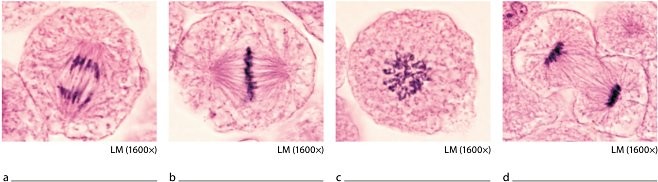
Which image shows replicated chromatin.
a. a
b. b.
c. c
d. d
c
Which cell type is commonly found in connective tissue proper?
a. fibroblast
b. chondrocytes
c. erythrocytes
d. osteocytes
fibroblasts
Which muscle tissue contains myofilaments?
a. skeletal and smooth
b. skeletal
c. cardiac
d. smooth, skeletal, and cardiac
smooth, skeletal, and cardiac
Why are “henna tattoos” of the epidermis not permanent like other tattoos?
a. The henna stain is water soluble and excreted with sweat as a byproduct.
b. Regular tattoos inject their ink into the mitotic epidermal cells making the dye permanent.
c. The epidermis is continually renewing its keratinocytes of sloughing off the old cells.
d. The epidermis’s dendritic cells phagocytize/remove the henna stain.
The epidermis is continually renewing its keratinocytes of sloughing off the old cells.
Which cartilage is characterized by a significant preponderance of collagen fibers in its matrix?
a. hyaline
b. elastic
c. fibrocartilage
d. areolar cartilage
fibrocartilage
The transfer of an electron from sodium to chlorine is an example of:
a. electrical energy
b. chemical energy
c. sound energy
d. mechanical energy
chemical energy
The virus that causes COVID-19 can enter the cell through an integral protein that acts as:
a. a channel
b. a receptor
c. structural support.
d. an enzyme
a receptor
What is NOT part of the endomembrane system?
a. lysosome
b. peroxisome
c. Golgi apparatus
d. endoplasmic reticulum
peroxisome
Fibrosis results in the formation of a type of:
a. dense regular collagenous connective tissue
b. adipose tissue
c. loose connective tissue
d. dense irregular connective tissue
dense irregular connective tissue
A tissue is more likely to heal by regeneration if it:
a. is avascular
b. is amitotic
c. lacks satellite cells
d. possesses stem cells
possesses stem cells
Striated, multinucleate cells are commonly found in:
a. smooth muscle tissue
b. skeletal muscle tissue
c. cardiac muscle tissue
d. both smooth and cardiac muscle tissue
skeletal muscle tissue
What type of secretion involves the release of substances, such as saliva and sweat, in secretory vesicles by exocytosis?
a. merocrine
b. endocrine
c. apocrine
d. holocrine
merocrine
A serous membrane contains a superficial layer of epithelial tissue and a deeper layer of connective tissue. Thus, serous membranes are classified as:
a. organs
b. tissues
c. avascular
d. amitotic
organs
Eccrine glands produce:
a. sweat containing mostly water
b. hormones
c. cerumen
d. sebum
sweat containing mostly water
Skin without keratin would be more likely to:
a. burn upon exposure to the sun
b. be unable to thermoregulate
c. lose the sensation of touch
d. tear upon being mechanically stressed
tear upon being mechanically stressed
For a person who starts running for exercise,
a. bone deposition exceeds bone resorption
b. bone deposition is less than bone resorption
c. bone deposition equals bone resorption
d. bone deposition is not related to bone resorption.
bone deposition exceeds bone resorption
Within the epiphyseal plate, which zone houses actively dividing cartilage cells in their lacunae?
a. zone of hypertrophy
b. zone of ossification
c. zone of proliferation
d. zone of reserve cartilage
zone of proliferation
Intramembranous ossification occurs in:
a. skull bones
b. arm and leg bones
c. secondary bone
d. long bones
skull bones
In the epiphyseal plate of a long bone, cartilage grows:
a. in a circular fashion
b. from the edges inward
c. by pulling the diaphysis toward the epiphysis
d. by pushing the epiphysis away from the diaphysis
by pushing the epiphysis away from the diaphysis
Calcitonin functions to:
a. stimulate bone resorption
b. increase blood calcium ion levels
c. increase bone deposition
d. stimulate osteoclast activity
increase bone deposition
Which of the following promotes bone resorption?
a. pressure
b. calcium-rich diet
c. tension
d. compression
pressure
The hard, dense bone that forms the outer surface of bones is:
a. spongy bone
b. cancellous bone
c. articular cartilage
d. compact bone
compact bone