StemUp: AQA A level physics 3.12.1: The discovery of the electron
 Call Kai
 Learn
Learn Practice Test
 Spaced Repetition
 Match
Match Flashcards
 Knowt Play
1/48

There's no tags or description
Looks like no tags are added yet.
Name | Mastery | Learn | Test | Matching | Spaced | Call with Kai | Chat |
|---|
No analytics yet
Send a link to your students to track their progress
49 Terms
What happens when a high potential difference is applied across a discharge tube? (1)
The discharge tube begins to glow.
Where is the glow brightest in a discharge tube? (1)
The glow is brightest at the cathode end of the tube.
What is the glow produced in a discharge tube called? (1)
The glow is called a cathode ray.
What does a labelled diagram of a discharge tube look like? (3)
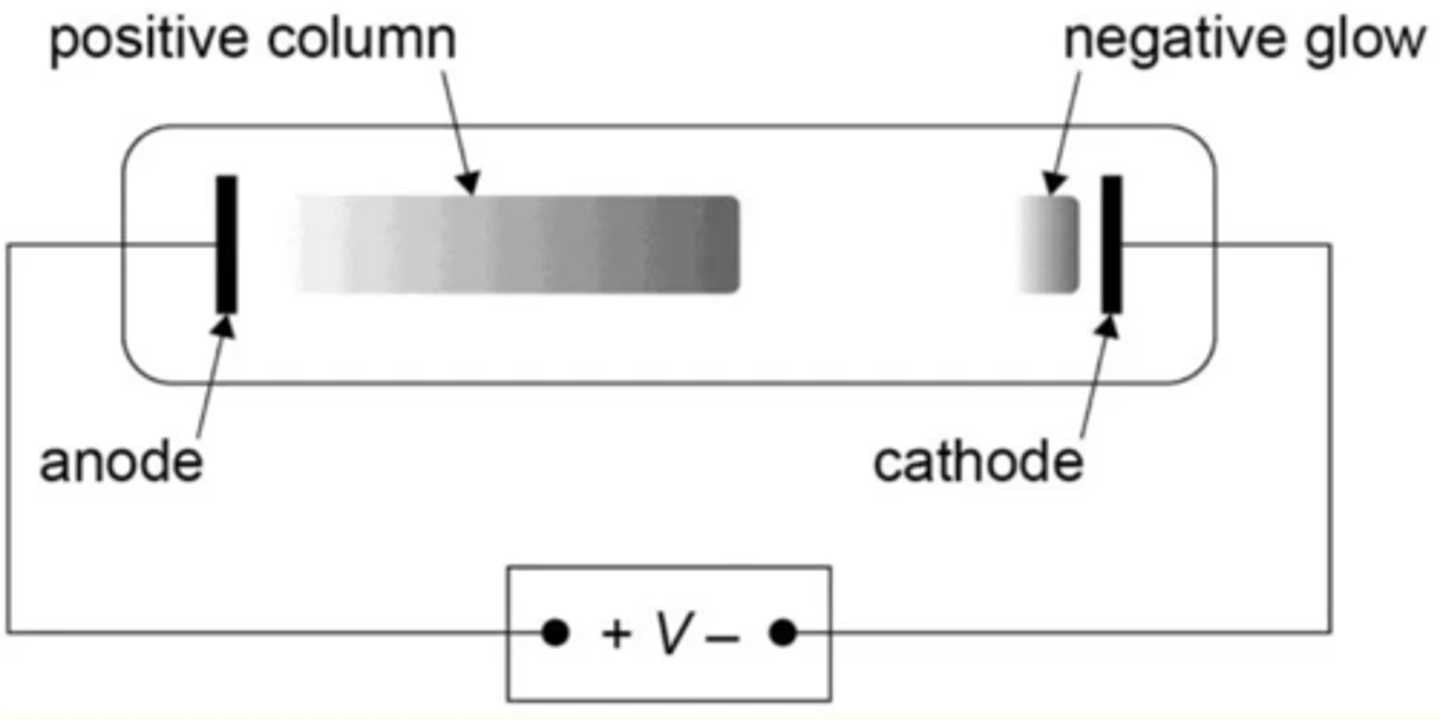
What are four properties of cathode rays observed by Thomson? (4)
- Cathode rays have a measurable mass, energy and momentum.
- They carry a negative charge.
- They behave the same regardless of the gas used in the discharge tube.
- They have a very large charge-to-mass ratio.
How did cathode ray observations lead to the discovery of the electron? (2)
- Cathode rays behaved the same with all gases used.
- This suggested the particles (electrons) were universal and present in all atoms.
What causes electrons to be freed in a discharge tube? (2)
- A high potential difference pulls electrons off gas atoms.
- This forms ions and electrons.
What happens to the positive ions in a discharge tube? (1)
Positive ions are accelerated towards the cathode.
What happens when positive ions hit the cathode? (1)
Positive ions release more electrons from the cathode surface.
How do the released electrons behave inside the discharge tube? (2)
- The released electrons are accelerated to high speeds.
- This is due to the low-pressure gas.
What do the high-speed electrons do in the discharge tube? (1)
High-speed electrons collide with gas atoms and excite them.
What causes the visible glow in a discharge tube? (2)
- The excited gas atoms de-excite.
- This releases photons of light.
Why is the glow brightest near the cathode? (2)
- Recombination of electrons and gas ions occurs there.
- This releases more photons.
What happens during thermionic emission? (2)
- When a metal is heated, free electrons gain enough energy to overcome electrostatic forces.
- They are then emitted from the metal.
How are electrons emitted in an electron gun? (1)
Electrons are emitted from a heated cathode via thermionic emission.
How are electrons accelerated in an electron gun? (2)
- A potential difference is applied between the cathode and anode.
- This causes electrons to be accelerated between the cathode and anode.
How do electrons travel through the anode in an electron gun? (1)
Electrons pass through a small gap in the anode.
What happens to the electrons after passing the anode? (1)
The electrons form a narrow beam and travel at constant velocity.
What does a labelled diagram of an electron gun look like? (4)
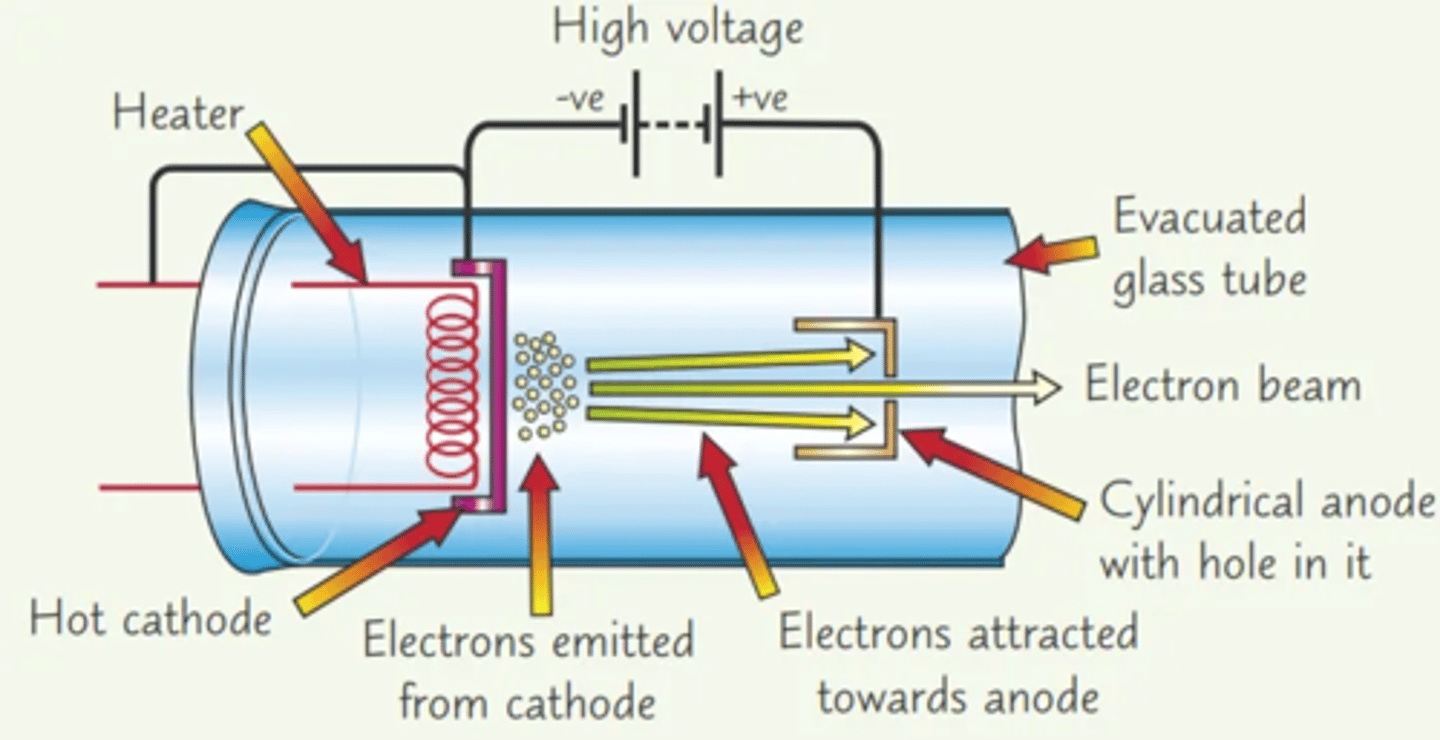
What equation relates work done to the potential difference in an electron gun? (2)
- The equation is
ΔW = eV.
- Where e is the electron charge (C) and V is the potential difference (V).
What is an electron volt (eV)? (1)
An electron volt is the energy transferred when one electron moves through a potential difference of one volt.
What is the conversion factor between an electronvolt (eV) and joules? (1)
1 electronvolt is equal to 1.6 x 10^-19 Joules.
How does an electron's kinetic energy relate to the electric potential difference? (2)
- As the electron moves from cathode to anode, its electric potential energy is converted into kinetic energy.
- The final kinetic energy is given by ½mv² = eV.
What is meant by specific charge? (2)
- Specific charge is the ratio of a particle's charge to its mass.
- This is given by e/m.
How is a fine beam tube setup to determine specific charge? (2)
- A fine beam tube contains low-pressure gas.
- It also contains a uniform magnetic field.
What happens to electrons inside the fine beam tube? (1)
Electrons accelerated by an electron gun enter the magnetic field perpendicularly.
What causes the electrons to move in a circle in the fine beam tube? (2)
- The magnetic force acts perpendicular to their velocity.
- This creates circular motion.
How is the electron path observed in the fine beam tube? (2)
- Collisions with gas atoms make the path glow (the glow is formed as electrons in the excited hydrogen atoms fall back to the ground state and emit light).
- This allows the radius to be measured.
How is specific charge derived from the fine beam tube experiment? (5)
- Start by equating forces mv² / r = Bev.
- Cancelling v gives
mv / r = Be.
- Using energy conservation we have ½mv² = eV, which rearranges to v = √(2eV / m).
- Using this expression for v and rearranging for e/m we get
e / m = 2V / (B²r²).
- Where e/m is the specific charge (Ckg^-1), V is the potential difference (V), B is the magnetic field strength (T), and r is the radius measured (m).
How is Thomson's crossed fields method set up? (2)
- Electrons enter perpendicular electric and magnetic fields.
- These are acting in opposite directions.
What does a setup of Thomson's cross fields method look like? (3)
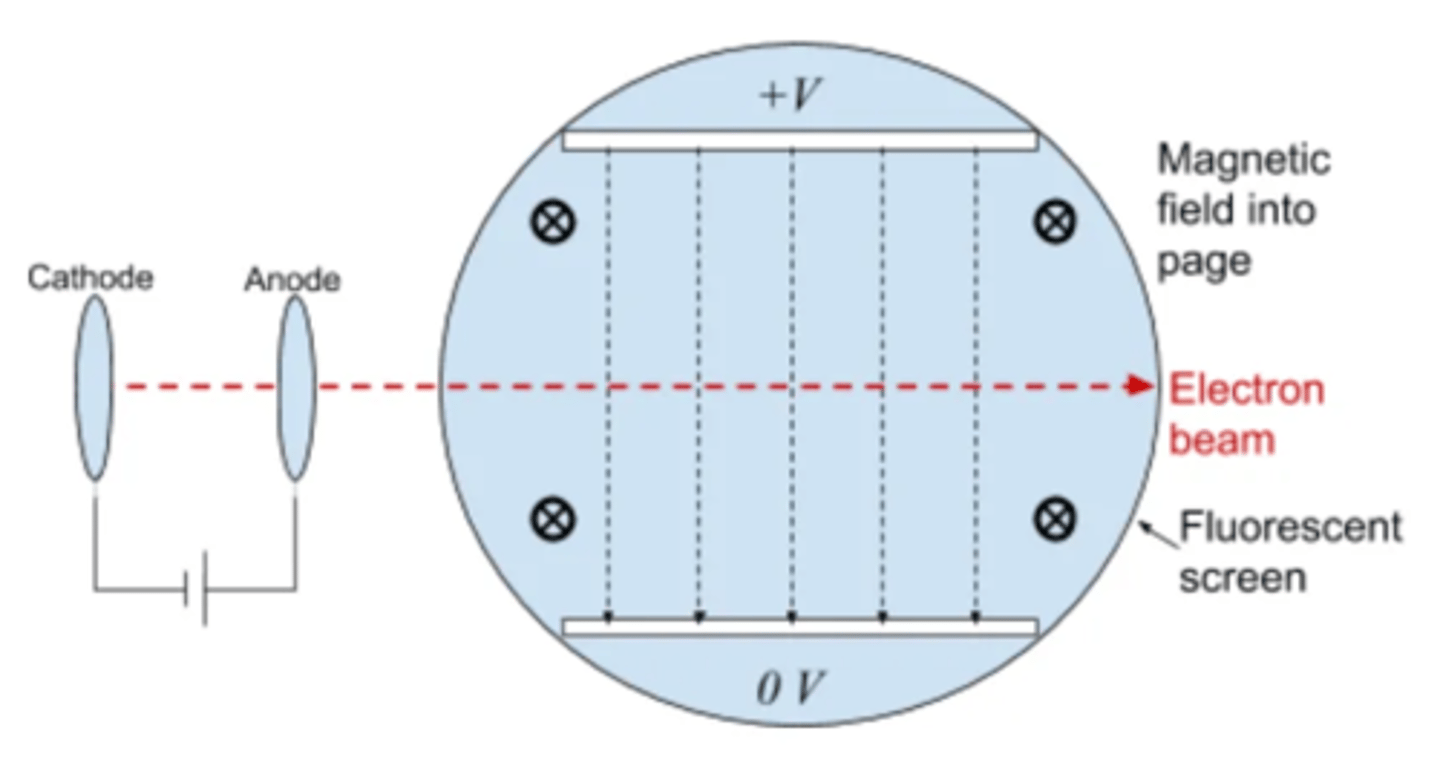
What happens when the beam is undeflected in crossed fields? (1)
Electric and magnetic forces are balanced,
Ee = Bev.
What is the derived formula for specific charge using crossed fields? (6)
- Forces are balanced
Ee = Bev.
- As E = V/d we have
v = Ve / (Bd).
- Use energy conservation so
½mv² = eVa, which gives v² = 2eVa / m.
- Substitute this velocity in (Ve / Bd)² = 2eVa / m.
- Rearrange for the specific charge so
e/m = Ve² / (2B²d²Va).
- Where e/m is the specific charge (Ckg^-1), V is the potential difference (V), e is the charge on the electron (1.6x10^-19 C), B is the magnetic field strength (T), d is the distance between plates (m), and Va is the accelerating voltage (V).
What was Thomson's result and what is its significance? (2)
- Thomson found the specific charge was constant regardless of the gas used.
- This proved that all atoms contain electrons.
What is the approximate specific charge of an electron? (1)
The specific charge of an electron is
≈1.76 × 10¹¹ C/kg.
What is the approximate specific charge of a proton? (1)
The specific charge of a proton is
≈9.58 × 10⁷ C/kg.
How does the electron's specific charge compare to the proton's? (1)
The electron's specific charge is about 1800 times greater than the proton's.
What was the purpose of Millikan's oil drop experiment? (1)
The Millikan's oil drop experiment helps determine the charge of a single electron.
How was Millikan's oil drop experiment set up? (3)
- An atomiser sprayed oil droplets into a chamber.
- This occurs between two parallel plates.
- Th plates have a uniform electric field.
What does a labelled diagram of the Millikan's oil drop experiment set up look like? (3)
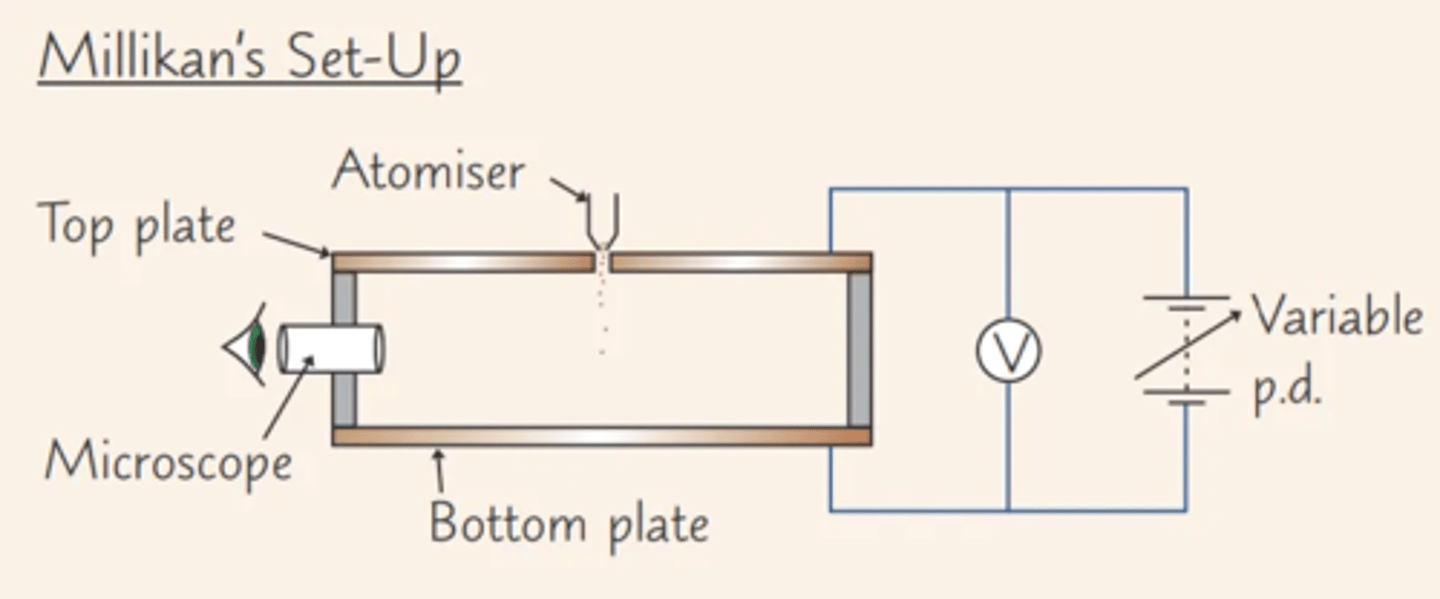
How do oil droplets become charged in Millikan's experiment? (1)
The oil droplets become negatively charged due to friction when sprayed.
How is the motion of oil droplets controlled? (3)
- Droplets fall under gravity until entering the electric field.
- This applies an upward force.
- The voltage is adjusted until this electric force balances the droplet's weight.
What is the condition for a stationary oil droplet? (1)
The upward electric force must equal the downward gravitational force.
What is the equation for a stationary droplet? (3)
- The equation is
EQ = mg.
- Or use E = V/d: QV/d = mg.
- Where E is the electric field strength (Vm^-1), Q is the charge of the droplet (C), m is the mass of the droplet (kg), g is the gravitational field strength (9.81 ms^-2), d is the distance between the plates (m), and V is the potential different between the plates (V).
Why must the mass of the oil droplet be determined? (1)
The mass is needed to calculate the charge but cannot be measured directly.
How is the mass of the oil droplet found? (4)
- The electric field is turned off so the droplet falls at terminal velocity.
- Using Stokes' law, drag force equals weight
F = 6πηrv.
- Where η is the viscosity of the fluid (Pa s), r is the radius of the oil droplet (m), and v is the velocity of the droplet (ms^-1).
- As weight = mg the mass in kg of the droplet can be found.
What equation is used to calculate the radius of the oil droplet? (2)
- Set 6πηrv = mg and m = (4/3)πr³ρ.
- Then, r² = (9ηv) / (2gρ).
How is the charge on the droplet found using the radius? (2)
- Use the radius.
- Find
Q = [(4/3)πr³ρg] × (d / V).
What key conclusions did Millikan reach? (2)
- The charge on droplets was always a multiple of 1.6 × 10⁻¹⁹ C (charge of an electron).
- This showed charge is quantised and comes in discrete values.