biochem: lec 1
 Call Kai
 Learn
Learn Practice Test
 Spaced Repetition
 Match
Match Flashcards
 Knowt Play
1/45

There's no tags or description
Looks like no tags are added yet.
Name | Mastery | Learn | Test | Matching | Spaced | Call with Kai | Chat |
|---|
No analytics yet
Send a link to your students to track their progress
46 Terms
roles of water
70% of human body mass
allows moc to take shape
req for metabolic activties
ex: chemical rxn needs solvent
water structure
bond length: 1A
angle: 104.5
polarity —> life
linear —> no life
how many h-bond can a water moc do?
4
H donor group
O—H, N—H, S—H (can do h-bond in protein struc)
weakly acidic
H acceptor group
O, N, S,
weakly basic
h bond w/ func groups
H: monovalent
O: bivalent/ di
N: trivalent
C: tetravalent
add extra bond: +
take away: -
what is bond strength
how much energy to break bond
KJ - mol^-1
3 types of dipole dipole
permanent dipoles
dipole-induced dipole
London dispersion force
permanent dipole
both polar moc
strong charge
dipole- induced dipole
polar & np
ldf
very weak
btw np
solubility
ability of solvent to interact w solute > strongly than solute particles intx w/ e/o
water: good solvent for ionic & polar
ex: solvation of NaCl
strong ionic bond
water tries to break bond via compensation
uses partial charges to replace
gibbs free energy equation (combo for always spontaneity)
delat G: <0
delta H: <0
delta S: >0
delta H: enthalpy change
heat
break bond: need energy, >0
form bond: energy rel, <0
delta S, entropy change of system
randomness
>0, more randomness, more spon
hydrophobic effect
tendency of water min contact w/ hp moc
aggregation of np moc in water
water drives np mic tgt→ water more favorable, less ordered state
what drives oil tgt-?
entropy of the system (Delta S)
water increases in entropy → more random, less contact w/ oil
amphiphlies
moc w/ polar & np grps
ex: micelle & bilayer
hydrocarbon tails come tgt- inside 2/ polar heads interact w/ water outside
3 key things why protein structure is important
life
disease
pharmaceuticals
disease
ex: sickle cell disease
SCD → mutation in one aa of hemoglobin
changes shape → np aggregate tgt → block blood vessels
what’s a protein
a polymer of amino acids
how can proteins become active
must twist & fold into their final, native conformation
an a amino acid
all aa derived from proteins (except glycine) are chiral
all chiral aa → L-stereochemistry
pH
measure of acidity/ basicity of aq solution
pka= - logka
Ka: measure of acid strength
lower pka = stronger acid
pH < pKa
protonation
low pH, more H, protonate moc
pH > pKa
un-protonate
high pH, less H, deprotonate moc
pH = pKa
50:50 (de/protonated)
ionized vs un-ionized
ionized: has charge, likes water
unionized: lipophilic (likes fat)
difference in 1 unit of pKa & pH
ex: pka 9 & pH 8
pronation, 90% protonated species
if more than 1 unit, >90%
zwitterions
aa are dipolar ions
at 7.4, amino is protonated & COOH 9s unprotonated
pK1(alpha) COOH: 2.2
pk2 amino: 9.4
isoelectric point (pI)
pH where moc has no charge
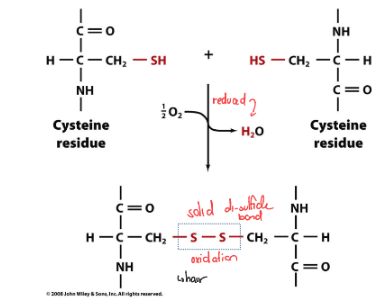
cysteine residues bond
disulfide bon forms
two thiol groups get oxidized
½ O2 gets reduced to H20
Asp side-chain
side chain: –CH₂–COO⁻
α-carbon → β-carbon (CH₂) → β-COOH
Glu side chain
side chain: –CH₂–CH₂–COO⁻
α-carbon → β-carbon (CH₂) → γ-carbon (CH₂) → γ-COOH
lysine side chain
α → β → γ → δ → ε
peptide bond
condensation of 2 aa
CO—NH form, water is romved → dipeptide
peptide bond forms
what structure is polypeptide
linear, not branched like polymers
what are aa in a polypeptide called?
residues
how does glutathione (GSH) act as a cellular antioxidant?
cysteine -SH group can donate electrons to reactive moc → less harmful
two GSH form disulfide bond (S–S) → GSSG (glutathione disulfide) → gets oxidzied
glutathione redox rxn
2GSH + X(oxidized) —> GSSG + X (reduced)
lose water
what is GFP (Green Fluorescent Protein)
protein in jellyfish → green glow
Chromophore
part of moc that absorbs light & give color
it forms inside GFP protein
how does GFP (green fluorescent protein) produce fluorescence?
chromophore forms inside GFP
made of Ser–Tyr–Gly residues.
undergo rearrangement + oxidation → emits green light
