Week 2 Development - peds
 Call Kai
 Learn
Learn Practice Test
 Spaced Repetition
 Match
Match Flashcards
 Knowt Play
1/109

There's no tags or description
Looks like no tags are added yet.
Name | Mastery | Learn | Test | Matching | Spaced | Call with Kai | Chat |
|---|
No analytics yet
Send a link to your students to track their progress
110 Terms
Typical pregnancy is how many weeks?
Trimesters are how many weeks each?
40 wks
13 wks each

Periods of Motor development

Neural tube development happens around?
Spina bifida - what supplement for mom?
4-6 wks (pregnancy test won’t show)
folic acid supplement
Critical Milestones - First Trimester
implantation occur; placenta & neural tube begin to form
weeks 3-4

Critical Milestones - First Trimester
Heart start beating
Tiny limb buds appear
Week 5

Critical Milestones - First Trimester
Major internal organs & body systems develop
Fingers & toes take shape

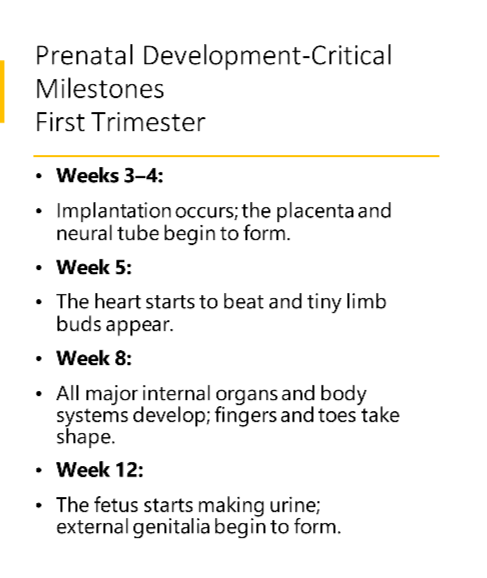
Critical Milestones - First Trimester
Fetus start making urine
External genitalia begin to form


Critical Milestones - Second Trimester
Movement becomes coordinated
heartbeat is clear via Doppler
Skin is thin

Critical Milestones - Second Trimester
“Quickening” occurs: mother feels first movement
Anatomy US can check development & gender

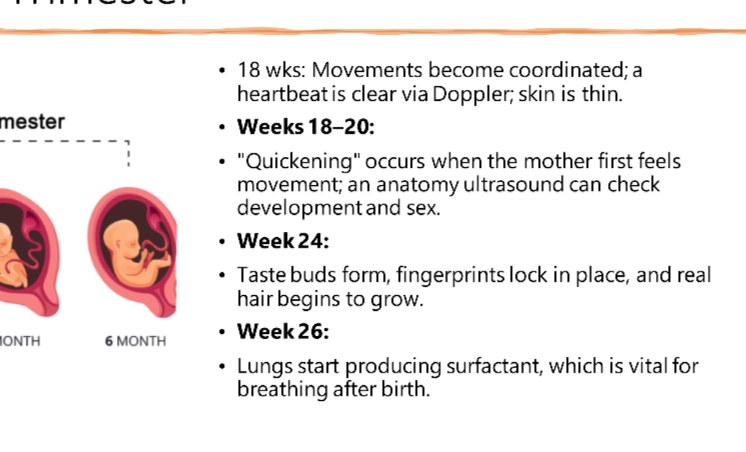
Critical Milestones - Second Trimester
Tastebuds form
Fingerprints lock in place
Real hair begins to grow


Critical Milestones - Second Trimester
Lungs start producing surfactant - vital for breathing after birth

When is fetus viable - higher change of surviving birth at this point
25 wks

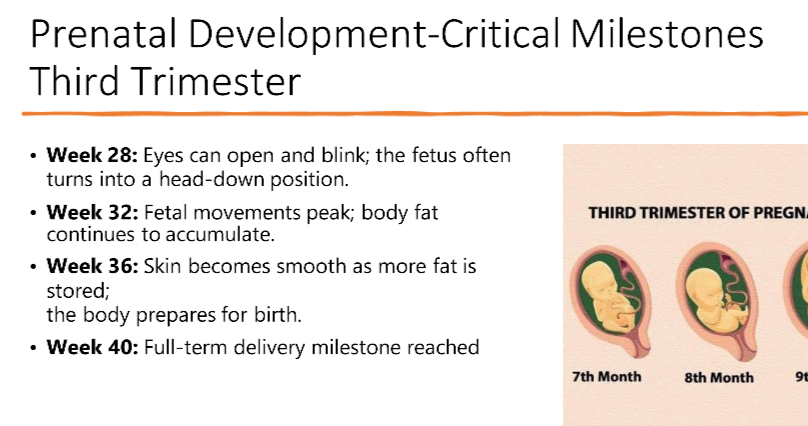
Critical Milestones - Third Trimester
Eyes can open & blink
Fetus often in head down position

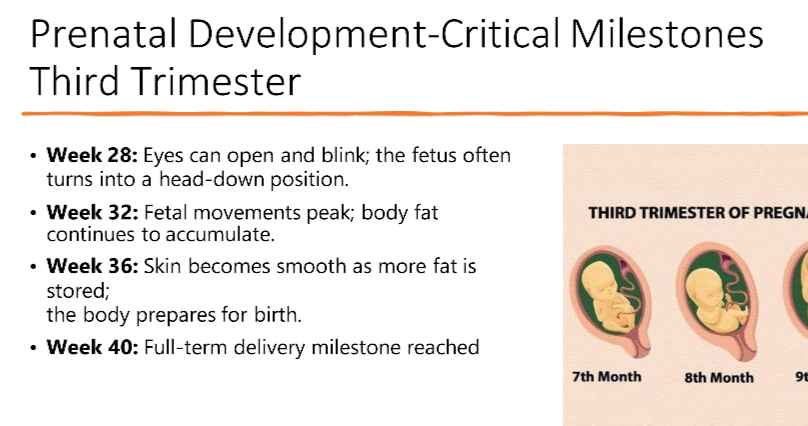
Critical Milestones - Third Trimester
Week 32:

Fetal movements peak
Body fat continues to accumulate

Critical Milestones - Third Trimester
Week 36:

Skin becomes smooth as more fat is stored
Boddy prepares for birth
When is full term delievery milestone reached?

38-40 wks
Neonatal/Infant
Reflex:
Within a few weeks should be able to?
What changes?

Physiologic flexion
Primitive reflexes present
Within few weeks - turn head to either side when in prone (with tummy time)
Head shape changes - back of head may be flat due to laying on their back when sleeping

What is the breached position
feet first
FIgure out what chart to use
email her
Our standard

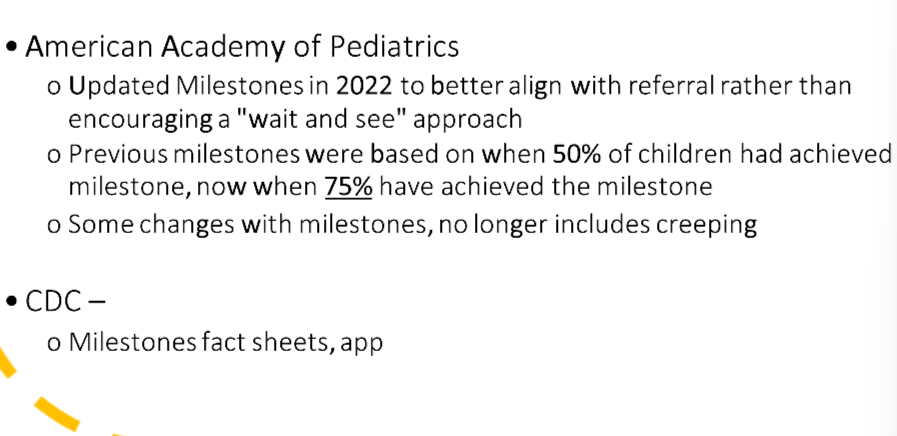
Skills associated with positioning
Prone - lengthens which muscles? develops which muscles?

Lengthen flexor muscles
have to lengthen mm before strengthening it
Flexor lengthening before strengthening extensors
Develops extensor muscles (antigravity)
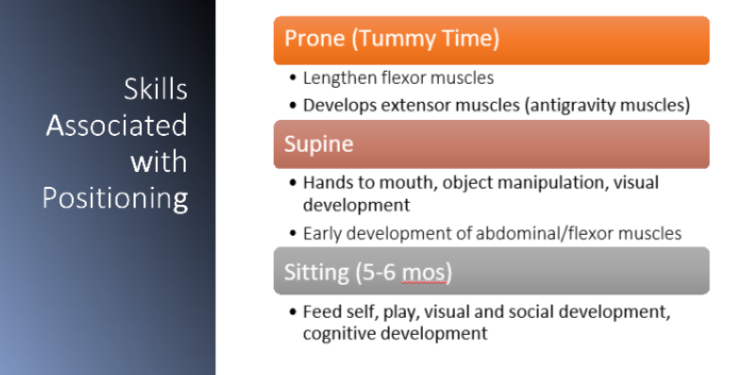
Skills associated with positioning
Supine - 3 things? Early development of which muscles?

Hands to mouth, object manipulation, visual development
Early development of abdominal/flexor muscles

Skills associated with positioning
Sitting - at how many months? 4 things?

5-6 months
Feed self, play, visual/social/cognitive development
Tummy time position

Sit
The baby sits by leaning forward and propping themselves up on their hands
Name? When?
Tripod/Prop sitting
5-6 months
Sit
The baby sits steadily without using their hands for balance, typically able to reach for toys
Name? When?
Independent sitting
6-8 months
Sit
The baby pivots, shifts weight, and transitions into and out of the sitting position on their own.
Name? When?
Functional/Dynamic Sitting
7-11 months
a floor-sitting posture where a person sits on their hip with both knees bent and pointing to the same side
Side sit
refers to a crucial gross motor milestone where an infant supports their full body weight on all fours—specifically, on both hands and both knees
Quadruped
moving forward with the belly resting on the floor
Crawl
moving forward on hands and knees with the belly lifted entirely in the air
Creep
developmental stage where a child bears weight on both knees while keeping their hips fully extended and their torso completely upright
Tall kneel
a crucial transitional position where a child places one knee on the floor (stacked directly under the hip) while the other leg is brought forward with the foot planted flat on the ground
Half kneel
Prone progression - 1 month
Slightly elevates, may rotate head side to side

Prone progression - 2-3 month

Elbow in line with shoulders
Forearm support
Lateral wt shift
Head/neck at 45 deg

Prone progression - 4-5 month

Weight shifting
Reaching w/ 1 arm
Pivot in prone

Prone progression - 6-7 month
Push up on extended arms
Rocking on hands and knees
Pushes self backwards on tummy
May “army” crawl
Head is more at 90 deg angle

Prone progression - 8-9 month

Transitions in/out of quadruped, sitting, and prone
Pulls to stand with support

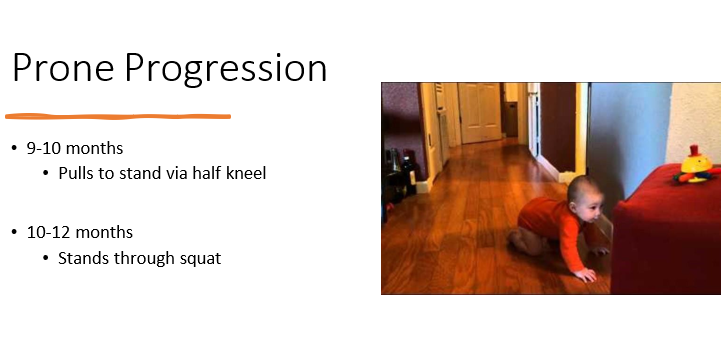
Prone progression - 9-10 month

Pulls to stand via half kneel
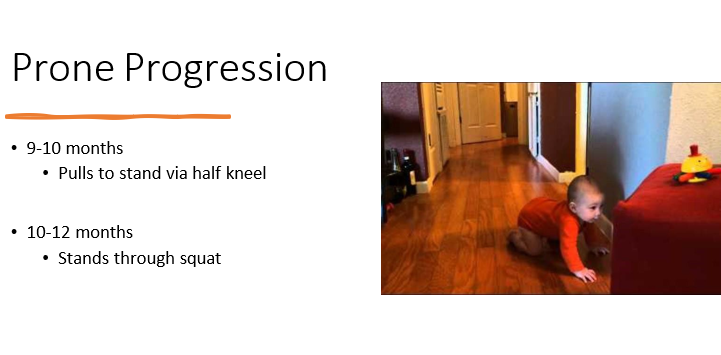
Prone progression - 10-12 month

Stand through squat
Supine Progression - 1-3 months
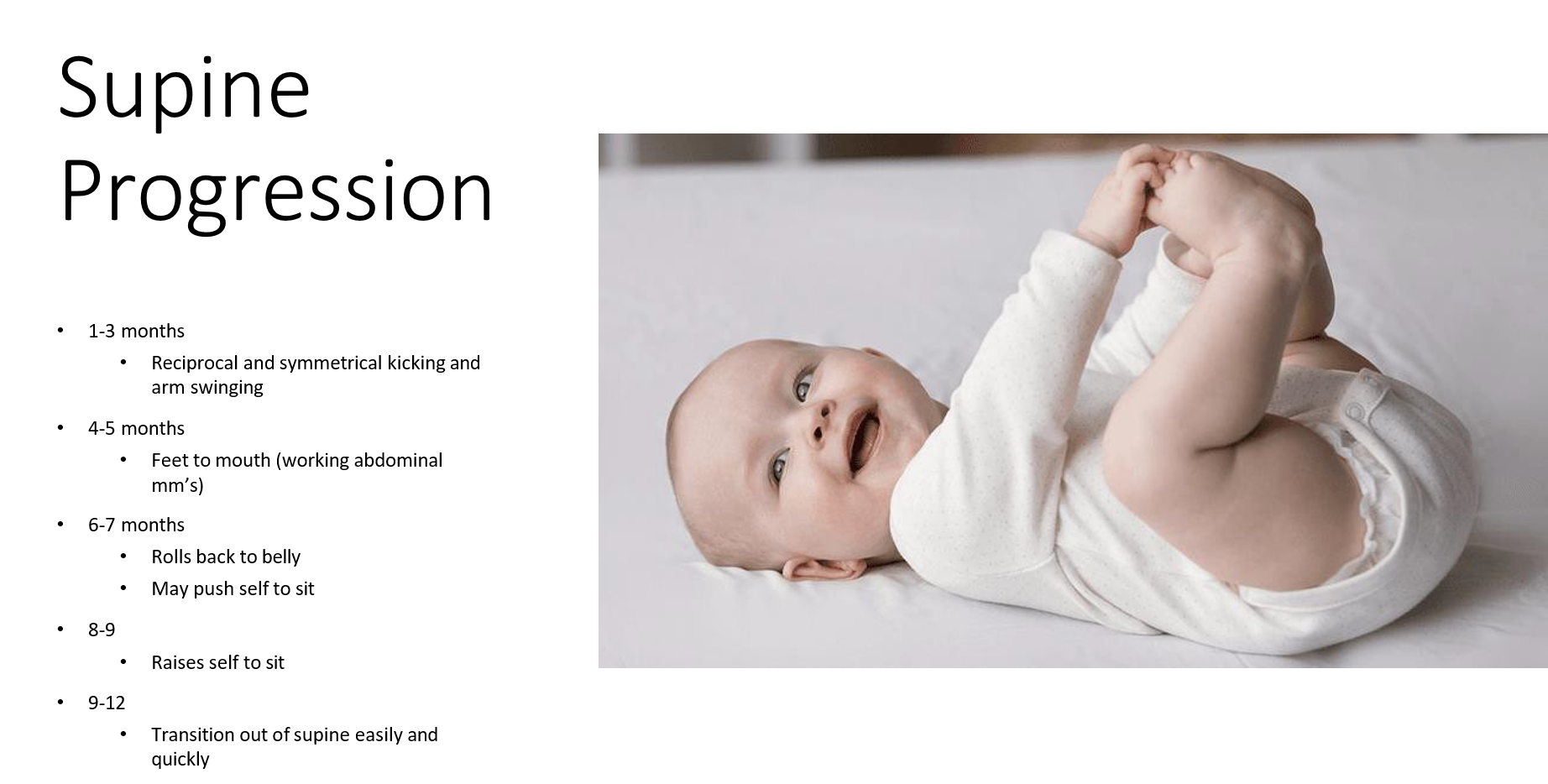
Reciprocal and symmetrical kicking and
arm swinging

Supine Progression - 4-5 months
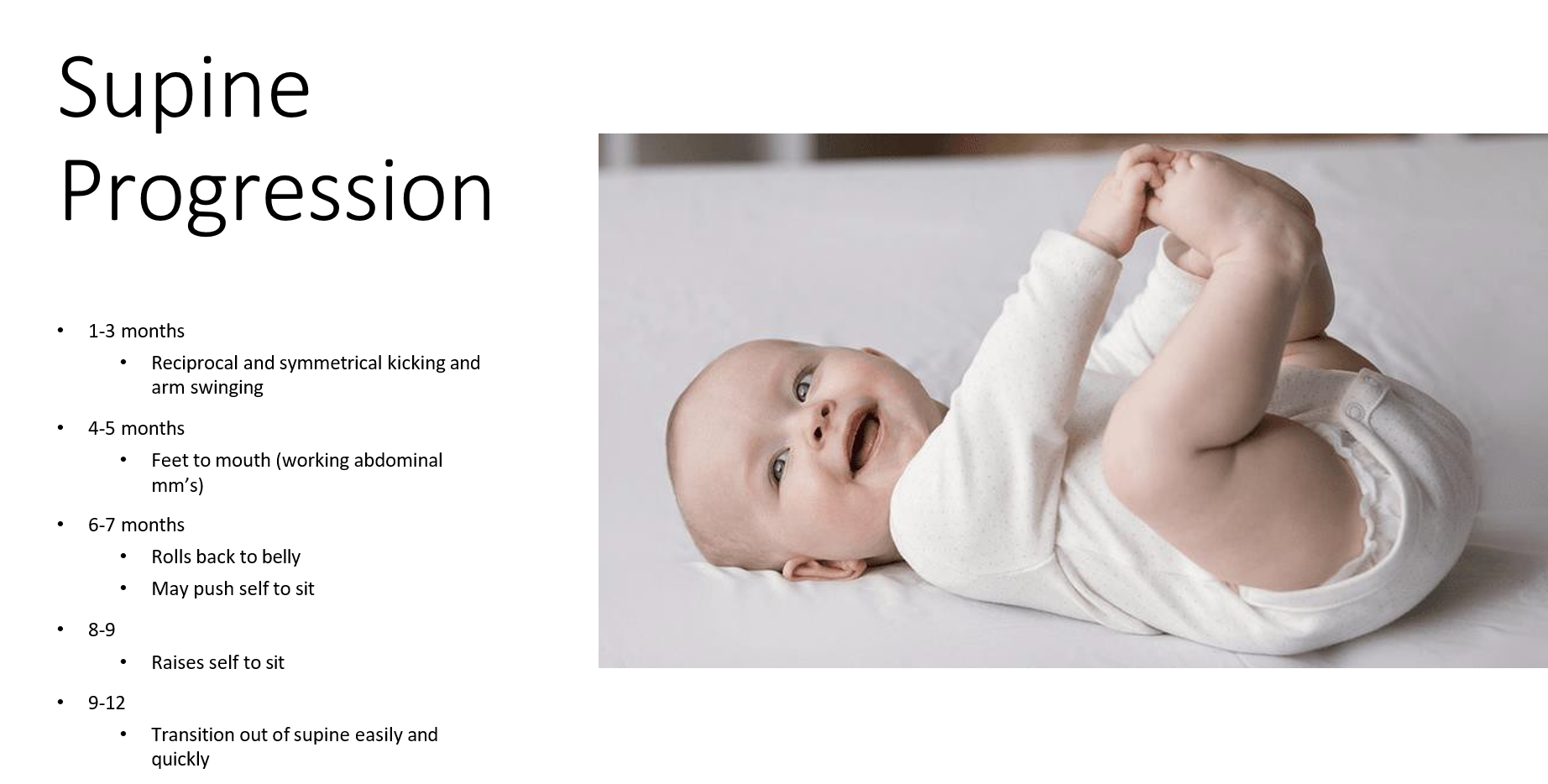
Feet to mouth (working abdominal mm’s)

Supine Progression - 6-7 months
Rolls back to belly
May push self to sit
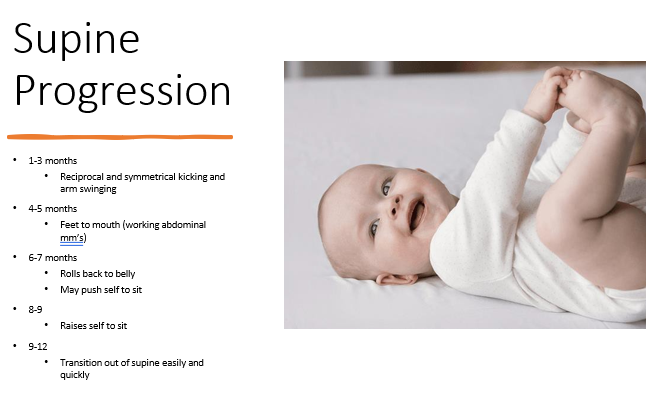
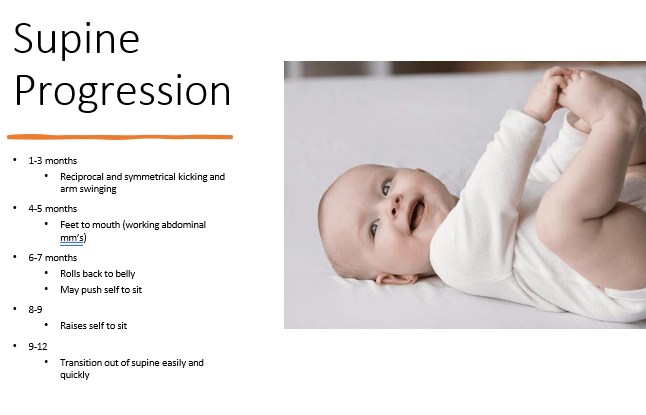
Supine Progression - 8-9 months

Raises self to sit
Supine Progression - 9-12 months
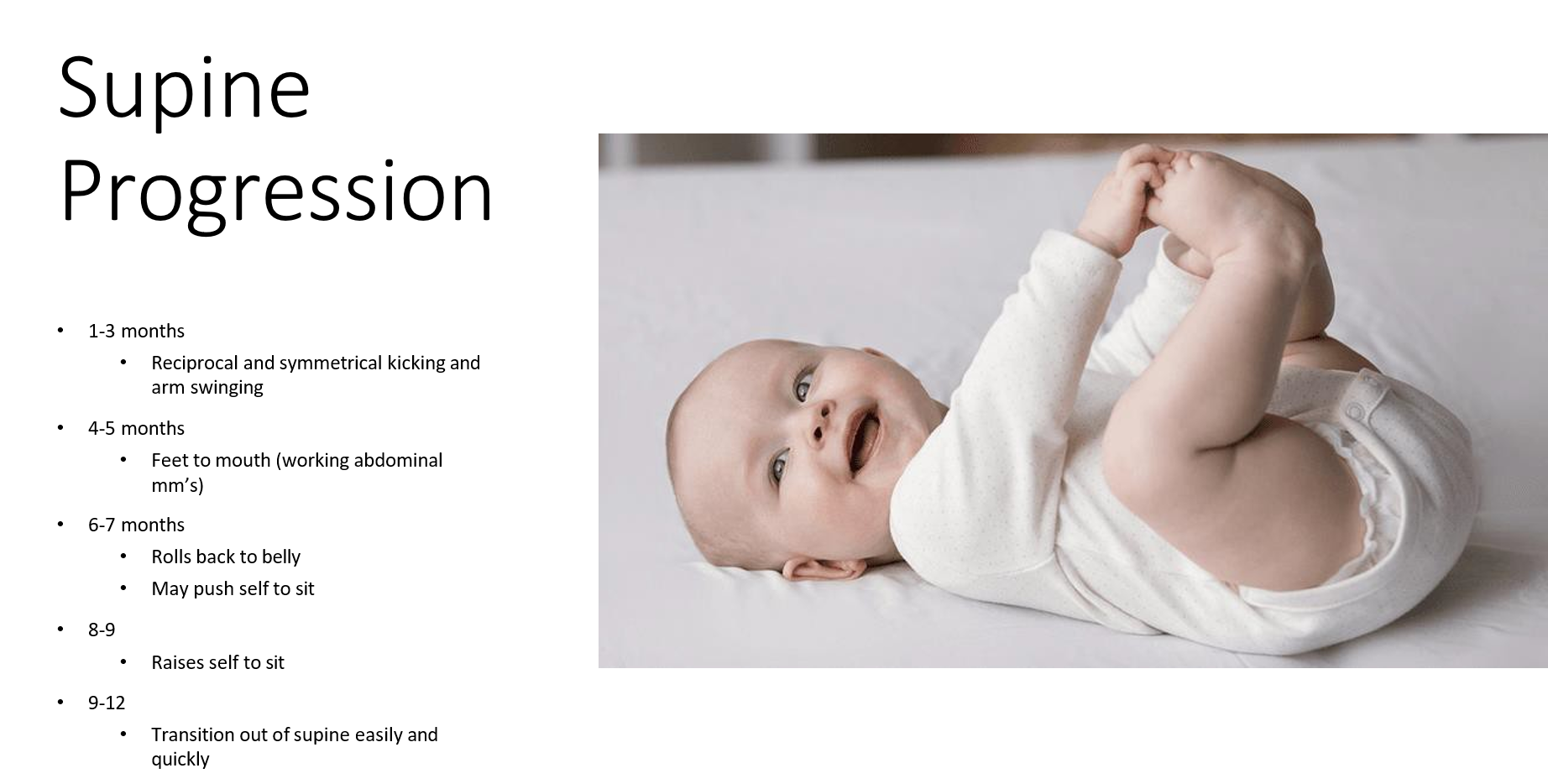
Transition out of supine easily and quickly

What are the most sensitive parts of the body
Palms
bottom of feet
around mouth
When do they push self to sit?
6-7 months

Sitting progression - 1 month
Forward flexion, head inline with trunk
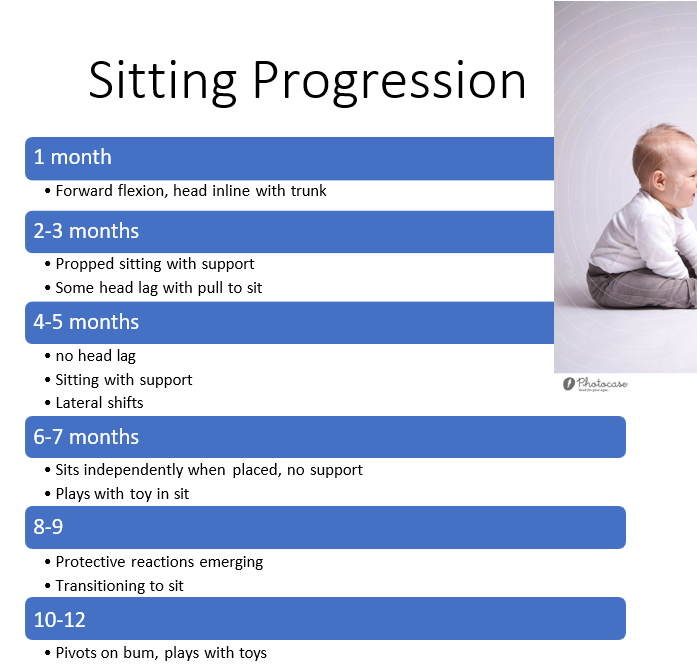
Sitting progression - 2-3 month
•Propped sitting with support
•Some head lag with pull to sit
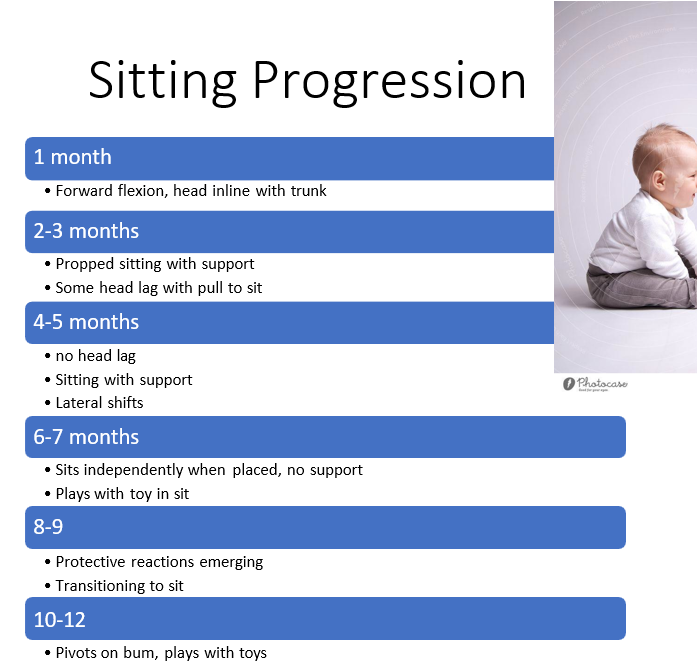
Sitting progression - 4-5 month
•no head lag
•Sitting with support
•Lateral shifts

Sitting progression - 6-7 months
•Sits independently when placed, no support
•Plays with toy in sit

Sitting progression - 8-9 months
•Protective reactions emerging
•Transitioning to sit

Sitting progression - 10-12 months
•Pivots on bum, plays with toys

Summary of mobility in 1st year
3-5 months
•Pivoting in prone
•May rock in quadruped
•Push self backwards
Summary of mobility in 1st year
6-7 months
•Rolling both ways
•Forward motion - Army type crawling

Summary of mobility in 1st year
8-9 months
•Crawls, creeps, and pulls to stand
•Walks with assist

Summary of mobility in 1st year
10-12 months
•Cruises, stands alone, walks with one hand held
•Walks independently

Reach & Grasp
Goal: match motor control of their own body to?
Normal UE movements:
Initially, each child will have a somewhat individual style of reaching depending on?
“Normal” reach and grasp start around? Refinement period?
proprioceptive and visual cues from the environment
Flapping, swinging, variable & w/out intent
Environment
2 y/o, 8-12 y/o
Reach & grasp are input dependent
3 inputs?
What also has an impact?
Vision, environment (toys, motivators in environment), opportunity
Gross motor skills
Reach is followed by?
Reach - Grasp - Release
Reaching 0-5 months
0–2 months |
1–3 months |
1–4½ months |
2–6 months |
3½–4½ months |
0–2 months | Visual regard of objects |
1–3 months | Swipes at objects |
1–4½ months | Alternating glance from hand to object |
2–6 months | Inspects own hands; reaches for, but may not contact, object |
3½–4½ months | Visually directed reaching |
Reaching 0-5 months
3½–6 months |
4 months |
5 months |
Hands are oriented to object, rapid reach for object without contact |
Shoulders come down to natural level; hands are together in space; in sitting bilateral backhand approach with wrist turned so thumb is down |
In prone bilateral approach, hands slide forward; two-handed corralling of object |
Reaching 5-12 months
5–6 months |
6 months |
7 months |
5–6 months | Elbow is in front of shoulder joint; developing isolated voluntary control of forearm rotation |
6 months | In prone, reaches with one hand while weight-bearing on the other forearm; elbow is extended, wrist is straight, midway between supination and pronation |
7 months | Prone: reaches with one hand while weight-bearing on the other extended arm |
Reaching 5-12 months
8–9 months |
9 months |
10 months |
11–12 months |
8–9 months | Unilateral direct approach, reach and grasp single continuous movement |
9 months | Controls supination with upper arm in any position, if trunk is stable |
10 months | Wrist extended, appropriate finger extension |
11–12 months | Voluntary supination, upper arm in any position |
Grasp
0–3 months |
2–7 months |
3–3½ months |
4 months |
0–3 months | Hands are predominantly closed |
2–7 months | Object is clutched between little and ring fingers and palm |
3–3½ months | Hands clasped together often |
4 months | Able to grasp rattle within 3 inches of hand |
Grasp
3–7 months |
4 months |
4–6 months |
4–8 months |
3–7 months | Able to hold a small object in each hand |
4 months | Hands are partly open |
4–6 months | Hands are predominantly open |
4–8 months | Partial thumb opposition on a cube; attempts to secure tiny objects; picks up cube with ease |
Grasp
5–9 months |
6–7 months |
6–10 months |
7–12 months |
8 months |
5–9 months | Rakes or scoops tiny objects using ulnar grasp |
6–7 months | Objects held in palm by finger and opposed thumb (radial palmar grasp) |
6–10 months | Picks up tiny objects with several fingers and thumb |
7–12 months | Precisely picks up tiny objects |
8 months | Tiny objects are held between the side of index finger and thumb (lateral scissors) |
Grasp
8–9 months |
9–10 months |
10 months |
12 months |
8–9 months | Objects are held with opposed thumb and fingertips; space is visible between palm and object |
9–10 months | Small objects are held between the thumb and index finger, first near middle of index (inferior pincer) finger; later between pads of thumb and index finger with thumb opposed (pincer) |
10 months | Pokes with index finger |
12 months | Small objects are held between the thumb and index finger, near tips, thumbs opposed (fine pincer) |
Release
0–1 month |
1–4 months |
4 months |
4–8 months |
5–6 months |
6–7 months |
0–1 month | No release, grasp reflex is strong |
1–4 months | Involuntary release |
4 months | Mutual fingering in midline |
4–8 months | Transfers object from hand to hand |
5–6 months | Taking hand grasps before releasing hand lets go |
6–7 months | Taking hand and releasing hand perform actions simultaneously |
Release
7–9 months |
7–10 months |
8 months |
9–10 months |
10–14 months |
12–15 months |
7–9 months | Volitional release |
7–10 months | Presses down on surface to release |
8 months | Releases above a surface with wrist flexion |
9–10 months | Releases into a container with wrist straight |
10–14 months | Clumsy release into small container; hand rests on edge of container |
12–15 months | Precise, controlled release into small container with wrist extended |
10 stages of Manipulation
Stage 1 - Skill & age
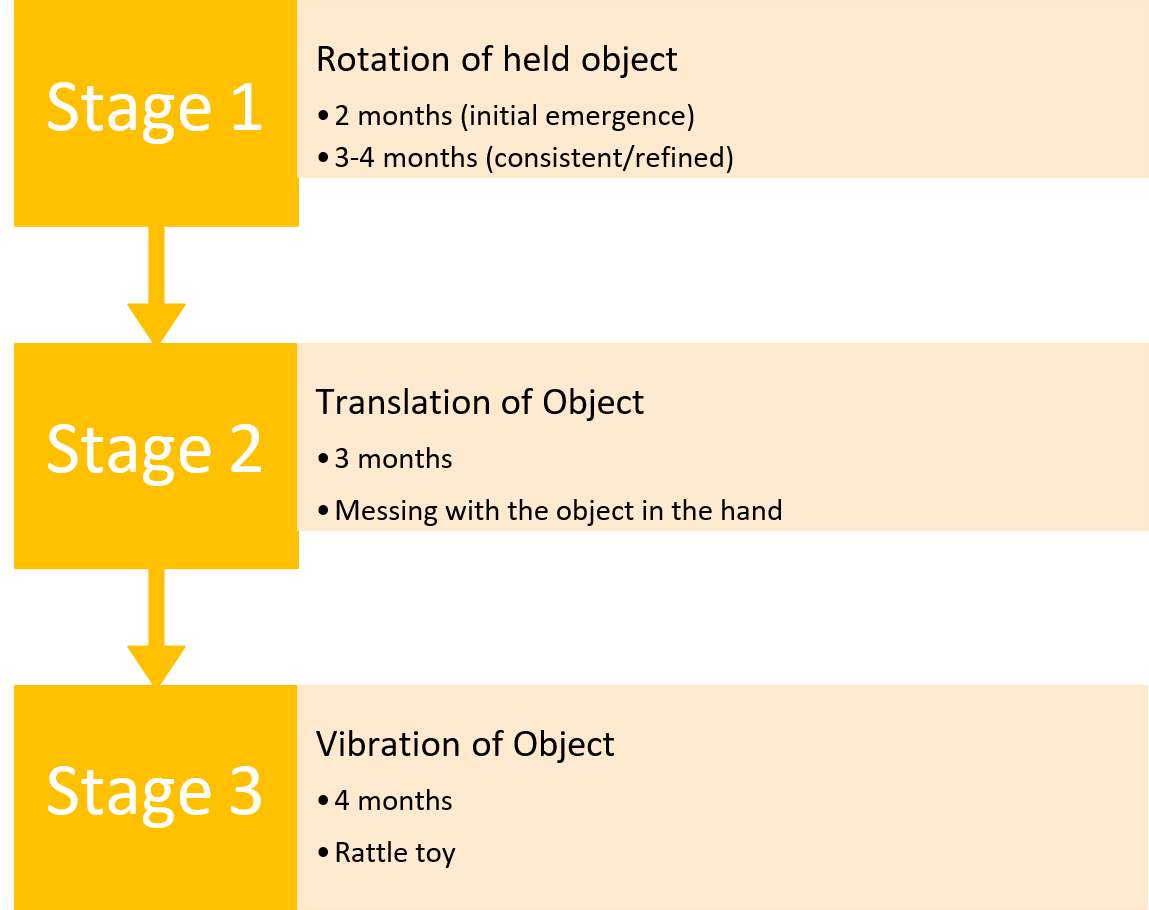
10 stages of Manipulation
Stage 2 - Skill & age
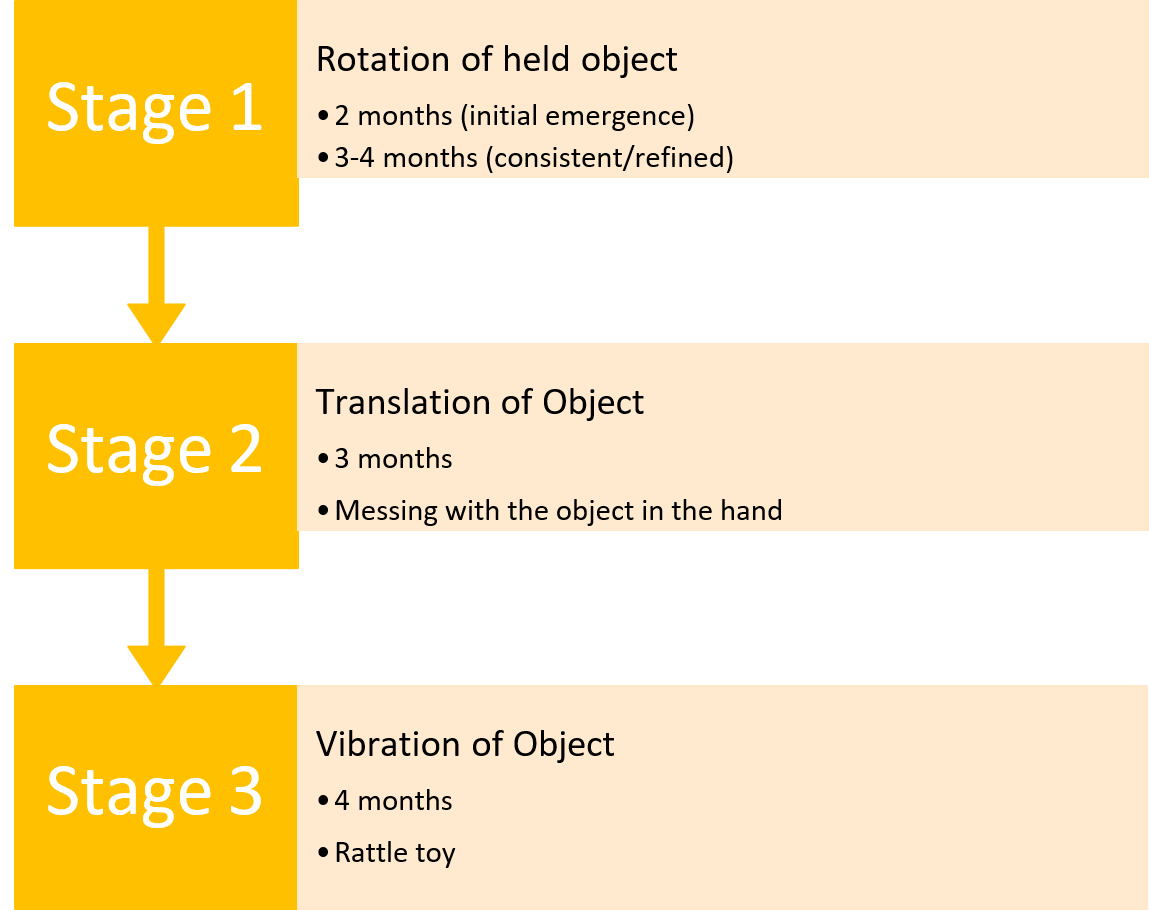
10 stages of Manipulation
Stage 3 - Skill & age
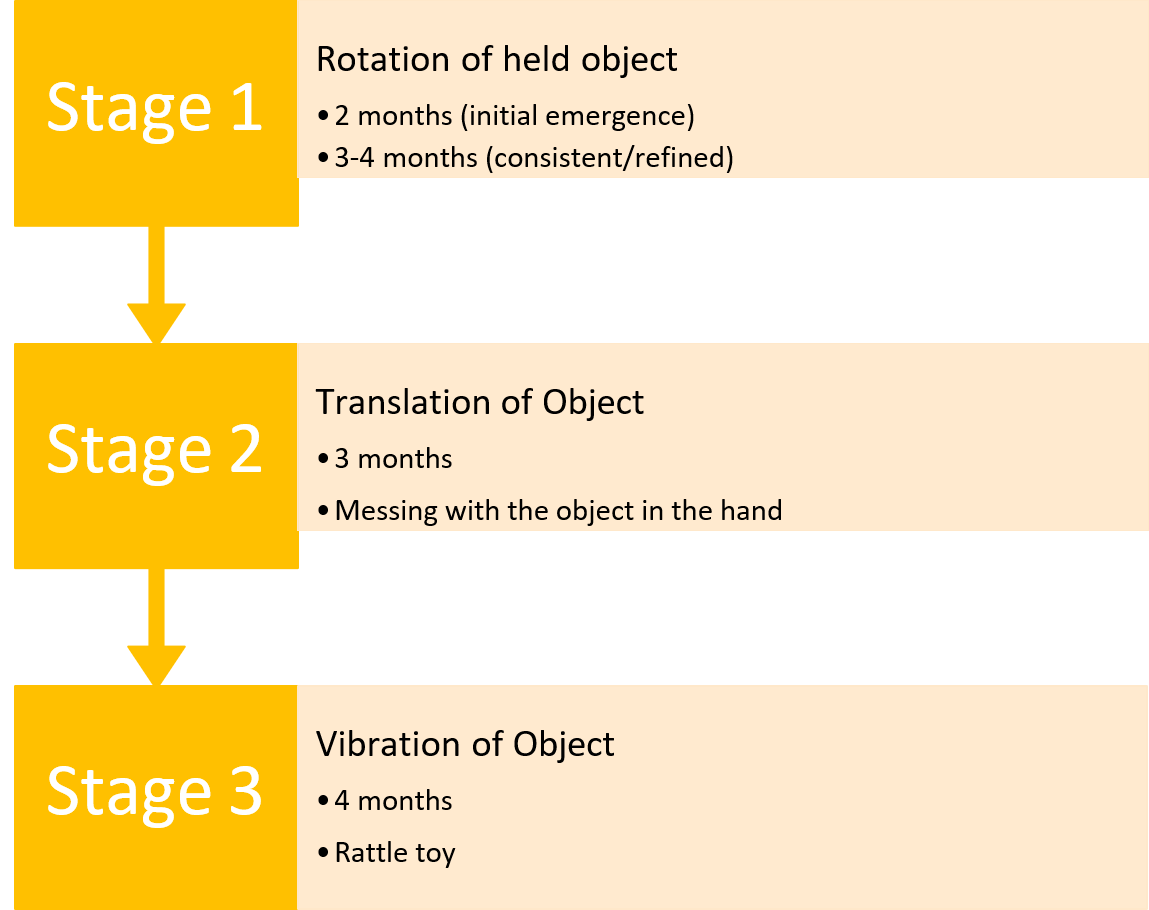
10 stages of Manipulation
Stage 4 - Skill & age
Stage 4: Bilateral Hold of Two Objects
•4-5 months
10 stages of Manipulation
Stage 5 - Skill & age
Stage 5: Bilateral Hold of One Object
•4-5 months
•Typically starts with a bottle
•Progresses to larger/heavier toys that need to be rotated
10 stages of Manipulation
Stage 6 - Skill & age
Stage 6: Hand to Hand Transfer
•4-6 months
•Typically will do the same thing with both hands
10 stages of Manipulation
Stage 7 - Skill & age
Stage 7: Coordinated Action with One object
•5-7 months
•Hold it in one hand and use the other hand to manipulate it
10 stages of Manipulation
Stage 8 - Skill & age
Stage 8: Coordinated Action with Two Objects
•6-9 months
•Banging two blocks together è driven by sound or vibration
10 stages of Manipulation
Stage 9 - Skill & age
Stage 9: Deformation of Objects
•7-9 months
•Rip, squeeze, bend etc
10 stages of Manipulation
Stage 10 - Skill & age
Stage 10: Sequential Actions
7-10 months
Sequential use of two hands to reach a goal
When does ulnar palmar grasp develop
6 months - scooping motion
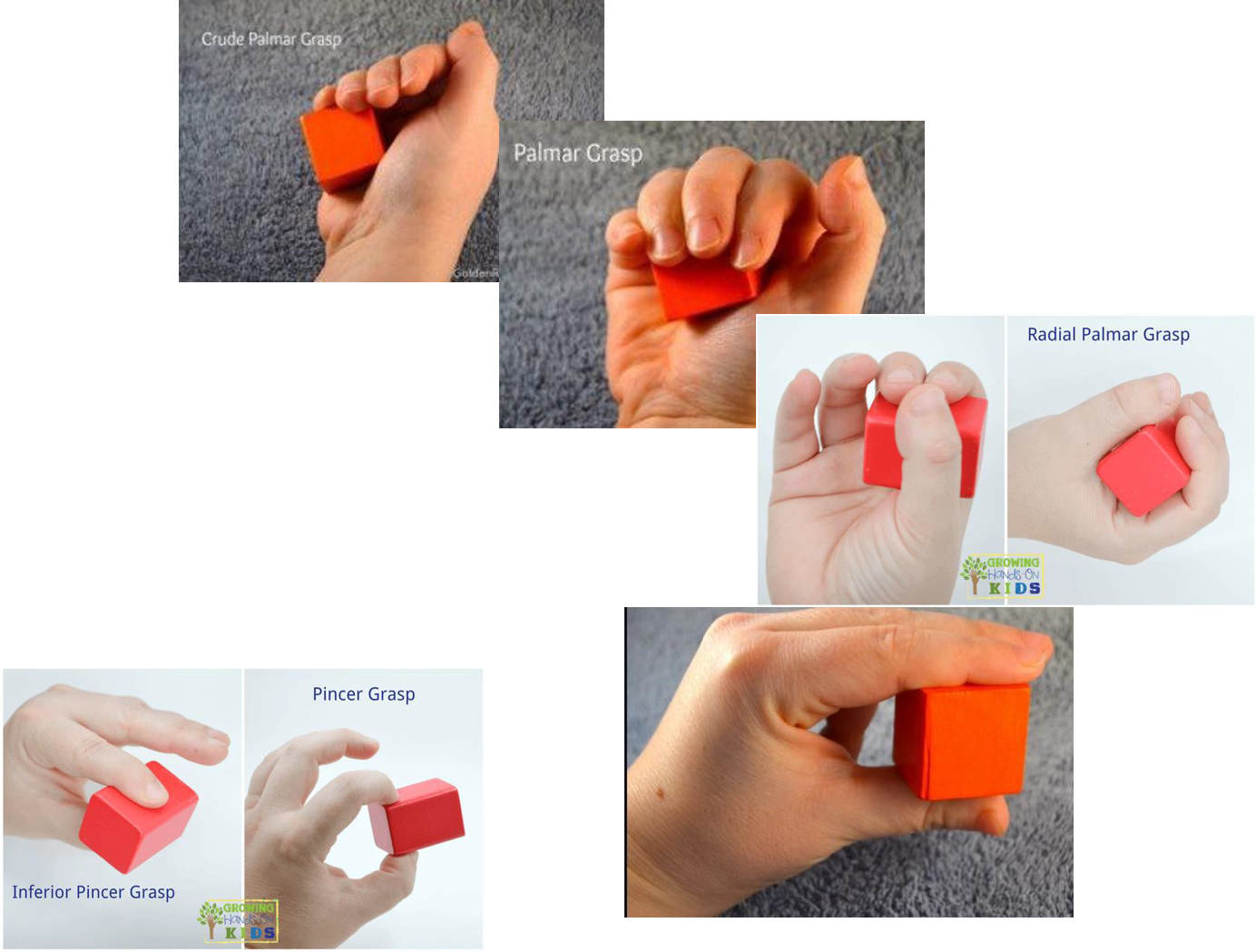
When does radial palmar grasp develop
6-9 months
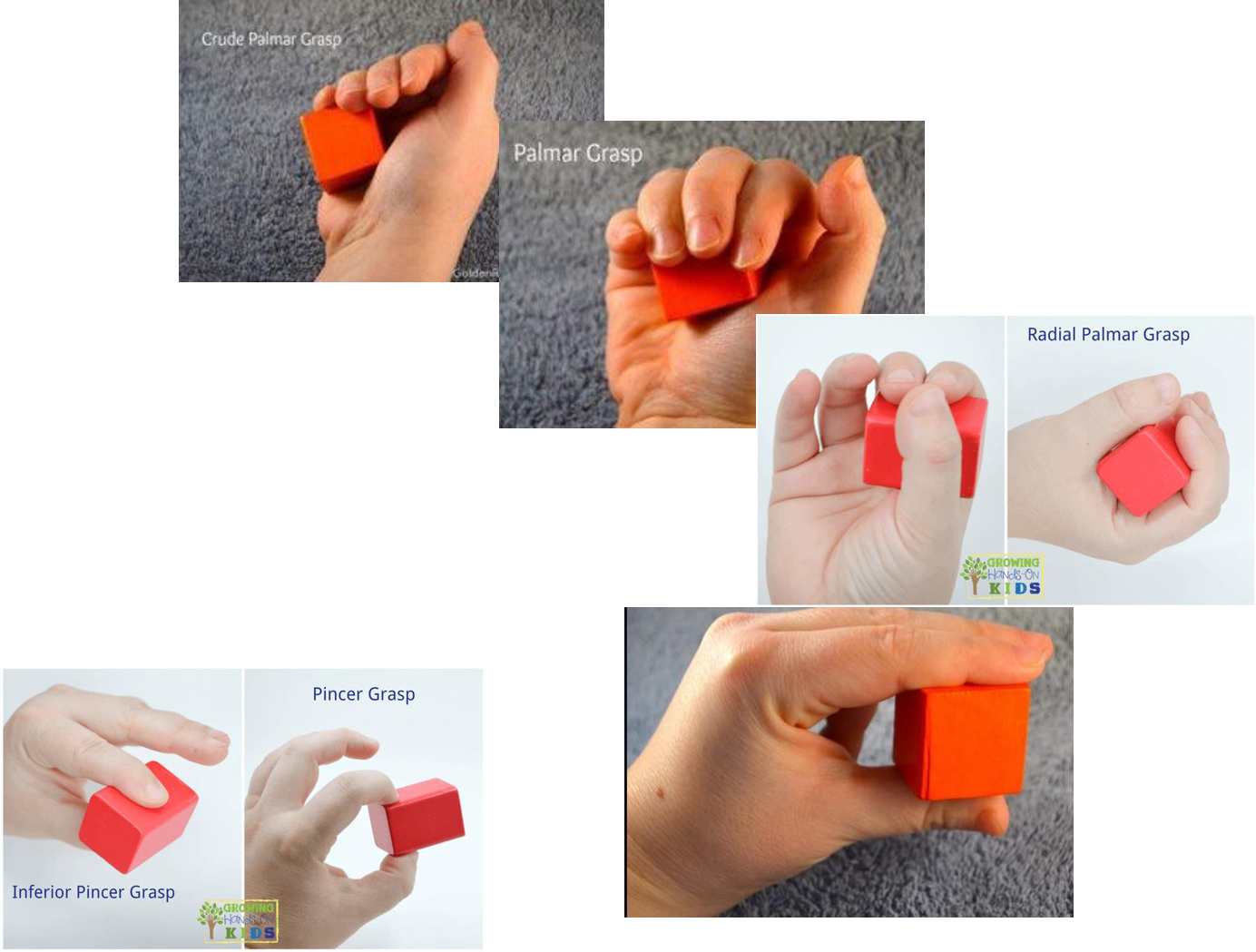
When does 3-jaw chuck grasp develop
10 months

When does pincer grasp develop
12 months
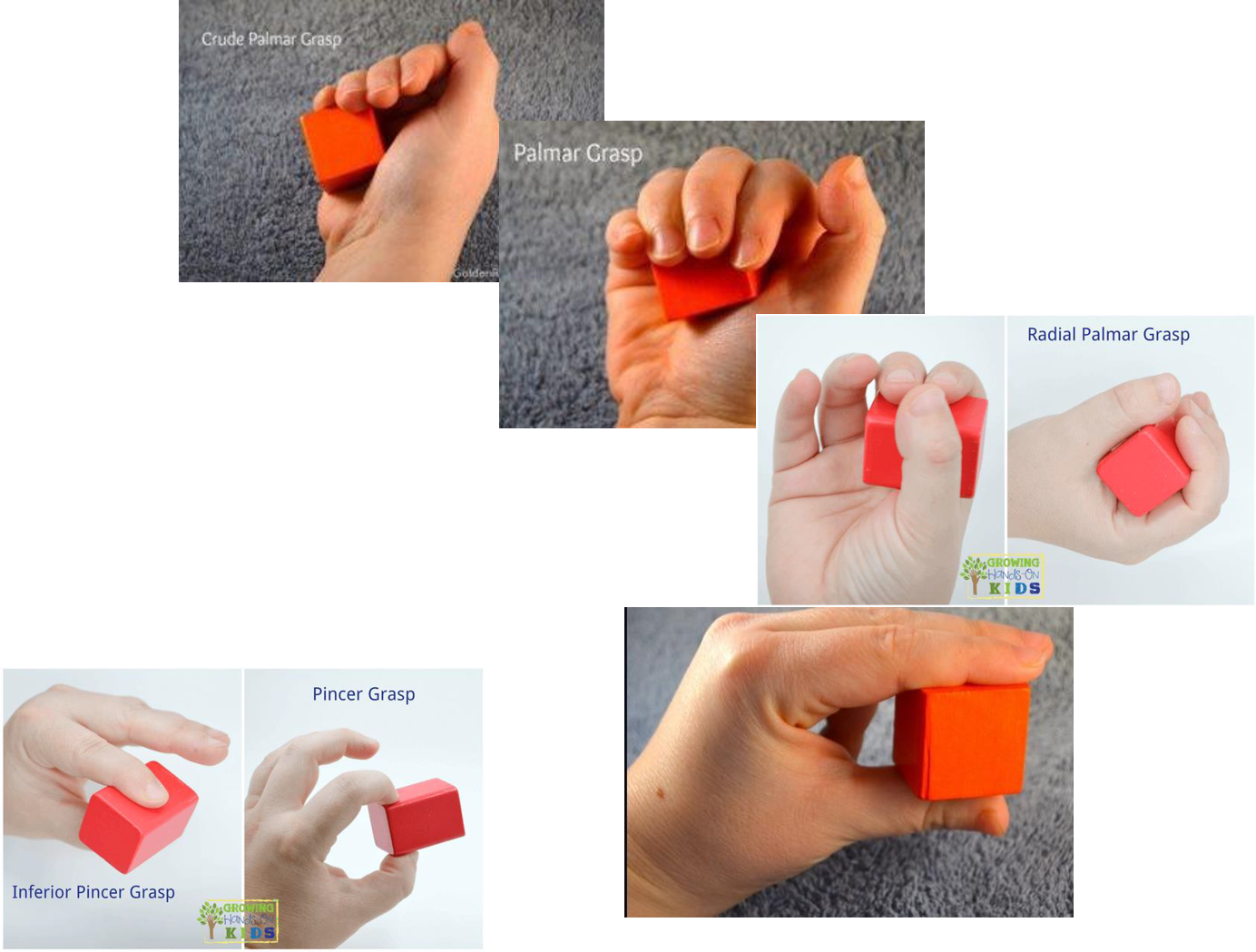
3 requirements for locomotion
Progression
Stability
Adaptability
3 requirements for locomotion
Progression - what kind of stepping pattern? reflex?
•Rhythmic Stepping Pattern
•Reflex? (primitive stepping reflex)
3 requirements for locomotion
Stability - requires what 2 things?
•Balance
•Postural Control
3 requirements for locomotion
3: Adaptability - modify gait based on? Refined after?
•Modify gait based on environment
•Refined after the initiation of gait
7 Phases of Bipedal Development
Phase 1

7 Phases of Bipedal Development
Phase 2

7 Phases of Bipedal Development
Phase 3

7 Phases of Bipedal Development
Phase 4
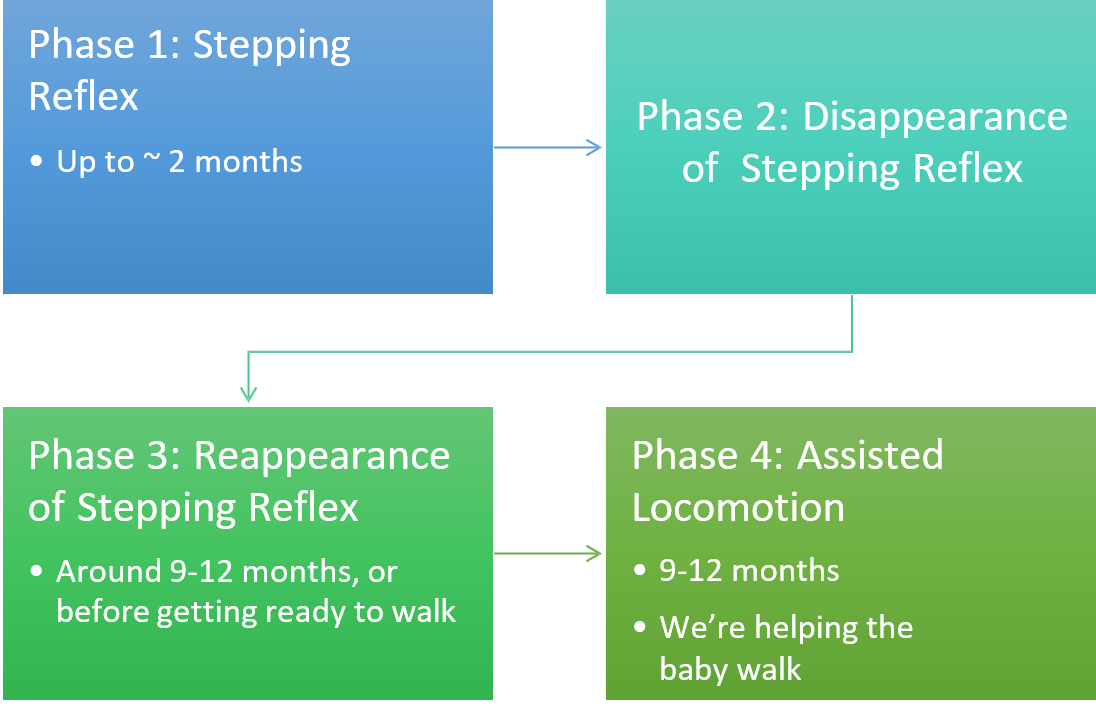
7 Phases of Bipedal Development
Phase 5
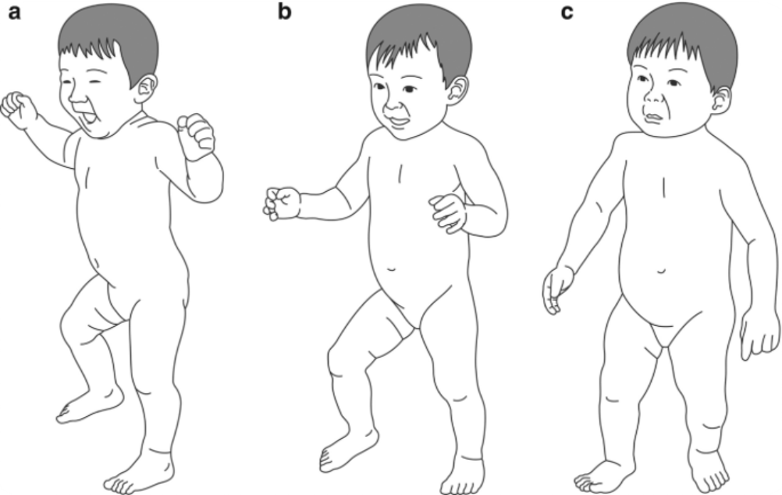
Phase 5: Walking with High Guard
•10-15 months
•Pic a
7 Phases of Bipedal Development
Phase 6
Phase 6: Low Guard - arms down at side
•10-12 weeks AFTER the initiation of gait
•Pic b

7 Phases of Bipedal Development
Phase 7
Phase 7: Head and Trunk Erect
•24+ months

Why is walking so hard???
•Top Heavy
•Practice
•Growth (baby is still growing)
•Motivation
Early Gait NORMAL Characteristics
•Hip : knee flexion
•Flat footed gait
•Wide BoS
•Arm Swing?
•Variable Steps
•Variable Path
Initial walking
Age:
Balance:
Gait:
Step length:
Arms:
Initial contact:
BOS:
Toe position:
Stance:
Knee flexion:
Falls:
Initial Walking |
First 3–6 months after learning to walk |
Unpredictable loss of balance |
Rigid, halting stepping |
Short step length (22 cm) |
High hand guard/outstretched arms |
Flat-foot contact |
Wide base of support |
Toes turned out/external rotation |
Brief single limb stance (32% of gait cycle) |
Knee flexion in stance |
17 falls/hour |
Immature Walking
Age:
Balance:
Gait:
Step length:
Arms:
Initial contact:
BOS:
Toe position:
Stance:
Knee flexion:
Falls:
Immature Walking |
Approximately 2 years of age |
Occasionally loses balance |
Gradual smoothing of pattern |
Increased step length (28 cm at 2 years and 33 cm at 3 years) |
Reciprocal arm swing1 |
Heel strike1 |
Base of support within lateral dimensions of the trunk |
Minimal out toeing/external rotation |
Vertical lift |
Longer single limb stance (34% of gait cycle) |
Greater knee flexion af1ter foot strike and then extends before toe-off |
Seldom falls |
Mature Walking
Age:
Balance:
Gait:
Step length:
Arms:
Initial contact:
BOS:
Stance:
Knee flexion:
Mature Walking |
7 years of age; approximates adult gait |
Rarely loses balance without perturbation |
Relaxed, elongated gait |
Increased step length (48 cm) |
Reciprocal arm swing |
Heel strike |
Narrow base of support |
Minimal vertical lift |
38% of gait cycle single limb stance |