16
0.0(0)
Studied by 3 people Call Kai
 Learn
Learn Practice Test
 Spaced Repetition
 Match
Match Flashcards
 Knowt Play
Card Sorting
1/24

Earn XP
Description and Tags
Last updated 11:30 PM on 3/4/23
Name | Mastery | Learn | Test | Matching | Spaced | Call with Kai |
|---|
No analytics yet
Send a link to your students to track their progress
25 Terms
1
New cards
What is the general path that glucose takes to become Acetyl-CoA?
Glucose undergoes glycolysis, yielding pyruvate.
Pyruvate is oxidized by pyruvate dehydrogenase complex, yielding Acetyl-CoA.
Pyruvate is oxidized by pyruvate dehydrogenase complex, yielding Acetyl-CoA.
2
New cards
What are the 3 stages of cellular respiration?
1. Production of Acetyl-CoA
2. Oxidation of Acetyl-CoA, yielding NADH and FADH2 and GTP
3. Oxidative phosphorylation: synthesis of ATP and reduction of oxygen to water.
3
New cards
Why is pyruvate a logical point of metabolic regulation?
It links two huge metabolic pathways: glycolysis and the citric acid cycle.
4
New cards
What are the different names for the citric acid cycle?
TCA: tricarboxylic acid cycle
Krebs cycle
Krebs cycle
5
New cards
What drives the production of ATP in the oxidative phosphorylation phase?
Electron flow.
6
New cards
What are the functional groups part of Coenzyme A? How does it bond with acetate?
B-mercaptoethylamine,
pantothenic acid,
adenine, and
ribose 3’-phosphate.
\
It bonds to acetate via a thioester bond.
pantothenic acid,
adenine, and
ribose 3’-phosphate.
\
It bonds to acetate via a thioester bond.
7
New cards
What cofactors are required for conversion of pyruvate to acetyl-CoA?
TPP, lipoate, FAD, NAD+, and CoA-SH.
8
New cards
What are the two end products of conversion of pyruvate?
Acetyl CoA + CO2
9
New cards
How does pyruvate from glycolysis enter the mitochondria?
MPC: mitochondrial pyruvate carrier.
Not passively diffused, MPC is a **pyruvate-specific symporter** coupled with H+.
Not passively diffused, MPC is a **pyruvate-specific symporter** coupled with H+.
10
New cards
What is E1 in the pyruvate dehydrogenase complex?
E1: pyruvate dehydrogenase
11
New cards
What is E2 in the pyruvate dehydrogenase complex?
E2: dihydrolipoyl (lipoate) transacetylase
12
New cards
What is E3 in the pyruvate dehydrogenase complex?
E3: dihydrolipoyl (lipoate) dehydrogenase
13
New cards
What is the overall reaction catalyzed by PDH complex?
oxidative decarboxylation
14
New cards
What is lipoate? Describe its structure and function. How is it bound to PDH?
One of the coenzymes required for conversion of pyruvate.
It was two thiol groups that undergo reversible oxidation to a disulfide bond.
It serves as an electron (hydrogen) and acyl carrier.
**It is covalently bound to E2 via lysine residue**.
It was two thiol groups that undergo reversible oxidation to a disulfide bond.
It serves as an electron (hydrogen) and acyl carrier.
**It is covalently bound to E2 via lysine residue**.
15
New cards
What is the function of TPP?
Breaks an alpha carbonyl bond (which is unfavorable), carrying out the removal of a CO2 group from a molecule.
16
New cards
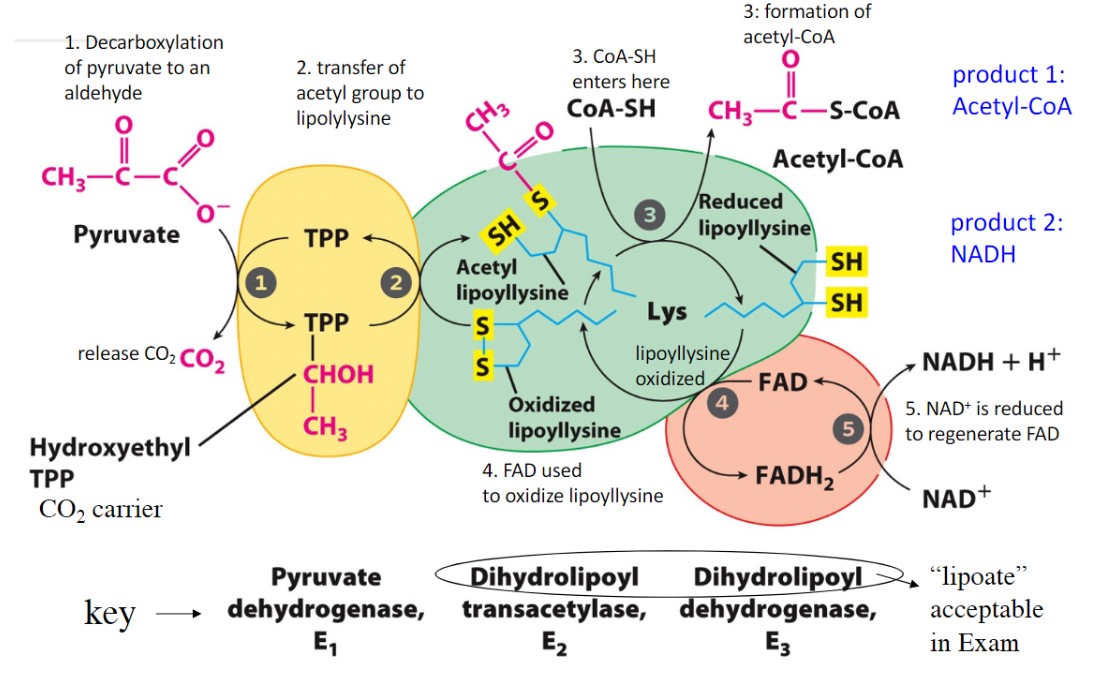
Describe the five steps that pyruvate undergoes to form Acetyl-CoA via the PDH.
1. Pyruvate is decarboxylated, yielding aldehyde (acetal).
2. Acetyl group is transferred to lipolylysine, yielding acetyl lipoyllysine.
3. CoA-SH binds to acetyl lipoyllysine, forming **acetyl CoA.**
4. *FAD oxidizes (meaning FAD is reduced itself) lipoyllysine to allow it to bind further acetyls again.*
5. *NAD+ is reduced to regenerate FAD.*
Steps 4 and 5 are regenerative steps to allow cyclic proliferation.
17
New cards
The PDH uses a method called substrate ________ to improve catalytic efficiency.
channeling
18
New cards
What is the importance of E2 with regard to “substrate channeling” ? (What is substrate channeling?)
Substrate channeling is the movement of intermediates directly from one enzyme to another without release. This occurs via E2 (lipoate)’s long side chain, which delivers intermediates to each enzyme.
19
New cards
What are the inputs and outputs of the citric acid cycle?
Input:
**1 acetyl-CoA**
Output:
**2 CO2**
**3 NADH**
**1 FADH2**
**1 GTP**
**1 acetyl-CoA**
Output:
**2 CO2**
**3 NADH**
**1 FADH2**
**1 GTP**
20
New cards
What are two functions of the citric acid cycle?
1. Energy production
2. Metabolite production required for anabolism of biomolecules (nucleic acids, proteins, sugars, and fats).
21
New cards
What are the net outputs of the citric acid cycle?
3 NADH
1 FADH
1 GTP
1 FADH
1 GTP
22
New cards
List the names of each intermediate of the citric acid cycle, in order, starting with oxaloacetate.
Oxaloacetate
Citrate
Cis-aconitate
Isocitrate
a-Ketoglutarate
Succinyl-CoA
Succinate
Fumarate
Malate
Oxaloacetate.
Citrate
Cis-aconitate
Isocitrate
a-Ketoglutarate
Succinyl-CoA
Succinate
Fumarate
Malate
Oxaloacetate.
23
New cards
How many reactions within the citric acid cycle are reversible, and which ones?
3; two form CO2, and one is the formation of citrate.
24
New cards
25
New cards