Clinical Skills I Exam 1
 Call Kai
 Learn
Learn Practice Test
 Spaced Repetition
 Match
Match Flashcards
 Knowt Play
1/36

There's no tags or description
Looks like no tags are added yet.
Name | Mastery | Learn | Test | Matching | Spaced | Call with Kai | Chat |
|---|
No analytics yet
Send a link to your students to track their progress
37 Terms
Good body mechanics = the use of one’s body to produce motion that prioritizes:
Safety
Energy Conservation
Anatomically Efficient Movement
Physiologically Efficient Movement
Injury Prevention
COG
the point of the body about which all the particles of its mass are equally distributed (at equilibrium)
What is the most common cause of back problems?
Improper body mechanics
COG of the human body in the anatomical position is located…
slightly anterior to the 2nd sacral vertebrae
How will COG affect stability in a squat position?
It will increase stability.
How will COG affect stability with the arms placed overhead?
It will decrease stability.
BOS
the area under and between the parts of the body that are in contact with the ground.
*Increasing the BOS increases stability
LOG
LOG is an imaginary vertical line drawn through the COG of the body and the center of the Earth.
The system is stable when the LOG…
projects within the BOS.
The system is stable when the LOG…
projects within the BOS.
What is the general proper body mechanics for stability when picking up an object?
Squatting keeping the object within the BOS => use leg muscles; more stable than leaning forward
Friction
force opposing the movement of one object over the surface of another object
-Is determined by vertical pressure and the surface area of contact between the objects
Inertia
a property of matter by which it remains at rest or in uniform motion on the same straight line unless acted upon by an external force
M = F x d
M = moment of force; F = magnitude of force; d = length of the lever arm (perpendicular distance from the axis of rotation to the point of force application)
Traditional Lift
⚫ Lower extremities are in a full squat position, stride position on each side of the object
⚫ Upper extremity flexor muscles begin the lift followed by the lower extremity extensors
⚫ Normal lumbar lordosis is maintained throughout the lift
Physical therapists interpret and synthesize the history and the physical
examination findings to:
• Establish a diagnosis from which to develop a management plan.
• Determine a prognosis, including goals for physical therapist management.
• Develop a management plan or plan of care if indicated.
• Develop a working diagnosis list as part of the process used to determine whether a referral to or consultation with another health care provider is indicated
P.T. Evaluation
A dynamic process in which the physical therapist makes
clinical judgments based on data gathered during the
examination. This process may also identify possible problems
that require consultation with or referral to another provider.
Elements of Patient and Client Management
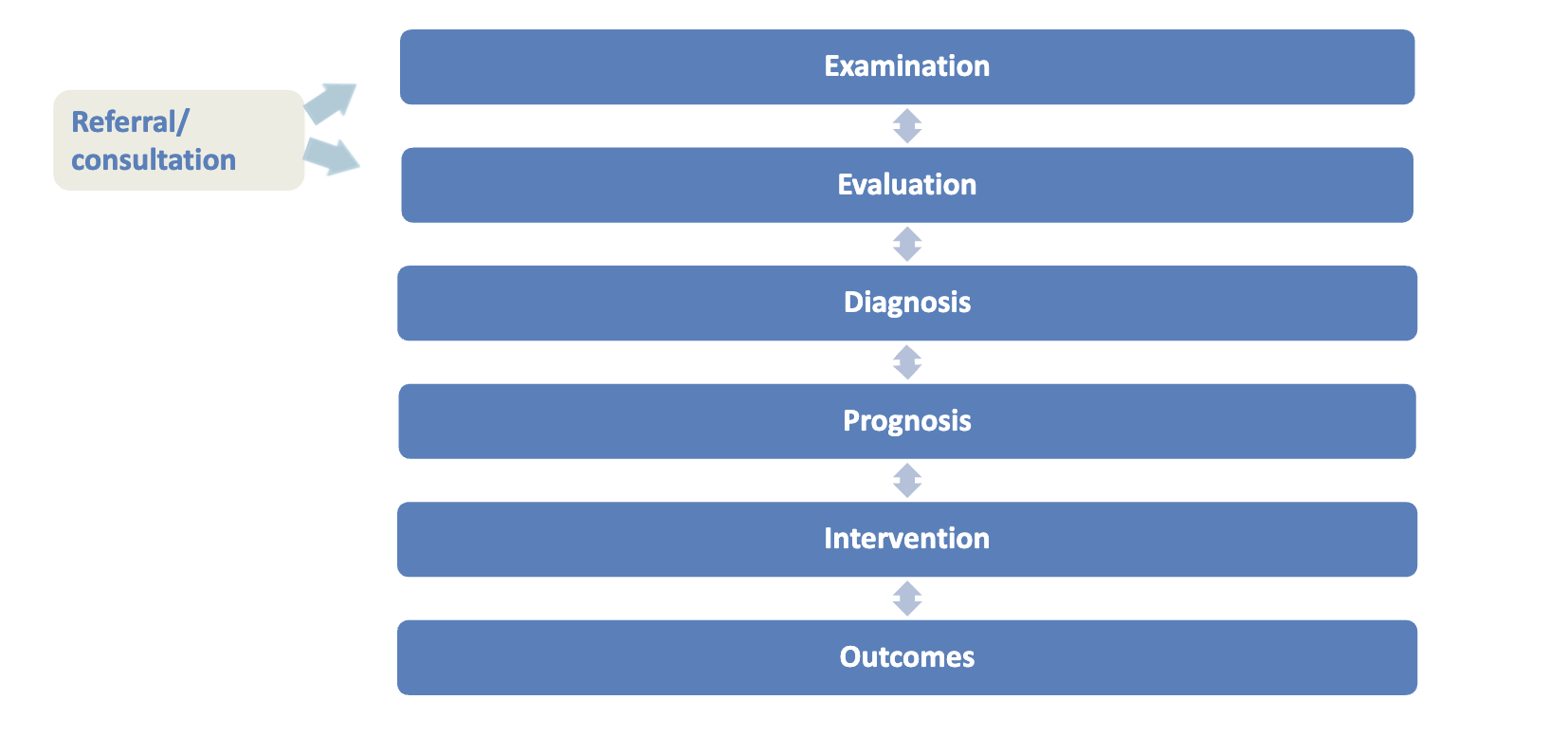
Examination
• The physical therapist
conducts an examination that
includes:
• Chart/Questionnaire
review
• History
• Systems Review
• Physical Exam,
including Tests &
Measures
Physical Examination Components
• Vital signs
• Range of motion (AROM, PROM, Overpressure,Tone,
goniometry)
• Muscle Performance (Gross Strength, MMT, Provocation,
Isokinetic)
Physical therapists use
measurements (including outcome
measures):
– To identify impairments and
potential causes of
impairments in body
structures and functions,
activity limitations, and
participation restrictions.
The results of tests and measures:
• Inform risk identification and prevention and health promotion activities.
• Contribute to outcome assessment.
• Help the PT determine change in the individual’s status.
Tests and measures are a component of the physical examination used to:
– Confirm or reject a clinical hypothesis regarding the factors that contribute to making the individual’s current level of function less than optimal.
– Support the physical therapist’s clinical judgments about the diagnosis, prognosis, and development of an effective management plan.
Diagnosis
A label encompassing a cluster of signs and symptoms commonly associated with a disorder or syndrome or category of impairments in body structures and function, activity limitations, or participation restrictions.
Prognosis
The physical therapist’s determination of the predicted optimal level of improvement in function over a designated time frame.
Measuring Outcomes
When standardized tests and measures are used to determine change in outcome status during and at the end of an episode of care
Motivational Interviewing
The provider must first establish a collaborative relationship with the patient and have empathy toward the patien
Four general principles of motivational interviewing
1. Express empathy and show understanding
2. Support self-efficacy
3. Roll with resistance. Remain nonjudgmental and listen well
4. Show discrepancy between where the patient is and what they want
OARS
• Open-ended questions
• Affirmations
• Reflective listening
• Summaries
Parts of the History
• Introduction
• Chief complaint (CC)
• History of current illness (HCI)
• Past Medical History (PMH)
• Prior level of function (PLF)
• Personal/family history
• Wrap up/Summary
HCI: Behavior of Symptoms
• 24-hour behavior
• Severity
• Irritability
• Nature
SEVERITY
• The pt’s interpretation of the level of the symptom
• Related to function
IRRITABILITY
• Helps determine how extensive your physical examination is, and the
intensity of treatment
• Determined by the intensity of the activity that causes the symptom, the
degree to which the symptom is brought on, and the time it takes for that
symptom to subside to its previous level
NATURE
Situations that because of their ‘nature’ may affect the
physical examination and intervention
Red Flags for Stroke
• Face: Smile and see if one side of the
face droops.
• Arms: Raise both arms. Does one
arm drop down?
• Speech: Say a short phrase and check
for slurred or strange speech.
• Time: If the answer to any of these is
yes, call 911 right away and write
down the time when symptoms
started
B.E.F.A.S.T
Adds:
Balance (changes in balance)
Eyes (changes in vision
Red Flags
• Night pain
• Significant Weight loss/gain without effort
• Nausea/Vomiting
• Bowel & bladder changes
• Insidious onset – no known cause
(trauma/injury)
• Cyclical cold/flu symptoms
• Fever/chills/night sweats
• Infection (URI, UTI, bacterial, especially
when neurological, joint or back pain
follow
• Hx of Immunosupression
• Symptoms out of proportion with
condition/injury
• (B) symptoms
• HA or visual changes
• (+) McBurney’s point
• Abdominal rebound tenderness
• No discernible pattern of symptoms
Yellow Flags
• Dizziness
• Progressive weakness
• Circulatory changes
• Abnormal pattern of
sensation
• Fainting