Chemistry Ch 14 : Quizzes
 Call Kai
 Learn
Learn Practice Test
 Spaced Repetition
 Match
Match Flashcards
 Knowt Play
1/15

There's no tags or description
Looks like no tags are added yet.
Name | Mastery | Learn | Test | Matching | Spaced | Call with Kai | Chat |
|---|
No analytics yet
Send a link to your students to track their progress
16 Terms
Which statement best describes acid–base chemistry as introduced in the passage?
A. Acid–base reactions involve the irreversible transfer of hydrogen ions (H⁺) from bases to acids.
B. Acid–base reactions involve the transfer of hydroxide ions (OH⁻) from acids to bases.
C. Acid–base reactions only occur in nonaqueous environments.
D. Acid–base reactions involve the reversible transfer of hydrogen ions (H⁺) from acids (donors) to bases (acceptors), establishing equilibrium systems.
D
Which scenario best represents a Brønsted–Lowry acid–base reaction?
A. A compound dissolves in water to produce hydroxide ions.
B. A proton is transferred from one compound to another, forming a conjugate acid–base pair.
C. Two ionic compounds exchange ions to form a precipitate.
D. An electron is transferred from a metal to a nonmetal.
B
In the reaction
H2O + NH3 ⇌ OH- + NH4+
Why is OH⁻ considered the conjugate base of H₂O?
A. OH⁻ has a negative charge, while H₂O is neutral.
B. OH⁻ is formed when H₂O accepts a proton.
C. OH⁻ is the species that remains after H₂O donates a proton.
D. OH⁻ can dissolve in water to produce hydrogen ions.
C
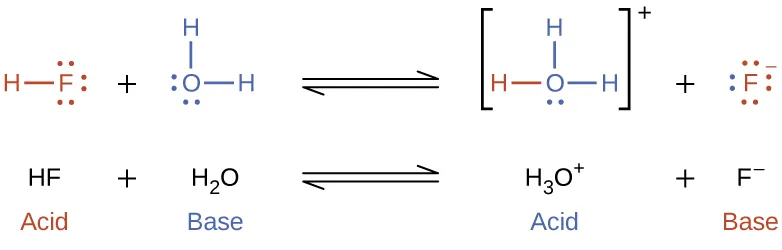
When hydrogen fluoride (HF) dissolves in water, it undergoes acid ionization:
HF + H2O ⇌ H2O+ + F-
Which statement correctly describes the roles of the species in this reaction?
A. HF acts as a base and H₂O acts as an acid.
B. HF donates a proton to H₂O, forming H₃O⁺ and F⁻.
C. H₂O donates a proton to HF, forming OH⁻ and HF₂⁻.
D. HF produces hydroxide ions when dissolved in water.
B
What is true about the autoionization of water?
A. Water molecules react with acids to produce hydroxide ions.
B. Autoionization occurs when water molecules react with each other to produce ions, such as H₃O⁺ and OH⁻.
C. Autoionization produces ions in large amounts at room temperature.
D. Autoionization only occurs when water is mixed with bases.
B
A solution is neutral at 25 °C. If the hydronium ion concentration is doubled from its pure water value, what is the new hydroxide ion concentration?
A) 5.0 × 10⁻⁸ M
B) 5.0 × 10⁻⁷ M
C) 0.5 × 10⁻⁷ M
D) 2.0 × 10⁻⁷ M
A
If a solution has a greater concentration of hydronium ions than hydroxide ions, how is it classified?
A) Neutral
B) Acidic
C) Basic
D) Amphoteric
B
At 25 °C, the sum of pH and pOH in an aqueous solution is 14. What does this number represent?
A) The concentration of hydroxide ions in the solution
B) The ion product of water, Kw, expressed in pH units
C) The neutral pH of water
D) The temperature in Celsius
B
Which of the following is true for a neutral solution at 25 °C?
A) [H3O+] > [OH-]
B) [H3O+] < [OH-]
C) [H3O+] = [OH-] = 1.0 X 10⁻⁷M
D)[H3O+] x [OH-] = 0
c
A solution has a hydronium ion concentration of . What is its pH?
6
Why was acid rain especially damaging in North America and Europe before the 1980s?
A) It increased global temperatures
B) It caused droughts
C) It damaged forests, lakes, soil, and stone buildings
D) It reduced oxygen levels in the atmosphere
C
What determines the relative strength of an acid or base?
A) Its color in solution
B) Its concentration in water
C) The extent to which it ionizes in water
D) The temperature of the solution
C
Why is [H2O] not included in the expression for the acid ionization constant Ka ?
A) Water does not participate in the reaction
B) Its concentration changes significantly during the reaction
C) Water is the solvent and its concentration is essentially constant
D) Water is a product, not a reactant
C
Which statement best explains why HCl, HBr, and HI are considered weak acids in ethanol but strong acids in water?
A) Ethanol is a stronger acid than water.
B) Water completely ionizes these acids, but ethanol does not.
C) Ethanol increases the value of Ka to infinity.
D) These acids do not dissolve in water.
B
Why can aqueous salt solutions be acidic, basic, or neutral?
A) Because all salts are strong electrolytes
B) Because the cations and/or anions may react with water
C) Because salts do not dissolve completely in water
D) Because water is always neutral
B
What allows a buffer solution (such as acetic acid and sodium acetate) to resist large changes in pH?
A) The presence of a strong acid and strong base
B) The presence of a weak conjugate acid–base pair
C) The complete ionization of all species
D) The absence of water
B