Anatomy and Physiology II: Cardiovascular System - Blood
 Call Kai
 Learn
Learn Practice Test
 Spaced Repetition
 Match
Match Flashcards
 Knowt Play
1/40

Earn XP
Description and Tags
A set of vocabulary flashcards covering the instructor's A&P II Chapter 19 materials, including syllabus-based evaluations and detailed blood physiology.
Name | Mastery | Learn | Test | Matching | Spaced | Call with Kai | Chat |
|---|
No analytics yet
Send a link to your students to track their progress
41 Terms
Blood
A specialized connective tissue that transports oxygen, nutrients, hormones, and waste products while playing roles in immunity and temperature regulation.
Heart
A muscular pump that generates the force necessary to circulate blood through the pulmonary and systemic circuits.
Blood Vessels
A network of arteries, capillaries, and veins that carry blood to and from tissues, allowing for gas and nutrient exchange.
Whole Blood
The combination of plasma and formed elements including cells and cell fragments.
Plasma
The fluid matrix of blood, making up approximately 46−63% of total blood volume.
Most important factor is the Albumin
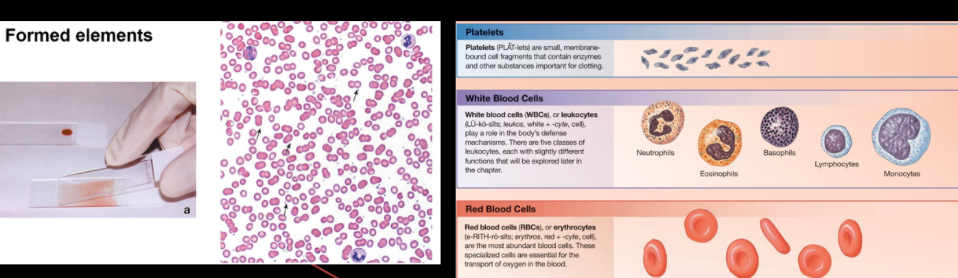
Formed Elements
The blood cells and cell fragments, including platelets, white blood cells, and red blood cells, that are suspended in plasma.
Platelets:
White blood cells: purple under stain but normally clear
Red blood cells:99% looks red or pink under stain because they contain the pigment in cell
Hematocrit
The percentage of red blood cells within a sample of whole blood.
Hemopoiesis
The continuous process of producing new blood cells from myeloid and lymphoid stem cells; also called hematopoiesis.
Venipuncture
A common sampling technique used to collect fresh whole blood from a superficial vein, such as the median cubital vein.
Blood Viscosity
A physical characteristic of blood that is five times as sticky and resistant to flow as water due to dissolved proteins and formed elements.
Albumin
A plasma protein accounting for approximately 60% of all plasma proteins that maintains osmotic pressure and transports substances.
Globulins
Plasma proteins that include antibodies for immune defense and transport proteins for lipids and ions.
Fibrinogen
A plasma protein essential for blood clotting that converts into insoluble fibrin.
Erythrocytes
The most abundant blood cells, also known as red blood cells, which are essential for oxygen transport.
Hemoglobin (Hb)
A protein specialized for respiratory gas transport consisting of four globin chains, each containing a heme group with an iron ion.
Sickle Cell Disease
An inherited disorder caused by a mutation in the β-globin chain that produces abnormal hemoglobin S (HbS) and causes cells to become rigid.
Erythropoiesis
The specific process by which new red blood cells are produced in the red bone marrow.
Erythropoietin (EPO)
A hormone released by the kidneys in response to low blood oxygen levels that primarily regulates erythropoiesis.
Hemolysis
The rupture of red blood cells in the bloodstream, after which macrophages remove hemoglobin and iron for recycling.
Bilirubin
An orange-yellow pigment released from macrophages that binds to albumin and is transported to the liver for excretion in bile.
Transferrin
A transport protein in the bloodstream that carries Fe2+ (iron) released from recycled hemoglobin.
Agglutination
A cross-reaction where antibodies react with target surface antigens on red blood cells, causing them to clump together.
RhoGAM
An injection of Rh immunoglobulin given to Rh-negative mothers to prevent sensitization and Hemolytic Disease of the Newborn (HDN).
Leukocytes
White blood cells that play a critical role in the body's defense mechanisms against toxins and pathogens.
Diapedesis
The ability of white blood cells to squeeze through the gaps in capillary walls to enter surrounding tissues.
Chemotaxis
The process where white blood cells follow chemical \"scent trails\" left by damaged cells or pathogens.
Neutrophils
Granulocytes acting as \"First Responders\" that rush to infection sites to kill bacteria and fungi through phagocytosis.
Lymphocytes
Agranulocytes that include B cells to make antibodies and T cells to coordinate attacks or kill infected cells directly.
Monocytes
Large agranulocytes that enter tissues to become macrophages, acting as a \"Clean-up Crew\" for debris and infections.
Eosinophils
Granulocytes that attack larger parasites and are involved in allergic reactions and asthma.
Basophils
The \"Alarm System\" granulocytes that release histamine to trigger inflammation and prevent early blood clotting.
Platelets
Small, membrane-bound cytoplasmic fragments (thrombocytes) produced by megakaryocytes that are essential for clotting.
Hemostasis
The localized and regulated physiological process that stops bleeding in three phases: vascular, platelet, and coagulation.
Vascular Spasm
The immediate response to blood vessel injury where smooth muscle in the vessel wall undergoes reflex vasoconstriction.
Endothelins
Hormones released by damaged endothelial cells that stimulate smooth muscle contraction and endothelial division.
Thrombin
An enzyme of the common pathway that converts soluble fibrinogen into insoluble fibrin strands.
Fibrin
An insoluble protein that forms a network to trap blood cells and platelets, creating a stable blood clot.
Vitamin K
A fat-soluble vitamin required by the liver for the synthesis of four clotting factors, including prothrombin.
Major function of blood
Transport: gases, nutrients, hormones, metabólica Wastes, etc.
2 Components of Blood
Plasma and formed elements
Why are veins used instead of Arteries
artery’s are thicker
Veins are easier to access, more superficial