Chapter 6: Nucleotides, Nucleic Acids, and Genetic Information
 Call Kai
 Learn
Learn Practice Test
 Spaced Repetition
 Match
Match Flashcards
 Knowt Play
1/51

There's no tags or description
Looks like no tags are added yet.
Name | Mastery | Learn | Test | Matching | Spaced | Call with Kai | Chat |
|---|
No analytics yet
Send a link to your students to track their progress
52 Terms
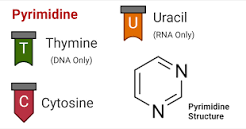
purine

pyrimidine
Adenosine Monophosphate (& ADP & ATP)
nucleotides most commonly contain 1-3 phosphate groups
ATP: energy transfer agent
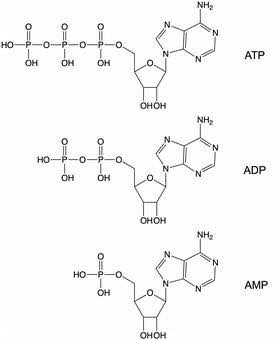
ATP formation (from ADP and Phosphate)
condensation ADP and phosphate
endergonic (nonspontaneous)
process of breakdown of metabolic fuels provides energy for this
catalyzed by ATP synthase (complex V of mitochondria)
Chemical PE of ATP is made available when
it transfers 1 of its 2 phosphate groups to another molecule
hydrolysis of ATP —→ ADP
ADP-Glucose
starch synthesis in plants proceeds by repeated additions of glucose units donated by ADP-glucose
group attached to ADP is usually linked to the nucleotide via mono- or diphosphate groups

(deoxy)guanosine

(deoxy)cytidine
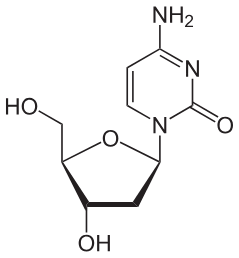
(deoxy)thymidine

uridine
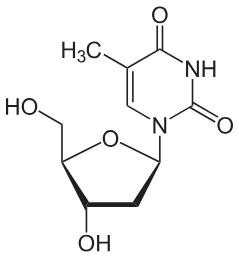
nucleobase
planar, aromatic, heterocyclic structural derivative of…
purine (adenine, guanine)
pyrimidine (cytosine, thymine/uracil)
nucleoside
nucleobase N + pentose
nucleotide
nucleobase + sugar + one or more phosphate groups
Purines: ribose at N_
N9
Pyrimidines: ribose at N_
N1
functions of nucleotides
information storage and transfer
free nucleotides and derivatives perform an enormous variety of metabolic functions
phosphate esters can form 3’ or 5’
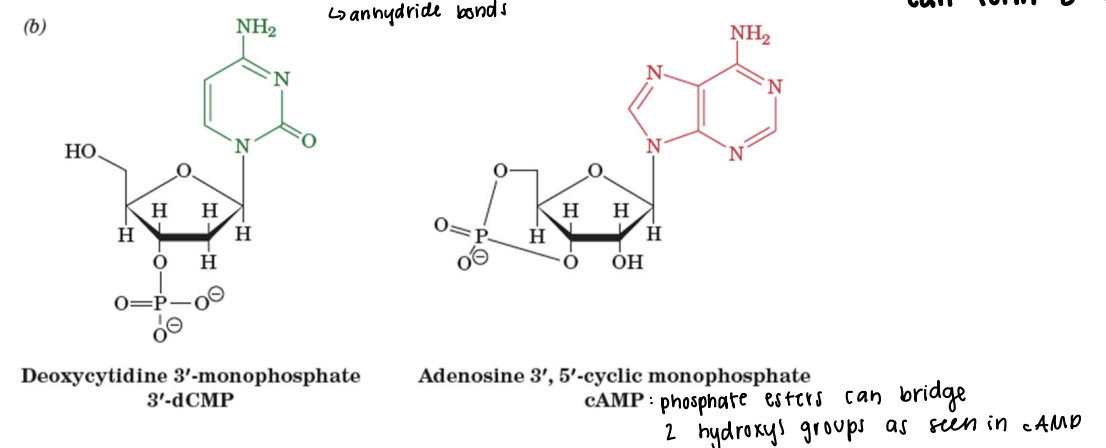
nucleic acids = chain of nucleotides
phosphate groups bridge the 3’ and 5’-positions of neighboring ribose units
phosphates of polynucleotides = acidic
at physiological pH (7.4), nucleic acids are
polyanions
information encoded in sequence (Chargaff’s rules)
complementary base pairing in dsDNA
G% = C%
A% = T% (or U%)
Dominant tautomer form of guanine and thymine
keto form

Double-Helical Model of DNA
Watson-crick-franklin
R-handed helix
Keto tautomer dominates
Chargaff’s rules
crystal structure
dsDNA (B-DNA) is antiparallel
complementary base pairing with H-bonding between b.p.
Number of H bonds between G:C and A:T?
3 between G:C
2 between A:T
Higher G:C content means a _____ T is required to melt/separate strands
higher T is required
Ring stacking
base stacking is enthalpically driven (greater thermal stability)
stacking interactions are a form of van der Waals (London dispersion/instantaneous dipoles)
interactions between G&C is greater due to greater thermal stability
How does Na+ help stabilize nucleic acids
cations shield the negative charges of the backbone
DNA is stabilized by Na ions b/c ions electrostatically shield the anionic phosphate group
DNA Melting curve
melting temp = temp at midpoint — gives useful info for G:C content
hyperchromic effect
DNA’s UV absorbance (due to aromatic bases) increases on denaturation as a consequence of electronic interactions among neighboring bases
UV absorbance increases as dsDNA—>ssDNA
Base orientations in B-DNA structures
Purines can be syn or anti conformation
Pyrimidines are stable in anti (syn configuration introduces steric interference)
Biologically most common form of DNA
B-DNA
In most double helical nucleic acids, all bases are in ____ conformation except in Z-DNA
most in anti conformation
Z-DNA is alternating
What conditions take B-DNA to A-DNA?
dehydrating conditions
A-DNA
right handed
major groove=narrow and deep
minor groove=wide and shallow
B-DNA
right handed
major groove: wide and deep
minor groove: narrow and shallow
standard
solid core
Z-DNA
left handed
solid core
RNA-RNA Double helix
the genetic material of certain viruses (synthesized only as a single strand)
RNA can form an A-form on double helix
RNA stem-loop
single strand of RNA folds back on itself to form a double-helical "stem" paired with an unpaired "loop" at the end
Yeast tRNAPhe Structure
Highly compact and L-shaped, with each leg ~60Å long.
covalently modified bases (such as pseudouridine) and unusual base pairs
RNA exhibits greater structural/chemical variety than DNA because of these modifications.
Tertiary Stabilization: Relies on unique hydrogen-bonding networks—including base triples (associations involving three bases)—to maintain its tightly folded, compact structure.
16s rRNA structure
16S = sedimentation coefficient of ribosome
rRNA = ribosomal RNA
Divided into distinct structural regions, including the 5'-domain, central domain, and 3'-domain.
Characterized by numerous internal loops and hairpin turns that create binding sites for ribosomal proteins.
16S rRNA has unusual base-base hydrogen bonding interactions in 16S rRNA
Non-Watson-Crick Interactions: rRNA relies on complex hydrogen-bonding networks outside of normal base-pairing
These unusual interactions help stabilize the intricate 3D tertiary architecture necessary for ribosomal function.
Why is DNA more stable than RNA?
RNA is highly susceptible to base-catalyzed hydrolysis
this makes DNA the dominant molecule of heredity
Step-by-Step Mechanism:
Deprotonation: A base induces deprotonation of the 2'-OH group.
Nucleophilic Attack: The activated 2'-oxygen attacks the adjacent phosphorus atom in the backbone.
Cleavage: This cleaves the RNA backbone, forming a 2',3'-cyclic nucleotide intermediate before yielding a 2'- or 3'-nucleotide.
Ribozymes: Catalytic RNA molecules that can accelerate reactions and cleave RNA strands.
Hammerhead Ribozyme
Features three distinct helical regions (Stem I, Stem II, and Stem III) connected by conserved sequence motifs and a characteristic uridine turn.
The 3D fold positions key residues (such as G-8, C-1.1, A-9, and G-12) precisely around the scissile bond to execute site-specific self-cleavage.
Semiconservative DNA Replication
Each resulting DNA molecule consists of one parental (old) strand and one progeny (new) strand.
DNA Polymerase: Synthesizes the new strand using the template strand.
Helicase: Unwinds the double-stranded DNA parental helix.
Complementarity: Base-pairing rules ensure transmission of genetic info
flow of genetic info

transcription and translation
1 strand of DNA directs mRNA synthesis
base sequence of transcribed RNA is complementary to DNA strand
message=translated when tRNA molecules align with mRNA by codons
**each tRNA carries a specific amino acid
Polymerase Chain Reaction (PCR)
apparatus = thermocycler
denature DNA with heat (sep. by melting)
Annealing with primers for the gene of interest while cool
Add dNTPs and Taq polymerase for synth of new strands using primer as starting point
repeat cycles
Gel Electrophoresis
DNA is negatively charged (b/c phosphate backbone), so it moves neg—>pos on gel
gel = usually agarose (for DNA)

Sanger sequencing (Chain termination sequencing)
denature DNA with heat
annealing with primers for gene of interest while cool
add dNTPs and Taq polymerase AND fluorescently-labeled dideoxynucleotides
repeat cycles — but not sometimes the ddNTPs are incorporated instead of dNTPs
If ddNTPs are tagged with fluorescent molecules, sequence can be determined following DNA strand separation based on size (using a gel)
ddNTPs in Sanger Sequencing
stop the chain from growing b/c no 3’ OH
very important to keep dNTPs » ddNTPs
Illumina sequencing (reversible terminator sequencing)
DNA is fragmented to a few hundred b.p./ fragment
DNA is bound to specific adapters of known sequence and immobilized on a flow cell
in place, some Illumina preps now do PCR to form “clusters” of identical DNA strands at a particular location
Add primer specific adapter of known sequence, DNA polymerase, and all modified dNTPs
in between each bonding, the fluorescent label and blocking group are removed with washing, allowing the next modified nucleotide to bind
all of these clusters are sequenced simultaneously
difference in modified dNTP role between Sanger sequencing and illumina
modified dNTPs are chain terminators
modified dNTPs are reversibly chain terminators
why is a flow cell helpful in illumina sequencing
solid support: anchor ssDNA fragments
primary rxn chamber: houses the physical space needed for bridge amplification/exclusion amplification